Olfen
Ukraine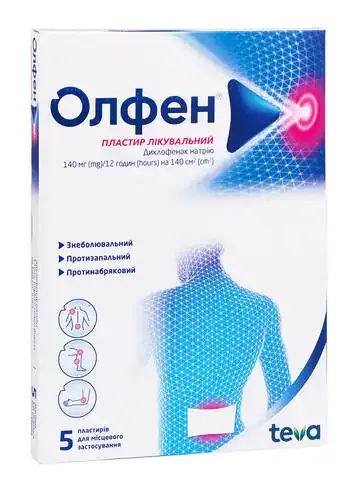
Table of Contents
INSTRUCTIONS FOR MEDICAL USE OF THE MEDICINAL PRODUCT OLFEN® (OLFEN®)
Composition:
Active ingredient: diclofenac sodium;
1 plaster contains 140 mg of diclofenac sodium/12 hours per 140 cm²;
Excipients: macrogol lauryl ether, diisopropyl adipate, glycerol (E 422), propylene glycol, sorbitol crystallizing solution (E 420), sodium polyacrylate, sodium carmellose (E 466), butyl-methacrylate copolymer base, colloidal anhydrous silicon dioxide, light natural kaolin, anhydrous sodium sulfite (E 221), disodium edetate, dibutylhydroxytoluene (E 321), aluminum-potassium sulfate anhydrous, tartaric acid (E 334),
L-menthol, purified water;
Backing: non-woven fabric (EL-8100S), polypropylene film.
Pharmaceutical form. Therapeutic plaster.
Main physicochemical properties: paste ranging from white to light brown in color, applied to non-woven fabric. The surface of the paste is covered with a transparent polymer film.
Pharmacotherapeutic group. Topical non-steroidal anti-inflammatory drugs. ATC code M02A A15.
Pharmacological properties.
Pharmacodynamics.
Olfen®, therapeutic patch, is a non-steroidal anti-inflammatory drug (NSAID) with analgesic properties intended for topical application. The therapeutic effect is due to the inhibitory action of sodium diclofenac on prostaglandin synthesis.
When applied topically, the active substance of Olfen®, therapeutic patch, penetrates through the skin, reaching subcutaneous tissues, and exerts analgesic and anti-inflammatory effects, reducing tissue swelling. In patients with significant sports injuries, Olfen®, therapeutic patch, demonstrated effective analgesic action compared to placebo.
Pharmacokinetics.
The concentration of diclofenac in tissues is maintained by continuous penetration from the patch and does not depend on the time of day. The average plasma concentration of the substance is approximately 3 ng/mL.
The metabolism and elimination mechanism of diclofenac after topical application corresponds to that observed with oral administration of sodium diclofenac preparations. The elimination half-life is 1–2 hours.
Clinical characteristics.
Indications.
Local short-term treatment of:
- inflammation of tendons, ligaments, muscles and joints of traumatic origin, e.g., ligament and tendon sprains, dislocations, contusions;
- localized forms of rheumatism affecting soft tissues and joints.
Contraindications.
Hypersensitivity to diclofenac, acetylsalicylic acid, other nonsteroidal anti-inflammatory drugs, analgesics, or to any component of the medicinal product. History of asthma attacks, urticaria, or acute rhinitis induced by acetylsalicylic acid or other nonsteroidal anti-inflammatory drugs. Exacerbation of gastric or duodenal ulcer, open skin lesions, burns, skin infections or eczema, third trimester of pregnancy.
Interaction with other medicinal products and other forms of interaction.
Systemic absorption of diclofenac when Olfen® therapeutic patch is used correctly is very low compared to oral administration; therefore, interaction with other medicinal products is unlikely.
Special precautions for use
Olfen®, medicated plaster, must not be applied to open wounds (e.g., abrasions, cuts) or to areas of skin affected by eczema. Avoid contact with eyes and mucous membranes.
If the patient's condition does not improve or worsens after 3 days of treatment, medical advice should be sought.
To minimize the risk of adverse effects, the lowest effective dose of sodium diclofenac should be used for the shortest possible duration.
In patients with a history of allergy or bronchial asthma associated with the use of NSAIDs, bronchospasm may occur.
If any skin rash appears after application of Olfen®, medicated plaster, treatment with the product should be discontinued.
Direct exposure to sunlight or solarium radiation at the site of application should be avoided for approximately 1 day to reduce the risk of photosensitization.
Although the risk of systemic adverse reactions is minimal, Olfen®, medicated plaster, should be used with caution in patients with impaired kidney, heart, or liver function, with a history of peptic ulcer of the stomach or duodenum, intestinal phlegmon, or hemorrhagic diathesis.
Elderly patients should use NSAIDs with caution due to increased susceptibility to adverse effects.
Olfen®, medicated plaster, contains propylene glycol and dibutyl hydroxytoluene. Propylene glycol may cause skin irritation. Dibutyl hydroxytoluene may cause local skin reactions (e.g., contact dermatitis) or irritation of the eyes and mucous membranes.
It is not recommended to use any other NSAIDs or medicinal products containing diclofenac during treatment with Olfen®, medicated plaster.
Use during pregnancy or breastfeeding
First and second trimesters
There are insufficient clinical data on the topical use of diclofenac during pregnancy. Even though systemic exposure after topical application is lower than with oral administration, it is unknown whether the systemic exposure achieved after topical use could be harmful to the embryo/fetus.
Animal studies have shown reproductive toxicity after systemic administration of the drug.
Inhibition of prostaglandin synthesis may adversely affect pregnancy and/or embryofetal development. Epidemiological data suggest an increased risk of miscarriage, congenital heart defects, and gastroschisis following use of prostaglandin synthesis inhibitors in early pregnancy. This risk is considered to increase with higher drug doses and longer duration of therapy.
During the first and second trimesters of pregnancy, this medicinal product should not be used except in cases of extreme necessity. If used during the first and second trimesters, the dose should be kept as low as possible and the duration of treatment as short as possible.
Third trimester
During the third trimester of pregnancy, all prostaglandin synthesis inhibitors, including diclofenac, may:
- cause in the fetus:
- cardiopulmonary toxicity (with premature closure of the arterial duct and development of pulmonary hypertension);
- impaired kidney function, progressing to renal failure with oligohydramnios, and renal toxicity;
- cause in the mother towards the end of pregnancy and in the newborn:
- prolonged bleeding – an effect related to inhibition of platelet aggregation, which may occur even with very low doses of the drug;
- inhibition of uterine contractions, leading to delayed or prolonged labor.
Therefore, the medicinal product Olfen®, medicated plaster, is contraindicated during the third trimester of pregnancy.
Breastfeeding
A small amount of diclofenac and its metabolites passes into breast milk. The decision to use the drug during breastfeeding should be made by a physician when there are strong medical reasons, and only when the expected benefit of treatment outweighs the potential risk. Olfen®, medicated plaster, should not be applied to the breasts or to large areas of skin, and should not be used for prolonged periods.
Ability to influence reaction speed when driving or operating machinery
Negative effect is unlikely.
Method of Administration and Dosage.
The patch is applied to the affected area of the body. Apply 1 patch twice daily, in the morning and evening. Before application, remove the transparent protective film covering the patch surface. The patch must not be divided. Do not use the patch with an occlusive dressing.
If necessary, secure the patch with an elastic bandage. One therapeutic patch is intended for continuous use over 12 hours.
Only one patch should be applied at a time to one affected area. The maximum daily dose is 2 patches, even if application to more than one area is required.
Method of Administration:
Cut the patch packaging along the marked line
Remove one patch and immediately reseal the packaging by properly closing it
Remove the protective film from the patch surface
Apply the patch to the painful area twice daily, in the morning and in the evening
The patch should be used for as short a duration as possible.
The treatment duration should not exceed 7 days.
Children.
The efficacy and safety of the medicinal product Olfen®, therapeutic patch, in children under 18 years of age have not been studied.
Overdose.
Cases of overdose have not been reported.
If systemic adverse effects occur due to incorrect use or accidental overdose of Olfen®, therapeutic patch, appropriate measures should be taken, as in the case of intoxication with oral nonsteroidal anti-inflammatory drugs.
Side effects.
Skin and subcutaneous tissue disorders
Common: redness, itching, burning sensation, erythema, skin rash, sometimes with pustules or blisters.
Uncommon: hypersensitivity reactions, local allergic reactions, including contact dermatitis.
Frequency not known: generalized skin rashes, hypersensitivity reactions including angioedema, anaphylactic reactions, and photosensitization reactions have been observed in patients using topical NSAIDs.
When using the product Olfen®, therapeutic patch, over large areas for prolonged periods, the occurrence of systemic side effects (such as kidney or gastrointestinal disorders, bronchospasm) cannot be completely excluded; however, the risk of such effects is very low compared to oral administration of sodium diclofenac.
Shelf life. 30 months.
Shelf life after first opening of the packaging – 4 months at a temperature not exceeding 25 °C; 6 months at 2–8 °C (in the refrigerator).
Storage conditions.
Store at a temperature not exceeding 25 °C. Keep out of reach of children.
Packaging.
№2: 2 patches per pouch, 1 pouch per box.
№5: 5 patches per pouch, 1 pouch per box.
№10: 5 patches per pouch, 2 pouches per box.
Supply category. Over-the-counter.
Manufacturer. Merckle GmbH.
Manufacturer's address and place of business.
Ludwig-Merckle-Strasse 3, 89143 Blaubeuren, Germany.