Olatropil®
Ukraine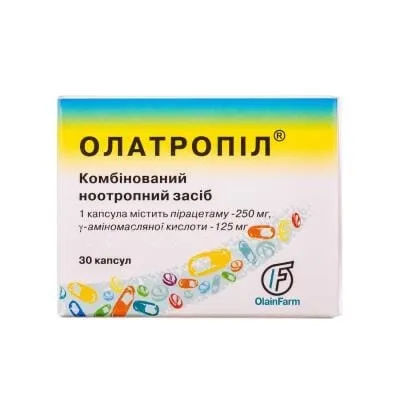
Table of Contents
INSTRUCTIONS FOR MEDICAL USE OF THE MEDICINAL PRODUCT OLAТROPIL® (OLATROPIL®)
Composition:
Active substances: piracetam, gamma-aminobutyric acid;
1 capsule contains 250 mg of piracetam and 125 mg of gamma-aminobutyric acid;
Excipients: microcrystalline cellulose, talc; capsule: titanium dioxide (E 171), gelatin.
Dosage form. Capsules.
Main physicochemical properties: hard white gelatin capsules. The contents of the capsules are a powder ranging from white to light cream in color. Color heterogeneity is permitted.
Pharmacotherapeutic group. Psychostimulants and nootropics. ATC code N06B X.
Pharmacological properties.
Pharmacodynamics.
Olatropil® is a combined medicinal product whose properties are determined by its components: gamma-aminobutyric acid (aminobutanol) and a pyrrolidone derivative – piracetam. Gamma-aminobutyric acid (GABA) is the main mediator of inhibitory processes in the central nervous system (CNS). The neurometabolic effect of the drug is primarily due to its stimulating influence on the GABAergic system, which ensures normalization of neural process dynamics. GABA increases the activity of energy processes in the central nervous system, improves glucose utilization, and enhances cerebral tissue blood supply. Aminobutanol improves neural process dynamics in the brain, cognitive functions such as thinking and memory, increases attention concentration, promotes restoration of motor activity and speech after cerebrovascular disorders, and exerts a mild psychostimulant effect.
The second component of Olatropil® is piracetam, a cyclic derivative of γ-aminobutyric acid. It is a nootropic agent acting on the brain to improve cognitive functions such as learning ability, memory, attention, and mental performance. The mechanisms of piracetam’s action on the central nervous system are likely multiple: alteration of the rate of excitation propagation in the brain; enhancement of metabolic processes in nerve cells; improvement of microcirculation by influencing blood rheological properties, without vasodilatory effects. Piracetam improves interhemispheric connections and synaptic conductivity in neocortical structures. After prolonged use of the drug, improvement in cognitive functions and attention is observed. These changes are objectively recorded on electroencephalogram (EEG) as increased α- and β-rhythms and decreased δ-rhythms. Piracetam inhibits platelet aggregation and restores erythrocyte membrane elasticity, reducing erythrocyte adhesion.
Piracetam exerts protective and restorative effects on impaired brain function due to hypoxia, intoxication, or electroconvulsive therapy.
The combined action of both components enhances nootropic and anti-hypoxic processes, increases physical performance, and improves tolerance to stress factors of various origins. The pronounced synergistic effect of aminobutanol with piracetam allows reduction of therapeutic doses of each component in the combination, thereby decreasing the likelihood of adverse effects and increasing treatment safety.
Pharmacokinetics.
Aminobutanol and piracetam, components of Olatropil®, are well absorbed after oral administration and penetrate into organs and tissues, including the brain. They are excreted by the kidneys: partially as metabolites, while piracetam is excreted predominantly unchanged, in non-metabolized form.
Clinical characteristics.
Indications.
Olatropil® is prescribed to adults:
- for diseases of the nervous system in the treatment of vascular encephalopathy (atherosclerosis, hypertension);
- in chronic cerebrovascular insufficiency with memory impairment, attention concentration difficulties, speech disorders, dizziness, headache;
- for the treatment of encephalopathies (alcoholic, post-stroke, post-traumatic);
- in the therapy of senile dementias (including Alzheimer's disease);
- for the treatment of psycho-organic syndromes of various etiologies.
Contraindications.
Hypersensitivity to piracetam or to pyrrolidone derivatives, as well as to other components of the drug.
Acute renal failure.
Acute cerebral circulation disorders (hemorrhagic stroke). Terminal stage of renal failure (with creatinine clearance less than 20 ml/min).
Huntington's chorea.
Interaction with other medicinal products and other types of interactions.
Olatropil® enhances the effect of antidepressants, which is particularly important in treating patients resistant to typical or atypical antidepressants. Olatropil® reduces the adverse effects of neuroleptics, tranquilizers, and hypnotics.
Concomitant use with alcohol does not affect serum concentration levels, and alcohol concentration in blood serum was unchanged when 1.6 g of piracetam was administered.
When used concomitantly with thyroid hormones (T3 + T4), increased irritability, disorientation, and sleep disturbances may occur. No interaction has been observed between piracetam and clonazepam, phenytoin, phenobarbital, or sodium valproate. Administration of piracetam at a dose of 20 mg/day did not alter the peak or concentration-time curve of these drugs in epileptic patients.
In patients with severe recurrent thrombosis, administration of high doses (9.6 g/day) of piracetam did not require adjustment of acenocoumarol dosage to achieve a prothrombin time (INR — International Normalized Ratio) of 2.5–3.5; however, when used concomitantly, a significant reduction was observed in platelet aggregation, fibrinogen levels, von Willebrand factor, and blood and plasma viscosity.
The likelihood of altered pharmacodynamics of piracetam due to other medicinal products is low, as 90% of the drug is excreted unchanged in urine. Metabolic interaction of piracetam with drugs metabolized by the following cytochrome P450 isoenzymes is unlikely, since in vitro experiments have shown that at concentrations of 142, 426, and 1422 mcg/ml, piracetam does not affect the activity of the following cytochrome P450 isoenzymes: CYP1A2, 2B6, 2C8, 2C9, 2C19, 2D6, 2E1, and 4A9/11. At concentrations above 1422 mcg/ml, there is slight inhibition of CYP2A6 and 3A4/5 activity (by 21% and 11%, respectively), but the Ki levels for these two CYP isomers remain sufficient.
When used concomitantly with benzodiazepine derivatives (tranquilizers, anticonvulsants) and sedatives (barbiturates), mutual enhancement of effects may occur. When combining with benzodiazepines, each drug should be administered at the lowest or medium effective doses.
Pyridoxine hydrochloride (vitamin B6) may enhance the drug's effect.
Special precautions for use
At the beginning of treatment, arterial pressure should be monitored due to possible fluctuations.
In elderly patients experiencing an exacerbation of heart failure, the dose of the drug should be reduced or treatment discontinued.
The use of Olatropil® is not recommended in patients with psychomotor agitation.
During long-term therapy in elderly patients, regular monitoring of renal function parameters is recommended; if necessary, the dose should be adjusted according to creatinine clearance.
Since piracetam reduces platelet aggregation, caution is required when prescribing the drug to patients with coagulation disorders, conditions that may be associated with bleeding (e.g. gastrointestinal ulcer), and in the pre- and post-operative periods of major surgical procedures (including dental interventions), as well as in patients receiving anticoagulants, platelet antiaggregants—including low-dose acetylsalicylic acid—and in patients exhibiting signs of severe bleeding.
The drug penetrates through the filtration membranes of hemodialysis equipment.
The drug should not be administered in the evening or before bedtime due to a possible disturbance of sleep.
Alcohol consumption should be avoided during treatment with this drug.
Use during pregnancy or breastfeeding.
Olatropil® is not used during pregnancy or breastfeeding due to insufficient data on the use of the drug during these periods.
Ability to influence reaction speed when driving or operating machinery.
Given that adverse reactions (e.g. drowsiness, impaired balance, confusion) may occur in sensitive patients during treatment, patients should refrain from driving or operating machinery and from any other activities requiring concentration of attention during therapy.
Method of administration and dosage.
Olatropil® is taken orally before meals.
The optimal dose for adults is 1 capsule taken 3–4 times daily. If necessary, the dose may be gradually increased up to 6 capsules per day.
Therapeutic effect usually develops within 2 weeks after the start of treatment.
The duration of treatment is determined individually by a physician. Typically, treatment lasts from 1 to 2 months; if necessary, the course can be repeated after 6–8 weeks.
Children.
The drug is not used in children.
Overdose.
Components of Olatropil® belong to the class of non-toxic substances, therefore cases of poisoning have not been reported. In case of psychomotor excitation due to overdose, administration of sedatives is recommended.
Exceeding the recommended dose may intensify the drug's adverse effects.
Treatment is symptomatic: gastric lavage (induce vomiting). There is no specific antidote; hemodialysis may be used (eliminates 50–60% of piracetam).
Adverse Reactions.
Nervous system disorders: Common – hyperkinesia;
Uncommon – ataxia, headache, insomnia, loss of balance, somnolence, increased frequency of epileptic seizures, tremor.
Immune system disorders: Uncommon – hypersensitivity reactions, including anaphylactoid reactions.
Gastrointestinal disorders: Uncommon – abdominal pain, upper abdominal pain, nausea, diarrhea, vomiting, dyspeptic symptoms, intestinal disorders.
Skin and subcutaneous tissue disorders: Uncommon – angioneurotic edema, dermatitis, pruritus, rash, urticaria.
Psychiatric disorders: Uncommon – increased excitability, depression, anxiety, confusion, hallucinations.
Ear and labyrinth disorders: Uncommon – dizziness.
Reproductive system disorders: Uncommon – increased sexual activity.
Other: weight gain, asthenia, arterial hypertension, fluctuations in blood pressure, hyperthermia, feeling of warmth, hemorrhagic disorders.
If any adverse reactions occur, discontinue use of the medicinal product immediately and consult a physician without delay.
Shelf Life.
4 years.
Storage Conditions.
Store in the original packaging at a temperature not exceeding 25 °C.
Keep out of reach of children.
Packaging.
10 capsules in a blister. 3 blisters per cardboard box.
Prescription Status.
Prescription only.
Manufacturer.
JSC "Olainfarm".
Manufacturer's Address and Place of Business.
5 Rupnicu street, Olaine, LV-2114, Latvia.