Nitroglycerin-zdorovya
Ukraine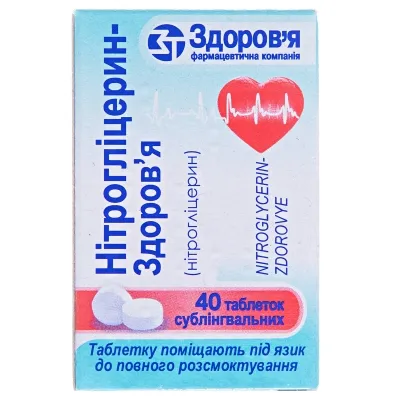
Table of Contents
INSTRUCTIONS FOR MEDICAL USE of the medicinal product NITROGLYCERIN-ZDOROVYE (NITROGLYCERIN-ZDOROVYE)
Composition:
Active substance: 1 tablet contains 0.5 mg of nitroglycerin diluted (with lactose), calculated as nitroglycerin;
Excipients: microcrystalline cellulose, potato starch, povidone, colloidal anhydrous silicon dioxide, magnesium stearate, aspartame (E 951), crospovidone, monohydrate lactose.
Pharmaceutical form. Sublingual tablets.
Main physicochemical properties: white or almost white, flat cylindrical tablets with beveled edges.
Pharmacotherapeutic group. Vasodilators used in cardiology. Organic nitrates. ATC code C01DA02.
Pharmacological Properties.
Pharmacodynamics. Nitroglycerin is a peripheral vasodilator with a predominant effect on peripheral vessels.
Nitroglycerin acts directly on smooth muscles, primarily in venous and arterial vessels, via the nitrate receptor located in the smooth muscle layer of the vessel wall. In smooth muscle cells, nitroglycerin is enzymatically converted to produce nitric oxide (NO), which stimulates soluble guanylyl cyclase, responsible for the formation of cyclic guanosine-3',5'-monophosphate (cGMP), a mediator of relaxation.
It affects processes of central regulation of vascular tone and cardiac activity. It promotes the release of catecholamines in the brain and heart, resulting in central suppression of sympathetic and vasomotor tone, indirect sympathomimetic effects on the myocardium, and conformational changes in the troponin-tropomyosin complex. The nature and intensity of nitroglycerin's effects on the heart and peripheral vessels depend on the interaction between central and peripheral mechanisms. Suppression of vasoconstrictor reflexes in coronary vessels—resulting from central inhibition of pain impulses—contributes to relief of angina attacks. The antianginal effect of nitroglycerin is due to its normalizing influence on myocardial electrolyte metabolism and energetics, particularly on key parameters of the respiratory chain—the ratio of oxidized to reduced forms of nicotinamide coenzymes and the activity of NAD-dependent dehydrogenases. It affects cardiac function and systemic hemodynamics. Under the influence of nitroglycerin, retrograde blood flow increases due to dilation and increased number of functioning collaterals. Indirect sympathomimetic action, as well as accumulation of cyclic AMP in the myocardium, leads to enhanced contractility. Additionally, nitric oxide effectively inhibits both platelet aggregation and adhesion. Reduction in peripheral resistance and decreased venous return—effects associated with relaxation of vascular smooth muscles—result in decreased preload and afterload on the heart. Venodilation leads to reduced blood volume returning to the heart and thus decreased preload, while arterial dilation reduces total peripheral resistance and afterload, ultimately reducing cardiac workload and improving coronary circulation.
There is a redistribution of myocardial blood flow in favor of ischemic areas, and myocardial inotropic function is enhanced. End-diastolic pressure in the left ventricle and cardiac size are reduced, improving blood supply to the subendocardial region of the myocardium, which is most vulnerable to ischemia. Reduced peripheral venous and arterial resistance and decreased cardiac filling pressure contribute to lower energy expenditure by the left ventricle and reduced myocardial oxygen demand. Pulmonary capillary pressure decreases, which justifies the use of nitroglycerin in myocardial infarction complicated by pulmonary edema and in heart failure. In ischemic hypokinesia of specific myocardial segments, contractility is restored. Meningeal vessels dilate, while vessels of internal organs constrict; pulmonary arterial pressure decreases due to the vasodilatory and systemic effects of nitroglycerin. Nitroglycerin relaxes smooth muscles of the bronchi, biliary tract, gastrointestinal tract, and urinary tract. In experimental studies, no teratogenic or embryotoxic effects were observed.
Pharmacokinetics. After sublingual administration, the effect begins within 0.5–2 minutes; 75% of patients report improvement within the first 3 minutes, and another 15% within 4–15 minutes.
Sublingually administered nitroglycerin is absorbed through the mucous membrane and enters primarily into the systemic circulation. Approximately 60–75% of the administered dose is absorbed. Maximum plasma concentration—2.3 μg/L—is reached within 2–4 minutes after administration; by the 8th minute, the concentration decreases by 50%, and nitroglycerin is nearly undetectable in the blood within 20 minutes. It is rapidly metabolized in the liver. Nitrate esters of polyhydric alcohols undergo rapid denitration. Denitrated metabolites, such as 1,2- and 3,4-dinitrates, are less active and have a longer elimination half-life compared to nitroglycerin. The elimination half-life of nitroglycerin is approximately 30 minutes. Nitro groups are sequentially cleaved, both through the formation of inorganic nitrites and nitrates. The organic portion of nitrate ester molecules is converted into alcohols, aldehydes, and organic acids. Four hours after administration, nitrate esters (the initial compound) are almost undetectable. The most active metabolism occurs in the liver, kidneys, and blood. Nitrate esters are cleaved via two pathways: by glutathione-dependent reductase, primarily located in the soluble fraction of hepatocytes, and by an enzyme independent of reduced glutathione. The drug is primarily metabolized in the arteriovenous vascular bed, diffuses into smooth muscle cells, where it is converted into nitric oxide. A small portion of the drug, mainly under the influence of glutathione-S-reductase, is biotransformed in the liver into dinitrates, mononitrates, and glycerol. When administered orally, the majority of the drug is metabolized in the liver (first-pass effect). A significant portion of dinitrate and mononitrate metabolites form conjugates with glucuronic acid. Excretion of nitroglycerin metabolites occurs primarily via the kidneys; some metabolites are excreted through the lungs with exhaled air. Total clearance of nitroglycerin is 25–30 L.
Elimination half-life is 4–5 minutes. The elimination half-life of metabolites is 4 hours.
Clinical Characteristics.
Indications. Relief and short-term prevention of attacks|episodes| of angina pectoris.
Contraindications. Hypersensitivity to nitrates and excipients of the drug; cerebral ischemia, hemorrhagic stroke, intracranial bleeding, increased intracranial pressure, recent head trauma, bradycardia (less than 50 beats/min), arterial hypotension (systolic blood pressure below 100 mm Hg, diastolic blood pressure below 60 mm Hg), shock, collapse, hypertrophic obstructive cardiomyopathy, aortic stenosis, conditions associated with reduced left ventricular filling pressure (acute myocardial infarction, isolated mitral stenosis, constrictive pericarditis), cardiac tamponade, toxic pulmonary edema, closed-angle glaucoma with high intraocular pressure, concomitant use of phosphodiesterase-5 (PDE-5) inhibitors (sildenafil, tadalafil, vardenafil).
Interaction with other medicinal products and other types of interactions. When used concomitantly with other vasodilators, antihypertensive agents, angiotensin-converting enzyme (ACE) inhibitors, calcium channel blockers ("slow-channel" blockers), diuretics, tricyclic antidepressants, monoamine oxidase inhibitors, ethanol and ethanol-containing medications, β-adrenoblockers, procainamides, quinidine, and novocainamide, the hypotensive effect of nitroglycerin is enhanced.
Phosphodiesterase inhibitors (sildenafil, tadalafil, vardenafil) – concomitant use of nitroglycerin with these agents is contraindicated due to the potential risk of uncontrolled arterial hypotension and life-threatening cardiovascular complications.
Atropine and other drugs exhibiting M-cholinolytic activity may reduce the effect of nitroglycerin due to decreased secretion and bioavailability of the drug.
Concomitant use with dihydroergotamine may increase its plasma concentration and elevate blood pressure (due to increased bioavailability of dihydroergotamine).
Concomitant use with heparin may reduce heparin's anticoagulant effect (after discontinuation of the drug, a significant decrease in blood coagulation may occur, which may require a reduction in heparin dosage).
Phenobarbital enhances the metabolism of nitrates in the liver. α-adrenomimetics, histamine, pituitrin, corticosteroids, central nervous system stimulants, bee and snake venom, and sunlight reduce the antianginal effect of nitroglycerin. Salicylates increase nitroglycerin blood levels; barbiturates accelerate its metabolism. Sulfhydryl group donors (captopril, acetylcysteine, unithiol) restore reduced sensitivity to nitroglycerin.
Special precautions for use.
The drug should be administered with caution, carefully weighing the risks and benefits, in patients with: uncontrolled hypovolemia, heart failure with normal or low pulmonary artery pressure, severe anemia, hyperthyroidism, severe renal and/or hepatic insufficiency (risk of developing methemoglobinemia).
Use with caution in patients with pronounced cerebral atherosclerosis and in elderly patients. During treatment, alcohol consumption is prohibited; visiting saunas, baths, and taking hot showers are contraindicated.
The tablet must not be chewed, as excessive amounts of the active substance may enter systemic circulation through the oral mucosa.
With frequent use, tolerance (tolerance development) may develop to nitroglycerin and other organic nitrates, requiring dose escalation. To prevent tolerance during prolonged therapy, intermittent administration of the drug is recommended throughout the day (with a 10–12 hour interval) or concomitant use of calcium antagonists, ACE inhibitors, or diuretics. If tolerance develops and treatment adjustment is needed, nitroglycerin may sometimes need to be temporarily discontinued (for several days), and replaced with antianginal agents from other pharmacotherapeutic groups.
Before first use of the drug, consult a physician!
It is essential to inform the physician about any previous reactions to drugs in this group.
After taking nitroglycerin, a significant drop in arterial blood pressure and dizziness may occur when rapidly changing from a lying or sitting position to an upright position, especially when consuming alcohol, during physical exertion, or in hot weather.
If blurred vision or dry mouth persists or is markedly pronounced, treatment must be discontinued.
Headache caused by the drug can be reduced by lowering the dose and/or simultaneous administration of valerian or validol.
The risk of methemoglobinemia, manifested by cyanosis and blood discoloration, increases with prolonged uncontrolled use of nitroglycerin and high-dose administration in patients with hepatic insufficiency. In case of methemoglobinemia, nitroglycerin must be immediately discontinued and an antidote—methylthioninium chloride (methylene blue)—should be administered. If further nitrate therapy is required, methemoglobin levels must be monitored.
Aspartame (E 951), an ingredient of the drug, is a phenylalanine derivative and poses a risk for patients with phenylketonuria.
The drug contains lactose. If a patient has known sugar intolerance, consult a physician before taking this medication.
Use during pregnancy or breastfeeding. Nitroglycerin use during pregnancy or breastfeeding is contraindicated.
Ability to affect reaction speed when driving or operating machinery. When driving vehicles or operating machinery requiring high attention, bear in mind that nitroglycerin may reduce reaction speed.
Administration route and dosage. For adult use only.
When initiating treatment, the drug's effect on arterial blood pressure should be evaluated. Efficacy should be monitored by heart rate and arterial blood pressure.
The drug should be taken immediately at the first signs of an angina attack.
Immediately after onset of pain, place 1 tablet under the tongue and hold in the mouth until completely dissolved, without swallowing. The usual dose is 1 sublingual tablet. If no antianginal effect occurs within 3–5 minutes, another tablet should be taken.
If no therapeutic effect is observed after taking 2–3 tablets, medical help must be sought immediately.
For frequent angina attacks, prolonged-release formulations are recommended.
Tolerance to sublingual nitroglycerin develops rarely; however, if it occurs, the dose may need to be gradually increased up to 2–3 tablets in some patients.
Children. Experience with use in pediatric patients is limited; therefore, the drug is not recommended for this age group.
***Overdose.***Symptoms: decreased arterial blood pressure (below 90 mm Hg) with orthostatic dysregulation, headache, severe dizziness, fainting, tachycardia, nausea and vomiting, dyspnea, pronounced weakness, drowsiness, elevated body temperature, sensation of warmth, arterial hypotension, excessive sweating, chills.
With high doses (more than 20 mcg/kg): collapse, cyanosis of lips, nails, or palms, methemoglobinemia, dyspnea, and tachypnea.
Treatment: place the patient in a horizontal position with elevated legs; in severe cases, administer plasma expanders, sympathomimetics, oxygen; in case of methemoglobinemia—methylene blue.
Adverse reactions.
Central nervous system: blurred vision, "nitrate" headache (especially at the beginning of treatment, decreases with prolonged therapy), dizziness and feeling of weakness, anxiety, psychotic reactions, drowsiness, disorientation.
Cardiovascular system: decreased arterial pressure, reflex tachycardia, rarely (especially in overdose) – orthostatic collapse, cyanosis, methemoglobinemia, facial flushing.
Gastrointestinal tract: dry mouth, nausea, vomiting, abdominal pain.
Immune system: allergic reactions, including skin rashes, urticaria, itching; skin hyperemia, pallor, anaphylactic shock.
Other: irritability, visual disturbances, exacerbation of glaucoma, hypothermia, sensation of warmth, respiratory disturbances, weakness.
There have also been reports of isolated adverse reactions: exacerbation of ischemic heart disease due to hypoxia, complete heart block, asystole, angioneurotic edema.
Occasionally, a sudden drop in arterial pressure may lead to worsening of angina symptoms (paradoxical "nitrate" reactions).
Shelf life. 2 years.
Storage conditions. Store in the original packaging at a temperature not exceeding 25°C. Keep out of reach of children.
Packaging. Tablets, 40 in a bottle or container in a box.
Availability. Over-the-counter.
Manufacturer. LIMITED LIABILITY COMPANY "CORPORATION "ZDOROVIYA".
Manufacturer's location and address of business activity. Ukraine, 61013, Kharkiv region, city of Kharkiv, Shevchenka Street, 22.