Nitroglycerin
Ukraine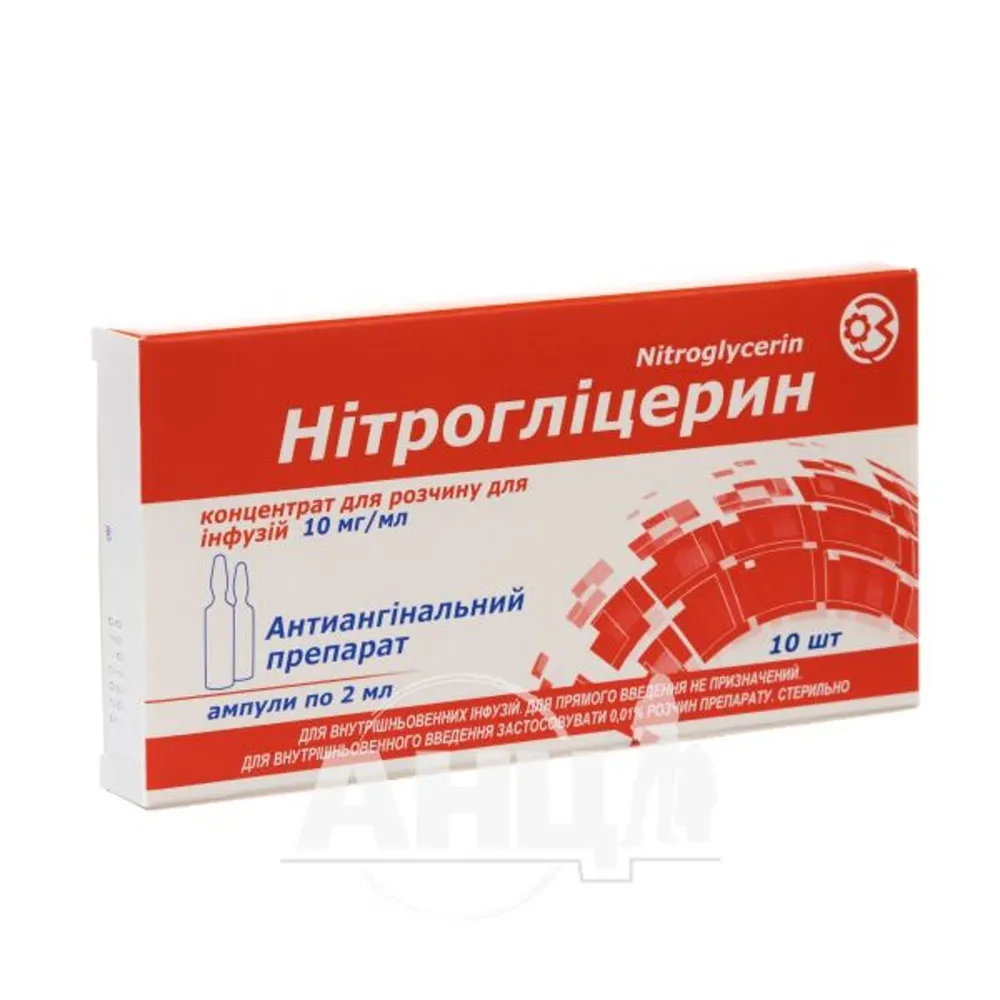
Table of Contents
INSTRUCTIONS FOR MEDICAL USE OF THE MEDICINAL PRODUCT NITROGLYCERIN
Composition:
Active substance: glyceryl trinitrate;
1 ml of solution contains glyceryl trinitrate 5% solution in ethanol, calculated as 100% content of the active substance – 10 mg;
Excipient: ethanol (96%).
Pharmaceutical form. Concentrate for solution for infusion.
Main physicochemical properties: clear, colorless or slightly yellow liquid.
Pharmacotherapeutic group.
Vasodilators used in cardiology. Organic nitrates.
ATC code C01DA02.
Pharmacological properties.
Pharmacodynamics.
Nitroglycerin is an antianginal agent belonging to the group of peripheral vasodilators with predominant action on venous vessels. Its mechanism of action is associated with the release of the active substance, nitric oxide (NO), in vascular smooth muscle. Nitric oxide induces activation of guanylate cyclase and increases the level of cGMP, leading to relaxation of smooth muscle cells in the vessel walls. Under the influence of nitroglycerin, arterioles and precapillary sphincters are less relaxed compared to large arteries and veins.
The antianginal effect of nitroglycerin is primarily related to reduced myocardial oxygen demand due to decreased preload (venous dilation and reduced blood flow to the right atrium) and afterload (reduction in total peripheral vascular resistance). It promotes redistribution of coronary blood flow to ischemic areas of the myocardium. It increases tolerance to physical exertion in patients with ischemic heart disease and angina pectoris. In heart failure, it promotes myocardial unloading, primarily by reducing preload. It reduces pressure in the pulmonary circulation.
Pharmacokinetics.
The effect is observed within 1–2 minutes after the start of glyceryl trinitrate infusion and lasts for 3–5 minutes.
The volume of distribution of glyceryl trinitrate is 3.3 ± 1.2 L/kg. At plasma concentrations of 50–500 mcg/L, 60% of nitroglycerin is protein-bound.
Nitroglycerin metabolism occurs predominantly in the liver under the influence of glutathione-dependent reductase. Additionally, spontaneous hydrolysis and non-enzymatic degradation of nitroglycerin occur in blood serum. The metabolites are mainly water-soluble, partially or completely denitrated, and subsequently metabolized to glucuronides and excreted in urine or bile. Enterohepatic recirculation does not occur.
The pharmacokinetics of nitroglycerin are complex and depend on individual patient characteristics. Variability is caused, for example, by first-pass metabolism in the liver, large volume of distribution, concentration in vessel walls, significant differences in concentrations between arteries and veins, hydrolysis in blood serum, and unstable plasma concentrations. The plasma clearance of nitroglycerin during prolonged infusion is 230 ± 9 mL/min/kg.
Clinical characteristics.
Indications.
Severe and prolonged ischemic pain in the area of the heart, associated with myocardial infarction or unstable angina.
Cardiac pump failure and pulmonary edema associated with acute myocardial infarction.
Arterial hypertension related to open-heart surgery and other surgical interventions.
Provision of controlled arterial hypotension during surgical procedures.
Contraindications.
Hypersensitivity to nitroglycerin and other nitro compounds. Hypovolemia (requires correction prior to nitroglycerin administration), marked arterial hypotension (systolic pressure < 90 mm Hg), increased intracranial pressure, hemorrhagic stroke, recent head trauma, cardiac tamponade, conditions associated with reduced left ventricular filling pressure (acute myocardial infarction, isolated mitral stenosis, constrictive pericarditis), hypertrophic obstructive cardiomyopathy, closed-angle glaucoma with high intraocular pressure, toxic pulmonary edema, anemia, acute vascular insufficiency (shock, vascular collapse).
Sildenafil. Concomitant use of phosphodiesterase type 5 inhibitor sildenafil is contraindicated, as sildenafil potentiates the hypotensive effect of nitrates (interval between administrations should be at least 48 hours).
Interaction with other medicinal products and other forms of interactions.
Concomitant use with morphine and other vasodilators, ACE inhibitors, calcium channel blockers ("slow" calcium channel blockers), beta-adrenergic blockers, diuretics, other antihypertensive agents, neuroleptics, tricyclic antidepressants, MAO inhibitors, Viagra (sildenafil) and other phosphodiesterase type 5 inhibitors, opioid analgesics, ethanol, and ethanol-containing medications enhances the hypotensive effect of nitroglycerin; combination with beta-adrenergic blockers, calcium channel blockers, and ACE inhibitors results in potentiation, whereas with sympathomimetics (noradrenaline, mesaton) antianginal effect is suppressed. Combination with dihydroergotamine may increase its bioavailability, thereby increasing the risk of dihydroergotamine-induced coronary spasm. Use of nitroglycerin together with quinidine or procainamide may cause orthostatic collapse. Concomitant use with heparin may reduce anticoagulant effect. Atropine and other drugs with M-cholinolytic action (etacizin, etmozine) may reduce nitroglycerin's effect due to decreased secretion and bioavailability of the drug. Phenobarbital enhances hepatic metabolism of nitrates; sulfhydryl group donors (captopril, acetylcysteine, unithiol) restore reduced sensitivity to the drug.
Special precautions for use.
Particular attention should be paid to patients with anemia, hypertrophic obstructive cardiomyopathy, aortic or mitral stenosis, cor pulmonale, severe renal or hepatic dysfunction, hypothyroidism, malnutrition, or hypothermia when prescribing this medication.
The drug should be administered with caution, carefully weighing the risks against the benefits, in cases of uncontrolled hypovolemia; heart failure patients with normal or low pulmonary artery pressure; severe anemia; hyperthyroidism; cerebrovascular disorders; severe renal and/or hepatic insufficiency (risk of methemoglobinemia development); patients with pronounced cerebral atherosclerosis; and elderly patients.
To reduce the risk of adverse effects: caution is required when co-administering with medicinal products possessing pronounced hypotensive and vasodilating properties; alcohol consumption should be avoided, and exposure to high ambient temperatures (e.g., saunas, steam rooms, hot showers) should be limited. A significant drop in arterial blood pressure and dizziness may occur upon sudden transition from a lying or sitting position to a standing position.
Nitroglycerin, concentrate for infusion 10 mg/mL, contains ethanol as an excipient at a concentration of 750 mg/mL. At the maximum infusion rate of nitroglycerin (400 mcg/min), the ethanol intake amounts to approximately 1.8 g/hour, which exceeds by 3–5 times the rate of its elimination in healthy adults. Nitroglycerin, concentrate for infusion 10 mg/mL, should be used in children, pregnant women, and patients with epilepsy or impaired liver function only under life-threatening conditions. In such cases, the lowest possible dose should be administered.
Alcoholic beverages should not be consumed during treatment.
Use during pregnancy or breastfeeding.
The use of nitroglycerin during pregnancy or breastfeeding is contraindicated.
Ability to affect reaction speed while driving or operating machinery.
This medication should be administered only in a hospital setting.
Method of administration and dosage.
The dosage regimen is determined individually by a physician, depending on the clinical response and systolic blood pressure.
An infusion solution containing 100 mcg/mL of nitroglycerin should usually be used. This solution is prepared by diluting 1 ampoule of the drug containing 2 mL (= 20 mg nitroglycerin) in 200 mL of 0.9% sodium chloride solution, 5% glucose solution, or isotonic glucose-saline solution, or 1 ampoule of the drug containing 5 mL (= 50 mg nitroglycerin) in 500 mL of 0.9% sodium chloride solution, 5% glucose solution, or isotonic glucose-saline solution to obtain a solution concentration of 100 mcg/mL. Higher concentrations may be used, but not exceeding 400 mcg/mL.
Infusion systems must be made of polyethylene (PE), polypropylene (PP), polytetrafluoroethylene (PTFE), or glass. Nitroglycerin is absorbed by materials made of polyvinyl chloride (PVC) and polyurethane (PU), which necessitates an increase in its dosage.
| Dosing of nitroglycerin, solution prepared from concentrate for infusion. Intravenous infusion can be initiated at a rate of 10–20 mcg/min. The rate may then be increased by 10–20 mcg/min every 5–10 minutes, depending on patient response. A good therapeutic effect is usually observed at infusion rates of 50–100 mcg/min. With prolonged administration of large doses, tolerance may develop within 8–24 hours, and dose escalation may be required. The maximum infusion rate is 400 mcg/min. |
|||
| mcg/min |
mg/h |
mg/h, with solution concentration of 100 mcg/mL |
drops/min, with solution concentration of 100 mcg/mL |
| 10 |
0.6 |
6 |
2 |
| 20 |
1.2 |
12 |
4 |
| 30 |
1.8 |
18 |
6 |
| 40 |
2.4 |
24 |
8 |
| 50 |
3 |
30 |
10 |
| 60 |
3.6 |
36 |
12 |
| 70 |
4.2 |
42 |
14 |
| 80 |
4.8 |
48 |
16 |
| 90 |
5.4 |
54 |
18 |
| 100 |
6 |
60 |
20 |
| 150 |
9 |
90 |
30 |
| 200 |
12 |
120 |
40 |
| 300 |
18 |
180 |
60 |
| 400 |
24 |
240 |
80 |
When nitroglycerin is administered intravenously, a pronounced hemodynamic effect is observed. Therefore, the drug should be used only under hospital conditions, with continuous monitoring of cardiovascular system functions. Systolic blood pressure should not decrease by more than 10–15 mm Hg in normotensive patients, and no more than 5 mm Hg in patients with arterial hypotension or those predisposed to it. Pulse rate should not increase by more than 5 beats per minute, provided that the clinical picture simultaneously improves significantly.
Children.
Contraindicated, as efficacy and safety in children have not been established.
Overdose.
Symptoms: arterial hypotension, tachycardia, sensation of warmth, hyperemia, headache, rapid heartbeat, syncope. Increased intracranial pressure, which may lead to confusion and neurological disturbances. Overdose over several hours may result in ethanol intoxication.
Treatment. Excessive arterial hypotension can be corrected by reducing the infusion rate or discontinuing the drug administration. In cases of severe arterial hypotension, the patient should be placed in a horizontal position with the foot of the bed lowered. In arterial hypotension associated with bradycardia, atropine and dopamine are indicated. Hypoxia caused by methemoglobinemia may result in cyanosis, metabolic acidosis, coma, seizures, and vascular collapse. In cases of methemoglobinemia, administer intravenous methylene blue solution (1–2 mg/kg body weight).
Adverse reactions.
In most cases, adverse effects of nitroglycerin are related to excessive reduction of blood pressure.
The frequency of adverse reactions is defined as follows: common (≥ 1/100, < 1/10), uncommon (≥ 1/1000, < 1/100), rare (≥ 1/10000, < 1/1000).
Psychiatric disorders: rare – feeling of anxiety.
Nervous system disorders: common – headache; uncommon – dizziness; rare – syncope.
Eye disorders: rare – visual disturbances.
Cardiovascular system disorders: common – tachycardia, arterial hypotension (especially orthostatic); uncommon – flushing; rare – bradycardia, cyanosis.
Gastrointestinal disorders: rare – nausea, vomiting.
Skin disorders: rare – urticaria.
Immune system disorders: anaphylactic shock.
General disorders: respiratory disturbances, weakness.
There have also been isolated reports of adverse reactions: exacerbation of ischemic heart disease due to hypoxia, complete heart block, asystole, angioneurotic edema, hypersensitivity reactions.
With high infusion rates (> 290 mcg/min) or in patients with reduced drug clearance, methemoglobin concentration in blood may increase.
Shelf life.
3 years.
Storage conditions.
Store in the original packaging at a temperature not exceeding 25 °C, away from fire.
Keep out of reach of children.
Incompatibility.
Use only the solvents specified in the section "Administration and dosage". Should not be mixed in the same container with other medicinal products.
Packaging.
2 ml in ampoules № 10 in a pack, № 10 in a blister in a pack; 5 ml in ampoules № 5 in a blister in a pack.
Prescription status.
Prescription only.
Manufacturer.
Limited Liability Company "Experimental Plant "GNCLS".
LIMITED LIABILITY COMPANY "CORPORATION "ZDOROV'YA".
Manufacturer's location and address of business activity.
Ukraine, 61057, Kharkiv region, city of Kharkiv, Vorobiova Street, building 8.
(Limited Liability Company "Experimental Plant "GNCLS")
Ukraine, 61013, Kharkiv region, city of Kharkiv, Shevchenka Street, building 22.
(LIMITED LIABILITY COMPANY "CORPORATION "ZDOROV'YA")