Nimotop®
Ukraine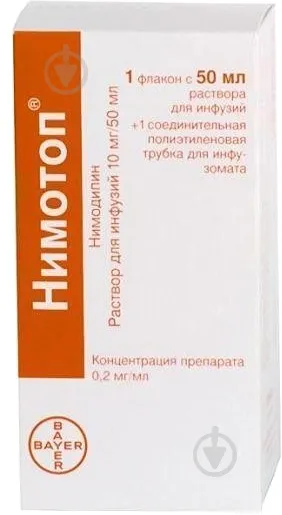
Table of Contents
INSTRUCTIONS FOR MEDICAL USE OF THE MEDICINAL PRODUCT NIMOTOP® (NIMOTOP®)
Composition:
Active ingredient: nimodipine;
One 50 ml vial contains 10 mg of nimodipine;
Excipients: ethanol 96%, macrogol 400, sodium citrate, citric acid anhydrous, water for injections.
Pharmaceutical form. Solution for infusion.
Main physicochemical properties: clear, slightly yellowish solution.
Pharmacotherapeutic group. Selective calcium channel blockers with predominant vascular effect.
ATC code C08CA06.
Pharmacological Properties
Pharmacodynamics
Mechanism of action
Nimodipine is a calcium channel antagonist of the 1,4-dihydropyridine group. Due to its high lipophilicity, the substance readily penetrates the blood-brain barrier. Preclinical studies have shown that nimodipine binds with high affinity and selectivity to L-type Ca2+ calcium channels, blocking transmembrane Ca2+ influx. In pathological conditions associated with increased Ca2+ ion influx into nerve cells, such as cerebral ischemia, nimodipine is believed to improve neuronal stability and functional properties. Ischemic neurological deficits in patients with subarachnoid hemorrhage and mortality rates are significantly reduced with nimodipine treatment.
Pharmacokinetics
Absorption
The active substance nimodipine is almost completely absorbed following oral administration. Within 10–15 minutes after tablet intake, the unchanged active ingredient and early first-pass metabolites can be detected in blood plasma. In elderly individuals, after repeated oral administration (30 mg three times daily), the mean peak plasma concentration (Cmax) ranges from 7.3 to 43.2 ng/mL and is reached within 0.6–1.6 hours (tmax). In young individuals, after a single 30 mg or 60 mg dose, the mean peak plasma concentration is 16±8 ng/mL and 31±12 ng/mL, respectively. Peak plasma concentration and area under the concentration-time curve (AUC) increase proportionally with dose up to the highest studied dose (90 mg). With dosing at 0.03 mg/kg/h (continuous infusion), a steady-state plasma concentration of 17.6–26.6 ng/mL is achieved. After intravenous bolus injection, a biphasic decline in nimodipine plasma concentration is observed, with elimination half-lives of 5–10 minutes and approximately 60 minutes.
The calculated volume of distribution (Vss, two-compartment model) following intravenous administration is 0.9–1.6 L/kg body weight. Total (systemic) clearance ranges from 0.6–1.9 L/h/kg.
Protein binding and distribution
Nimodipine is 97–99% bound to plasma proteins. Preclinical studies have demonstrated that nimodipine can cross the placental barrier. Despite the lack of human data, penetration through the placental barrier in women is possible. In preclinical studies, significantly higher concentrations of nimodipine and/or its metabolites were found in the milk of lactating animals compared to plasma. In human breast milk, nimodipine concentrations are similar to those in plasma.
After oral or intravenous administration, nimodipine can be detected in cerebrospinal fluid at concentrations approximately 0.5% of those measured in plasma. This is roughly equivalent to the concentration of unbound drug in plasma.
Metabolism, elimination, and excretion
Nimodipine is metabolized primarily via the cytochrome P450 3A4 system, mainly through dehydrogenation of the dihydropyridine ring and oxidative cleavage of the ether bond. Oxidative cleavage of the ether, hydroxylation of the 2- and 6-methyl groups, and glucuronidation as a conjugation reaction are further important steps in the drug's metabolism. The three main metabolites identified in plasma have shown no or only minimal residual therapeutic activity.
No enzyme-inducing or enzyme-inhibiting activity toward liver enzymes has been observed. Elimination of metabolites in humans occurs via the kidneys (50%) and biliary excretion (30%).
Elimination kinetics are linear. The elimination half-life of nimodipine ranges from 1.1 to 1.7 hours. The terminal half-life of 5–10 hours is not relevant for determining the dosing interval.
Mean plasma concentration-time profile of nimodipine after oral administration of a 30 mg tablet and after intravenous infusion of 0.015 mg/kg over 1 hour (n=24, elderly individuals)
Bioavailability
Due to extensive first-pass metabolism in the liver (first-pass effect approximately 85–95%), absolute bioavailability is 5–15%.
Preclinical safety data
Preclinical studies revealed no specific risks for humans based on standard single- and repeated-dose toxicity studies, genotoxicity, carcinogenic potential, or effects on fertility in males and females.
Clinical characteristics.
Indications.
Prevention and treatment of ischemic neurological disorders caused by cerebral vasospasm following subarachnoid hemorrhage due to rupture of an aneurysm.
Contraindications.
Individual hypersensitivity to nimodipine or to any component of the drug.
Interaction with other medicinal products and other forms of interaction.
Medicinal products affecting nimodipine
Fluoxetine
Concomitant administration of nimodipine and the antidepressant fluoxetine increases plasma concentration of nimodipine by nearly 50% at steady state. Plasma levels of fluoxetine are significantly reduced, while the activity of its active metabolite norfluoxetine remains unchanged (see section "Special precautions for use").
Nortriptyline
Concomitant administration of nimodipine and nortriptyline results in a slight decrease in nimodipine exposure at steady state, while plasma concentration of nortriptyline remains unchanged.
Effect of nimodipine on other medicinal products
Antihypertensive agents
Nimodipine may potentiate the hypotensive effect of the following antihypertensive drugs when administered concomitantly:
- diuretics,
- β-blockers,
- ACE inhibitors (angiotensin-converting enzyme inhibitors),
- A1-antagonists,
- other calcium antagonists,
- α-adrenoblockers,
- phosphodiesterase-5 inhibitors,
- α-methyldopa.
However, if such combinations cannot be avoided, careful monitoring of the patient is required.
Zidovudine
Studies in monkeys have shown that concomitant intravenous administration of nimodipine (as a bolus injection) and the anti-HIV drug zidovudine leads to a significant increase in plasma levels of zidovudine (AUC) and to a reduction in its volume of distribution and clearance.
Concomitant intravenous administration of nimodipine and β-blockers may result in mutual potentiation of the negative inotropic effect and even lead to development of congestive heart failure.
Potentially nephrotoxic medicinal products
Concomitant therapy with potentially nephrotoxic drugs (e.g., aminoglycosides, cephalosporins, furosemide) or treatment of patients with impaired renal function may lead to further deterioration of kidney function. Such treatment should be carried out under close monitoring of renal function. If worsening of renal function is observed, discontinuation of nimodipine therapy should be considered (see section "Special precautions for use").
Medicinal products incompatible with alcohol
Nimotop® infusion solution contains 23.7% v/v alcohol; therefore, possible interactions with medicinal products incompatible with alcohol should be considered (see section "Special precautions for use").
Special precautions for use.
Careful monitoring of the patient is recommended in cases of increased intracranial pressure or elevated water content in brain tissue (generalized cerebral edema), although the use of nimodipine is not associated with increased intracranial pressure.
Nimodipine should be used with particular caution in patients with arterial hypotension (systolic blood pressure less than 100 mm Hg).
In patients with unstable angina or within the first 4 weeks following acute myocardial infarction, the physician must carefully weigh the potential risks (e.g., reduced coronary blood flow and myocardial ischemia) against the benefits of treatment (e.g., improved cerebral perfusion).
If concomitant use of antihypertensive agents is required, Nimotop® infusion solution should only be administered under conditions of careful monitoring (see section "Interaction with other medicinal products and other forms of interaction").
Concomitant therapy with potentially nephrotoxic agents (e.g., aminoglycosides, cephalosporins, furosemide) or treatment of patients with impaired renal function may lead to further deterioration of kidney function. Such treatment should be conducted under close monitoring of renal function. If worsening of renal function is observed, discontinuation of nimodipine therapy should be considered (see section "Interaction with other medicinal products and other forms of interaction").
The active substance in Nimotop® infusion solution is slightly photosensitive; therefore, direct exposure to sunlight should be avoided during administration. However, if Nimotop® infusion solution is administered under diffused daylight or artificial lighting, special protective measures are not required for up to 10 hours. If exposure to sunlight cannot be avoided during infusion, appropriate precautions should be taken (such as protecting the infusion pump and tubing with a light-resistant cover; using tinted infusion sets).
Warning
This medicinal product contains 23.7% v/v ethanol.
The medicinal product contains 1 mmol (23 mg) of sodium per 1 vial (50 ml solution), equivalent to 1.15% of the maximum daily intake of sodium (2 g) recommended by WHO for adults.
Nimotop® infusion solution is a clear, slightly yellowish solution. Vials containing cloudy solution or solution with altered color should be discarded. Any unused product should be disposed of properly.
Use during pregnancy or breastfeeding.
Pregnancy
There are no adequate controlled clinical studies on the use of this medicinal product in pregnant women. Therefore, if Nimotop® must be used during pregnancy, the benefit of treatment should be carefully weighed against the potential risk, depending on the severity of the clinical condition.
Breastfeeding
Nimodipine and its metabolites have been detected in breast milk at concentrations approximately equivalent to those in maternal plasma. Therefore, breastfeeding should be discontinued during treatment with this medicinal product.
Fertility
In isolated cases under in vitro fertilization conditions, calcium antagonists have been associated with reversible biochemical changes in the sperm head region, which may lead to impaired sperm function. The clinical significance of these changes during short-term treatment is unknown.
Ability to affect reaction speed when driving or operating machinery.
The ability to drive or operate machinery may be impaired due to the potential occurrence of dizziness. However, this factor is usually not relevant during administration of Nimotop® infusion solution.
Method of Administration and Dosage
Dosage
Infusion therapy should be initiated with intravenous administration of Nimotop® at a dose of 1 mg nimodipine/(5 mL infusion solution)/hour for the first 2 hours (approximately 15 mcg/kg/hour).
If the drug is well tolerated and there is no pronounced arterial hypotension, after the initial 2 hours the dose may be increased to 2 mg nimodipine/(10 mL infusion solution)/hour (approximately 30 mcg/kg/hour).
For patients with body weight significantly less than 70 kg and for those with labile arterial pressure, infusion should be initiated at a dose of 0.5 mg/(2.5 mL of Nimotop® infusion solution)/hour.
Intracisternal administration.
During surgical procedures, a freshly prepared solution of nimodipine (1 mL of Nimotop® infusion solution mixed with 19 mL of Ringer's solution), warmed to body temperature, may be administered intracisternally. This solution must be used immediately after preparation.
Patients experiencing concomitant adverse reactions may require dose reduction or discontinuation of treatment.
When used concomitantly with drugs that induce or inhibit the cytochrome P450 3A4 system, dose adjustment may be necessary (see section "Interaction with other medicinal products and other forms of interaction").
Patients with hepatic impairment
In cases of severe hepatic dysfunction, particularly cirrhosis, the bioavailability of nimodipine may be increased due to reduced first-pass effect and decreased metabolic clearance. The drug's effects and adverse reactions, such as arterial hypotension, may be more pronounced in these patients.
In such cases, the dose should be reduced, or treatment discontinuation should be considered if necessary.
Route and Duration of Administration
For patients in whom volume overload is undesirable or contraindicated, the drug may be administered via a central venous catheter without additional co-infusion solutions.
Nimotop® infusion solution should be administered as a continuous intravenous infusion via a central catheter using an infusion pump. The systems are connected via a three-way stopcock. The Nimotop® infusion solution should not be added to a bag or bottle containing a co-infusion solution and should not be mixed with other medicinal products.
The drug may be administered concomitantly with one of the following solutions: 5% glucose solution, 0.9% sodium chloride solution, Ringer's lactate solution, Ringer's lactate solution with magnesium, 40% dextran solution, 6% poly(0-2-hydroxyethyl) starch solution, 5% human serum albumin, or whole blood. Based on study results, mannitol may also be co-infused during the first 24 hours. The ratio of Nimotop® infusion solution to co-infusion solution should be 1:4.
Administration of Nimotop® infusion solution may continue during anesthesia, surgical procedures, and angiography.
Prophylactic use
Intravenous nimodipine therapy should be initiated no later than 4 days after hemorrhage and continued throughout the period of maximum risk of vasospasm, i.e., up to 10–14 days after subarachnoid hemorrhage.
If surgical treatment of hemorrhage is performed during prophylactic use of Nimotop® solution, intravenous nimodipine therapy should be continued for at least 5 days after surgery.
After completion of infusion therapy, oral administration of nimodipine tablets is recommended for the following 7 days or longer at a dose of 60 mg 6 times daily, with intervals between doses of at least 4 hours.
Therapeutic use
If ischemic neurological deficits due to vasospasm following subarachnoid hemorrhage are already present, infusion therapy should be initiated as early as possible and continued for at least 5 days, but not more than 14 days.
After completion of infusion therapy, oral administration of nimodipine tablets is recommended for the following 7 days at a dose of 60 mg 6 times daily, with intervals between doses of at least 4 hours.
If surgical treatment of hemorrhage is performed during therapeutic use of Nimotop® solution, intravenous nimodipine therapy should be continued for at least 5 days after surgery.
Children
The safety and efficacy of Nimotop® for use in children (under 18 years of age) have not been established. Due to insufficient experience with nimodipine in pediatric patients, Nimotop® is not recommended for use in this age group.
Overdose
Symptoms of intoxication: Acute overdose may result in severe arterial hypotension, tachycardia or bradycardia, nausea, and, in case of oral overdose, gastrointestinal disturbances and nausea.
Treatment of intoxication: In cases of acute overdose, immediate discontinuation of the drug is recommended. Emergency management should be symptom-oriented. In cases of oral nimodipine overdose, gastric lavage followed by activated charcoal administration is recommended as emergency treatment. If further reduction in blood pressure occurs, intravenous norepinephrine or dopamine should be administered. As no specific antidote is known, management of other adverse reactions should be based on the most prominent symptoms.
Adverse reactions
Below is a list of adverse reactions identified during clinical trials with nimodipine for the indication of subarachnoid hemorrhage due to aneurysm, categorized by frequency according to CIOMS III categories (placebo-controlled studies: nimodipine N=703; placebo N=692; non-controlled studies: nimodipine N=2496 – as of August 31, 2005).
Within each frequency group, adverse reactions are listed in decreasing order of severity. The adverse reactions listed below are classified by frequency of occurrence as follows: very common (≥1/10), common (≥1/100, <1/10), uncommon (≥1/1000, <1/100), rare (≥1/10,000, <1/1000), very rare (<1/10,000), and frequency not known (cannot be estimated based on available data).
| Frequency Organ system classes |
Uncommon |
Single |
Frequency unknown |
| Blood and lymphatic system disorders |
thrombocytopenia |
||
| Immune system disorders |
allergic reaction, skin rash |
||
| Nervous system disorders |
headache |
||
| Cardiac disorders |
tachycardia |
bradycardia |
|
| Vascular disorders |
hypotension, vasodilation |
||
| Respiratory, thoracic and mediastinal disorders |
hypoxia |
||
| Gastrointestinal disorders |
nausea |
intestinal obstruction |
|
| Hepatobiliary disorders |
transient increase in liver enzyme activity |
||
| General disorders and administration site conditions |
reactions at injection and infusion sites, thrombophlebitis at infusion site |
Reporting of suspected adverse reactions
Reporting of suspected adverse reactions after authorization of the medicinal product is important. It allows continuous monitoring of the benefit/risk balance of the drug. Healthcare professionals should report any suspected adverse reactions.
Shelf life. 4 years.
Storage conditions.
Store at a temperature not exceeding 30 °C in the original packaging to protect from light and in a place inaccessible to children.
Incompatibility.
Nimodipine, the active substance of Nimotop® infusion solution, is absorbed by polyvinyl chloride; therefore, for parenteral administration of Nimotop®, only systems with polyethylene tubing must be used.
Nimotop® infusion solution should not be added to a bag or bottle containing a co-infused solution and should not be mixed with other medicinal products.
Packaging.
50 ml in a vial; 1 vial together with a polyethylene connecting tube for the infusion pump and instructions for use of the tube, in a cardboard box; 5 boxes in a polyethylene pack.
Prescription status.
Prescription only.
Manufacturer.
Bayer AG.
Manufacturer's address and place of business.
Kaiser-Wilhelm-Allee, 51368 Leverkusen, Germany.