Nicomex
Ukraine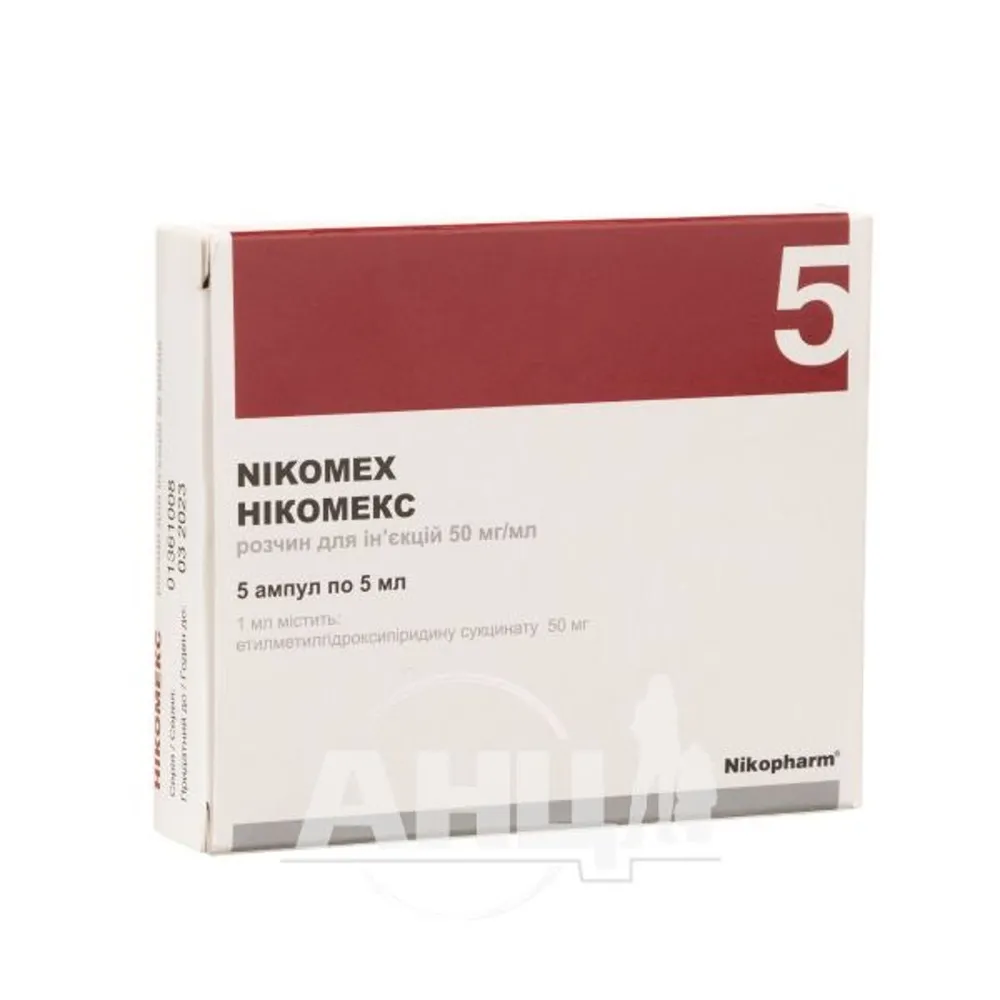
Table of Contents
INSTRUCTIONS FOR MEDICAL USE OF THE MEDICINAL PRODUCT NIKOMEX (NIKOMEX)
Composition:
Active substance: ethylmethylhydroxypyridine succinate;
1 ml of solution contains ethylmethylhydroxypyridine succinate 50 mg;
Excipients: sodium metabisulfite (E 223), water for injections.
Pharmaceutical form. Solution for injection.
Main physicochemical properties: clear colorless or slightly yellowish liquid.
Pharmacotherapeutic group. Agents affecting the nervous system.
ATC code N07X X.
Pharmacological properties.
Pharmacodynamics.
Nicomex is an inhibitor of free radical processes and a membrane protector that exerts antihypoxic, stress-protective, nootropic, anticonvulsant, and anxiolytic effects. The drug enhances the body's resistance to various damaging factors, including oxygen-dependent pathological conditions (shock, hypoxia and ischemia, cerebral circulation disorders, alcohol intoxication, and intoxication with antipsychotic agents (neuroleptics)).
The drug improves cerebral metabolism and cerebral blood supply, enhances microcirculation and rheological properties of blood, and reduces platelet aggregation. It stabilizes membrane structures of blood cells (erythrocytes and platelets). Nicomex exerts a hypolipidemic effect, reducing levels of total cholesterol and low-density lipoproteins. It decreases enzymatic toxemia and endogenous intoxication in acute pancreatitis.
The mechanism of action is determined by its antioxidant and membrane-protective properties. The drug inhibits lipid peroxidation, increases superoxide dismutase activity, improves the lipid-protein ratio, and reduces membrane viscosity. It modulates the activity of membrane-bound enzymes (calcium-independent phosphodiesterase, adenylate cyclase, acetylcholinesterase) and receptor complexes (benzodiazepine, GABA, and acetylcholine receptors), thereby enhancing their ligand-binding capacity, supporting the structural and functional organization of biomembranes, neurotransmitter transport, and improving synaptic transmission. Nicomex increases dopamine levels in the brain. It enhances compensatory activation of aerobic glycolysis and reduces the degree of suppression of oxidative processes in the Krebs cycle under hypoxic conditions, leading to increased ATP and creatine phosphate levels, activation of mitochondrial energy-synthesizing functions, and stabilization of cellular membranes.
The medicinal product normalizes metabolic processes in ischemic myocardium, reduces the area of necrosis, restores and improves myocardial electrical activity and contractility, increases coronary blood flow in the ischemic area, and reduces the consequences of reperfusion syndrome in acute coronary insufficiency. It enhances the antianginal activity of nitro-compounds. Nicomex helps preserve retinal ganglion cells and optic nerve fibers in progressive neuropathy caused by chronic ischemia and hypoxia. It improves functional activity of the retina and optic nerve, thereby increasing visual acuity.
Pharmacokinetics.
After intramuscular administration, the drug is detectable in blood plasma for up to 4 hours post-administration. Time to reach maximum concentration is 0.45–0.5 hours. Maximum concentration at doses of 400–500 mg is 3.5–4 μg/mL. Nicomex rapidly transfers from the bloodstream into organs and tissues and is quickly eliminated from the body. The drug is excreted in urine, primarily in glucuronide-conjugated form, and in minor amounts unchanged.
Clinical characteristics.
Indications.
- Acute cerebrovascular disorders;
- traumatic brain injury, consequences of traumatic brain injuries;
- dyscirculatory encephalopathy;
- vegetative dystonia syndrome;
- mild cognitive impairment of atherosclerotic origin;
- anxiety disorders in neurotic and neurosis-like conditions;
- acute myocardial infarction (from the first day) – as part of complex therapy;
- primary open-angle glaucoma at various stages – as part of complex therapy;
- management of alcohol withdrawal syndrome with predominant neurosis-like and vegetative-vascular disorders;
- acute intoxication with antipsychotic agents;
- acute purulent-inflammatory processes in the abdominal cavity (acute necrotic pancreatitis, peritonitis), as part of complex therapy.
Contraindications.
Acute hepatic or renal failure, increased individual sensitivity to the drug, childhood, pregnancy, breastfeeding.
Interaction with other medicinal products and other types of interactions.
Nicomex enhances the effect of benzodiazepine anxiolytics, anticonvulsant agents (carbamazepine), antiparkinsonian agents (levodopa). Reduces the toxic effect of ethanol.
Special precautions for use.
In individual cases, especially in patients with limited allergic history, in patients with bronchial asthma, or in those with increased sensitivity to sulfites, severe hypersensitivity reactions may occur.
The medicinal product contains sodium metabisulfite, which may cause hypersensitivity reactions and bronchospasm.
Caution is advised in patients with diabetic retinopathy (the course should not exceed 7–10 days) due to the drug's potential to enhance proliferative processes. After completion of parenteral administration, to maintain the therapeutic effect achieved, continuation of treatment with the drug orally in tablet form is recommended.
Use during pregnancy or breastfeeding.
Nikomex is contraindicated during pregnancy and breastfeeding.
Ability to affect reaction rate when driving or operating machinery.
During treatment, driving vehicles or operating complex machinery should be avoided, considering the possible adverse effects that may influence reaction speed and the ability to concentrate.
Administration and Dosage.
Nikomex is administered intramuscularly or intravenously (by bolus injection or infusion). Dosages are individually adjusted. When administered by infusion, the drug should be diluted in 0.9% sodium chloride solution (200 ml). Treatment in adults is initiated at a dose of 50–100 mg 1–3 times daily, gradually increasing the dose until the desired therapeutic effect is achieved. Bolus administration of Nikomex should be performed slowly over 5–7 minutes; infusion should be given at a rate of 40–60 drops per minute. The maximum daily dose must not exceed 1200 mg.
In acute cerebral circulation disorders, Nikomex is used as part of combination therapy during the first 2–4 days, administered intravenously either by bolus injection or infusion at a dose of 200–500 mg once daily. Subsequently, it is administered intramuscularly at 200–500 mg 2–3 times daily. The treatment duration is 14 days.
In traumatic brain injury and its consequences, Nikomex is administered intravenously by infusion at a dose of 200–500 mg 2–4 times daily for 10–15 days.
In decompensated phase of dyscirculatory encephalopathy, Nikomex should be administered intravenously either by bolus injection or infusion at a dose of 200–500 mg 1–2 times daily for 14 days. Then the drug is administered intramuscularly at 100–250 mg daily for the following 2 weeks.
For course prophylaxis of dyscirculatory encephalopathy, the drug is administered intramuscularly to adults at a dose of 200–500 mg twice daily for 10–14 days.
In mild cognitive disorders in elderly patients and in anxiety states, the drug is administered intramuscularly at a dose of 100–300 mg daily for 14–30 days.
In acute myocardial infarction as part of combination therapy, Nikomex is administered intravenously or intramuscularly for 14 days, alongside conventional myocardial infarction treatment including nitrates, beta-adrenoblockers, angiotensin-converting enzyme (ACE) inhibitors, thrombolytics, anticoagulant and antiplatelet agents, as well as symptomatic therapy as indicated. For maximum efficacy during the first 5 days, intravenous administration of Nikomex is recommended; during the subsequent 9 days, intramuscular administration is possible. Intravenous administration of Nikomex is performed by slow infusion (to avoid adverse effects) in 0.9% sodium chloride solution or 5% glucose solution in a volume of 100–150 ml over 30–90 minutes. If necessary, slow bolus injection of Nikomex may be performed over no less than 5 minutes.
Administration of Nikomex (intravenous or intramuscular) should be performed 3 times daily, every 8 hours. The daily therapeutic dose is 6–9 mg per kilogram of body weight; the single dose is 2–3 mg/kg. The maximum daily dose must not exceed 800 mg; the maximum single dose must not exceed 250 mg.
In open-angle glaucoma at various stages as part of combination therapy, Nikomex is administered intramuscularly at a dose of 100–300 mg 1–3 times daily for 14 days.
In alcoholic withdrawal syndrome, Nikomex is administered at a dose of 200–500 mg intravenously or intramuscularly 2–3 times daily for 5–7 days.
In acute intoxication with antipsychotic agents, the drug is administered intravenously to adults at a dose of 200–500 mg daily for 7–14 days.
In acute purulent-inflammatory processes of the abdominal cavity (acute necrotizing pancreatitis, peritonitis), the drug is administered on the first day both in the preoperative and postoperative periods. Dosages depend on the form and severity of the disease, extent of the process, and clinical course variants. Discontinuation of the drug should be gradual and only after a stable positive clinical and laboratory response.
In acute edematous (interstitial) pancreatitis, Nikomex is administered to adults at 200–500 mg 3 times daily by intravenous infusion (in 0.9% sodium chloride solution) and intramuscularly.
- Mild severity: 100–200 mg 3 times daily by intravenous infusion (in 0.9% sodium chloride solution) and intramuscularly.
- Moderate severity: 200 mg 3 times daily by intravenous infusion (in 0.9% sodium chloride solution) in adults.
- Severe course: pulse-dose regimen of 800 mg on the first day with two administrations, followed by 200–500 mg twice daily, with gradual reduction of the daily dose.
- Very severe course: initial dose of 800 mg daily until stable suppression of pancreatogenic shock symptoms; after stabilization of the patient's condition – 300–500 mg twice daily by intravenous infusion (in 0.9% sodium chloride solution), with gradual reduction of the daily dose.
Children.
Well-controlled clinical studies on the safety of Nikomex in children have not been conducted; therefore, Nikomex is contraindicated in this patient category.
Overdose.
Symptoms: drowsiness, insomnia.
Treatment: due to the low toxicity of the drug, overdose is unlikely. Treatment is usually not required; symptoms resolve spontaneously within 1 day. In cases of pronounced symptoms, supportive and symptomatic therapy is administered.
Adverse Reactions
To avoid adverse reactions, it is recommended to adhere to the recommended dosage regimen and rate of administration. The frequency of adverse effects was determined according to the classification of the World Health Organization (WHO): very common (≥ 10%); common (≥ 1% but ≤ 10%); uncommon (≥ 0.1% but ≤ 1%); rare (≥ 0.01% but ≤ 0.1%); very rare (≤ 0.01%); frequency not known (frequency cannot be estimated based on available data).
Immune system disorders: very rare – anaphylactic shock, angioedema, urticaria; frequency not known – allergic reactions, hyperemia, possible severe hypersensitivity reactions.
Psychiatric disorders: very rare – drowsiness; frequency not known – sleep disturbances, anxiety, emotional lability.
Cardiac disorders: frequency not known – palpitations, tachycardia.
Nervous system disorders: very rare – headache, dizziness (may be related to excessively rapid administration and is transient in nature); frequency not known – coordination disturbances, tremor.
Vascular disorders: very rare – decreased blood pressure, increased blood pressure (may be related to excessively rapid administration and is transient in nature).
Respiratory, thoracic and mediastinal disorders: very rare – dry cough, throat irritation, chest discomfort, dyspnea (may be related to excessively rapid administration and is transient in nature); frequency not known – bronchospasm.
Gastrointestinal disorders: very rare – dry mouth, nausea, unpleasant taste sensation, metallic taste in the mouth; frequency not known – dyspeptic disorders, diarrhea.
Skin and subcutaneous tissue disorders: very rare – itching, rash, facial hyperemia; frequency not known – distal hyperhidrosis.
General disorders and administration site conditions: very rare – sensation of warmth; frequency not known – changes at the injection site.
With prolonged administration of the drug, the following adverse effects may occur: flatulence, weakness, peripheral edema.
Reporting of suspected adverse reactions
Reporting of adverse reactions after drug registration is important. It allows continuous monitoring of the benefit-risk balance of the medicinal product. Healthcare and pharmaceutical professionals, as well as patients or their legal representatives, are encouraged to report all suspected adverse reactions and lack of efficacy via the Automated Pharmacovigilance Information System at the following link: https://aisf.dec.gov.ua.
Shelf life
Shelf life of the medicinal product in the original packaging –
3 years.
Shelf life after opening the ampoule
Any unused contents of the ampoule should be discarded and must not be used for subsequent administration.
Shelf life after dilution
From a microbiological standpoint, the product should be used immediately.
Storage conditions
Store at a temperature not exceeding 25 °C. To protect from light, keep ampoules in the outer packaging. Store out of reach of children.
Incompatibilities
The medicinal product must not be mixed with other medicinal products. Only use the diluents specified in the instructions.
Packaging
2 ml in an ampoule; 5 ampoules per blister; 2 blisters per cardboard box;
5 ml in an ampoule; 5 ampoules per blister; 1 blister per cardboard box.
Prescription status
Prescription only.
Marketing Authorization Holder
LLC "FARMASEL".
Address of the Marketing Authorization Holder
3 Prorizna Street, Kvitneve, Brovary District, Kyiv Region, 07408, Ukraine.
Manufacturer
LLC "FARMASEL".
JSC "Farmak".
Manufacturer's address and place of business
3 Prorizna Street, Kvitneve, Brovary District, Kyiv Region, 07408, Ukraine.
74 Kyrylivska Street, Kyiv, 04080, Ukraine.