Neurovitane®
Ukraine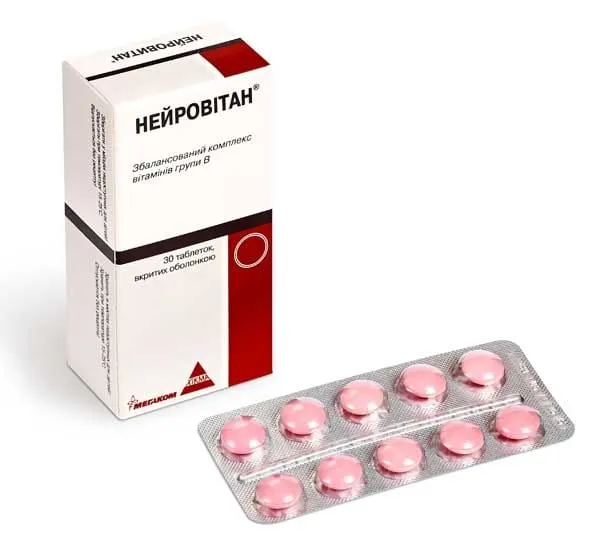
Table of Contents
INSTRUCTIONS for medical use of the medicinal product NEUROVITAN® (NEUROVITAN®)
Composition:
Active substances: octothiamine, riboflavin, pyridoxine, cyanocobalamin;
1 tablet contains
| octotiamine |
25 mg, |
| riboflavin |
2.5 mg, |
| pyridoxine (as hydrochloride) |
40 mg, |
| cyanocobalamin |
0.25 mg; |
Excipients: sucrose, monohydrate lactose, potato starch, corn starch, povidone, microcrystalline cellulose, colloidal silicon dioxide, magnesium stearate, talc, titanium dioxide (E 171), gelatin, shellac, castor oil, purified water, Yellow West FCF (E 110), erythrosine (E 127), carnauba wax, paraffin.
Dosage form. Film-coated tablets.
Main physicochemical properties: round, biconvex tablets coated with a sugar coating ranging in color from pink to pink-orange; on cross-section, speckles of pink, orange, and white color are visible.
Pharmacotherapeutic group.
Vitamin B complex preparations without additional components.
ATC code A11E A.
Pharmacological properties.
Pharmacodynamics.
The action of the drug is determined by the vitamins contained in its composition.
Octothiamine (a combination of vitamin B1 and α-lipoic acid) actively participates in carbohydrate and fat metabolism and is necessary for the synthesis of nucleic acids. It potentiates the action of acetylcholine, which is involved in nerve impulse transmission. It plays an important role in regulating the functions of the muscular and autonomic nervous systems. It enhances tissue respiration and improves oxygen delivery to skin cells.
Riboflavin (vitamin B2) is a component of numerous oxidoreductase enzymes. It participates in tissue respiration and ATP synthesis, synthesis of higher fatty acids, and other cellular energy-producing processes. It exhibits antioxidant properties and participates in hematopoiesis, promoting increased levels of hemoglobin and erythrocytes. It improves vision, enhances color perception, and adaptation to darkness.
Pyridoxine (vitamin B6) is a component necessary for the metabolism of amino acids, fats, and carbohydrates, as well as for the synthesis of physiological regulators such as serotonin and histamine. It participates in cholesterol breakdown and in the synthesis and nourishment of the peripheral nerve myelin sheath and axon. Vitamin B6 deficiency leads to the development of neuromuscular dystrophy and seizures.
Cyanocobalamin (vitamin B12) participates in protein, fat, and carbohydrate metabolism. It prevents fatty degeneration of the liver. It promotes reduction of blood cholesterol levels and its removal from blood vessels. By stimulating protein synthesis, it normalizes growth and development processes. It regulates hematopoietic processes. By increasing leukocyte phagocytic activity and activating the reticuloendothelial system, it enhances the body's immunological defense.
Pharmacokinetics.
The components of Neivitan**®** are absorbed in the small intestine, bind to plasma proteins, and are distributed in all tissues. They undergo biotransformation in the body and are excreted primarily in the urine (both unchanged and as metabolites).
Clinical characteristics.
Indications.
Treatment of nervous system disorders: neuritis, polyneuritis, diabetic neuropathy, neuralgia, ischialgia, intercostal neuralgia, trigeminal neuralgia, paresthesia, peripheral neuroparalyses, facial nerve paralysis, lumbago, arthralgia, and myalgia.
Contraindications.
Hypersensitivity to the components of the drug.
Vitamin B1 is contraindicated in allergic diseases.
Vitamin B6 is contraindicated in peptic ulcer disease of the stomach and duodenum during exacerbation (due to possible increase in gastric juice acidity).
Vitamin B12 is contraindicated in erythremia, erythrocytosis, and thromboembolism.
Interaction with other medicinal products and other types of interactions.
The action of thiamine is inactivated by 5-fluorouracil, as the latter competitively inhibits phosphorylation of thiamine to thiamine pyrophosphate.
Antacids reduce thiamine absorption. Loop diuretics, such as furosemide, which inhibit tubular reabsorption, may during prolonged therapy lead to increased excretion of thiamine and thus reduce thiamine levels.
Concomitant use with levodopa is contraindicated, as vitamin B6 may reduce the antiparkinsonian effect of levodopa. Pyridoxine may enhance the peripheral metabolism of levodopa, thereby reducing its therapeutic efficacy. Therefore, patients with Parkinson's disease receiving treatment with levodopa alone should not take vitamin B6 in doses significantly exceeding the daily requirement. This effect is not observed when levodopa is combined with peripheral decarboxylase inhibitors.
Concomitant use with pyridoxine antagonists (e.g., isoniazid, hydralazine, penicillamine, or cycloserine) and oral contraceptives may increase the requirement for vitamin B6. Serum levels of cyanocobalamin may decrease with concomitant use of oral contraceptives. This interaction is unlikely to have clinical significance.
Absorption of vitamin B12 may be reduced by concomitant use of para-aminosalicylic acid, colchicine, biguanides, neomycin, cholestyramine, potassium chloride, methyldopa, and cimetidine.
Patients receiving chloramphenicol may exhibit an inadequate response to cyanocobalamin.
Antimetabolites and most antibiotics may cause false results in the quantitative determination of vitamin B12 by microbiological methods.
Special precautions for use.
When vitamin B12 is administered, the clinical picture as well as laboratory findings in funicular myelosis or pernicious anemia may lose their specificity.
The preparation contains lactose; therefore, this drug must not be used in patients with rare hereditary forms of galactose intolerance, lactase deficiency, or glucose-galactose malabsorption syndrome.
Alcohol consumption must be avoided during treatment with Neirovitan**®**. The intake of beverages containing sulfites (e.g., wine) increases thiamine degradation.
Since the preparation contains vitamin B6, it should be used with caution in patients with a history of peptic ulcer of the stomach and duodenum, and in those with pronounced impairment of renal or hepatic function.
The drug should not be used in patients with neoplastic diseases, except in cases associated with megaloblastic anemia and vitamin B12 deficiency.
The drug must not be used in severe or acute forms of cardiac decompensation and angina pectoris.
The urine may turn yellow, which is a harmless effect due to the presence of riboflavin in the preparation.
The drug is not recommended to be prescribed together with other multivitamins and trace elements due to the risk of overdose.
The medicinal product contains sucrose; therefore, it should be used with caution in patients with diabetes mellitus.
Neurovitan**®** film-coated tablets contain the coloring agent E 110, which may cause allergic reactions.
Use during pregnancy or breastfeeding.
Pregnancy:
The medicinal product should be used with caution in pregnant women, especially during the first trimester.
Breastfeeding:
Vitamins B1, B6, and B12 are excreted in breast milk.
High concentrations of vitamin B6 may interfere with prolactin release and suppress milk production. Therefore, the drug should be used with caution in breastfeeding women. Studies on the extent of vitamin secretion into breast milk have not been conducted. The decision to discontinue breastfeeding or to use the drug should be made based on the necessity of the drug for the mother. If use of the drug is necessary, breastfeeding should be discontinued during this period.
Effect on the ability to drive vehicles or operate machinery.
The drug does not affect the ability to drive vehicles or operate complex machinery. However, if dizziness occurs during treatment, patients should refrain from driving or operating machinery.
Method of Administration and Dosage.
Administer orally to adults and children aged 3 years and older.
For adults and children aged 14 years and older, the recommended dose is 1 to 4 tablets per day.
For children aged 3–7 years, the recommended dose is 1 tablet per day; for children aged 8–14 years, the dose is 1 to 3 tablets per day.
Treatment duration: 2–4 weeks.
Children.
Use in children aged 3 years and older.
Overdose.
Vitamin B1: has a wide therapeutic range. Very high doses (more than 10 g) may produce curare-like effects, suppressing nerve impulse conduction.
Vitamin B6: has very low toxicity. Prolonged use (more than 6–12 months) at doses exceeding 50 mg of vitamin B6 daily may lead to peripheral sensory neuropathy, nervous excitement, malaise, dizziness, and headache. Excessive intake of vitamin B6 at doses above 1 g per day over several months may result in neurotoxic effects. Neuropathies with ataxia and sensory disturbances, cerebral seizures with EEG changes, and, in isolated cases, hypochromic anemia and seborrheic dermatitis have been reported after ingestion of more than 2 g per day.
Vitamin B12: following parenteral administration (rarely after oral use) at doses exceeding recommended levels, allergic reactions, eczematous skin disorders, and benign forms of acne have been observed.
Prolonged use of high doses of vitamin B12 may lead to impaired liver enzyme activity, chest pain, and hypercoagulation.
Adverse Reactions.
Adverse reactions occur very rarely.
General disorders: weakness, increased body temperature, excessive sweating.
Cardiac disorders: tachycardia.
Vascular disorders: arterial hypotension/hypertension, sensation of warmth.
Immune system disorders: allergic reactions, anaphylactic shock, angioneurotic edema, anaphylaxis, skin manifestations including pruritus, rash, urticaria, hyperemia, burning sensation.
Gastrointestinal disorders: dyspeptic symptoms (epigastric pain, increased gastric acidity, heartburn, nausea, vomiting, belching, feeling of stomach fullness, bloating, flatulence, diarrhea), dry mouth.
Eye disorders: sensation of itching and burning in the eyes.
Shelf life.
3 years.
Storage conditions.
Keep out of reach of children. Store at a temperature not exceeding 25 °C.
Packaging.
10 tablets in a blister pack, 3 blisters in a cardboard box.
Availability.
Over-the-counter (without prescription).
Manufacturer.
Hikma Pharmaceuticals Co. Ltd.
Manufacturer's address and place of business.
Industrial Area - Bayader Wadi Al-Seer, P.O. Box 182400, Amman 11118, Jordan.
Marketing Authorization Holder.
Hikma Pharmaceuticals Co. Ltd.
Address of the Marketing Authorization Holder.
P.O. Box 182400, Amman 11118, Jordan