Neuromultivit
Ukraine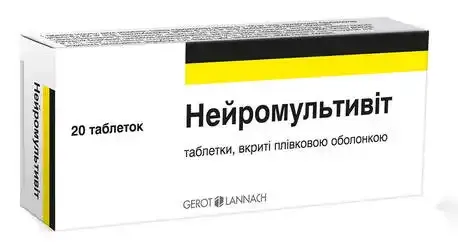
Table of Contents
INSTRUCTIONS FOR MEDICAL USE | consumption | of the medicinal product | NEUROMULTIVIT (NEUROMULTIVIT)
Composition:
Active substances: thiamine hydrochloride (vitamin B1), pyridoxine hydrochloride (vitamin B6), cyanocobalamin (vitamin B12);
1 tablet contains thiamine hydrochloride (vitamin B1) 100 mg, pyridoxine hydrochloride (vitamin B6) 200 mg, cyanocobalamin (vitamin B12) 0.2 mg;
Excipients: modified pregelatinized starch, sodium citrate dihydrate, citric acid monohydrate, colloidal anhydrous silicon dioxide, microcrystalline cellulose, magnesium stearate, povidone, macrogol 6000, titanium dioxide (E 171), talc, hypromellose, polyacrylate dispersion 30%.
Pharmaceutical form. Film-coated tablets.
Main physicochemical properties: white or almost white, round biconvex tablets, film-coated.
Pharmacotherapeutic group. Vitamin B1 in combination with vitamin B6 and/or B12.
ATC code A11D B.
Pharmacological properties.
Pharmacodynamics.
The drug contains a combination of neurotropic active substances — vitamin B complex: thiamine (B1), pyridoxine (B6), and cyanocobalamin (B12), which are particularly important as coenzymes in intermediate metabolism occurring in the central and peripheral nervous systems.
Like all other vitamins, they are essential nutrients that cannot be synthesized directly in the body.
Therapeutic administration of vitamins B1, B6, and B12 compensates for insufficient dietary intake, thereby ensuring adequate levels of coenzymes in the body. Therapeutic use of these vitamins in various nervous system disorders aims, on one hand, to compensate for existing deficiencies (possibly due to increased bodily requirements caused directly by the disease) and, on the other hand, to stimulate natural recovery mechanisms.
Pharmacokinetics.
Thiamine. After oral administration, it undergoes dose-dependent transport, a process with dual mechanisms: active absorption at concentrations up to 2 µmol and passive diffusion at concentrations above 2 µmol. The elimination half-life is approximately 4 hours. The human body can store up to 30 mg of thiamine. However, due to rapid metabolism, body reserves are very limited and are depleted within 4–10 days.
Pyridoxine. Pyridoxine is absorbed very rapidly, primarily in the upper gastrointestinal tract, and is excreted within a maximum of 2–5 hours.
Approximately 40–150 mg can be stored in the human body; 1.7–3.6 mg is excreted in urine per day.
Cyanocobalamin. Vitamin B12 is absorbed from the gastrointestinal tract via two mechanisms:
- release under the influence of gastric juice and rapid binding to intrinsic factor;
- independent of intrinsic factor, through passive entry into the bloodstream.
At doses exceeding 1.5 µg, the latter mechanism plays a significant role.
Vitamin B12 is stored mainly in the liver. The rate of metabolism is 2.5 µg per day, or 0.05% of the stored amount. Vitamin B12 is primarily excreted via bile and is largely reabsorbed through enterohepatic circulation.
Clinical characteristics.
Indications.
Neurological disorders caused by vitamin B group deficiencies.
Contraindications.
Hypersensitivity to the components of the drug.
Vitamin B1 is contraindicated in allergic diseases.
Vitamin B6 is contraindicated in peptic ulcer of the stomach and duodenum in the acute phase (since it may increase gastric juice acidity).
Vitamin B12 is contraindicated in erythremia, erythrocytosis, and thromboembolism.
Interaction with other medicinal products and other forms of interaction.
The action of thiamine is inactivated by 5-fluorouracil, as the latter competitively inhibits phosphorylation of thiamine to thiamine pyrophosphate.
Antacids reduce thiamine absorption. Loop diuretics, such as furosemide, which inhibit tubular reabsorption, may during prolonged therapy cause increased excretion of thiamine and thus reduce thiamine levels.
Concomitant use with pyridoxine antagonists (e.g., isoniazid, hydralazine, penicillamine, or cycloserine) and oral contraceptives may increase the requirement for vitamin B6.
When used concomitantly, vitamin B6 may reduce the effectiveness of levodopa.
Alcohol consumption and black tea decrease thiamine absorption.
Beverages containing sulfites (e.g., wine) enhance thiamine degradation.
Special precautions for use
The drug should not be taken in high doses for longer than 4 weeks, as this may provoke neurological symptoms.
If signs of peripheral sensory neuropathy (paresthesia) occur, the dosage should be reassessed and administration of the drug discontinued if necessary.
Since the drug contains vitamin B6, it should be used with caution in patients with a history of peptic ulcer of the stomach and duodenum, or with pronounced renal and hepatic dysfunction.
Neuropathies have been observed with prolonged administration (more than 6–12 months) of daily doses exceeding 50 mg of vitamin B6, as well as with short-term use (more than 2 months) of more than 1 g of vitamin B6 per day. Therefore, continuous monitoring is recommended during long-term treatment.
When vitamin B12 is administered, the clinical picture and laboratory findings in funicular myelosis or pernicious anemia may lose their specificity. The drug should not be used in patients with neoplasms, except in cases associated with megaloblastic anemia and vitamin B12 deficiency.
The drug is contraindicated in severe or acute forms of cardiac decompensation and angina pectoris.
The drug contains macrogol 6000, which may cause stomach discomfort and diarrhea.
The medicinal product contains approximately 0.4 mg of sodium per tablet. Caution is advised when administering to patients on a sodium-restricted diet.
The medicinal product contains starch; therefore, patients with allergy to wheat (other than celiac disease) should not use this medicinal product.
Use during pregnancy or breastfeeding
Pregnancy. During pregnancy or breastfeeding, the recommended daily intake of vitamin B1 is generally 1.4 mg and of vitamin B6 is 1.9 mg.
These doses should be exceeded only in pregnant women with evident deficiency of vitamins B1 and B6, as the safety of doses higher than the recommended daily intakes has not been established.
Animal studies on the effects of the drug on pregnancy, embryofetal, prenatal, and postnatal development are insufficient. The potential risk to humans is unknown. The physician must carefully evaluate the benefit-risk ratio before deciding on the use of the drug during pregnancy.
Breastfeeding. Vitamins B1, B6, and B12 are excreted in human breast milk. High concentrations of vitamin B6 may suppress lactation. Data from animal studies on the extent of excretion into breast milk are lacking. The decision to discontinue breastfeeding or to discontinue therapy with the drug should be made after careful consideration of the potential benefits of breastfeeding for the infant and the potential benefits of treatment for the mother.
Ability to affect reaction speed when driving or operating machinery
The drug does not affect the ability to drive or operate machinery.
However, if dizziness occurs during treatment with the drug, patients should refrain from driving or operating machinery.
Method of Administration and Dosage.
Tablets should be taken after meals, without chewing, with sufficient liquid.
The recommended dose is 1 tablet per day. In individual cases, the dose may be increased to 1 tablet three times per day.
The duration of treatment is determined individually by a physician. After a treatment period of 4 weeks, the physician decides on dose adjustment and reduction.
Children.
Do not use in children and adolescents (under 18 years of age).
Overdose.
Vitamin B1: has a wide therapeutic range. Very high doses (more than 10 g) may produce a curare-like effect, inhibiting nerve impulse conduction.
Vitamin B6: has very low toxicity. However, prolonged use (more than 6–12 months) of vitamin B6 in doses exceeding 50 mg per day may cause peripheral sensory neuropathy. Neuropathies with ataxia and sensory disturbances, cerebral convulsions with ECG changes, and, in individual cases, hypochromic anemia and seborrheic dermatitis have been reported after ingestion of more than 2 g per day.
Excessive use of vitamin B6 in doses exceeding 1 g per day for more than two months may lead to neurotoxic effects.
Vitamin B12. After parenteral administration (very rarely, also after oral use) of high doses, allergic reactions, eczematous skin disorders, and benign forms of acne have been observed.
With prolonged use of high doses of vitamin B12, possible adverse effects include impaired liver enzyme activity, chest pain, and hypercoagulation.
Side Effects.
Immune system: hypersensitivity reactions, including increased sweating, tachycardia, anaphylactic shock, anaphylaxis, or skin reactions such as pruritus, urticaria, and rash.
Nervous system: prolonged use (more than 6–12 months) of vitamin B6 in doses exceeding 50 mg per day may lead to peripheral sensory neuropathy, nervous excitement, malaise, dizziness, headache.
Renal and urinary system: chromaturia.
Gastrointestinal tract: gastrointestinal disturbances, including nausea, vomiting, diarrhea, abdominal pain, and increased gastric juice acidity.
Shelf Life. 3 years.
Storage Conditions. Store in a dry, light-protected place at a temperature not exceeding 25 °C. Keep out of reach of children.
Packaging. 10 tablets in a blister; 2 blisters per cardboard box.
Prescription Status. Over-the-counter.
Manufacturer. G.L. Pharma GmbH.
Manufacturer's Address and Place of Business.
Schlossplatz 1, 8502 Lannach, Austria.