Neotrizol®
Ukraine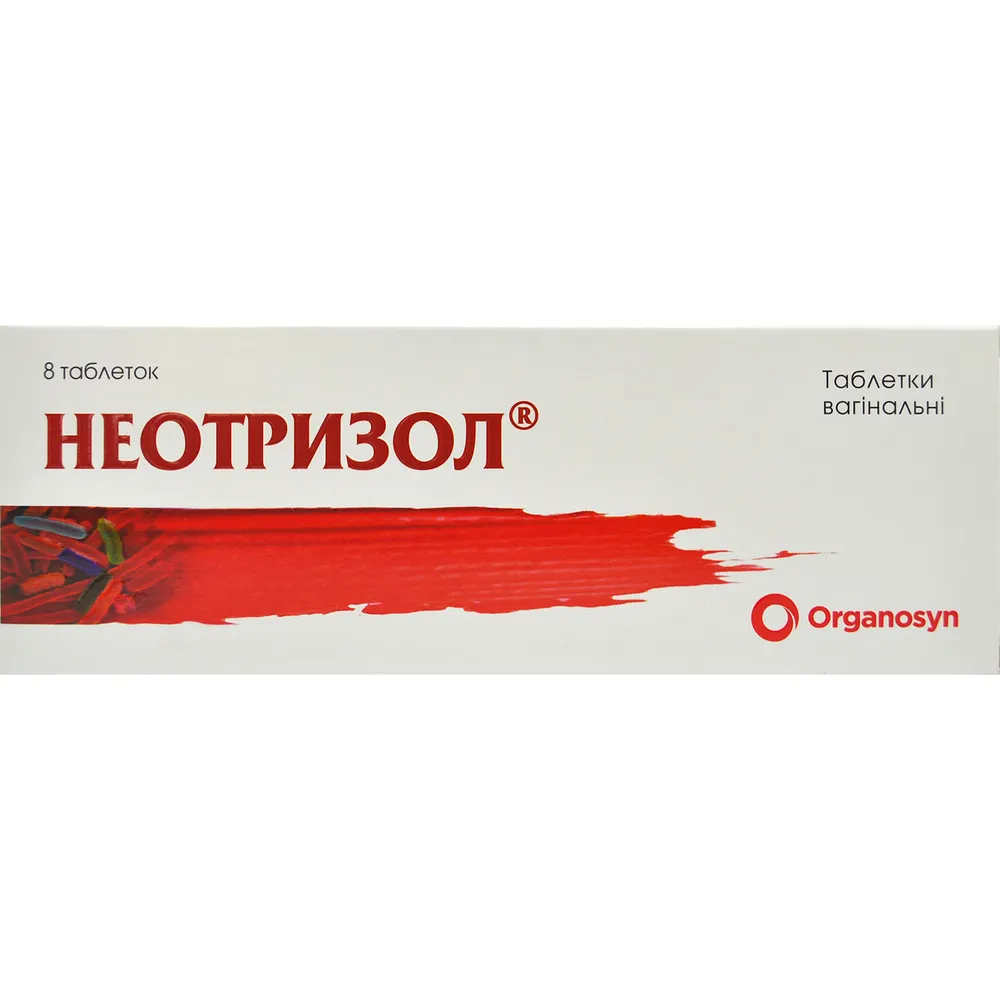
Table of Contents
INSTRUCTIONS FOR MEDICAL USE OF THE MEDICINAL PRODUCT NEOTRIZOLE® (NEOTRIZOLE®)
Composition:
Active substances: ornidazole, neomycin, miconazole, prednisolone;
1 vaginal tablet contains ornidazole 500 mg, neomycin sulfate 100 mg (equivalent to activity of 68,000 IU), miconazole nitrate 100 mg, prednisolone 3 mg;
Excipients: lactose monohydrate, povidone K-30, corn starch, talc, colloidal anhydrous silicon dioxide, sodium starch glycolate (type A), magnesium stearate, sodium croscarmellose.
Pharmaceutical form. Vaginal tablets.
Main physicochemical properties: elongated, biconvex, uncoated tablets, white to almost white on one side and almost white or yellowish-white on the opposite side, with a rounded end on one side and a flat end on the other.
Pharmacotherapeutic group.
Antimicrobial/antiseptic agents in combination with corticosteroids. Imidazole derivatives and corticosteroids. ATC code G01BF.
Pharmacological properties.
Pharmacodynamics.
Ornidazole. The mechanism of action of ornidazole is associated with disruption of DNA structure in susceptible microorganisms. The drug easily penetrates into microbial cells and, by binding to DNA, interferes with the replication process. Ornidazole is active against Trichomonas vaginalis, Entamoeba histolytica, Giardia lamblia (Giardia intestinalis), as well as certain anaerobic bacteria such as Bacteroides and Clostridium spp., Fusobacterium spp., and anaerobic cocci.
Metronidazole. Metronidazole is an antifungal agent intended for local treatment of vulvovaginal candidiasis (moniliasis) and is active only against Candida vulvovaginitis.
Neomycin. Neomycin is an antibiotic belonging to the aminoglycoside group. Aminoglycosides have high activity against gram-negative bacteria and are also effective against gram-positive bacteria. It penetrates bacterial cell structures by inducing the production of abnormal proteins. These proteins block the synthesis of proteins essential for bacterial survival.
Prednisolone. Prednisolone is a synthetic corticosteroid used to reduce inflammatory symptoms. Prednisolone suppresses the secretion and release of inflammatory mediators and inhibits proliferative processes in inflammatory conditions, thereby reducing the likelihood of scar formation.
Pharmacokinetics.
Despite local administration of the drug, systemic absorption is possible, especially during vaginal inflammation. Systemic effects of the components are not expected, but potential minor systemic absorption should be considered.
The concentration of ornidazole in vaginal tissues significantly exceeds the concentration achieved with oral or intravenous administration.
Systemic absorption of metronidazole following local application is limited. It exhibits selective toxicity against yeast-like fungi of the genus Candida.
Neomycin is poorly absorbed into the body through intact skin. It penetrates bacterial cell structures by inducing the production of abnormal proteins. These proteins block the synthesis of proteins essential for bacterial survival.
Prednisolone reduces manifestations of inflammatory symptoms, including hyperemia.
Clinical characteristics.
Indications.
- Treatment of combined gynecological disorders, particularly bacterial vaginosis and vaginitis (caused by Candida albicans), mixed infections (caused by trichomonads, anaerobic infection, including Gardnerella and yeast-like fungi).
- Prevention of gynecological disorders prior to surgical treatment.
- Vaginal sanitation: before childbirth or abortion, before and after insertion of intrauterine contraceptives, before and after diathermocoagulation of cervical erosions, before intrauterine examinations.
Contraindications.
- Hypersensitivity to the active substances, to other imidazole derivatives, or to any of the excipients of the drug.
- Systemic and local infectious diseases until specific therapy has been initiated.
Interaction with other medicinal products and other forms of interaction.
Clinically significant interactions of the drug with other medicinal products have not been identified. However, possible systemic absorption of the drug should be considered, especially in the presence of inflammation.
Interactions related to prednisolone
Undesirable combinations:
- with acetylsalicylic acid: increased risk of bleeding when used concomitantly with anti-inflammatory doses of acetylsalicylic acid (≥ 1 g per dose or ≥ 3 g per day).
Combinations requiring cautious use:
- with anticonvulsants and enzyme-inducing agents: reduced plasma concentration and efficacy of corticosteroids due to enhanced hepatic metabolism. The consequences of this interaction are particularly severe (or significant) in patients with Addison's disease treated with hydrocortisone and in organ transplantation. Clinical and laboratory monitoring is required, along with dose adjustment of corticosteroids during and after treatment with enzyme-inducing agents;
- with isoniazid: reduced plasma concentration of isoniazid due to enhanced hepatic metabolism and reduced hepatic metabolism of glucocorticosteroids;
- with rifampicin: reduced plasma concentration and efficacy of corticosteroids due to enhanced hepatic metabolism following interaction with rifampicin. The consequences of this interaction are particularly severe (or significant) in patients with Addison's disease treated with hydrocortisone and in organ transplantation. Clinical and laboratory monitoring is required, along with dose adjustment of corticosteroids during and after treatment with rifampicin;
- with other hypokalemic drugs: increased risk of hypokalemia. Serum potassium levels should be monitored and corrected if necessary;
- with digitalis preparations: hypokalemia exacerbates the toxic effects of digitalis preparations. Assess for presence of hypokalemia, determine serum potassium levels, and perform electrocardiography before initiating treatment;
- with medicinal products that may cause torsades de pointes: increased risk of ventricular arrhythmia, including polymorphic ventricular tachycardia of the torsades de pointes type. Before initiating treatment, assess for presence of hypokalemia, determine serum potassium levels, and perform electrocardiography.
Combinations requiring attention:
- with cyclosporine: enhanced effects of prednisolone, including Cushingoid symptoms, reduced carbohydrate tolerance (reduced prednisolone clearance);
- with acetylsalicylic acid: increased risk of bleeding with antipyretic or analgesic doses ≥ 500 mg per dose or < 3 g per day;
- with nonsteroidal anti-inflammatory drugs: increased risk of peptic ulceration and gastrointestinal bleeding;
- with fluoroquinolones: possible increased risk of tendinitis or even tendon rupture (rare), particularly in patients receiving prolonged corticosteroid therapy.
Special precautions for use.
Simultaneous treatment of the sexual partner is necessary to prevent the risk of reinfection.
The drug should be used with caution under constant medical supervision by specialists in patients who are concurrently using systemic corticosteroids, and in patients with osteoporosis, arterial hypertension, heart failure, existing or previously documented serious emotional disorders, tuberculosis, diabetes mellitus, glaucoma, corticosteroid-induced myopathy, hepatic insufficiency, epilepsy, peptic ulcer, hypothyroidism, or recent myocardial infarction.
The drug should be used with caution in patients with severe pseudoparalytic myasthenia gravis, ulcerative colitis, diverticulitis, and fresh intestinal anastomoses.
Despite topical administration, systemic absorption is possible, especially in the presence of vaginal inflammation.
Despite topical use, minor absorption of various components may occur (see "Adverse reactions").
Increased sensitivity following local application may indicate contraindication to the use of these or related antibiotics.
Adverse reactions can be minimized by using the drug for the shortest duration of treatment and under constant medical supervision.
Neotrizol® may damage latex contraceptives and reduce the effectiveness of locally applied contraceptives; therefore, during treatment with this drug, sexual intercourse should be avoided and local contraceptives (diaphragms, latex condoms, spermicides) should not be used.
Patients should use individual personal hygiene items (sponge, towel, etc.), wear underwear made of natural cotton, and use sanitary pads instead of tampons.
Precautions for use.
The duration of treatment should be limited to reduce the risk of development of resistant microorganisms or superinfection caused by such microorganisms.
The drug contains lactose; therefore, Neotrizol® should not be used in patients with rare hereditary forms of galactose intolerance, lactase deficiency, or glucose-galactose malabsorption syndrome.
Use during pregnancy or breastfeeding.
The medicinal product is contraindicated during the first trimester of pregnancy. When deciding whether to use the medicinal product during the second and third trimesters of pregnancy, the physician should weigh the benefit-risk ratio. When deciding whether to use the medicinal product during breastfeeding, the physician should weigh the benefit-risk ratio.
Since corticosteroids may pass into breast milk in small amounts, possible signs of adrenal suppression should be monitored. When using the medicinal product as part of combination therapy with oral ornidazole, breastfeeding should be discontinued.
Ability to influence reaction rate while driving or operating machinery.
No data available.
Method of Administration and Dosage
Insert 1 tablet deeply into the vagina each night. After insertion, lie down for at least 15 minutes. Do not interrupt treatment during menstruation. Continue using the tablets even after all symptoms of the disease have disappeared.
The average duration of treatment and prevention with the drug is 8 days. If symptoms persist after an 8-day course of therapy, treatment should be repeated.
Insertion Procedure
Place the vaginal tablet into the applicator.
Immerse the applicator with the tablet in warm (30–40 °C) boiled water for several seconds.
Carefully insert the applicator with the tablet as deeply as possible into the vagina (preferably while lying on your back).
Leave the tablet in the vagina by expelling it from the applicator, then wash the applicator with warm soapy water, rinse, and dry thoroughly.
Children
The drug is not intended for use in children.
Overdose
Due to the local action of the drug, overdose has not been observed; however, an increase in the manifestations of adverse reactions is possible. Treatment is symptomatic.
Adverse Reactions
With topical application, slight absorption of the drug components may occur, potentially leading to systemic effects.
Immune system disorders: Hypersensitivity, allergic reactions including allergic dermatitis, allergic stomatitis, pruritus, rash, urticaria.
If hypersensitivity reactions or irritation occur, the use of the drug should be discontinued.
Nervous system disorders: Headache.
Skin and subcutaneous tissue disorders: Delayed healing of wounds and fissures.
Reproductive system and breast disorders: Application site reactions including irritation, pruritus, spasms, burning, pain, erosions, mucosal atrophy, vaginal swelling, vulvovaginal erythema, vulvovaginal pain, vulvovaginal pruritus.
Reporting of adverse reactions after drug registration is of great importance. It enables continuous monitoring of the benefit-risk balance of the medicinal product. Healthcare and pharmacy professionals, as well as patients or their legal representatives, are encouraged to report all suspected adverse reactions and lack of efficacy via the automated pharmacovigilance information system at the following link: https://aisf.dec.gov.ua
Shelf life. 3 years.
Storage conditions.
Store in the original packaging, out of reach of children, at a temperature not exceeding 25 °C.
Packaging.
4 tablets per strip; 2 strips per cardboard box, supplied with an applicator.
8 tablets in a blister; 1 blister per cardboard box, supplied with an applicator.
Prescription status. Prescription only.
Manufacturer.
Evertogen Life Sciences Limited.
Manufacturer's address and location of business activity:
Plot No: S-8, S-9, S-13/P & S-14/P TSIIC, Pharma SEZ, Green Industrial Park, Polepally (V), Jadcherla (M), Mahabubnagar, Telangana, IN-509 301, India.