Neosinus
Ukraine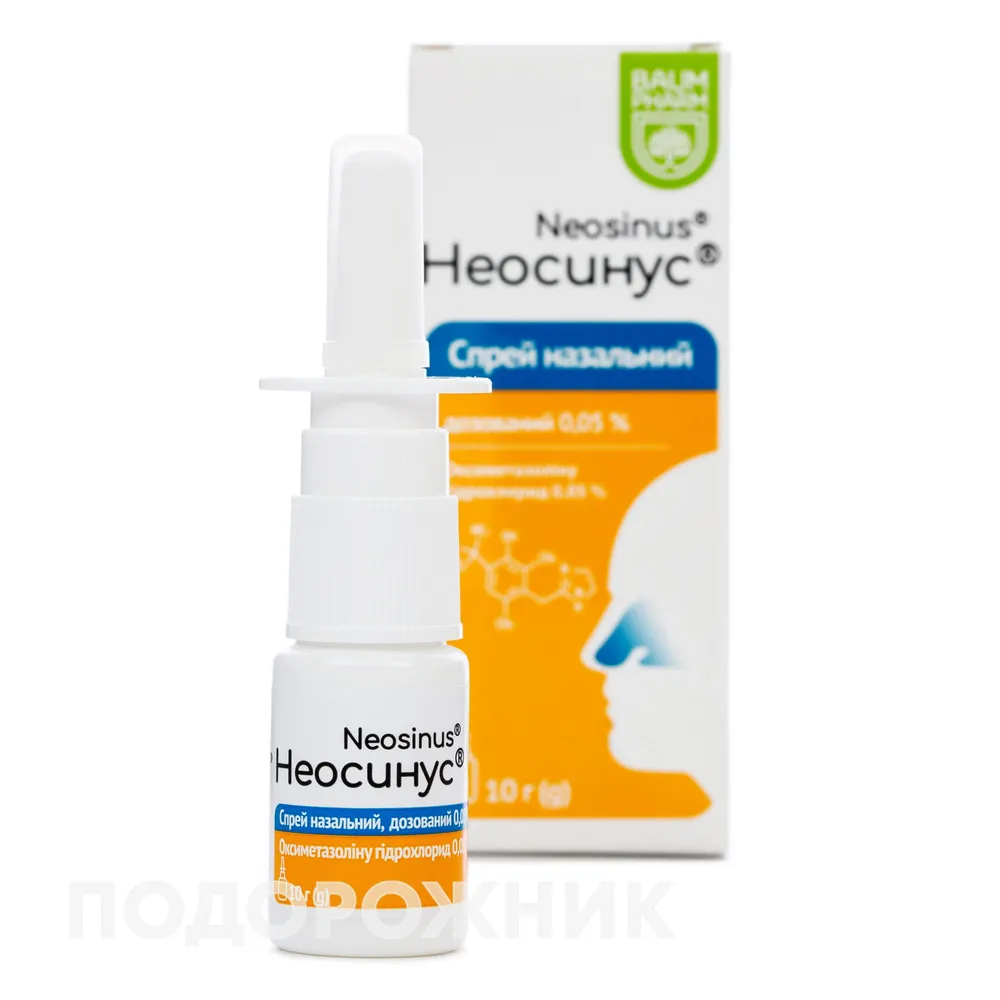
Table of Contents
INSTRUCTIONS FOR MEDICAL USE OF THE MEDICINAL PRODUCT NEOSINUS® NEOSINUS®
Composition:
Active substance: oxymetazoline hydrochloride; 100 g of the preparation contains 0.05 g of oxymetazoline hydrochloride calculated as 100 % substance;
Excipients: benzalkonium chloride, polyethylene glycol, disodium edetate, povidone, sodium hydrogen phosphate dodecahydrate, potassium dihydrogen phosphate, propylene glycol, purified water.
Pharmaceutical form. Nasal spray, metered.
Main physicochemical properties: the medicinal product is dispensed as an aerosol jet consisting of fine liquid droplets dispersed in air.
Pharmacotherapeutic group.
Decongestants and other agents for topical use in nasal cavity disorders. Sympathomimetics, simple preparations. Oxymetazoline.
ATC code R01A A05.
Pharmacological properties.
Pharmacodynamics.
Neo-Synus® belongs to the group of local vasoconstrictors (decongestants). Oxymetazoline hydrochloride is a synthetic adrenomimetic agent exerting alpha-adrenomimetic action.
The medication rapidly relieves symptoms of rhinitis of any origin. Oxymetazoline hydrochloride, the active ingredient of the medicinal product, produces a local vasoconstrictive effect: it quickly reduces swelling of the nasal mucosa, restores nasal breathing, and alleviates olfactory dysfunction. It does not impair mucociliary clearance and promotes rapid restoration of protective properties of the nasal mucosa and nasal passages.
Pharmacokinetics.
The effect of the medicinal product begins rapidly (within a few minutes after administration). The duration of action is up to 12 hours.
Clinical characteristics.
Indications.
For the treatment of acute rhinitis (nasal congestion) of any origin: infectious, viral, vasomotor, or allergic (pollinosis); as part of combination therapy for sinusitis, eustachitis, and otitis media.
To facilitate nasal endoscopy and surgical procedures within the nasal cavity.
Contraindications.
Hypersensitivity to oxymetazoline, other adrenergic agents, or any of the excipients of the medicinal product.
Atrophic rhinitis.
Concomitant use with monoamine oxidase inhibitors (MAOIs) or within 2 weeks after discontinuation of MAOI therapy, as well as concomitant use with other agents that increase blood pressure.
Elevated intraocular pressure, particularly in closed-angle glaucoma.
Severe cardiovascular disorders (e.g., ischemic heart disease, arterial hypertension).
Marked atherosclerosis, cardiac arrhythmias (e.g., tachycardia).
Renal insufficiency.
Pheochromocytoma.
Metabolic disorders (hyperthyroidism, thyrotoxicosis, diabetes mellitus).
Prostatic hypertrophy.
Should not be used after transsphenoidal hypophysectomy or other surgical interventions involving opening of the dura mater.
Skin inflammation or injury around the nasal passages or nasal mucosa.
Interaction with other medicinal products and other forms of interaction.
If using other medications prior to starting treatment with Neosinus**®**, it is recommended to consult a physician.
Neosinus**®** should be used together with other vasoconstrictive agents (regardless of the route of administration) or with other nasal decongestants, as well as tricyclic antidepressants and maprotiline, only after consultation with a physician due to the potential for increased blood pressure. The medicinal product slows the absorption of local anesthetics and prolongs their effect. It enhances the central nervous system effects of MAO inhibitors. Due to the risk of increased blood pressure, MAO inhibitors, tricyclic antidepressants, and other agents causing elevated blood pressure and arrhythmias should not be used concomitantly with Neosinus®.
Oxymetazoline may reduce the effectiveness of β-blockers, methyldopa, or other antihypertensive agents.
Concomitant use of sympathomimetic agents and antiparkinsonian drugs may result in additive toxic effects on the cardiovascular system.
Special precautions for use.
When spraying into the nasal cavity, do not tilt the head back or invert the bottle. It is not recommended to use one bottle for several individuals in order to avoid the spread of infection.
Persistent nasal congestion after the third day of treatment may indicate the presence of nasal septum deviation, purulent sinusitis, adenoids, allergic rhinitis, persistent bacterial infection, or other undiagnosed conditions requiring medical consultation and specialized comprehensive therapy.
Medical advice should be sought before starting treatment with this medicinal product in the following cases: elevated arterial pressure, cardiovascular diseases, hepatic or renal impairment, porphyria.
Prolonged use and overdosing of the product should be avoided. Long-term use of nasal decongestants may lead to reduced efficacy. Misuse of this product may cause atrophy of the mucous membrane and reactive hyperemia with drug-induced rhinitis, as well as damage to the mucosal epithelium and inhibition of epithelial activity.
Concomitant use of Neosinus**®** and other intranasal medicinal products is not recommended.
Special monitoring is required after administration in patients with chronic rhinitis and when nasal congestion has been relieved prior to diagnostic procedures. Doses higher than recommended should only be administered under medical supervision.
Do not exceed the recommended dosage.
The preservative (benzalkonium chloride) contained in the medicinal product may cause nasal mucosal swelling, especially with prolonged use. If such a reaction is suspected (chronic nasal congestion), another intranasal medicinal product without preservatives should be used. If a preservative-free nasal preparation is unavailable, an alternative dosage form should be used.
Propylene glycol may cause skin irritation.
Use during pregnancy or breastfeeding.
Oxymetazoline has not been associated with adverse pregnancy outcomes. It should be used with caution in patients with hypertension or signs of reduced placental perfusion. Frequent or prolonged use of high doses may lead to reduced placental blood flow. The use of this medicinal product in pregnant women is possible only if, in the physician’s opinion, the benefit to the mother outweighs the potential risk to the fetus/child.
It is unknown whether oxymetazoline is excreted in breast milk. Due to the lack of data, oxymetazoline should not be used during breastfeeding.
Effect on ability to drive or operate machinery.
Oxymetazoline has no effect or a negligible effect on the ability to drive or operate machinery. However, with prolonged use of doses exceeding the recommended levels, a systemic effect on the cardiovascular system cannot be ruled out. As a result, the ability to drive or operate machinery may be impaired.
Method of Administration and Dosage
- Remove the protective cap. Before the first use of the medicinal product, press the spray pump several times until a fine mist appears.
- Insert the spray nozzle into the nostril and administer a spray by firmly pressing the nozzle with the index and middle fingers.
- Administer the required number of sprays (see below) into each nostril; there is no need to tilt the head backward.
- During administration, it is recommended to gently inhale through the nose, which will facilitate optimal distribution of the aerosol within the nasal cavity.
- After use, cover the spray nozzle with the protective cap.
For adults, administer 1–2 sprays; for children aged 6 years and older, administer 1 spray into each nostril. The interval between administrations should be at least 10–12 hours. The treatment course should not exceed 3–5 days. Do not use doses exceeding those recommended.
Children.
The medicinal product should not be used in children under 6 years of age.
Overdose.
With topical application, systemic adverse reactions usually do not occur. Overdose may occur after nasal or accidental oral administration.
Symptoms of oxymetazoline overdose vary. Stages of hyperactivity and depression of the central nervous, cardiovascular, and respiratory systems may occur. Central nervous system stimulation manifests as anxiety, agitation, hallucinations, and seizures.
Depression of central nervous system function manifests as decreased body temperature, lethargy, drowsiness, bradycardia, arterial hypotension, collapse, shock, respiratory disturbances, respiratory arrest, loss of consciousness, and coma.
Other symptoms may include miosis, mydriasis, fever, increased sweating, pallor, cyanosis, palpitations, tachycardia, bradycardia, cardiac arrhythmia, cardiac arrest, arterial hypertension, shock hypotension, nausea and vomiting, respiratory depression, apnea, and psychogenic disorders.
In children, overdose often leads to predominant central nervous effects, including seizures and coma, hallucinations, bradycardia, apnea, and arterial hypertension, followed by hypotension.
Emergency Treatment. If oxymetazoline overdose is suspected, immediate hospitalization to an intensive care unit is required. Activated charcoal and laxatives should be administered. Gastric lavage is necessary. To reduce elevated arterial pressure, α-adrenergic blockers (phentolamine) should be administered. Vasopressor agents should not be used. Anticonvulsant therapy may be required. In severe cases, endotracheal intubation and artificial ventilation of the lungs may be necessary.
Side effects.
With frequent and prolonged use, sensations of burning, tingling in the nose, facial flushing, sneezing, and dryness of the nasal mucosa may occur. Rarely, after the effect of the medicinal product has worn off, a feeling of severe nasal congestion may occur (rebound hyperemia). Prolonged continuous use of vasoconstrictive agents may lead to tachyphylaxis or the development of drug-induced rhinitis. In newborns and infants, apnea may occur (especially in cases of overdose). Generally, severe adverse effects are not expected.
Cardiovascular disorders. Very rarely possible tachycardia, palpitations (sensation of rapid heartbeat), increased blood pressure, chest pain, arrhythmias.
Eye disorders. Rarely, eye irritation, discomfort, or redness of the eyes, blurred vision may occur.
Gastrointestinal disorders. Rarely, nausea may occur.
Immune system disorders. In isolated cases, hypersensitivity reactions may occur, including rash, itching, angioedema (Quincke's edema).
Respiratory, thoracic and mediastinal disorders. Rarely, discomfort or irritation in the nose, mouth, and throat, nasal bleeding, rebound effect (rebound congestion), increased swelling of the mucous membrane may occur.
Nervous system disorders. Restlessness, nervousness, anxiety, insomnia, drowsiness, tremor, hallucinations (especially in children), increased fatigue, sedative effect, headache, dizziness.
Skin and subcutaneous tissue disorders. Rash.
Skeletal muscle and connective tissue disorders. Seizures (especially in children).
General disorders. Weakness.
Reporting of adverse reactions after drug registration is of great importance. It allows continuous monitoring of the benefit-risk balance of the medicinal product. Healthcare and pharmaceutical professionals, as well as patients or their legal representatives, should report all suspected adverse reactions and lack of drug efficacy through the Automated Information System for Pharmacovigilance at the following link: https://aisf.dec.gov.ua/.
Shelf life.
3 years.
Storage conditions.
Store in the original packaging at a temperature not exceeding 25 °C. Keep out of reach of children.
Packaging.
10 g in a bottle with a spray dispenser. 1 bottle per carton.
Availability.
Over-the-counter.
Manufacturer.
"Micropharm" Limited Liability Company.
Manufacturer's location and address of business activity.
20 Shevchenka Street, Kharkiv, Kharkiv Oblast, 61013, Ukraine.
Marketing Authorization Holder.
LLC "VALARTIN PHARMA".
Address of the Marketing Authorization Holder.
60 Hrushevskoho Street, Chayky, Kyiv-Sviatoshyn District, Kyiv Oblast, 08135, Ukraine.