Nephrotec
Ukraine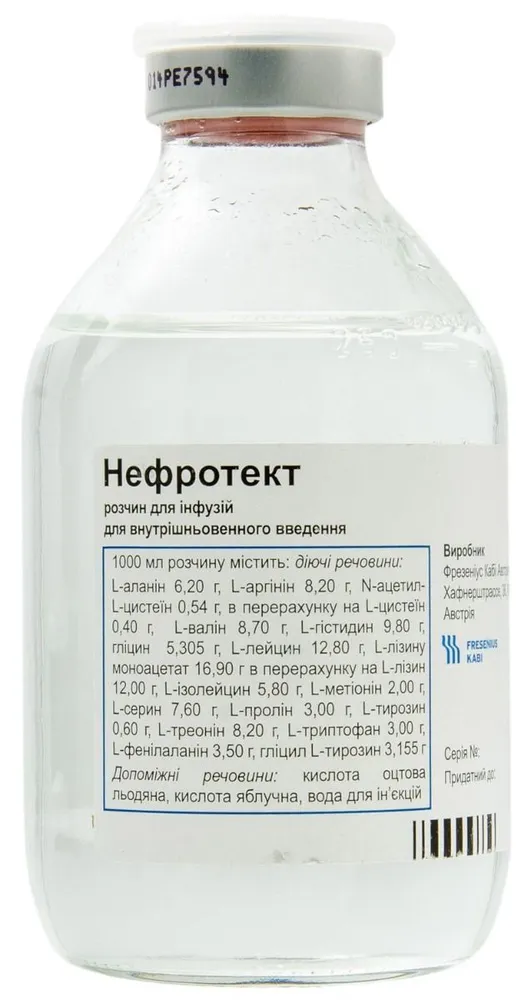
Table of Contents
INSTRUCTIONS FOR MEDICAL USE OF THE MEDICINAL PRODUCT NEPHROTECT (NEPHROTECT)
Composition:
Active substances: 1000 ml of solution contains
L-isoleucine 5.80 g,
L-leucine 12.80 g,
L-lysine monacetate 16.90 g,
equivalent to L-lysine 12.00 g,
L-methionine 2.00 g,
L-phenylalanine 3.50 g,
L-threonine 8.20 g,
L-tryptophan 3.00 g,
L-valine 8.70 g,
L-arginine 8.20 g,
L-histidine 9.80 g,
L-alanine 6.20 g,
N-acetyl-L-cysteine 0.54 g,
equivalent to L-cysteine 0.40 g,
glycine 5.305 g,
L-proline 3.00 g,
L-serine 7.60 g,
L-tyrosine 0.60 g,
glycyl-L-tyrosine 3.155 g;
Excipients: glacial acetic acid, malic acid, water for injections.
Total amount of amino acids: 100.0 g/L.
Total nitrogen: 16.3 g/L.
Total energy value: 1600 kJ/L (= 400 kcal/L).
Titratable acidity: 60 mmol NaOH/L.
Osmolarity: 960 mOsmol/L.
Pharmaceutical form. Infusion solution.
Main physicochemical properties: clear solution, colorless to pale yellow.
Pharmacotherapeutic group. Parenteral nutrition solutions. Amino acids.
ATC code B05BA01.
Pharmacological properties.
Pharmacodynamics.
Nephrotekt is an amino acid solution required for protein synthesis in parenteral nutrition of patients with renal insufficiency. The bioavailability of Nephrotekt following intravenous administration is 100%. The amino acid solution is intended for patients with impaired renal function.
Pharmacokinetics.
Since tyrosine has poor water solubility, yet is an essential amino acid in patients with impaired renal function, the dipeptide glycyl-L-tyrosine has been included in Nephrotekt as an additional source of L-tyrosine. After administration, this dipeptide is rapidly metabolized (half-life ~ approximately 5 minutes), and its constituent components are released even in patients with renal insufficiency. The released amino acids accumulate together with other amino acids and are utilized in the body for protein synthesis.
Clinical characteristics.
Indications.
For parenteral nutrition of patients when oral or enteral nutrition is impossible, inadequate, or contraindicated; in patients with renal function disorders, patients with acute and chronic renal failure, including patients undergoing dialysis, including during the dialysis procedure itself.
Contraindications.
- Hypersensitivity to any component of the medicinal product;
- inherited disorders of amino acid metabolism;
- severe renal failure without access to hemofiltration or dialysis;
- acute stage of shock.
General contraindications for infusion therapy: acute pulmonary edema, hyperhydration, decompensated heart failure, and hypotonic dehydration. Severe hepatic insufficiency.
Special safety precautions.
The medicinal product should be administered with caution in patients with hyponatremia or increased plasma osmolarity.
During therapy, fluid balance, serum electrolyte levels, acid-base balance, urea levels, and ammonia levels must be monitored.
In cases of hypotonic dehydration, fluid and electrolytes should be provided to the body prior to initiating parenteral nutrition.
Administration of any amino acid solutions may provoke acute folate deficiency; therefore, patients should receive daily supplementation with folic acid.
Caution should be exercised when infusing large volumes of fluid in patients with heart failure.
Individual dose determination is required in cases of adrenal insufficiency and in hepatic, renal, cardiac, or pulmonary insufficiency.
Careful clinical and laboratory monitoring during the use of the medicinal product is recommended in patients with the following conditions: hepatic insufficiency; risk of development or worsening of pre-existing neurological disorders associated with hyperammonemia; renal insufficiency, particularly in the presence of hyperkalemia; presence of risk factors favoring the development or worsening of metabolic acidosis; and azotemia due to impaired renal clearance. During prolonged use of the medicinal product (several weeks), blood parameters and coagulation factors should be closely monitored.
Interaction with other medicinal products and other forms of interaction.
Currently unknown.
Special precautions for use.
When using the drug, the following recommendations should be observed:
- The drug should be used immediately after opening the vial;
- The drug is intended for single use only;
- Do not use the drug after its expiration date;
- Use the drug only from an intact container containing a clear solution free from foreign particles;
- Any unused solution remaining in the vial and all mixture left after infusion should be discarded;
- The drug may be mixed under sterile conditions with other parenteral nutrition agents such as fat emulsions, carbohydrates, and electrolytes.
Any peripheral vein infusion may cause irritation of the vessel wall and thrombophlebitis. Therefore, daily inspection of the catheter insertion site is recommended. If the patient is also receiving fat emulsion, it should be administered simultaneously with Nephrotect whenever possible to reduce the risk of phlebitis.
The choice of catheter placement site (central or peripheral vein) depends on the final osmolarity of the mixture: for infusion into a peripheral vein, the osmolarity limit is 800–900 mOsmol/L. The patient's age, clinical condition, and status of peripheral veins should also be taken into account.
Strict aseptic techniques must be followed, especially during central venous catheter placement.
Use during pregnancy or breastfeeding.
Specific studies to determine the safety of Nephrotect during pregnancy or breastfeeding have not been conducted. Before prescribing Nephrotect to pregnant women or women who are breastfeeding, the benefit-risk ratio should be carefully evaluated.
Ability to affect reaction rate when driving or operating machinery.
The drug is intended for use only in a hospital setting.
Administration and Dosage
NephroTect is intended for intravenous administration. Dosage should be individually adjusted.
If not otherwise prescribed, the following doses should be administered to patients with acute and chronic renal failure:
- For patients not undergoing dialysis:
0.6–0.8 g of amino acids per kg of body weight per day, corresponding to 6–8 mL per kg of body weight per day;
- For patients undergoing dialysis:
0.8–1.2 g of amino acids per kg of body weight per day, corresponding to 8–12 mL per kg of body weight per day;
- For parenteral nutrition during prolonged hemodialysis procedures:
0.5–0.8 g of amino acids per kg of body weight per dialysis session, corresponding to 5–8 mL per kg of body weight per dialysis session.
Maximum recommended daily dose:
0.8–1.2 g of amino acids per kg of body weight, corresponding to 8–12 mL per kg of body weight, or 560–840 mL per day for patients weighing 70 kg.
Maximum recommended infusion rate:
- For parenteral nutrition:
0.1 g of amino acids per kg of body weight per hour, corresponding to 1 mL per kg of body weight per hour;
- For parenteral nutrition during hemodialysis procedures:
0.2 g of amino acids per kg of body weight per hour, corresponding to 2 mL per kg of body weight per hour.
In general, amino acids should be administered in combination with infusion solutions providing energy sources during parenteral nutrition. For total parenteral nutrition, NephroTect should be used in combination with electrolytes, energy sources, vitamins, and trace elements. NephroTect, together with other nutrients, may be administered via central or peripheral veins.
NephroTect may be administered through a separate infusion system or may be mixed under aseptic conditions with other solutions.
When used during dialysis procedures, NephroTect may be directly infused into the injection port of the dialysis apparatus.
Amino acid solutions, including NephroTect, should generally be used in combination with carbohydrates and lipids. An exception is the use of amino acid supplementation during dialysis procedures, during which a glucose-containing dialysate may be used. The duration of treatment depends on the patient's clinical condition.
Children.
Currently, there is no clinical experience with the use of NephroTect in children.
Overdose.
Overdosage or too rapid administration of NephroTect may result in nausea, chills, vomiting, fever, hyperammonemia, hyperaminoacidemia, and acidosis; in some patients, increased renal excretion of amino acids may occur. In such cases, administration of the drug should be immediately discontinued. Treatment is symptomatic.
If signs of overdose occur, the infusion should be immediately stopped. Administration may be resumed later at a reduced dosage. Too rapid infusion may lead to fluid overload and electrolyte imbalance.
There is no specific antidote for overdose. Emergency treatment should be supportive and directed towards maintaining respiratory and cardiovascular functions. Close monitoring of biochemical parameters and appropriate management of any disturbances detected is essential.
Side effects.
No adverse reactions have been observed with proper use. Administration of the drug into a peripheral vein may cause irritation of the venous walls and thrombophlebitis.
In case of overdose, the following symptoms may occasionally occur: general weakness, headache, increased body temperature; tachycardia, palpitations; hypersensitivity reactions including rash, skin hyperemia, itching; bronchospasm, dyspnea, decreased arterial pressure up to shock; local reactions at the injection site; chills, nausea, vomiting, increased excretion of amino acids through the urinary tract. These symptoms disappear upon discontinuation of the drug administration.
Shelf life. 2 years.
Do not use after the expiry date.
Storage conditions.
Keep out of reach of children. Store at a temperature not exceeding 25 °C.
Do not freeze!
Incompatibility.
Only medicinal products intended for parenteral nutrition, such as electrolytes, energy carriers, trace elements, and vitamins, with documented compatibility, may be added to the drug Nephro-Tect.
Packaging.
Infusion solution in glass bottles of 250 ml or 500 ml, pack of 10.
Prescription status. Prescription only.
Manufacturer. Fresenius Kabi Austria GmbH.
Manufacturer's name and address.
Hafnerstrasse, 36, 8055 Graz, Austria.
Marketing Authorization Holder.
Fresenius Kabi Deutschland GmbH.
Address of the Marketing Authorization Holder and/or its representative.
Else-Kröner-Strasse, 1, 61352 Bad Homburg, Germany.