Nazo-spray with aloe extract
Ukraine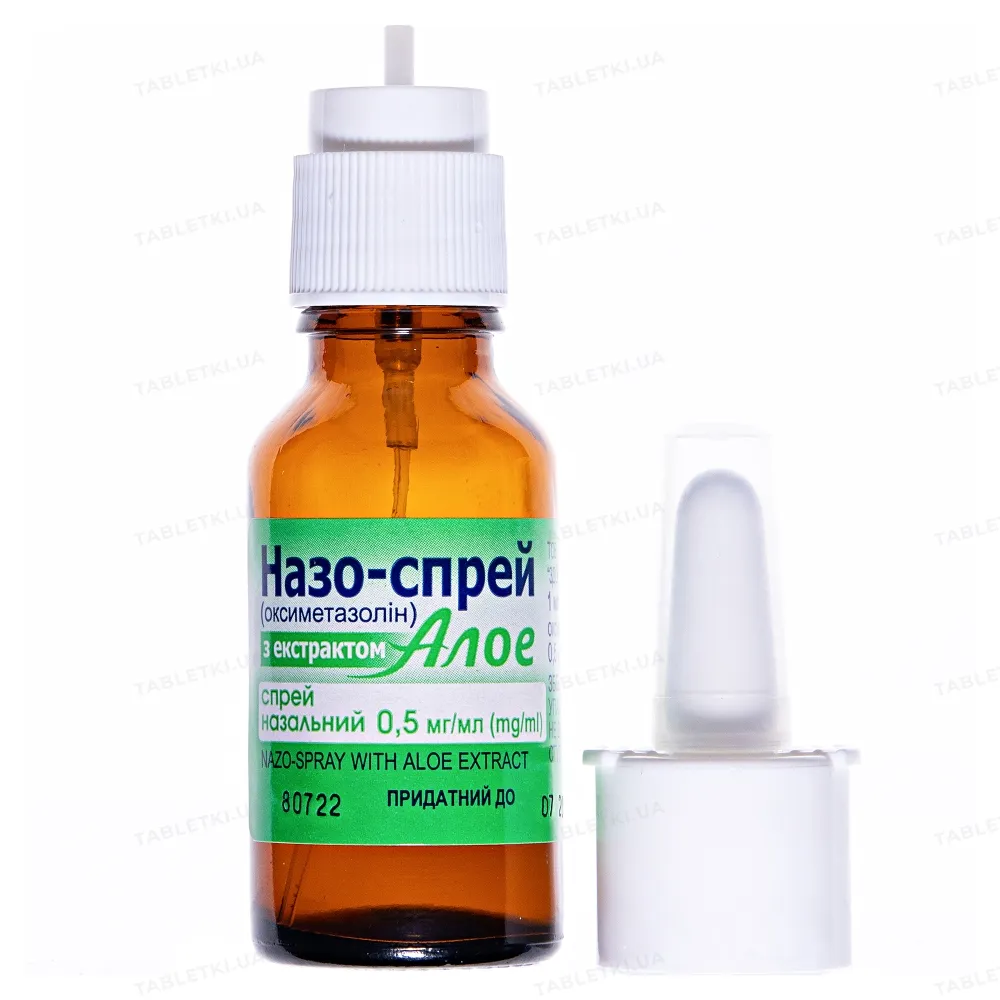
Instructions for Use
INSTRUCTIONS FOR MEDICAL USE OF THE MEDICINAL PRODUCT NARO-SPRAY WITH ALOE EXTRACT
Composition:
Active substance: oxymetazoline;
1 ml of the preparation contains 0.5 mg of oxymetazoline hydrochloride;
Excipients: sorbitol (E 420), sodium citrate, tyloxapol, chlorhexidine gluconate, anhydrous citric acid, benzalkonium chloride, potassium acesulfame, menthol, eucalyptol, disodium edetate, dry aloe extract, L-carvone, sodium hydroxide, purified water.
Pharmaceutical form. Nasal spray.
Main physicochemical properties: clear colorless or yellowish solution with a specific odor. Slight opalescence may occur during storage.
Pharmacotherapeutic group. Anti-edematous and other preparations for local use in nasal cavity disorders. Sympathomimetics, simple preparations. ATC code R01A A05.
Pharmacological Properties
Pharmacodynamics
The drug belongs to the group of local vasoconstrictive agents. Oxymetazoline exerts sympathomimetic and vasoconstrictive effects, reducing nasal mucosal edema. It constricts blood vessels at the site of application, decreases swelling of the nasal mucosa and upper respiratory tract, and reduces nasal discharge. It restores nasal breathing. Reduction of nasal mucosal swelling promotes restoration of ventilation in the paranasal sinuses and the middle ear cavity, thereby preventing the development of bacterial complications.
Oxymetazoline exhibits antiviral, anti-inflammatory, immunomodulatory, and antioxidant effects. Due to this combined mechanism of action, clinical studies have demonstrated faster and more effective relief of symptoms of acute rhinitis (nasal congestion, rhinorrhea, sneezing, and general malaise).
Duration of action of the drug is up to 12 hours.
Pharmacokinetics
When applied locally via the nasal route at therapeutic doses, the drug does not irritate the nasal mucosa or cause hyperemia. The elimination half-life is approximately 35 hours after administration. About 2.1% of the drug is excreted via the kidneys, and approximately 1.1% is excreted in feces.
Clinical characteristics.
Indications.
- Acute respiratory diseases accompanied by nasal congestion.
- Allergic rhinitis.
- Vasomotor rhinitis.
- For restoration of drainage and nasal breathing in diseases of the nasal sinus cavities, eustachitis.
- For relief of swelling prior to diagnostic procedures in the nasal passages.
Contraindications. Hypersensitivity to the components of the drug.
Atrophic rhinitis.
Inflammation or damage of the nasal mucosa or skin around the nostrils.
Use of monoamine oxidase inhibitors (MAOIs) and within 2 weeks after discontinuation of MAOI therapy, as well as other drugs that may increase blood pressure.
Elevated intraocular pressure, especially in closed-angle glaucoma.
Severe forms of cardiovascular diseases (e.g., ischemic heart disease, arterial hypertension).
Cardiac asthma.
Pheochromocytoma.
Metabolic disorders (hyperthyroidism, diabetes mellitus, porphyria).
Prostate hypertrophy.
After transsphenoidal hypophysectomy or other surgical interventions involving exposure of the dura mater.
Interaction with other medicinal products and other types of interactions. Do not use MAO inhibitors and other drugs that increase blood pressure due to the risk of elevated blood pressure. Concomitant use of other vasoconstrictive medicinal products increases the risk of adverse effects.
It is known that this medicinal product interacts with tricyclic antidepressants, which may manifest as an increased risk of arterial hypertension and arrhythmia.
The drug should be used with caution in patients receiving bromocriptine, as cardiovascular disorders may occur.
It may reduce the effect of β-blockers or other antihypertensive drugs, such as methyldopa, betanidine, debrisoquin, and guanethidine.
Special precautions for use
Prolonged use and overdosing of the medication should be avoided. Long-term use of a nasal decongestant may lead to reduced effectiveness of the drug. Misuse of this product may cause atrophic rhinitis, mucosal atrophy, and reactive hyperemia resulting in medication-induced rhinitis.
Special monitoring is required for patients with chronic rhinitis after administration of the drug. Doses exceeding the recommended amounts should be used only under medical supervision.
If symptoms worsen or no improvement occurs within 3 days, medical advice should be sought.
Benzalkonium chloride contained in the formulation may cause nasal mucosal swelling, particularly with prolonged use. If such a reaction is suspected (persistent nasal congestion), a preservative-free medicinal product should be used. If it is not possible to use a preservative-free formulation, consideration should be given to using another dosage form.
Use during pregnancy or breastfeeding. The medication should be used with particular caution during pregnancy or breastfeeding. Exceeding the recommended dosage is not permitted.
Ability to affect reaction speed when driving or operating machinery. After prolonged use of the drug in doses exceeding the recommended amounts, a systemic effect on the cardiovascular system cannot be excluded. In such cases, the ability to drive or operate machinery may be impaired.
Method of Administration and Dosage.
For adults and children aged 6 years and older: 1 spray into each nostril 2–3 times per day. Doses higher than recommended should be used only under medical supervision.
The product should not be used for longer than 5–7 days. Repeated use should be performed only after several days.
Children. The product should not be used in children under 6 years of age.
Overdose. After significant overdose or accidental ingestion, the following symptoms may occur: mydriasis, nausea, vomiting, cyanosis, elevated temperature, spasms, tachycardia, palpitations, arrhythmia, cardiovascular insufficiency, cardiac arrest, increased sweating, agitation, convulsions, arterial hypertension, pulmonary edema, respiratory disorders, pallor, miosis, hyposmia, and psychiatric disturbances.
In addition, central nervous system depression may occur, manifesting as drowsiness, decreased body temperature, bradycardia, arterial hypotension, apnea, and potential development of coma.
Treatment measures in case of overdose: gastric lavage, administration of activated charcoal, lung ventilation. In case of decreased arterial pressure, phentolamine should be administered. Vasopressor agents should not be used. Anticonvulsant therapy may be indicated if necessary.
Adverse reactions.
Respiratory system: nasal discomfort, burning or dryness of the nasal mucosa, sneezing; after the effect of oxymetazoline ends, a sensation of severe nasal congestion may occur (rebound hyperemia); epistaxis; apnea in young children (especially in case of overdose).
Nervous system: headache, insomnia, anxiety, drowsiness, restlessness, tremor, fatigue, sedative effect, irritability, seizures, hallucinations (especially in children).
Cardiovascular system: local nasal administration may cause systemic effects such as palpitations, tachycardia, arterial hypertension.
Immune system: allergic reactions are possible, including rash, itching, angioneurotic edema.
Shelf life. 2 years.
Storage conditions. Store in the original packaging at a temperature not exceeding 25 °C.
Keep out of reach of children.
Packaging. 15 ml or 20 ml in a bottle equipped with a pump valve, nasal spray nozzle, and protective cap, in a carton.
Availability. Over-the-counter.
Manufacturer. LIMITED LIABILITY COMPANY "CORPORATION "ZDOROVIYA".
Manufacturer's address and place of business. 22, Shevchenka Street, Kharkiv, Kharkiv Oblast, 61013, Ukraine.
Frequently Asked Questions
What is Nazo-spray with aloe extract indicated for?
The drug is used for acute respiratory diseases with nasal congestion, allergic and vasomotor rhinitis. It also helps restore breathing in diseases of the paranasal sinuses or Eustachian tube, as well as for reducing edema before medical procedures in the nose.
How should Nazo-spray with aloe extract be taken correctly?
Adults and children from 6 years of age should spray 1 dose into each nostril 2–3 times a day. It is important not to use the product for more than 5–7 consecutive days. The drug should not be used in children under 6 years of age.
What side effects may occur from using the drug?
Possible discomfort, burning, or dryness in the nose, sneezing, or nosebleeds. Headache, insomnia, anxiety, fatigue, palpitations, or increased blood pressure may also occur. In children, hallucinations or seizures are possible.
Who should not use this product?
The drug is contraindicated in cases of atrophic rhinitis, damage to the nasal mucosa, increased intraocular pressure (glaucoma), severe heart disease, diabetes, hyperthyroidism, prostatic hypertrophy, and certain other conditions specified in the instructions.
Can the drug be combined with other medicines?
It must not be used together with MAO inhibitors and other drugs that increase blood pressure. Interaction is also possible with tricyclic antidepressants, bromocriptine, and blood pressure medications (e.g., beta-blockers), as they may alter the effect of the product.
What should be done if symptoms do not disappear?
If nasal congestion does not resolve or if the condition worsens within 3 days, it is necessary to consult a physician.
Similar Medications
-
Nazalong® kids
Form: spray, nasal
Active substance Dosage oxymetazoline 0.25 mg/ml Manufacturer: LLC "Micropharm"
-
Nazivin® sensitive
Form: spray, nasal
Active substance Dosage oxymetazoline 0.25 mg/ml Manufacturer: P&G Health Austria GmbH & Co. OG (authorization for batch release)
-
Nazivin® sensitive
Form: spray, nasal
Active substance Dosage oxymetazoline 0.5 mg/ml Manufacturer: P&G Health Austria GmbH & Co. OG (authorization for batch release)
-
Nazo-spray
Form: spray, nasal
Active substance Dosage oxymetazoline 0.5 mg/ml Manufacturer: LLC "Research Plant "GNCLS" (quality control, batch release)
-
Nazol® advance
Form: spray, nasal
Active substance Dosage oxymetazoline 0.5 mg/ml Manufacturer: Istituto de Angelis S.r.l.
-
Nokspray pediatric
Form: spray, nasal
Active substance Dosage oxymetazoline 0.25 mg/ml Manufacturer: Joint Ukrainian-Spanish Enterprise "Sperko Ukraine"
-
Oxybris
Form: spray, nasal
Active substance Dosage oxymetazoline 0.5 mg/ml Manufacturer: Joint Ukrainian-Spanish Enterprise "Sperko Ukraine" (full production cycle, batch release; quality control)
-
Oxyfresh
Form: spray, nasal
Active substance Dosage oxymetazoline 0.5 mg/ml Manufacturer: Joint Ukrainian-Spanish Enterprise "Sperko Ukraine" (full production cycle, batch release; quality control)
-
Oxyspray
Form: spray, nasal
Active substance Dosage oxymetazoline 0.5 mg/ml Manufacturer: Joint Ukrainian-Spanish Enterprise "Sperko Ukraine" (full production cycle, batch release; quality control)
-
Rhinazolin®
Form: spray, nasal
Active substance Dosage oxymetazoline 0.5 mg/ml Manufacturer: Farmak JSC
-
Rint nasal spray® moisturizing
Form: spray, nasal
Active substance Dosage oxymetazoline 0.5 mg/ml Manufacturer: Farmak JSC
-
Rint nasal spray® with menthol
Form: spray, nasal
Active substance Dosage oxymetazoline 0.5 mg/ml Manufacturer: Farmak JSC
This page has been machine-translated and may contain inaccuracies. The original data is available in the manufacturing country's language.
Last data check: July 21, 2026 · Data source: Державний реєстр лікарських засобів України