Sodium adenosine triphosphate
Ukraine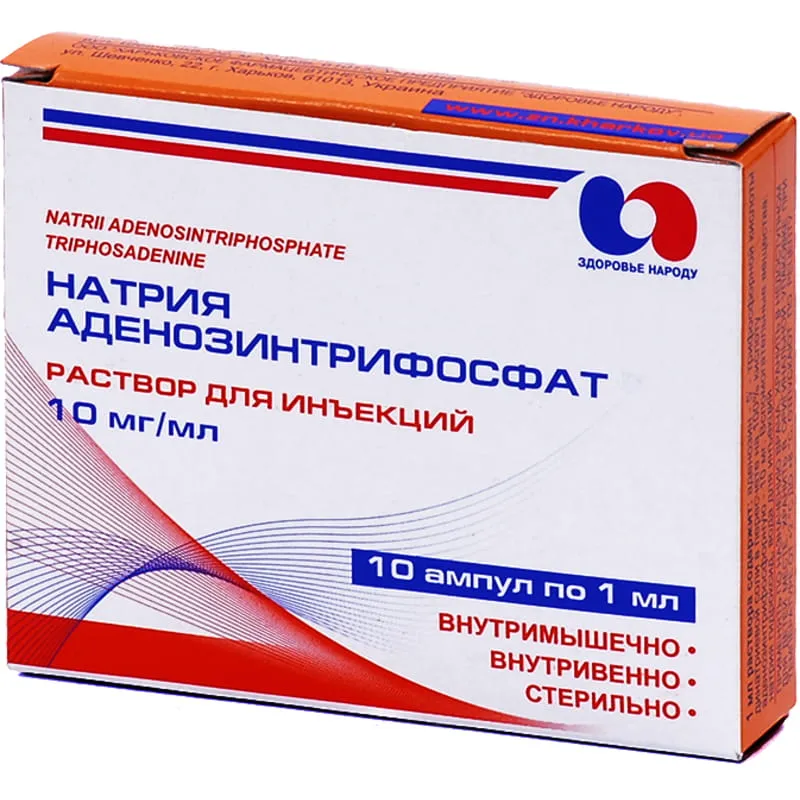
Table of Contents
INSTRUCTIONS for medical use of the medicinal product SODIUM ADENOSINE TRIPHOSPHATE (NATRII ADENOSINTRIPHOSPHATE)
Composition:
Active substance: adenosine;
1 ml of solution contains 10 mg of disodium adenosine-5'-triphosphate, calculated as 100 % adenosine triphosphoric acid;
Excipients: sodium hydroxide, water for injections.
Pharmaceutical form. Solution for injection.
Main physicochemical properties: clear colorless or slightly yellowish liquid.
Pharmacotherapeutic group.
Cardiological agents. ATC code C01EB10.
Pharmacological Properties.
Pharmacodynamics.
Sodium adenosine triphosphate – a salt of adenosine-5'-triphosphoric acid (ATP) – is a natural metabolite of the body that participates in many vital biochemical reactions. In interaction with the contractile protein actomyosin, ATP breaks down into adenosine diphosphoric acid and inorganic phosphate, releasing energy required for muscular activity and for many biosynthetic processes (protein, urea).
It promotes relaxation of smooth muscles, facilitates transmission of nerve impulses in autonomic adrenergic and cholinergic ganglia, and transmission of excitation from the vagus nerve to the heart. It exerts anti-ischemic, membrane-stabilizing, and antiarrhythmic effects, improves antioxidant protection of the myocardium, and enhances its contractile function.
Pharmacokinetics.
After parenteral administration, it penetrates into organ cells, where, interacting with the contractile protein actomyosin, ATP breaks down into adenosine diphosphoric acid and inorganic phosphate, releasing energy used by muscles for performing mechanical work and synthetic processes (protein, urea synthesis). Subsequently, the breakdown products are incorporated into ATP synthesis. The antiarrhythmic effect after intravenous administration occurs within 20–40 seconds.
Clinical characteristics.
Indications.
In complex therapy of muscular dystrophy and atrophy, for suppression of paroxysmal supraventricular tachycardias, in peripheral vascular spasms (Raynaud's disease, obliterating thromboangiitis). To be prescribed in peripheral, mixed and central forms of retinal pigmentary degeneration.
Contraindications.
Hypersensitivity to any component of the drug; cardiogenic shock and other types of shock; decompensated stage of heart failure, QT prolongation syndrome, acute myocardial infarction, hemorrhagic stroke, severe forms of bradyarrhythmias, II–III degree atrioventricular block; arterial hypotension; hyperkalemia, hypermagnesemia; lung diseases, chronic obstructive pulmonary diseases (e.g., bronchial asthma); pregnancy or lactation, childhood. Should not be administered simultaneously with cardiac glycosides in high doses.
Interaction with other medicinal products and other types of interactions.
When used concomitantly with potassium-sparing diuretics, potassium-containing agents, and angiotensin-converting enzyme (ACE) inhibitors, the risk of hyperkalemia increases; with magnesium-containing agents – the risk of hypermagnesemia.
The drug may enhance the antianginal effect of beta-adrenoblockers and nitrates.
When used concomitantly with dipyridamole, the effect of dipyridamole, particularly its vasodilatory effect, is enhanced.
Some antagonism may occur when the drug is used simultaneously with purine derivatives (caffeine and theophylline).
Concomitant administration with cardiac glycosides in high doses is contraindicated due to increased risk of adverse cardiovascular reactions.
When used concomitantly with xanthinol nicotinate, the effect of sodium adenosine triphosphate is reduced.
Carbamazepine may potentiate the effects of adenosine and lead to development of block.
Special precautions for use.
Intravenous administration of the drug should be performed only in a hospital setting under medical supervision and with monitoring of cardiac function.
Intravenous administration of the drug must be performed slowly, followed by measurement of arterial blood pressure.
Use with caution in marked bradycardia (except in severe forms of bradyarrhythmias), sick sinus syndrome, first-degree atrioventricular block, and predisposition to arterial hypotension.
During prolonged use, serum potassium and magnesium levels should be monitored. Use with caution in patients predisposed to bronchospasm. Limit consumption of products containing caffeine (coffee, tea, cola-containing beverages).
The drug must not be administered in high doses simultaneously with cardiac glycosides.
Use during pregnancy or breastfeeding.
Data on the use of the drug during pregnancy or breastfeeding are lacking.
Ability to affect reaction rate while driving or operating machinery.
During treatment, patients should refrain from driving or operating machinery that requires heightened attention.
Administration and Dosage
Administer intramuscularly or intravenously.
For the treatment of muscular dystrophies and peripheral circulation disorders, administer 1 mL once daily for the first 2–3 days, then 1 mL twice daily or 2 mL once daily in subsequent days. Treatment duration is 30–40 days. If necessary, repeat the course after an interval of 1–2 months.
For hereditary pigmentary retinal degeneration, administer 5 mL intramuscularly twice daily at 6–8 hour intervals daily for 15 days. If necessary, courses may be repeated every 8–12 months.
To suppress supraventricular tachyarrhythmias, administer 1–2 mL intravenously over 5–10 seconds (effect occurs within 20–40 seconds). If necessary, repeat the same dose after 2–3 minutes.
Children
There is no experience with the use of the drug in children; therefore, the drug is contraindicated in this patient group.
Overdose
Symptoms: second- and third-degree atrioventricular block, asystole, bronchospasm, development of arrhythmias and ventricular disturbances; sinus bradycardia and tachycardia; dizziness, arterial hypotension, transient loss of consciousness. Allergic reactions are possible.
Treatment: Immediately discontinue administration of the drug and administer cardiotonic agents. Symptomatic therapy. Xanthines (euphyllin, theophylline) are competitive antagonists of adenosine.
Side effects.
Central nervous system: headache, dizziness, transient loss of consciousness, sensation of pressure in the head, phobias.
Eye disorders: blurred vision.
Gastrointestinal tract: nausea, metallic taste in the mouth, increased gastrointestinal motility (with intravenous administration).
Cardiovascular system: palpitations, chest discomfort, tachycardia or bradycardia, arterial hypotension, disturbances in AV conduction (atrioventricular block), arrhythmia, asystole, coronary artery spasm which may lead to myocardial infarction.
Musculoskeletal system: pain in arms, back, neck.
Urinary system: increased diuresis.
Respiratory system: dyspnea, bronchospasm.
Skin and subcutaneous tissue: facial hyperemia, itching, skin rashes.
Local reactions at injection site: tingling sensation, skin hyperemia.
Allergic reactions: hypersensitivity reactions, allergic dermatitis, urticaria, anaphylactic shock, Quincke's edema.
General disorders: increased sweating, hyperthermia, sensation of warmth.
Shelf life.
2 years.
Storage conditions.
Store in original packaging at a temperature of +2 °C to +8 °C.
Keep out of reach of children.
Incompatibility.
The drug must not be administered simultaneously with carbamazepine, dipyridamole, xanthines, antiarrhythmic agents, and cardiac glycosides.
Packaging.
1 ml in an ampoule; 10 ampoules in a cardboard box.
1 ml in an ampoule; 5 ampoules in a blister pack; 2 blisters in a cardboard box.
1 ml in an ampoule; 10 ampoules in a blister pack; 1 blister pack in a cardboard box.
Prescription category.
Prescription only.
Manufacturer.
Limited Liability Company "Kharkiv Pharmaceutical Enterprise "Zdorov'ya Narodu".
LIMITED LIABILITY COMPANY "CORPORATION "ZDOROV'YA".
Manufacturer's address and place of business.
Ukraine, 61002, Kharkiv region, city of Kharkiv, Kuikivska Street, building 41.
(Limited Liability Company "Kharkiv Pharmaceutical Enterprise "Zdorov'ya Narodu")
Ukraine, 61013, Kharkiv region, city of Kharkiv, Shevchenka Street, building 22.
(LIMITED LIABILITY COMPANY "CORPORATION "ZDOROV'YA")