Multibic 4 mmol/l potassium
UkraineTable of Contents
INSTRUCTION for medical use of the medicinal product multiBic 4 mmol/l potassium (multiBic 4 mmol/l potassium)
Composition:
Active substances: potassium chloride, sodium chloride, sodium bicarbonate, calcium chloride dihydrate, magnesium chloride hexahydrate, glucose monohydrate (glucose).
"multiBic 4 mmol/l potassium" is supplied in a dual-chamber bag: 4750 ml of alkaline bicarbonate solution in one chamber and 250 ml of acidic electrolyte, glucose solution in the other chamber.
Prior to mixing:
1000 ml of solution contains:
in the acidic electrolyte solution based on glucose (small chamber):
| Potassium chloride |
5.964 g |
| Calcium chloride dihydrate |
4.410 g |
| Magnesium chloride hexahydrate |
2.033 g |
| Glucose monohydrate |
22.00 g |
| (glucose) |
(20.00 g) |
| K+ |
80 mmol/L |
| Ca2+ |
30 mmol/L |
| Mg2+ |
10 mmol/L |
| Cl– |
162 mmol/L |
| Glucose |
111 mmol/L |
in an alkaline solution of bicarbonate (large chamber):
| Sodium chloride |
6.453 g |
| Sodium bicarbonate |
3.104 g |
| Na+ |
147 mmol/l |
| Cl– |
110 mmol/l |
| HCO3– |
37 mmol/l |
After mixing:
1000 ml of ready-to-use solution contains:
| Potassium chloride |
0.2982 g |
| Sodium chloride |
6.136 g |
| Sodium bicarbonate |
2.940 g |
| Calcium chloride dihydrate |
0.2205 g |
| Magnesium chloride hexahydrate |
0.1017 g |
| Glucose monohydrate |
1.100 g |
| (Glucose) |
(1.000 g) |
| K+ |
4.0 mmol/L |
| Na+ |
140 mmol/L |
| Ca2+ |
1.5 mmol/L |
| Mg2+ |
0.50 mmol/L |
| Cl– |
113 mmol/L |
| HCO3– |
35 mmol/L |
| Glucose |
5.55 mmol/L |
Excipients: carbon dioxide, hydrochloric acid 25 %, water for injections, sodium dihydrogen phosphate dihydrate.
Pharmaceutical form. Solution for hemodialysis/hemofiltration.
Main physicochemical properties: ready-to-use solution, clear and colorless.
Ready-to-use solution:
theoretical osmolarity — 300 mOsm/L
pH ≈ 7.4
Pharmacotherapeutic group. Blood substitutes and perfusion solutions. Agents for hemodialysis and hemofiltration.
ATC code B05ZB.
Pharmacological Properties
Pharmacodynamics
Mechanism of action
Basic principles of hemodialysis, hemofiltration, and hemodiafiltration. During hemofiltration, water and dissolved substances such as uremic toxins, electrolytes, and bicarbonates are removed from the blood by ultrafiltration. The ultrafiltrate is replaced with a hemofiltration solution having a balanced electrolyte-buffer composition.
During hemodialysis, water and dissolved substances such as uremic toxins, electrolytes, bicarbonate, and other small molecules are exchanged between the patient's blood and the hemodialysis solution via diffusion. The direction and magnitude of the diffusion process depend on the respective concentration gradients between blood and the hemodialysis solution.
Hemodiafiltration combines the basic principles of hemofiltration and hemodialysis.
This medicinal product is a bicarbonate-buffered solution for intravenous administration or for use as a hemodialysis solution to balance the removal of water and electrolytes during continuous renal replacement therapy, which is applied, for example, in the treatment of acute kidney injury.
The electrolytes Na+, K+, Mg2+, Ca2+, Cl–, and bicarbonate are necessary to maintain and correct fluid and electrolyte homeostasis (blood volume, osmotic equilibrium, acid-base balance).
Pharmacokinetics
This medicinal product is administered only intravenously or as a hemodialysis solution.
Distribution / Biotransformation / Elimination
Distribution of electrolytes and bicarbonates is regulated according to needs, as well as metabolic status and residual kidney function. The active substances of this medicinal product are not metabolized, except for glucose. Removal of water and electrolytes depends on cellular requirements, metabolic status, residual kidney function, and other routes of fluid loss (e.g., gastrointestinal tract, lungs, and skin).
Safety Preclinical Data
There are no preclinical data relevant for the prescribing physician.
Clinical Characteristics
Indications
"multiBic 4 mmol/l potassium" is intended for intravenous use as a replacement solution in hemofiltration and hemodiafiltration, and as a dialysis solution in hemodialysis and hemodiafiltration.
To be used in patients:
- with acute renal failure requiring continuous renal replacement therapy: continuous hemodialysis, hemofiltration, or hemodiafiltration treatment;
- with chronic kidney disease who require temporary treatment with the solution, for example during admission to the intensive care unit;
- for whom continuous renal replacement therapy is part of the treatment for intoxication with water-soluble, filterable/dialyzable toxins.
"multiBic 4 mmol/l potassium" is intended for adults.
Contraindications
Contraindications for the use of the solution:
- hypersensitivity to the active substances or to any of the excipients of the medicinal product;
- hyperkalemia;
- metabolic alkalosis.
Contraindications related to the technique of the procedure:
- insufficient blood flow from the vascular access;
- high risk of bleeding due to systemic anticoagulation.
Interaction with other medicinal products and other forms of interaction
Interaction studies have not been conducted.
Appropriate dosing of the medicinal product "multiBic 4 mmol/l potassium" and strict monitoring of clinical-chemical parameters and vital signs will help avoid risks associated with interactions with other medicinal products.
Possible reactions include:
- the toxic effects of digitalis may be unmasked by hyperkalemia, hypermagnesemia, and hypocalcemia. Correction of these electrolytes via continuous renal replacement therapy may trigger signs and symptoms of digitalis toxicity, such as cardiac arrhythmia;
- electrolyte replacement, parenteral nutrition, and other types of infusions commonly administered in intensive care may affect serum parameters and the patient's fluid balance. This should be taken into account during continuous renal replacement therapy;
- continuous renal replacement therapy may reduce blood concentrations of medicinal substances, particularly those with low protein binding, small volume of distribution, molecular weight below the hemofilter cutoff, and substances adsorbed by the hemofilter. Dose adjustment of such medicinal products may therefore be necessary.
Special precautions for use
Use the medicinal product only after mixing the two solutions.
"multiBic 4 mmol/l potassium" should be warmed prior to use using appropriate equipment to approximately body temperature, and must under no circumstances be used if the solution temperature is below room temperature.
Careful monitoring of the temperature of the ready-to-use solution is required to ensure it is warmed to approximately body temperature, and the solution must be inspected to confirm it is clear and free from particles.
During administration of the ready-to-use solution, rare cases of formation of a white precipitate of calcium carbonate in the tubing system have been observed, particularly near the pump system of the device and the heating unit. Precipitation may primarily occur if the temperature of the ready-to-use solution exceeds 30°C before entering the pump system of the device.
Therefore, the ready-to-use solution in the tubing system must be carefully inspected every 30 minutes during continuous renal replacement therapy to ensure that the solution remains clear and free from precipitate. Precipitation may also occur with a significant delay after initiation of therapy.
If precipitate formation is observed, the ready-to-use solution and the tubing systems used for continuous renal replacement therapy must be immediately replaced, and the patient must be closely monitored.
Serum potassium concentration must be regularly monitored before and during continuous renal replacement therapy. The patient's potassium levels and their dynamics during therapy should be taken into account. In case of hypokalemia, potassium supplementation and/or switching to a hemodialysis/hemofiltration solution with a higher potassium concentration may be required. In case of hyperkalemia, increasing the applied dose and/or switching to a hemodialysis/hemofiltration solution with a lower potassium concentration may be indicated, along with standard intensive care measures.
Serum sodium concentration must be regularly monitored before and during the use of this hemodialysis/hemofiltration solution to control risks associated with hypo- or hypernatremia. The hemodialysis/hemofiltration solution may be diluted with an adequate amount of water for injections or, if necessary, concentrated sodium chloride solution may be added. The desired rate of normalization should be carefully planned to avoid adverse reactions due to rapid changes in serum sodium concentration.
In addition, the following parameters should be monitored before and during continuous renal replacement therapy: serum calcium, serum magnesium, serum phosphate, serum glucose, acid-base balance, urea and creatinine levels, body weight, and fluid balance (to allow early detection of fluid overload or dehydration).
Clinically important substances may be removed during hemodialysis, hemofiltration, and hemodiafiltration treatments and are not replenished by this medicinal product. The loss of essential nutrients should be compensated by adequate nutrition, nutritional supplements, or adapted parenteral nutrition.
Use during pregnancy or breastfeeding
Pregnancy
There is currently no or very limited information available on the use of the medicinal product "multiBic 4 mmol/l potassium" in pregnant women.
Reproductive toxicity studies in animals have been conducted in insufficient numbers.
"multiBic 4 mmol/l potassium" should not be used during pregnancy except in cases where the woman's clinical condition requires continuous renal replacement therapy.
Breastfeeding
Studies on the interaction of active substances/metabolites of the medicinal product "multiBic 4 mmol/l potassium" with human milk have been conducted in insufficient (minimal) numbers.
Women are not recommended to breastfeed during treatment with "multiBic 4 mmol/l potassium".
Fertility
There are no clinical data on the effect of the medicinal product on fertility.
Ability to affect the speed of reactions when driving vehicles or operating machinery. "multiBic 4 mmol/l potassium" does not affect the ability to drive vehicles or operate machinery.
Method of Administration and Dosage
Continuous renal replacement therapy, including administration of this medicinal product, must be supervised by a physician experienced in conducting such treatment.
Dosage
For acute renal failure in adults with a body weight of 70 kg, continuous treatment with a dose of 2000 mL/hour of the medicinal product "multiBic 4 mmol/L potassium" is recommended, allowing for the removal of metabolic waste products depending on the patient's metabolic status. The dosage should be adjusted according to the patient's body weight.
For patients with chronic kidney disease, unless otherwise indicated clinically, the dosage of the medicinal product "multiBic 4 mmol/L potassium" should be at least one-third of the body weight per session, administered in three sessions per week. It may be necessary to increase the weekly volume or distribute the weekly volume over more than three procedures per week.
The dosage and duration of hemodialysis, hemofiltration, or hemodiafiltration required for the treatment of acute intoxication states depend on the toxin, its concentration, and the severity of clinical symptoms, and must be clinically determined according to the individual patient's condition.
The recommended maximum dosage is 75 liters per day.
The safety and efficacy of "multiBic 4 mmol/L potassium" in children have not been established.
Only use clear, colorless, ready-to-use solution in an undamaged bag with intact connectors.
The medicinal product is intended for single use only. Any unused solution must be discarded.
The medicinal product must be administered using dosing pumps.
The hemodialysis/hemofiltration solution should be prepared in three steps:
- Removal of the protective film and careful inspection of the bag.
Remove the protective film only immediately before use. Plastic containers may occasionally be damaged during transport from the manufacturer to the clinic or within the clinic. This may lead to contamination and microbial or fungal growth in the solutions. Therefore, a careful visual inspection of the bag and solutions must be performed before mixing. Particular attention should be paid to even the smallest damage to the closure site, connecting seams, and corners of the bag due to the risk of contamination.
- Mixing the contents of the two chambers.
The contents of the dual-chamber bag — the bicarbonate chamber and the glucose-based electrolyte chamber — must be mixed immediately before use to obtain a ready-to-use solution.
| A) |
B) |
C) |
|
|
|
|
| Open the small chamber. |
Fold the bag with the solution starting from the corner opposite the small chamber, … |
… until the central seam between both chambers opens along its entire length and the solutions from both chambers mix. |
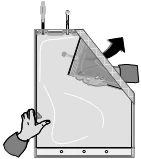
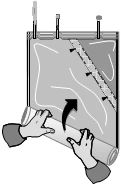
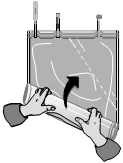
After mixing the contents of both chambers of the bag, it is necessary to check whether the middle seam is fully open, whether the mixed solution is clear and colorless, and whether the bag is leaking.
- Use of the ready-to-use solution.
The ready-to-use solution should be administered immediately, but no later than within 48 hours after mixing.
Any addition to the ready-to-use solution may only be performed after the ready-to-use solution has been thoroughly mixed. After such addition, the ready-to-use solution must be thoroughly mixed again before administration.
Sodium chloride solution (concentration from 3% to 30% sodium chloride; up to 250 mmol sodium chloride per 5 L of "multiBic 4 mmol/L potassium" solution) and water for injections (up to 1250 mL per 5 L of "multiBic 4 mmol/L potassium" solution) are compatible with this medicinal product.
Unless otherwise indicated, the ready-to-use solution should be warmed immediately before administration to a temperature of 36.5–38.0 °C. The exact temperature should be determined according to clinical indications and the type of equipment used.
There are no special requirements for disposal of the medicinal product.
Children
There is no clinical experience with the use of this medicinal product in children. "multiBic 4 mmol/L potassium" is not recommended for use in children until additional data are available.
Overdose
No emergencies have occurred after administration of the medicinal product at recommended doses; furthermore, administration of this medicinal product can be stopped at any time. If fluid balance is not accurately calculated and monitored, hyperhydration or dehydration with associated circulatory reactions may occur. These may manifest as changes in arterial pressure, central venous pressure, heart rate, and pulmonary arterial pressure. In cases of hyperhydration, congestive heart failure and/or pulmonary congestion may develop.
In cases of hyperhydration, ultrafiltration of pure fluid should be increased on the continuous renal replacement therapy machine. In cases of acute severe dehydration, ultrafiltration of pure fluid should be reduced or interrupted on the continuous renal replacement therapy machine; alternatively, fluid resuscitation may be used to restore hydration balance.
If too large a volume is administered, disturbances in electrolyte concentrations and acid-base balance may occur. For example, bicarbonate overdose may occur if an inappropriately large volume of hemodialysis/hemofiltration solution is infused. This may lead to metabolic alkalosis, decreased ionized calcium levels, or tetany.
Side effects
The following adverse reactions may be due to the treatment method itself or may be caused by this medicinal product:
Gastrointestinal disorders — nausea, vomiting;
Vascular disorders — hypertension, hypotension;
Musculoskeletal and connective tissue disorders — muscle cramps.
Potential adverse reactions of the treatment method:
Metabolism and nutrition disorders — hyper- or hypohydration, electrolyte disturbances (e.g., hypokalemia), hypophosphatemia, hyperglycemia, and metabolic alkalosis.
The exact frequency of these events is unknown (cannot be estimated from the available data).
Reporting of suspected adverse reactions
Reporting of adverse reactions after authorization of the medicinal product is important. It allows continuous monitoring of the benefit-risk balance of the medicinal product. Healthcare professionals and patients, as well as their legal representatives, are encouraged to report all suspected adverse reactions and lack of efficacy via the Automated Information System for Pharmacovigilance at the following link: https://aisf.dec.gov.ua.
Shelf life. The shelf life of the medicinal product in the original retail packaging is 2 years.
Storage conditions
Store at a temperature not below +4 °C.
After mixing the contents of the two chambers of the bag (ready-to-use solution): the chemical and physical stability of the ready-to-use solution is maintained for 48 hours at 30 °C.
It is not recommended to store the ready-to-use solution for longer than 48 hours, including the duration of the procedure, or at temperatures above 30 °C prior to administration via the pump system of the device.
From a microbiological standpoint, and due to the presence of bicarbonate, the medicinal product should be used immediately after connection to the hemodialysis, hemofiltration, or hemodiafiltration system. Keep out of reach of children.
Incompatibilities. The medicinal product must not be mixed with other medicinal products except those specified in this instruction.
Packaging. 5000 ml in a dual-chamber bag system; 2 bags per cardboard box labeled in Ukrainian and other languages.
Dual-chamber bag: 4750 ml alkaline bicarbonate solution + 250 ml acidic glucose-based electrolyte solution = 5000 ml ready-to-use solution.
The film used for the bag is made of polyethylene terephthalate, SiOx, polyamide, and polyolefin.
Each bag is equipped with an HF connector, a "Luer-lock" connector, and an injection port, and is covered with a protective film.
Prescription category. Prescription only.
Manufacturer. Fresenius Medical Care Deutschland GmbH / Fresenius Medical Care Deutschland GmbH.
Manufacturer's location and address of its business premises. Frankfurter Strasse 6-8, 66606 St. Wendel, Germany.
Marketing authorization holder. Fresenius Medical Care Deutschland GmbH / Fresenius Medical Care Deutschland GmbH.
Address of the marketing authorization holder. Else-Kroener-Str. 1, 61352 Bad Homburg v.d.H., Germany.
Local representative's address: LLC "Fresenius Medical Care Ukraine", 9 Boryspilska St., Kyiv, 02099, Ukraine.