Mucolik
Ukraine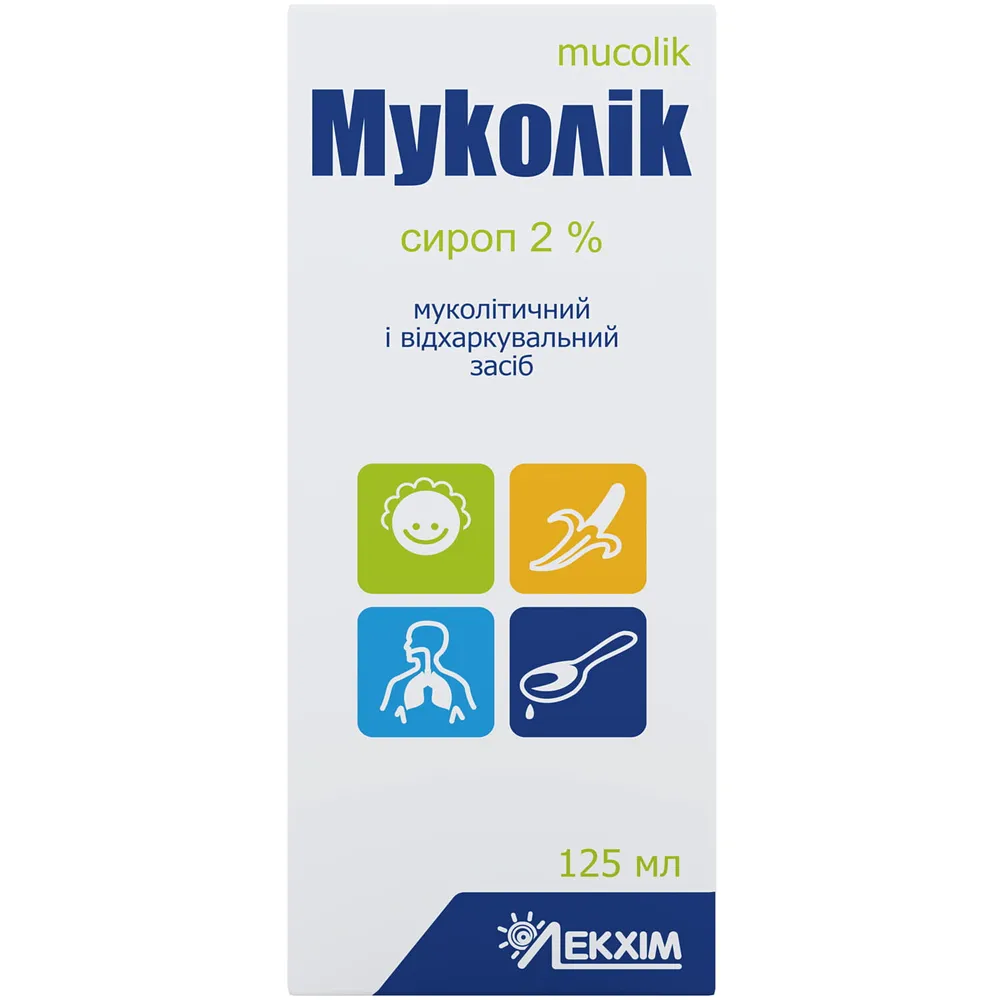
Table of Contents
INSTRUCTIONS FOR MEDICAL USE OF THE MEDICINAL PRODUCT MUCOLIK (MUCOLIK)
Composition:
Active ingredient: carbocisteine;
1 ml of syrup contains 50 mg of carbocisteine;
Excipients: methyl 4-hydroxybenzoate (E 218), sucrose, glycerol, flavour "Green Apple" (containing propylene glycol), quinoline yellow dye (E 104), sodium hydroxide, purified water.
Pharmaceutical form. Syrup.
Main physicochemical properties:
A clear, light yellow liquid with an apple aroma.
Pharmacotherapeutic group. Cough and cold preparations. Mucolytic agents. Carbocisteine.
ATC code R05C B03.
Pharmacological properties.
Pharmacodynamics.
Carbocysteine affects the gel phase of respiratory tract mucus: by cleaving disulfide bridges of glycoproteins, it causes liquefaction of excessively viscous bronchial secretions, thereby facilitating expectoration.
The mucoregulatory effect of carbocysteine is associated with activation of sialyltransferase – an enzyme of goblet cells in the bronchial mucosa. Carbocysteine normalizes the quantitative ratio of acidic and neutral sialomucins in bronchial secretion, restoring its viscosity and elasticity. It activates ciliary epithelium function and improves mucociliary clearance. It promotes regeneration of the respiratory tract mucosa, normalizes its structure, reduces hyperplasia of goblet cells, and consequently decreases mucus production. It restores secretion of immunologically active IgA (specific protection) and increases the number of sulfhydryl groups in mucus components (nonspecific protection). It exerts anti-inflammatory effects due to kinin-inhibiting activity of sialomucins, resulting in reduced edema and bronchoobstruction.
Pharmacokinetics.
After oral administration, carbocysteine is rapidly absorbed. Peak plasma concentration of the active substance is reached within 2 hours. Bioavailability is low – less than 10% of the administered dose (due to extensive metabolism in the gastrointestinal tract and first-pass liver effect). Carbocysteine and its metabolites are primarily excreted via urine. The elimination half-life is approximately 2 hours.
Clinical characteristics.
Indications.
Treatment of symptoms related to bronchial secretion disorders and impaired expectoration, particularly in acute bronchopulmonary diseases such as acute bronchitis; during exacerbations of chronic respiratory diseases.
Contraindications.
- Hypersensitivity to any component of the drug (especially to methylparahydroxybenzoate or other parahydroxybenzoate salts);
- Peptic ulcer of the stomach and duodenum in the acute phase;
- First trimester of pregnancy, due to insufficient data on teratogenic and embryotoxic effects;
Interaction with other medicinal products and other forms of interaction.
During treatment with Mucolic, antitussive agents and drugs that suppress bronchial secretion should not be used. Enhances the efficacy of glucocorticoid therapy (mutually) and antibacterial therapy.
Special precautions for use.
Productive cough is a fundamental protective mechanism of the bronchopulmonary system and should not be suppressed. It is irrational to combine medicinal products that modify bronchial secretion with cough-suppressant agents and/or substances that reduce secretion (atropine-like group).
The medication should be used with caution when treating patients with a history of peptic ulcer of the stomach or duodenum.
In cases of productive cough with purulent sputum, high fever, or chronic bronchial or lung disease, the clinical situation should be re-evaluated.
The medication contains sucrose and therefore should not be administered to patients with fructose intolerance, glucose-galactose malabsorption syndrome, or sucrase-isomaltase deficiency. Consult a physician before taking this medication if necessary.
It should be noted that 15 ml of the 5% syrup contains 5.25 g of sucrose, which should be taken into account by patients on a low-carbohydrate diet or those with diabetes mellitus. May be harmful to teeth.
This medicinal product contains sodium. Caution is advised when administering to patients on a sodium-controlled diet.
The medication contains methylparahydroxybenzoate, as well as the dyes sunset yellow FCF (E 110) and quinoline yellow (E 104), which may cause allergic reactions (delayed in time).
The medication contains the excipient glycerin, which may cause headache, gastrointestinal irritation, and diarrhea.
Use during pregnancy or breastfeeding.
Animal studies have shown no teratogenic effects. The absence of teratogenic effects in animals indicates that developmental abnormalities are not expected in humans. No teratogenic effects have been reported during the post-marketing period. There are no data on the passage of carbocysteine into breast milk.
During pregnancy (II and III trimesters) or breastfeeding, the medication should be used only after careful assessment of the benefit-risk ratio for the woman and the potential risk to the fetus (child), as determined by the physician.
Ability to influence reaction rate when driving or operating machinery.
No effect.
Method of administration and dosage.
For oral use.
Mukolik 5% is recommended for the treatment of adults and children aged 15 years and older. A measuring spoon with graduations is provided for accurate dosing of the syrup. One measuring spoon filled with Mukolik 5% syrup up to the 5 ml mark contains 250 mg of carbocysteine.
| Patient age |
Drug formulation |
Dosage |
| Adults and children aged 15 years and older |
Mucolik 5% |
2250 mg (45 ml) of carbocysteine per day in 3 divided doses, i.e. 3 measuring spoons filled up to the 5 ml mark, |
The duration of treatment should not exceed 8–10 days.
Children.
The drug should be used in children aged 15 years and older.
Administration of this medicinal product must be carried out after consultation with a physician.
Overdose.
Symptoms: stomach pain, nausea, diarrhea.
Treatment is symptomatic.
Adverse Reactions
Risk of bronchial obstruction in children under 2 years of age (see sections "Contraindications" and "Special Warnings and Precautions for Use").
Possible gastrointestinal disturbances (stomach pain, nausea, vomiting, diarrhea), bronchorrhea (increased bronchial secretion). In such cases, dose reduction is recommended.
Possible allergic skin reactions such as urticaria, angioneurotic edema, pruritus, erythematous skin rashes (possibly delayed in time). Particular caution is required in patients with bronchial asthma due to the risk of bronchospasm (contraction of bronchial wall muscles leading to reduced airflow). In such cases, treatment must be discontinued.
Headache, myalgia, dizziness, urinary incontinence, palpitations, and dyspnea.
Particular caution is required in patients with thyroid dysfunction due to the risk of developing hypothyroidism.
Several cases of fixed drug eruptions have been reported. There have also been reports of isolated cases of bullous dermatitis, such as Stevens-Johnson syndrome and erythema multiforme.
Shelf life. 2 years.
Storage conditions.
Store in the original packaging at a temperature not exceeding 25 °C. Keep out of reach of children.
Packaging.
125 ml of 5% syrup in a bottle. 1 bottle and a measuring spoon in a cardboard box.
Availability. Over-the-counter.
Manufacturer.
JSC "Tekhnolohiya".
Manufacturer's address and location of its business activity.
8 Stara Prorizna Street, City of Uman, Cherkasy Region, 20300, Ukraine.