Mucophalk orange
Ukraine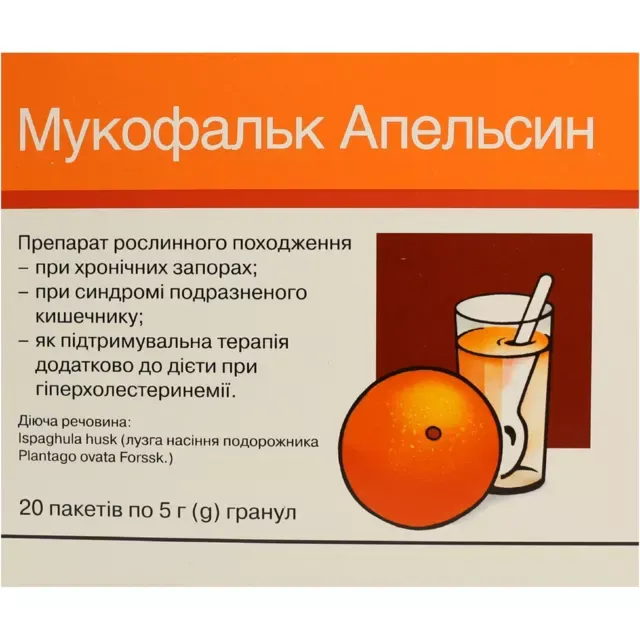
Table of Contents
INSTRUCTIONS FOR MEDICAL USE OF THE MEDICINAL PRODUCT MUCOFALK ORANGE (MUCOFALK® ORANGE)
Composition:
Active substance: Ispaghula husk (seed husk of Plantago ovata Forssk.)
1 sachet (5 g of granules) contains: Ispaghula husk (seed husk of Plantago ovata Forssk.) – 3.25 g;
Excipients: sucrose, dextrin, anhydrous citric acid, sodium alginate, sodium citrate, sodium chloride, sodium saccharin, orange flavoring.
Pharmaceutical form. Granules.
Main physicochemical properties: beige granules with brown particles of epidermis and adjacent destroyed layers removed from dried ripe seeds of Plantago ovata Forssk.
Pharmacotherapeutic group. Laxatives. Agents increasing intestinal contents volume. Preparations from Plantago ovata (plantago ovata) seeds.
ATC code A06A C01.
Lipid-modifying agents. ATC code C10A X.
Pharmacological properties.
Pharmacodynamics.
The active ingredient is psyllium seed husk, consisting of the epidermis and adjacent broken layers removed from dried ripe seeds of Plantago ovata Forssk. (Plantago ispaghula Roxb.). Psyllium seed husk is particularly rich in dietary fiber and mucilage, the mucilage content of which is much higher than in other Plantago species.
The active substance of the medicinal product absorbs an amount of water approximately 40 times its own weight. It consists of 85 % water-soluble fiber and is partially enzymatically degraded (in vitro 72 % undigested residue) and acts by hydrating the fecal mass.
Intestinal motility and transit rate may be modified by psyllium husk, causing mechanical distension of the intestinal wall. This occurs due to an increase in intestinal volume and a reduction in the viscosity of luminal contents through water absorption.
When the medicinal product is taken with a large amount of liquid, the psyllium husk increases the volume of intestinal contents due to the high bulking properties of the husk, resulting in stimulatory distension that triggers defecation. In turn, the swollen mass of mucilaginous forms creates a lubricating layer, facilitating the transit of intestinal contents.
Onset of action. Psyllium seed husk usually acts as a laxative within 12–24 hours after a single dose. Sometimes the maximum effect is achieved only after 2–3 days.
In mild to moderate hypercholesterolemia, a reduction in LDL cholesterol (low-density lipoproteins) of approximately 7 % has been observed. There are no data on the effect of psyllium seed husk on the incidence of cardiovascular complications or overall mortality.
Clinical characteristics.
Indications.
- Chronic constipation;
- conditions where soft, easy bowel evacuation is desirable, e.g. anal fissures, hemorrhoids, as well as the postoperative period following rectal surgery;
- irritable bowel syndrome;
‒ use as supportive therapy in addition to diet in hypercholesterolemia.
Contraindications.
- Known hypersensitivity reaction to Ispaghula (Plantago, Psyllium), as well as increased sensitivity to any component of the medicinal product;
- any sudden change in bowel function lasting more than two weeks;
- use of a laxative without defecation;
- rectal bleeding of unknown etiology;
- difficulty swallowing or other throat or swallowing problems;
- esophageal stricture, esophageal cardia stenosis, or other gastrointestinal tract strictures;
- risk of developing or existing intestinal obstruction (ileus) or megacolon; intestinal paralysis.
Special precautions.
Mucophalk Orange must be taken with sufficient fluid (at least 150 ml) per 1 sachet (5 g). Taking the product without sufficient fluid may cause difficulty in swallowing or lead to asphyxiation. Mucophalk Orange must not be taken while lying down or immediately before bedtime.
Interaction with other medicinal products and other forms of interaction.
An interval of approximately 30–60 minutes should be maintained between taking Mucophalk Orange and other medications, as intestinal absorption of other concurrently administered drugs—such as minerals (e.g. calcium, iron, zinc), vitamins (vitamin B12), lithium, cardiac glycosides, coumarins, and carbamazepine—may be delayed.
Bulk-forming agents and drugs that inhibit natural intestinal peristalsis (e.g. loperamide, opium tincture) must not be used simultaneously with this medicinal product, as intestinal obstruction may develop.
In diabetic patients, concomitant use of Mucophalk Orange may require adjustment of antidiabetic therapy. A reduced effect of thyroid hormones may occur, even if they are not taken simultaneously.
Special precautions for use
The use of psyllium seed husk for maintenance therapy as part of a diet in hypercholesterolemia should be under medical supervision.
When taking the product Mucophalk Orange, it is necessary to ensure the intake of sufficient fluid, at least 150 ml of water per sachet.
If insufficient fluid is consumed, bulk-forming agents may cause obstruction of the throat and oesophagus, leading to choking, as well as intestinal obstruction. Symptoms may include chest pain, vomiting, or difficulty in swallowing or breathing.
Swallowing granules dry may lead to difficulty in swallowing and choking.
In cases of diarrhoea, the most important aspect of treatment is restoration of electrolyte balance.
Mucophalk Orange should not be administered to patients with defecation problems and symptoms such as abdominal pain, nausea, and vomiting. These symptoms may indicate existing or possible intestinal obstruction.
Patients taking Mucophalk Orange for the treatment of chronic constipation should discontinue treatment and consult a physician if abdominal pain or changes in stool consistency occur.
Elderly and debilitated patients should be under medical supervision during treatment.
Mucophalk Orange contains sucrose; therefore, the medicinal product should not be used in patients with hereditary fructose intolerance, glucose-galactose malabsorption syndrome, or congenital sucrase-isomaltase deficiency.
One dose of Mucophalk Orange (5 g) contains 0.5 g of sucrose (sugar) and 3.07 kcal (12.86 kJ), equivalent to 0.064 carbohydrate exchange units.
One dose of Mucophalk Orange (5 g) contains 3.9 mmol (90 mg) of sodium. This should be taken into account by patients on a low-sodium/low-salt diet.
Use during pregnancy or breastfeeding
There are no contraindications regarding the use of Mucophalk Orange during pregnancy or breastfeeding.
There is limited data (less than 300 pregnancies) on the use of the product during pregnancy. Animal studies are insufficient to draw conclusions on reproductive toxicity.
The use of the product during pregnancy and lactation is possible if necessary or if dietary modifications have not been effective. Bowel cleansing should be performed before using other laxatives.
Ability to affect reaction speed when driving or operating machinery
No effects on the ability to drive or operate machinery have been observed.
Method of Administration and Dosage.
If not otherwise prescribed, the following administration recommendations must be strictly followed; otherwise, Mucophalk Orange will not exert its therapeutic effect!
For chronic constipation and conditions where easier bowel movements are desired, adults and children aged 12 years and older should take 1 sachet (5 g) of Mucophalk Orange 2–3 times daily, internally, after mixing with a sufficient amount of liquid (at least 150 mL per sachet).
If the drug is prescribed as an adjunctive treatment for diarrhea, irritable bowel syndrome, or hypercholesterolemia, take 1 sachet (5 g), dissolved in a sufficient amount of liquid (at least 150 mL per sachet), 2–6 times daily.
If a patient has prolonged constipation and irregular bowel movements lasting more than 3 days, or diarrhea persisting for more than 2 days accompanied by blood in the stool or fever, medical advice must be sought.
Administration Instructions:
- Never take this medication in dry form, as it may cause difficulty in swallowing.
- Pour the granules from the sachet into an empty glass.
- Slowly fill the glass with cold water (at least 150 mL).
- Stir with a spoon, ensure no lumps remain, and drink immediately. Do not take while lying down or immediately before bedtime!
- Then drink another glass of water.
The effect of Mucophalk Orange is usually observed within 12–24 hours after administration.
Take Mucophalk Orange during the day, at least half an hour before or after taking other medications.
For maintenance therapy in cases of moderately elevated cholesterol levels, it is recommended to take Mucophalk Orange with food.
If a patient forgets to take the medication, continue treatment according to the recommended dosage regimen, but do not double the dose.
Before interrupting or discontinuing treatment, it is advisable to consult a physician.
Children.
Mucophalk Orange must not be used in children under 12 years of age due to insufficient experience with the drug in this age group.
Overdose.
If a patient takes a higher than recommended dose, adverse effects such as abdominal pain, flatulence, or increased sensation of intestinal fullness may occur. First of all, it is necessary to drink an adequate amount of fluid. If needed, the physician should prescribe symptomatic treatment.
Side effects
Flatulence and a feeling of intestinal fullness are possible, but these symptoms usually disappear during continued treatment.
Abdominal distension and defecation difficulties may also occur. There is also a risk of intestinal obstruction or esophageal obstruction, especially if insufficient fluid is taken.
The husks of psyllium seeds contain allergens that may cause hypersensitivity reactions following oral intake or skin contact. Hypersensitivity reactions may include rhinitis, conjunctivitis, bronchospasm, and occasionally anaphylactic shock. Skin reactions such as exanthema and pruritus have also been reported.
The frequency of these adverse effects is unknown.
Shelf life. 5 years.
Do not use after the expiry date stated on the packaging.
Storage conditions.
Keep out of reach of children.
Packaging.
5 g of granules in a sachet. 20 sachets in a cardboard box.
Supply category. Over-the-counter.
Manufacturer.
Dr. Falk Pharma GmbH, Germany.
Manufacturer's address and place of business.
Leinenweberstrasse 5, 79108 Freiburg im Breisgau, Germany.