Motopride
Ukraine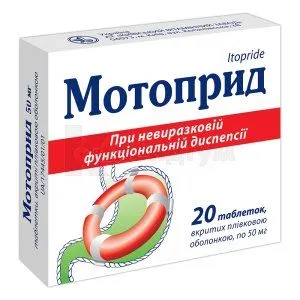
Table of Contents
INSTRUCTION FOR MEDICAL USE OF THE MEDICINAL PRODUCT MOTOFRID (MOTOPRID)
Composition:
Active substance: itopride hydrochloride;
1 tablet contains 50 mg of itopride hydrochloride;
Excipients: lactose monohydrate; corn starch; calcium carmellose (calcium carboxymethylcellulose); colloidal anhydrous silicon dioxide; magnesium stearate;
Coating: Opadry II White film-coating mixture: lactose monohydrate; hypromellose (hydroxypropylmethylcellulose); polyethylene glycol; titanium dioxide (E 171); triacetin.
Pharmaceutical form. Film-coated tablets.
Main physico-chemical properties: white, round, biconvex film-coated tablets.
Pharmacotherapeutic group. Prokinetic agents. ATC code A03F A07.
Pharmacological properties.
Pharmacodynamics.
Hydrochloride itopride activates propulsive gastrointestinal motility due to antagonism at dopamine D2 receptors and inhibitory activity against acetylcholinesterase. Hydrochloride itopride enhances acetylcholine release and inhibits its degradation. Hydrochloride itopride also exerts an antiemetic effect through interaction with D2 receptors located in the chemoreceptor trigger zone, as demonstrated by dose-dependent inhibition of apomorphine-induced vomiting in animals. The action of hydrochloride itopride is highly specific to the upper gastrointestinal tract.
Hydrochloride itopride does not affect serum gastrin levels.
Pharmacokinetics.
Absorption. Hydrochloride itopride is rapidly and almost completely absorbed from the gastrointestinal tract. Its relative bioavailability is 60%, which is associated with the first-pass liver effect. Food does not influence bioavailability. After administration of 50 mg hydrochloride itopride, Cmax is reached within 0.5 – 0.75 hours and amounts to 0.28 μg/mL. With continued administration of the drug at doses of 50 to 200 mg three times daily for 7 days, the pharmacokinetics of hydrochloride itopride and its metabolites were linear with minimal accumulation.
Distribution. Approximately 96% of hydrochloride itopride is bound to plasma proteins (primarily albumin). Binding to α1-acid glycoprotein is less than 15%.
Metabolism. Hydrochloride itopride is actively biotransformed in the liver. Three metabolites have been identified, only one of which exhibits negligible activity without pharmacological significance (approximately 2 – 3% of hydrochloride itopride). The primary metabolite is the N-oxide, formed by oxidation of the quaternary amino-N-dimethyl group.
Hydrochloride itopride is metabolized by flavin-dependent monooxygenase (FMO3). The quantity and activity of FMO isoenzymes in humans may vary depending on genetic polymorphism, sometimes resulting in an autosomal recessive condition known as trimethylaminuria (fish odor syndrome). In patients with trimethylaminuria, T1/2 is prolonged.
According to pharmacokinetic studies in vivo, hydrochloride itopride does not exert inhibitory or inductive effects on CYP2C19 and CYP2E1. Administration of hydrochloride itopride does not affect CYP content or uridine diphosphate glucuronosyltransferase activity.
Elimination. Hydrochloride itopride and its metabolites are primarily excreted in urine. Renal excretion of hydrochloride itopride and its N-oxide accounted for 3.7% and 75.4%, respectively, after single oral administration of the drug at therapeutic dose to healthy volunteers.
The terminal half-life (T1/2) of hydrochloride itopride is approximately 6 hours.
Clinical characteristics.
Indications.
Treatment of gastrointestinal symptoms of functional non-ulcer dyspepsia (chronic gastritis), namely:
- abdominal bloating;
- early satiety;
- pain and discomfort in the upper abdomen;
- anorexia;
- heartburn;
- nausea;
- vomiting.
Contraindications.
- Hypersensitivity to itopride hydrochloride and other components of the drug.
- Conditions in which increased gastrointestinal motility may be harmful, such as gastrointestinal bleeding, mechanical obstruction, or perforation.
Interaction with other medicinal products and other forms of interaction.
Metabolic interactions are not expected because itopride hydrochloride is primarily metabolized by flavin monooxygenase, not by cytochrome P450 isoenzymes. No changes in protein binding were observed when itopride hydrochloride was administered concomitantly with warfarin, diazepam, sodium diclofenac, ticlopidine hydrochloride, nifedipine, or nicardipine hydrochloride. Due to the gastrokinetic effect of itopride hydrochloride, it may influence the absorption of other medicinal products administered concomitantly by the oral route.
Medicinal products with a narrow therapeutic index, modified-release formulations, or enteric coatings should be used with particular caution.
Anti-ulcer drugs such as cimetidine, ranitidine, teprenone, and cetraxate do not affect the prokinetic action of itopride hydrochloride.
Anticholinergic drugs may reduce the effect of itopride hydrochloride.
Special precautions for use
Hydrochloride itopride enhances the effect of acetylcholine and may lead to cholinergic adverse effects. Data on long-term use are lacking.
In general, hydrochloride itopride should be administered to elderly patients with appropriate caution and careful monitoring, taking into account the increased frequency of impaired renal or hepatic function, concomitant diseases, or concomitant therapy with other medicinal products in such patients.
The medicinal product contains lactose; therefore, it should not be administered to patients with rare hereditary conditions such as galactose intolerance, Lapp lactase deficiency, or glucose-galactose malabsorption.
Use during pregnancy or breastfeeding.
Fertility. There are no data on the effect of itopride on human fertility. However, studies in animals have not revealed any harmful effects of itopride.
Pregnancy. Data on the use of itopride in pregnant women are absent or limited (less than 300 pregnancy outcomes). Animal studies have not shown any direct or indirect toxic effects on reproductive function. As a precautionary measure, it is advisable to avoid using itopride during pregnancy.
Breastfeeding. Itopride is excreted in breast milk in animals, but there is insufficient data regarding excretion of itopride in human breast milk. Risk to the breastfed infant cannot be excluded. The decision on whether to discontinue breastfeeding or to discontinue/withhold itopride therapy should be made taking into account the benefit of breastfeeding for the child and the benefit of therapy for the woman.
Ability to influence reaction speed when driving or operating machinery.
There is no information available on the possible effect of the medicinal product Motoprid on reaction speed. However, when deciding whether to drive or operate machinery, the possibility of dizziness occurring should be taken into account.
Method of administration and dosage.
The recommended dose for adults is 150 mg daily (1 tablet (50 mg) three times daily before meals). This dose may be adjusted downward based on the patient's age and symptoms (see section "Special precautions").
Clinical studies have shown that the duration of treatment with itopride hydrochloride was up to 8 weeks.
Children.
The safety of itopride hydrochloride in children under 16 years of age has not been established.
Overdose.
Treatment. In case of overdose, standard measures such as gastric lavage should be performed, along with symptomatic treatment.
Adverse Reactions
According to literature data, the following adverse reactions were observed at the specified frequencies in 998 patients who received itopride in 4 placebo-controlled clinical studies, 4 comparative clinical studies, and 13 uncontrolled interventional clinical studies, using a standard daily dose of itopride of 150 mg or less. Adverse reactions are classified by organ systems (according to MedDRA) and by frequency of occurrence: common (from >1/100 to <1/10) and uncommon (from >1/1000 to <1/100). No adverse reactions were identified in the categories "very common" (>1/10), "rare" (from >1/10,000 to <1/1,000), and "very rare" (<1/10,000).
Gastrointestinal system:
Common – abdominal pain, diarrhea;
Uncommon – increased salivation.
Nervous system:
Uncommon – dizziness, headache.
Skin and subcutaneous tissue:
Uncommon – rash.
Laboratory investigations:
Uncommon – increased aminotransferase levels, decreased white blood cell count.
Adverse reactions from spontaneous reports during post-marketing use. The frequency of occurrence cannot be estimated precisely based on available data.
Blood and lymphatic system:
Leukopenia, thrombocytopenia.
Immune system:
Hypersensitivity, including anaphylactoid reactions.
Endocrine system:
Increased blood prolactin levels.
Nervous system:
Dizziness, headache, tremor.
Gastrointestinal system:
Abdominal pain, diarrhea, constipation; increased salivation, nausea.
Hepatobiliary system:
Jaundice.
Skin and subcutaneous tissue:
Rash, erythema, and pruritus.
Reproductive system and breast:
Gynecomastia.
Laboratory investigations:
Elevated levels of AST, ALT, GGT, alkaline phosphatase, and bilirubin in blood.
Reporting of adverse reactions.
Reporting suspected adverse reactions after drug registration is important. It enables ongoing monitoring of the benefit-risk balance of the medicinal product. Healthcare and pharmaceutical professionals, as well as patients or their legal representatives, are encouraged to report all suspected adverse reactions and lack of efficacy via the Automated Information System for Pharmacovigilance at the following link: https://aisf.dec.gov.ua.
Shelf life. 3 years.
Storage conditions.
Store in the original packaging at a temperature not exceeding 25 °C.
Keep out of reach of children.
Packaging.
10 tablets in a blister; 1 blister per carton.
10 tablets in a blister; 2 blisters per carton.
10 tablets in a blister; 4 blisters per carton.
Prescription status. Prescription only.
Manufacturer: JSC "KYIV VITAMIN PLANT".
Manufacturer's address and location of business activity:
38 Kopilivska Street, Kyiv, 04073, Ukraine.
Web-site: www.vitamin.com.ua.