Monosan
Ukraine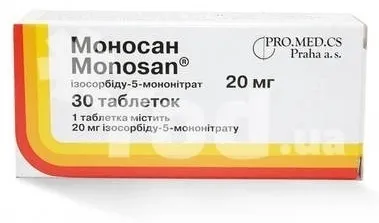
Table of Contents
I N S T R U C T I O N for medical use of the medicinal product MONOSAN® (MONOSAN®)
Composition:
Active substance: isosorbide mononitrate;
1 tablet contains isosorbide mononitrate diluted, equivalent to 20 mg or 40 mg of isosorbide mononitrate;
Excipients: lactose monohydrate, microcrystalline cellulose, maize starch, talc, magnesium stearate.
Pharmaceutical form. Tablets.
Main physicochemical properties: white-colored tablets, flat cylindrical shape, with bevel and score line, approximately 7 mm in diameter (20 mg tablets) and approximately 9 mm in diameter (40 mg tablets).
Pharmacotherapeutic group. Drugs affecting the cardiovascular system. Vasodilators used in cardiology. Organic nitrates. Isosorbide mononitrate.
ATC code C01D A14.
Pharmacological Properties
Pharmacodynamics
Isosorbide mononitrate (isosorbide-5-mononitrate) is a metabolite of isosorbide dinitrate. It induces relaxation of vascular smooth muscle and vasodilation due to the formation of nitric oxide. The effect of isosorbide dinitrate develops more rapidly than that of isosorbide mononitrate.
Isosorbide mononitrate simultaneously dilates peripheral veins and arteries, resulting in increased venous capacitance, reduced venous return to the heart, and consequently decreased ventricular end-diastolic pressure and preload. Its effect on arterial vessels reduces systemic vascular resistance (afterload), thereby reducing the workload of the heart. The combined effect on preload and afterload leads to reduced myocardial oxygen demand. Additionally, isosorbide mononitrate promotes redistribution of blood flow to subendocardial layers when coronary blood flow is partially impaired due to atherosclerotic plaques. Vasodilation induced by nitrates improves perfusion of the post-stenotic myocardial regions. Nitrates alleviate eccentric coronary stenosis by reducing venous spasm. Nitrates improve hemodynamics both at rest and during physical exertion in patients with congestive heart failure. As a result of reduced oxygen demand and improved oxygen supply, the extent of myocardial damage is limited. Isosorbide mononitrate also affects other organs and systems: it relaxes bronchial smooth muscle and smooth muscles of the gastrointestinal, biliary, and urinary tracts. The drug's effect begins within 20 minutes and lasts up to 8 hours.
Isosorbide mononitrate slightly inhibits platelet aggregation and reduces intraplatelet thromboxane synthesis.
The drug improves exercise tolerance in patients with ischemic heart disease.
Pharmacokinetics
After oral administration, maximum plasma concentration of the drug Moносan® is achieved within 1 hour. Bioavailability is nearly 100%. Isosorbide mononitrate does not undergo significant biotransformation during the "first-pass" effect in the liver and does not bind to plasma proteins. The elimination half-life is 4–5 hours. The pharmacokinetics of isosorbide mononitrate are not affected by the presence of cardiac, renal, or hepatic insufficiency.
Isosorbide mononitrate is metabolized in the liver to isosorbide and isosorbide-5-mononitrate-2-glucuronide. Both metabolites are pharmacologically inactive and are excreted by the kidneys. Only 2% of the drug is excreted unchanged in the urine.
Clinical characteristics.
Indications.
- Prophylaxis of angina pectoris.
- Congestive heart failure.
Contraindications.
- Hypersensitivity to the active substance or to any component of the medicinal product.
- Acute circulatory failure, severe arterial hypotension (systolic pressure below 90 mmHg) or hypovolemia, collapse; cardiogenic shock, unless adequately supported by intra-aortic counterpulsation or agents with positive inotropic effect.
- Acute myocardial infarction with low left ventricular filling pressure.
- Severe anemia.
- Toxic pulmonary edema.
- Recent head injury or intracranial hemorrhage, increased
intracranial pressure.
- Glaucoma.
- Increased sensitivity to nitrates.
- Concomitant use with sildenafil and other phosphodiesterase inhibitors.
Interaction with other medicinal products and other types of interactions.
Phosphodiesterase inhibitors (e.g., sildenafil), neuroleptics, tricyclic antidepressants, and vasodilators: potentiate the hypotensive effect of nitrates; therefore, they must not be used concomitantly with the medicinal product Monosan®.
Noradrenaline, acetylcholine, histamine: their effects are reduced when used concomitantly with nitrates.
Alcohol, opioid analgesics, vasodilating agents, and antihypertensive drugs (such as beta-adrenoblockers, calcium antagonists, vasodilators): possible enhancement of their hypotensive effect.
Sympathomimetics: may reduce the antianginal effect of nitrates.
Dihydroergotamine: nitrates may increase its plasma levels and enhance its hypertensive effect.
Heparin: enhanced antiplatelet effect when used concomitantly with the medicinal product Monosan®.
Special precautions for use.
Do not use for the treatment of acute myocardial infarction or for relief of acute angina attacks.
The use of isosorbide mononitrate may lead to transient hypoxia and ischemia in patients with ischemic heart disease due to a relative redistribution of blood flow to areas of alveolar hypoventilation.
Use with caution:
-
in hypertrophic obstructive cardiomyopathy, constrictive pericarditis, cardiac tamponade, low cardiac filling pressure, aortic or mitral stenosis;
-
in severe renal and/or hepatic dysfunction;
-
in patients with hypothyroidism, hypothermia, or malnutrition;
-
in elderly patients (since they may be more sensitive to the hypotensive effects of nitrates);
-
in patients prone to arterial hypotension, orthostatic dysfunction (a decrease in systolic blood pressure by 10–25 mmHg below 90 mmHg upon change in body position), or undergoing surgical procedures. Systolic blood pressure below 90 mmHg should be avoided.
Failure to observe the recommended dosing interval or prolonged use of high doses may lead to the development of nitrate tolerance due to depletion of tissue sulfhydryl group reserves. This can be avoided by following a dosing regimen that includes a nitrate-free interval. Additionally, administration of sulfhydryl group donors such as acetylcysteine, methionine, or captopril may help prevent the development of tolerance.
Cross-tolerance with other nitrates may occur. To prevent diminished response or complete ineffectiveness of the drug, continuous long-term administration of high doses should be avoided.
After prolonged high-dose therapy, discontinuation of the drug should be gradual to prevent recurrence of angina symptoms.
Methemoglobinemia may occur with high-dose administration.
Isosorbide mononitrate may interfere with the colorimetric determination of cholesterol.
Under the influence of nitrates, increased concentrations of catecholamines (epinephrine/adrenaline, norepinephrine) in urine and of vanillylmandelic acid in urine may occur.
Alcohol should not be consumed during treatment with this drug.
The drug contains lactose and therefore should not be administered to patients with lactase deficiency, galactosemia, or glucose-galactose malabsorption syndrome.
Use during pregnancy or breastfeeding.
The drug affects fetal/infant hemodynamics and is therefore contraindicated during pregnancy and breastfeeding.
Ability to influence reaction speed when driving or operating machinery.
During treatment, psychomotor reaction speed may decrease and dizziness may occur; this should be taken into account when driving or operating machinery.
Dosage and Administration
The medication should be taken orally before meals, without chewing, and with sufficient amount of liquid.
The dosage and frequency of administration are determined individually by a physician. To achieve the maximum therapeutic effect, individual dosing of the medication should be based on the patient's condition, response to the drug, and tolerability.
Treatment should be initiated with low doses, which may be increased during therapy if necessary. The recommended dose is 40 mg twice daily. In most cases, 20 mg twice daily or 40 mg twice daily in the morning and afternoon should be prescribed.
To prevent the development of nitrate tolerance (regardless of the dosing regimen), a nitrate-free interval of 10–12 hours (usually at night) must be ensured. The second tablet should be taken no earlier than 8 hours after the first dose.
For the treatment of angina with frequent nocturnal attacks, the medication should be administered in the morning and immediately before bedtime.
Hemodynamic monitoring is important for determining individual dosing.
The daily dose, depending on the severity of the disease, may reach up to 120 mg (maximum daily dose), divided into 3 doses.
Children
The medication must not be used in children.
Overdose
Symptoms: arterial blood pressure reduction below 90 mm Hg, pallor, increased sweating, weak pulse, tachycardia, dizziness upon standing, headache, sensation of warmth or chills, hyperemia, feeling of fear, weakness, loss of consciousness, vertigo, orthostatic hypotension, cerebral symptoms, nausea, vomiting, diarrhea, methemoglobinemia, seizures, visual disturbances, increased intracranial pressure, cyanosis, dyspnea, tachypnea, shortness of breath, coma.
Treatment: symptomatic. Discontinue the medication. General measures should include oxygen administration. Monitoring of vital signs in intensive care conditions should be performed for at least 12 hours after overdose. If necessary, other symptomatic measures should be applied. Intravenous administration of physiological saline and plasma is recommended. If drug ingestion occurred recently, gastric lavage and administration of enterosorbents (activated charcoal) are recommended to eliminate the drug. Activated charcoal should be administered orally within one hour after ingestion of a potentially toxic dose. In case of arterial hypotension, the patient should be placed on a horizontal surface with the head lowered (legs should be elevated).
In severe cases, administer dopamine and sympathomimetics. In case of methemoglobinemia, administer ascorbic acid 1 g orally, 1% methylene blue intravenously, toluidine blue 2–4 mg/kg body weight intravenously, artificial ventilation of the lungs, and, if necessary, blood transfusion. Hemodialysis is indicated.
Adverse reactions.
Nitrates used in therapeutic doses are safe and well tolerated. Adverse reactions are classified according to system organ classes and frequency of occurrence: very common (≥ 1/10); common (≥ 1/100 to <1/10); uncommon (≥ 1/1,000 to <1/100); rare (≥ 1/10,000 to <1/1,000); very rare (<1/10,000); unknown (frequency cannot be estimated from available data).
Nervous system disorders: headache (due to vasodilation of cerebral arteries), which can be relieved with analgesics; cephalalgia is usually dose-dependent and diminishes within a few days of treatment, but may be severe and persistent; therefore, it is recommended to start with lower doses and gradually increase them to the required level over several days. Concomitant use with alcohol significantly increases the likelihood of developing headache. Inattention, dizziness, somnolence, weakness, restlessness, syncope; this risk is also significantly increased with concomitant alcohol use. Marked vagal tone may rarely lead to complete heart block or asystole. Nitrate-induced syncope is treated by administration of atropine or elevation of the lower limbs.
Cardiovascular system disorders: arterial (including orthostatic) hypotension, collapse with cardiac arrhythmia and bradycardia, worsening of angina symptoms, bradyarrhythmia, reflex tachycardia, transient hypoxemia due to myocardial hypoxia in patients with ischemic heart disease.
Gastrointestinal disorders: nausea, vomiting, diarrhea, dyspepsia.
Skin and subcutaneous tissue disorders: skin allergic reactions (including rash, pruritus, exfoliative dermatitis), vascular dilation of the skin with redness, pallor, and increased sweating.
Immune system disorders: hypersensitivity reactions may occur in patients with individual intolerance to any component of the medicinal product.
Other: dry mouth, flushing, facial hyperemia, tinnitus, asthenia.
Cases of development of tolerance to the drug have been observed, including cross-tolerance to other organic nitrates. To prevent diminished response or complete loss of efficacy, continuous administration of high doses over prolonged periods should be avoided.
Shelf life.
5 years. Do not use after the expiry date.
Storage conditions.
No special storage conditions required.
Keep out of reach and sight of children.
Packaging.
20 mg tablets: 10 tablets in a blister, 3 blisters in a cardboard box.
40 mg tablets: 10 tablets in a blister, 3 blisters in a cardboard box.
Prescription category. Prescription only.
Manufacturer.
PRO.MED.CS Praha a.s.
Manufacturer's address.
Telčská 377/1, Michle, Praha 4, 140 00, Czech Republic.