Miramistin®-darnitsa
Ukraine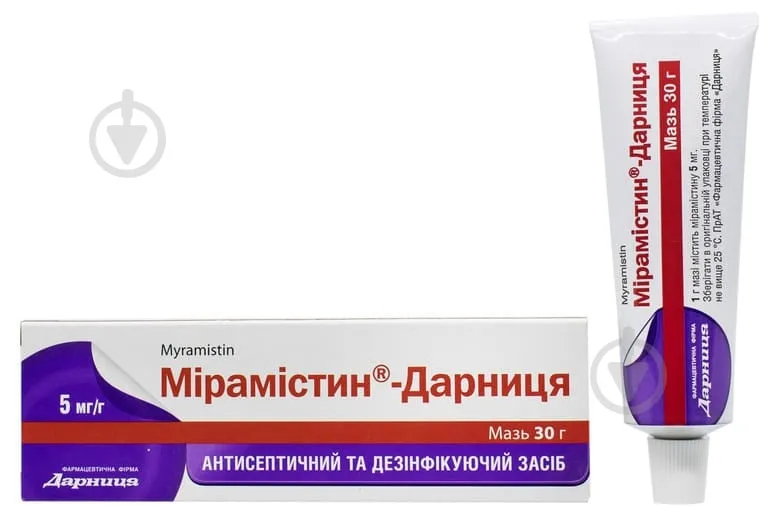
Table of Contents
INSTRUCTIONS FOR MEDICAL USE OF THE MEDICINAL PRODUCT MYRAMISTIN-DARNITSA (MYRAMISTIN-DARNITSA)
Composition:
Active substance: myramistin;
1 g of ointment contains miramistin 5 mg;
Excipients: disodium edetate, propylene glycol, polyethylene glycol 400, polyethylene glycol 1500, polyethylene glycol 6000, poloxamer, purified water.
Pharmaceutical form. Ointment.
Main physicochemical properties: homogeneous white ointment.
Pharmacotherapeutic group.
Antiseptics and disinfectants. ATC code D08AJ.
Pharmacological properties.
Pharmacodynamics.
The active substance of the medicinal product – miramistin – is a cationic surface-active agent (surfactant) with antimicrobial (antiseptic) activity. Its action is based on the direct hydrophobic interaction of the miramistin molecule with lipids in microbial cell membranes, leading to their fragmentation and destruction.
It exerts pronounced antimicrobial activity against gram-positive (Staphylococcus spp., Streptococcus spp., Streptococcus pneumoniae), gram-negative, aerobic and anaerobic, spore-forming and non-spore-forming bacteria, both as monocultures and microbial associations, including hospital strains with multidrug resistance to antibiotics. It demonstrates antifungal activity against ascomycetes (genera Aspergillus and Penicillium), yeasts (Rhodotorula rubra, Torulopsis gabrata), and yeast-like fungi (Candida albicans, Candida tropicalis, Candida krusei), dermatophytes (Trichophyton rubrum, Trichophyton mentagrophytes, Trichophyton verrucosum, Trichophyton schoenleini, Trichophyton violaceum, Epidermophyton Kaufman-Wolf, Epidermophyton floccosum, Microsporum gypseum, Microsporum canis), as well as other pathogenic fungi (e.g., Pityrosporum orbiculare (Malassezia furfur)), both as monocultures and microbial associations, including fungal microflora resistant to chemotherapeutic agents. Under the influence of miramistin, microbial resistance to antibiotics decreases.
At the site of application, it activates regenerative processes.
Due to its broad antimicrobial spectrum, miramistin effectively prevents wound and burn infections. The medicinal product has pronounced hyperosmolar activity, thereby suppressing wound and perifocal inflammation, absorbing purulent exudate, and selectively dehydrating necrotic tissues, promoting the formation of a dry eschar. At the same time, the ointment does not damage granulation tissue or viable skin cells and does not inhibit marginal epithelialization.
Pharmacokinetics.
Due to the physicochemical properties of the ointment base, the medicinal product acts not only on superficial wound microflora but also on pathogens located in the surrounding tissues. Therefore, it cannot be ruled out that a small fraction of miramistin may enter the systemic circulation.
Clinical characteristics.
Indications.
Surgery, traumatology: local treatment of infected wounds of various localizations and etiologies; prevention of secondary infection of granulating wounds.
Burn surgery: treatment of second- and third-degree burns (III A); preparation of burn wounds for skin grafting.
Dermatology: streptococcal and staphylococcal skin infections (dermatitis), fungal infections of smooth skin, feet and large skin folds (including dyshidrotic forms and forms complicated by pyoderma), nail infections (onychomycoses), keratomycoses (including pityriasis versicolor), candidiasis of skin and mucous membranes.
Prevention of wound infection complications – in minor industrial and domestic injuries.
Contraindications.
Hypersensitivity to the active substance or to any of the excipients of the medicinal product.
Interaction with other medicinal products and other forms of interactions.
When applied locally simultaneously with anionic surfactants (surface-active agents, e.g. soap solutions), miramistin becomes inactivated.
When miramistin is used concomitantly with systemic or topical antibiotics, a decrease in microbial resistance to these antibiotics is observed.
Special precautions for use
The efficacy of the medicinal product increases if the ointment is applied to a wound surface previously rinsed with an antiseptic solution.
The presence of purulent-necrotic material in the wound may require additional amounts of ointment.
Use during pregnancy or breastfeeding
Due to lack of sufficient experience, consult a physician before using the medicinal product during pregnancy or breastfeeding.
Ability to affect reaction rate when driving vehicles or operating machinery
The medicinal product does not affect the reaction rate when driving vehicles or operating machinery.
Method of Administration and Dosage
The medicinal product is intended for topical use in adults.
Treatment of wounds and burns
After standard treatment of wounds and burns, apply the ointment directly to the affected surface, then cover with a sterile gauze dressing, or apply the ointment onto the dressing material and then place it on the wound.
Alternatively, use medicinal product-soaked tampons to carefully fill the cavities of purulent wounds after surgical debridement, or insert gauze pledgets impregnated with the ointment into fistulous tracts.
The medicinal product should be applied once daily during treatment of purulent wounds and burns in the first phase of the wound process, and once every 1–3 days during the second phase, depending on the wound condition. The dose depends on the area of the wound surface and the degree of purulent exudation. The duration of treatment is determined by the dynamics of wound cleansing and healing. In cases of deep soft tissue infection, the medicinal product may be used in combination with systemic antibiotics; in such cases, the duration of treatment corresponds to the duration of the antibiotic course.
Treatment of dermatological conditions
Apply the medicinal product as a thin layer to affected skin areas, or apply the ointment onto dressing material and then onto the lesion site, 1–2 times daily. Treatment duration: continue using the medicinal product until negative results are obtained from microbiological monitoring. In extensive dermatomycoses, particularly rubromycosis, the ointment may be used for 5–6 weeks as part of combination therapy with griseofulvin or systemic antifungal agents. In nail fungal infections, nail plates should be detached prior to initiating treatment.
Children
Due to insufficient experience, the medicinal product should not be used in pediatric practice.
Overdose
Cases of overdose have not been reported. However, when the medicinal product is applied to large areas of affected skin, partial absorption of the active components into the systemic circulation cannot be ruled out, although quantities absorbed are unlikely to cause acute poisoning. Systemic effects of miramistin are manifested as those of a cationic detergent and may prolong bleeding time.
Treatment: reduce dose or discontinue the medicinal product; administer oral calcium preparations and Vikasol.
Side effects.
In individual cases, when treating burns and trophic ulcers, the medicinal product may cause a sensation of mild burning, which disappears within 15–20 seconds and does not require the use of analgesics or discontinuation of the ointment.
Hypersensitivity reactions are also possible, including rash, itching, hyperemia, dry skin, dermatitis, exudation, and skin irritation due to the presence of propylene glycol in the composition of the medicinal product.
Shelf life. 3 years.
Storage conditions.
Store in the original packaging at a temperature not exceeding 25 °C.
Keep out of reach of children.
Packaging.
15 g or 30 g in a tube; 1 tube per carton.
Dispensing category.
Over-the-counter.
Manufacturer.
JSC "Pharmaceutical company "Darnytsia".
Manufacturer's address and place of business.
13, Borispilska Street, Kyiv, 02093, Ukraine.