Minirin
Ukraine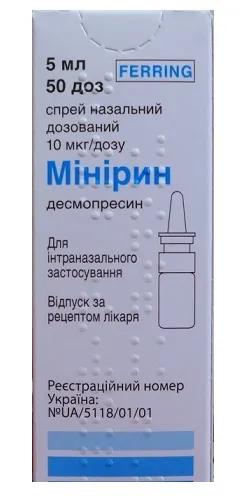
Table of Contents
INSTRUCTIONS FOR MEDICAL USE OF THE MEDICINAL PRODUCT MIMIRIN (MINIRIN®)
Composition:
Active substance: desmopressin;
1 ml (10 doses) of spray contains desmopressin acetate 0.1 mg, equivalent to desmopressin base 0.089 mg;
Excipients: sodium chloride; citric acid, monohydrate; sodium hydrogen phosphate, dihydrate; benzalkonium chloride; purified water.
Pharmaceutical form. Nasal spray, metered.
Main physicochemical properties: clear, colorless solution.
Pharmacotherapeutic group.
Hormones for systemic use, excluding sex hormones and insulin. Posterior pituitary hormones. Vasopressin and its analogs. ATC code H01BA02.
Pharmacological properties.
Pharmacodynamics.
Desmopressin is a synthetic analogue of natural human L-arginine vasopressin, differing from the latter in that the amino group of cysteine at position 1 is removed and L-arginine is replaced by its stereoisomer D-arginine. These modifications result in a significant reduction of vasopressor activity, while the antidiuretic effect is enhanced and prolonged many times.
Desmopressin increases the water permeability of the epithelium in the distal convoluted tubules and collecting ducts of the kidneys, thereby enhancing water reabsorption from primary urine. When administered intranasally, the dose required for the treatment of diabetes insipidus varies considerably both between and within individuals. On average, the effect of 20 mcg of intranasal desmopressin lasts for more than 10 hours.
The bioavailability of desmopressin after intranasal administration is approximately 10%.
Pharmacokinetics.
Absorption. Bioavailability is approximately 3–5%. Peak plasma concentration is reached after about 1 hour.
Distribution. Desmopressin distribution is best described by a two-compartment model, with a volume of distribution during the elimination phase of 0.3–0.5 L/kg.
Metabolism. In vivo studies on desmopressin metabolism have not been conducted. In vitro studies on microsomal metabolism in human liver cells showed no significant metabolism of desmopressin by the cytochrome P450 system. Therefore, hepatic metabolism of desmopressin in vivo is unlikely. The effect of desmopressin on the pharmacokinetics of other drugs is probably minimal due to the lack of influence on the cytochrome P450 system.
Excretion. Total clearance of desmopressin is 7.6 L/hour, and the terminal half-life is 2.8 hours. In healthy volunteers, the fraction of unchanged drug excreted amounted to 52% (44–60%).
Clinical characteristics.
Indications.
As an antidiuretic agent:
- treatment of central diabetes insipidus;
- post-traumatic polyuria and polydipsia in the presence of transient deficiency or absence of antidiuretic hormone following hypophysectomy, surgery in the pituitary region, or traumatic brain injury.
As a diagnostic agent:
- for rapid test to determine renal concentrating capacity;
- for differential diagnosis of diabetes insipidus.
Contraindications.
- Hypersensitivity to desmopressin or to any of the excipients;
- primary and psychogenic polydipsia (leading to urine output exceeding 40 ml/kg/24 hours), polydipsia in patients with alcoholism;
- severe forms of classical von Willebrand disease (type IIb); factor VIII activity below 5% and presence of factor VIII inhibitors;
- heart failure and other conditions requiring diuretic therapy;
- hyponatremia;
- moderate or severe renal impairment (creatinine clearance below 50 ml/min);
- syndrome of inappropriate antidiuretic hormone secretion (SIADH).
Interaction with other medicinal products and other forms of interaction.
Medicinal products capable of causing syndrome of inappropriate antidiuretic hormone secretion (SIADH), such as tricyclic antidepressants, selective serotonin reuptake inhibitors, chlorpromazine, and carbamazepine, as well as certain antidiabetic sulfonylurea agents (e.g., chlorpropamide), may enhance the antidiuretic effect and increase the risk of fluid retention or hyponatremia.
Nonsteroidal anti-inflammatory drugs (NSAIDs) may cause fluid retention or hyponatremia.
When oxytocin is used concomitantly, enhanced antidiuretic effect and reduced uterine perfusion should be taken into account.
Clofibrate and indomethacin may potentiate the antidiuretic effect of desmopressin, whereas glibenclamide and lithium salts may reduce it.
If the above-mentioned medicinal products are used concomitantly, arterial pressure, plasma sodium concentration, and urine output should be monitored.
Interaction of desmopressin with drugs affecting hepatic metabolism is unlikely, as in vitro studies of microsomal metabolism in human liver cells have shown no significant metabolism of desmopressin. However, formal in vivo interaction studies have not been conducted.
Special precautions for use.
Minirin nasal spray should only be used when oral administration of desmopressin is not possible. Treatment should be initiated with the lowest possible dose, and the dose should be gradually increased with caution.
Treatment with desmopressin without concomitant fluid restriction may lead to fluid retention and/or hyponatremia, with or without symptoms (such as headache, nausea/vomiting, weight gain, and edema). In severe cases, cerebral edema, seizures, and coma may occur.
All patients, parents (if the patient is a child), and healthcare personnel should be informed about the necessity to avoid fluid overload (including during swimming). If vomiting or diarrhea occurs, desmopressin should be discontinued until fluid balance is restored.
The risk of hyponatremic seizures can be minimized by maintaining the recommended starting dose and avoiding concomitant use of drugs that increase vasopressin secretion.
When the drug is used for diagnostic purposes, fluid intake should not exceed 0.5 L within 1 hour before administration and for at least 8 hours after administration.
In the treatment of central diabetes insipidus, severe hyponatremia may be associated with the use of Minirin nasal spray.
Intranasal administration may alter drug absorption in the presence of nasal mucosal damage (e.g., scarring, swelling). In such cases, desmopressin should not be used.
Weight gain may be related to overdosage or, more commonly, to hyperhydration.
Fluid retention should be monitored by regular assessment of body weight and determination of plasma sodium concentration or plasma osmolality.
Before initiating treatment, it should be confirmed that there is no severe bladder dysfunction or bladder outlet obstruction.
An increased risk of hyponatremia is observed in children, elderly patients, and patients with low serum sodium concentration. Desmopressin treatment should be discontinued or the dose carefully adjusted in the event of acute intercurrent illnesses that may lead to fluid and/or electrolyte imbalance, such as systemic infections, fever, or gastroenteritis.
Minirin nasal spray should be used with caution in:
- patients at risk of increased intracranial pressure;
- conditions characterized by fluid and/or electrolyte imbalance;
- patients at risk of thrombosis.
Precautionary measures to prevent hyponatremia, including fluid restriction and regular monitoring of serum sodium concentration, should be implemented in the following cases:
- concomitant use of drugs that may cause SIADH (syndrome of inappropriate antidiuretic hormone secretion), such as tricyclic antidepressants, selective serotonin reuptake inhibitors, chlorpromazine, carbamazepine, and certain sulfonylurea antidiabetic agents (e.g., chlorpropamide);
- concomitant treatment with nonsteroidal anti-inflammatory drugs (NSAIDs).
During the post-marketing period, several cases of severe hyponatremia associated with the use of desmopressin in nasal spray for the treatment of central diabetes insipidus have been reported.
Minirin nasal spray should be used with caution in patients with cystic fibrosis.
To prevent hyperhydration, fluid balance should be maintained.
The preservative benzalkonium chloride contained in the preparation may cause nasal mucosal swelling, especially with prolonged use. If such a reaction is suspected (e.g., chronic nasal congestion), the patient should be switched to a preservative-free nasal formulation. If such formulations are unavailable, alternative dosage forms of the drug should be considered.
Use during pregnancy or breastfeeding.
Clinical studies on the use of the nasal form of desmopressin during pregnancy or breastfeeding have not shown any signs of adverse effects on the mother or child. Minirin nasal spray may be used during pregnancy for replacement therapy in cases of antidiuretic hormone deficiency.
Pregnancy.
Published data from studies involving a small number of pregnant women with diabetes insipidus (n = 53) and pregnant women with hemorrhagic complications (n = 216) have not revealed any adverse effects of desmopressin on pregnancy or on fetal or neonatal health. Currently, other relevant epidemiological data are lacking. Animal studies have not shown any direct or indirect adverse effects on pregnancy, embryonic or fetal development, parturition, or postnatal development.
Desmopressin should be prescribed to pregnant women with caution.
Reproductive function studies in animals have not shown any clinically relevant effects on animals or their offspring. In vitro analysis of human placental cotyledon models has shown that transplacental transfer of desmopressin does not occur when administered at therapeutic concentrations corresponding to the recommended dose.
Breastfeeding.
Analysis of breast milk from mothers who received high doses of desmopressin (300 mcg intranasally) indicates that the amount of desmopressin transferred to the infant is significantly lower than the amount required to affect diuresis.
Only a very small amount of Minirin nasal spray passes into breast milk.
Ability to affect reaction speed when driving or operating machinery.
Minirin nasal spray has no effect or a negligible effect on the ability to drive or operate machinery.
Method of Administration and Dosage
The medication is intended for intranasal use.
Prior to administration, the nasal passages should be cleared. Insert the nasal applicator gently into one nostril and administer one spray. One spray delivers a dose of 10 μg.
If a higher dose is required, administer the medication into the other nostril. During administration, the patient should breathe calmly through the nose. After use, replace the protective cap on the applicator.
Diabetes insipidus and post-traumatic polyuria and polydipsia of central origin
Dosage should be individually adjusted. The average daily dose is 10 μg for children and 10–20 μg for adults. It is not possible to administer a dose of desmopressin lower than 10 μg using Minirin nasal spray.
If signs of fluid retention and/or hyponatremia occur, treatment should be temporarily discontinued and the dosage adjusted accordingly.
| Intranasal administration (divide the daily dose into 1–2 doses) |
||
| Patient groups |
Daily dose (mcg) |
Number of administrations |
| Adults |
10–20 mcg |
1–2 sprays |
| Children from 1 year of age |
10 mcg |
1 spray |
Before starting treatment, the physician should determine urine volume and urine osmolality in order to titrate the optimal dose. If treatment is ineffective, the dose should be increased. Treatment should be aimed at achieving two parameters: adequate duration of sleep and adequate fluid balance.
Express test for determining renal concentrating ability and for differential diagnosis of diabetes insipidus
| Intranasal administration |
||
| Patient groups |
Daily dose (mcg) |
Number of administrations |
| Adults |
1 × 40 mcg |
4 sprays |
| Children from 1 year of age |
1 × 20 mcg |
2 sprays |
| Children under 1 year of age |
1 × 10 mcg |
1 spray |
The express test is used for differential diagnosis of diabetes insipidus and polyuric syndrome of other etiology in order to distinguish between them, as well as for determining reduced renal concentrating ability associated with urinary tract infection (cystitis, pyelonephritis). This test can also be used for early diagnosis of tubulointerstitial damage, for example, caused by lithium preparations, analgesics, chemotherapeutic agents, and immunosuppressants.
Before starting the test, urine osmolality should be determined. After administration of desmopressin, collect 2 urine samples (preferably at 2 and 4 hours). Urine collected during the first hour should be collected separately and discarded. Osmolality should be measured in both urine samples. To assess renal concentrating ability, compare the highest obtained osmolality value with the pre-test value or with the age-appropriate reference value (for adults, 800–1000 mOsm/kg). Low values, absence of increase, or slight increase in urine osmolality indicate impaired renal concentrating ability. If urine osmolality increases significantly and urine volume decreases markedly, this indicates that polyuria is related to central diabetes insipidus.
Children.
Should be used in children under adult supervision to ensure proper dosing.
The renal concentrating ability test in children under 1 year of age should be performed exclusively in a hospital setting with subsequent monitoring.
Overdose.
Overdose of Minirin nasal spray leads to prolonged duration of action with an increased risk of fluid retention and hyponatremia.
Symptoms of overdose may occur in the following cases:
- excessively high administered dose;
- ingestion of excessive amounts of fluid during or shortly after desmopressin administration;
- presence of specific conditions enhancing absorption with intranasal administration.
Overdose may manifest with symptoms such as weight gain (fluid retention), headache, nausea, moderate hypertension, tachycardia, flushing, and in severe cases—cerebral edema and seizures.
In children, overdose may occur due to inadequate dose selection.
In case of overdose, depending on severity, the dose should be reduced, the interval between doses increased, or treatment discontinued. Presence of cerebral edema requires immediate hospitalization in an intensive care unit. Seizures in children also require immediate intensive treatment. There is no specific antidote for desmopressin. If diuretic therapy is indicated, saluretics such as furosemide may be used.
Adverse Reactions
The most serious adverse reaction associated with the use of desmopressin is hyponatremia, which may cause headache, nausea, vomiting, decreased serum sodium concentration, weight gain, malaise, abdominal pain, muscle cramps, dizziness, confusion, decreased level of consciousness, and in severe cases, seizures and coma.
Most other events were classified as non-serious.
The most commonly reported adverse reactions during treatment were nasal congestion (27%), elevated body temperature (15%), and rhinitis (12%). Other common adverse reactions included headache (9%), upper respiratory tract infection (7%), and abdominal pain (5%). Anaphylactic reactions were not observed in clinical trials; however, isolated spontaneous reports of such reactions have been received.
Adverse reactions observed during clinical trials of Minirin nasal spray in children and adults receiving the drug for the treatment of central diabetes insipidus (CDI), primary nocturnal enuresis, and for testing renal concentrating capacity are listed below by frequency of occurrence. Also included are reactions reported during the post-marketing period for all indications. Reactions observed only during the post-marketing period or with other formulations of desmopressin are listed as "Frequency not known."
Adverse reactions are categorized by frequency as follows:
Very common (≥ 1/10), common (≥ 1/100 to < 1/10), uncommon (≥ 1/1,000 to < 1/100), rare (≥ 1/10,000 to < 1/1,000), very rare (< 1/10,000), frequency not known.
Immune system disorders: frequency not known – allergic reactions.
Metabolism and nutrition disorders: uncommon – hyponatremia; frequency not known – dehydration***.
Psychiatric disorders: common – insomnia, affective lability**, nightmares**, restlessness**, aggression**; frequency not known – confusional state*.
Nervous system disorders: common – headache; rare – cerebral edema, hyponatremic seizures; frequency not known – seizures*, coma*, dizziness*, somnolence.
Cardiovascular disorders: frequency not known – arterial hypertension.
Respiratory, thoracic and mediastinal disorders: very common – nasal congestion, rhinitis; common – epistaxis, upper respiratory tract infection**; frequency not known – dyspnea.
Gastrointestinal disorders: common – gastroenteritis, nausea, vomiting, abdominal pain; frequency not known – diarrhea.
Skin and subcutaneous tissue disorders: rare – allergic reactions, hypersensitivity reactions (pruritus, exanthema, fever, bronchospasm, anaphylaxis); frequency not known – rash, urticaria.
Musculoskeletal and connective tissue disorders: frequency not known – muscle spasms*.
General disorders and administration site conditions: rare – allergic reactions, hypersensitivity reactions (pruritus, exanthema, pyrexia, bronchospasm, anaphylaxis); frequency not known – fatigue*, peripheral edema*, chest pain, chills.
Investigations: very common – increased body temperature**; frequency not known – weight gain*.
*Reported in association with hyponatremia.
**Reported primarily in children and adolescents.
***Reported during treatment of CDI.
Overview of selected adverse reactions
The most serious adverse reaction associated with desmopressin use is hyponatremia, reported with an incidence categorized as "uncommon."
Cardiovascular disorders
Due to increased fluid reabsorption, arterial pressure may rise, and in some cases, arterial hypertension may develop. In patients with ischemic heart disease, episodes of angina pectoris may occur.
The adverse effects listed above, except for allergic reactions, can generally be avoided or resolved by reducing the dose.
Children
Hyponatremia is a reversible condition and is frequently observed in children in association with changes in daily routine affecting water intake and/or sweating.
Other special patient groups
Patients at increased risk of hyponatremia include children, elderly patients, and patients with serum sodium levels at the lower end of the normal range.
Shelf life. 3 years.
After first use, the product should be stored for up to 2 months at a temperature not exceeding 25 °C.
Storage conditions.
Store at a temperature not exceeding 25 °C. Keep out of the reach of children. After first use, the product should be stored in an upright position.
Packaging.
5 ml in a dark glass bottle (with dosing device, nasal applicator, and protective cap); 1 bottle per cardboard box.
Prescription status.
Prescription only.
Manufacturer.
Ferring GmbH, Germany.
Manufacturer's address and place of business.
Wittland 11, 24109 Kiel, Germany.