Mezym forte 10000
Ukraine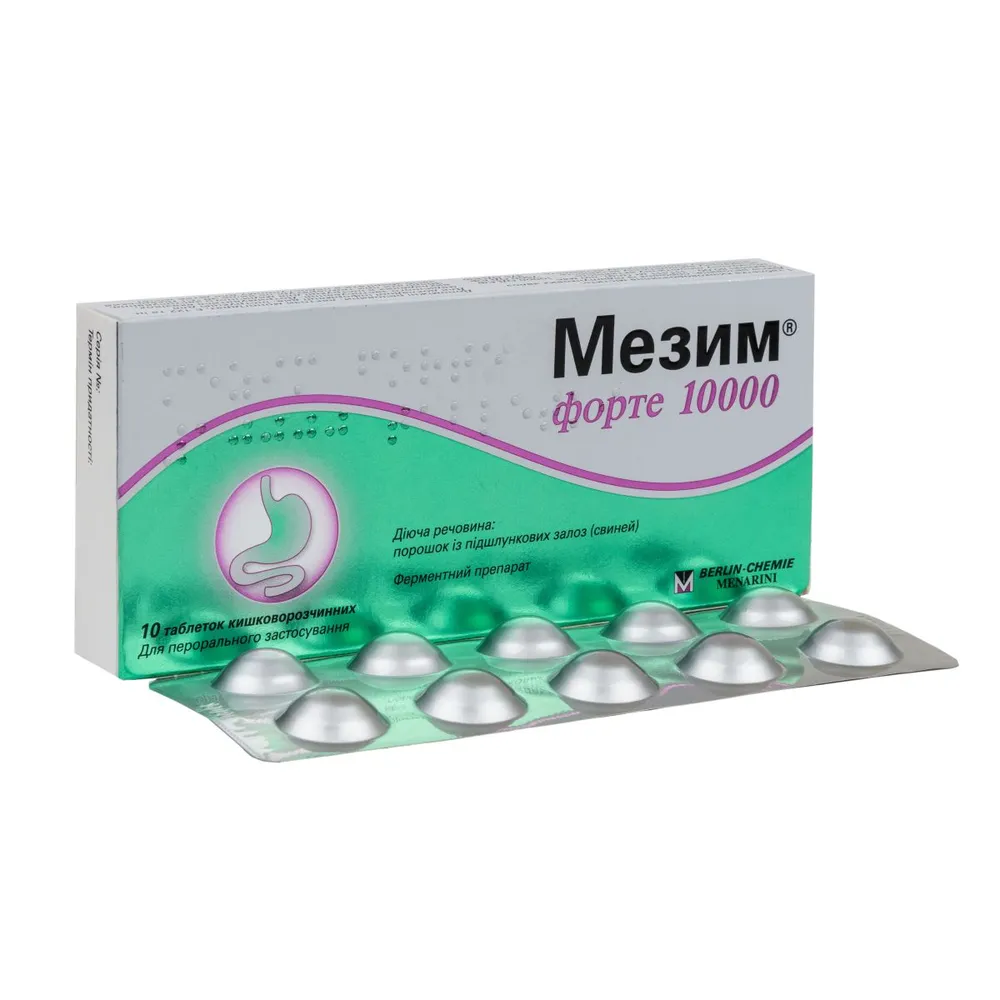
Table of Contents
INSTRUCTIONS FOR MEDICAL USE OF THE MEDICINAL PRODUCT MEZYMâ FORTE 10000 (MEZYMâ FORTE 10000)
Composition:
Active substance: pancreatic powder (from pigs);
One enteric-coated tablet contains 80.00–111.111 mg of pancreatic powder (from pigs), having a minimum lipolytic activity of 10,000 IU EP (European Pharmacopoeia units), minimum amylolytic activity of 7,500 IU EP, and minimum proteolytic activity of 375 IU EP;
Excipients: lactose monohydrate, microcrystalline cellulose, colloidal anhydrous silicon dioxide, crospovidone, magnesium stearate, hypromellose, methacrylic acid copolymer (type A), triethyl citrate, titanium dioxide (E 171), talc, simethicone, polyethylene glycol, sodium carmellose, polysorbate, azorubine (E 122), sodium hydroxide.
Pharmaceutical form. Enteric-coated tablets.
Main physicochemical properties:
Pink tablets, film-coated, with nearly flat parallel surfaces and beveled edges.
Pharmacotherapeutic group.
Digestive enzymes and other agents improving digestion. Pancreatic enzyme preparations.
ATC code A09AA02.
Pharmacological properties.
Pharmacodynamics.
The active substance of the medicinal product Mezymâ forte 10000 is a powder derived from the pancreatic glands (pancreatin) of mammals, usually pigs, which, in addition to exocrine pancreatic enzymes (lipase, alpha-amylase, trypsin, and chymotrypsin), contains other enzymes as well. Pancreatin also contains other accompanying substances that do not possess enzymatic activity.
Pharmacokinetics.
Absorption
Pancreatin powder is not absorbed in the gastrointestinal tract and is excreted in feces. Most of it is destroyed or denatured by digestive juices or with the involvement of bacteria.
Bioavailability
The enteric coating of the tablets, resistant to gastric juice, protects acid-sensitive enzymes from inactivation during passage through the stomach. The enzymes are released only after reaching the neutral or slightly alkaline environment of the small intestine, following dissolution of the coating. Since pancreatin powder is not absorbed in the gastrointestinal tract, data on its pharmacokinetics and bioavailability are lacking.
The efficacy of pancreatin powder is determined by the extent and rate of enzyme release from the dosage form.
Clinical characteristics.
Indications.
Disorders of the exocrine function of the pancreas associated with impaired digestion.
Contraindications.
Hypersensitivity to porcine pancreatin, azorubine lacquer, or to any other excipients of the drug.
Acute pancreatitis or chronic pancreatitis in the exacerbation phase (however, episodic use may be possible during the subsiding phase of exacerbation when expanding the diet, in the presence of pancreatic insufficiency). The drug should not be used in patients with obstructive intestinal obstruction.
Interaction with other medicinal products and other forms of interaction.
When using preparations containing pancreatic powder, absorption of folic acid may be reduced, which may require additional folic acid supplementation. The blood glucose-lowering effect of oral antidiabetic agents acarbose and miglitol may be reduced when used concomitantly with Mezym® forte 10000.
Special precautions for use.
As a precautionary measure, if unusual abdominal discomfort or changes in symptoms occur, patients should undergo an examination to rule out intestinal damage, especially if the patient is taking a dose exceeding 10,000 IU PE lipase per kilogram of body weight per day.
The product contains active enzymes which may damage the mucous membrane of the oral cavity, potentially leading to ulceration. Therefore, tablets should be swallowed whole, without chewing. Mezymâ forte 10000 should not be used in patients with rare hereditary forms of galactose intolerance, lactase deficiency, or glucose-galactose malabsorption syndrome.
Use during pregnancy or breastfeeding.
There are insufficient data on the use of Mezymâ forte 10000 in pregnant women. There is also inadequate information from animal studies regarding the effects on pregnancy, embryonic/fetal development, labor, or postnatal development; therefore, the potential risk to humans is unknown. For this reason, Mezymâ forte 10000 should not be used during pregnancy or lactation, except when absolutely necessary.
Ability to affect reaction speed when driving vehicles or operating machinery.
The effect of Mezymâ forte 10000 on the ability to drive vehicles or operate machinery is absent or negligible.
Method of administration and dosage.
Recommended dose per meal: 2 – 4 tablets (corresponding to 20000 – 40000 IU Ph. Eur. of lipase).
The dose of Mezymâ forte 10000 is determined according to the severity of existing pancreatic insufficiency. The usual recommended dose is 20000 – 40000 IU Ph. Eur. of lipase per meal, although it may be higher.
The goal of treatment with Mezymâ forte 10000 is to achieve or maintain normal body weight and normalize stool frequency or stool consistency. Dose escalation should be performed only under physician supervision and with the aim of alleviating symptom severity (e.g., steatorrhea, stomach pain).
The daily dose of enzymes should not exceed 15000 – 20000 IU of lipase per kilogram of body weight.
Mezymâ forte 10000 tablets should be swallowed whole with a large amount of liquid during meals, since the effectiveness of Mezymâ forte 10000 may be reduced if chewed. Enzymes released in the oral cavity may damage the mucosa.
The duration of treatment depends on the course of the disease and is determined by the physician.
Children.
Mezymâ forte 10000 may be used in children from 3 years of age. Dosage and duration of treatment are determined by the physician.
Overdose.
Administration of very high doses of pancreatic enzymes may be accompanied by hyperuricosuria and hyperuricemia. Treatment is symptomatic.
Adverse Reactions
The following classification is used to assess the frequency of adverse reactions:
Very common: ≥ 1/10;
Common: ≥ 1/100 to < 1/10;
Uncommon: ≥ 1/1000 to < 1/100;
Rare: ≥ 1/10,000 to < 1/1000;
Very rare: < 1/10,000;
Frequency not known (cannot be estimated from available data).
Cardiovascular system. Frequency not known: tachycardia.
Immune system. Very rare: immediate-type allergic reactions (skin rash, urticaria, sneezing, lacrimation, bronchospasm, dyspnea).
Frequency not known: Ponceau 4R (E 122) may cause allergic reactions.
Gastrointestinal tract. Very rare: allergic reactions affecting the gastrointestinal tract (diarrhea, abdominal pain, nausea, changes in stool characteristics).
Skin. Frequency not known: urticaria, hyperemia, pruritus, angioneurotic edema.
General disorders. Frequency not known: sensation of warmth, general weakness.
Reporting suspected adverse reactions.
Reporting of suspected adverse reactions after registration of the medicinal product is important. It allows continued monitoring of the benefit-risk balance of the medicinal product. Healthcare professionals should report any suspected adverse reactions.
Shelf life: 3 years.
Do not use the medicinal product after the expiry date stated on the packaging.
Storage conditions:
Store at a temperature not exceeding 30 °C. Keep out of reach and sight of children.
Packaging:
10 tablets in a blister; 1, 2, or 5 blisters in a cardboard box.
Supply category:
Over-the-counter (without prescription).
Manufacturer:
BERLIN-CHEMIE AG.
Manufacturer's location and address of place of business:
Glienicker Weg 125, 12489 Berlin, Germany.