Meratin
Ukraine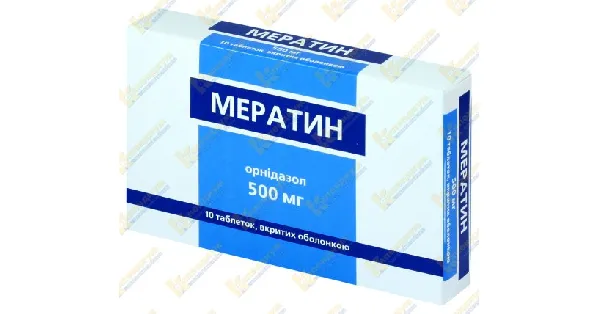
Table of Contents
INSTRUCTIONS FOR MEDICAL USE OF THE MEDICINAL PRODUCT MERAТIN (MERATIN)
Composition:
Active substance: ornidazole;
1 tablet contains ornidazole 500 mg;
Excipients: microcrystalline cellulose, maize starch, sodium methylparaben (E219), sodium propylparaben (E217), magnesium stearate, talc, colloidal anhydrous silicon dioxide, sodium starch glycolate (type A), hypromellose, titanium dioxide (E171), polyethylene glycol 6000.
Pharmaceutical form. Coated tablets.
Main physico-chemical properties: white, round, biconvex coated tablets, embossed with "500" on one side and "MERATIN" on the other.
Pharmacotherapeutic group. Agents used in amoebiasis and other protozoal infections. Nitroimidazole derivatives. Ornidazole. ATC code P01AB03.
Pharmacological properties.
Pharmacodynamics.
The mechanism of action of ornidazole is related to disruption of DNA structure in susceptible microorganisms. Ornidazole is active against Trichomonas vaginalis, Entamoeba histolytica, Giardia lamblia (Giardia intestinalis), Helicobacter pylori, as well as certain anaerobic bacteria such as Bacteroides and Clostridium spp., Fusobacterium spp., and anaerobic cocci.
Pharmacokinetics. After oral administration, 90 % of ornidazole is absorbed from the gastrointestinal tract. Maximum plasma concentration is reached within 3 hours. Plasma protein binding of ornidazole is approximately 13 %. Depending on the dosing regimen, the optimal concentration of the active substance ranges from 6 to 36 µg/L. Ornidazole is metabolized with minimal involvement of the cytochrome P450 system. The drug penetrates well into cerebrospinal fluid and other body fluids and tissues.
The elimination half-life is approximately 13 hours. After single-dose administration, 85 % of the dose is excreted within the first 5 days. The drug is excreted predominantly in urine (63 %) and feces (22 %). Approximately 4 % of the administered dose is excreted unchanged by the kidneys. The accumulation coefficient after multiple administrations of 500 mg or 1000 mg every 12 hours in healthy volunteers ranges from 1.5 to 2.5.
Clinical characteristics.
Indications.
Trichomoniasis (genitourinary infections in women and men caused by Trichomonas vaginalis).
Amebiasis (all intestinal infections caused by Entamoeba histolytica, including amoebic dysentery, and all extraintestinal forms of amebiasis, particularly amoebic liver abscess).
Giardiasis.
Contraindications.
Hypersensitivity to any component of the drug or to other derivatives of nitroimidazole. Central nervous system disorders (epilepsy, brain lesions, multiple sclerosis).
Pathological blood disorders or other hematological abnormalities.
Interaction with other medicinal products and other forms of interaction.
Alcohol should not be consumed during the treatment course and for at least 3 days after discontinuation of the drug. However, ornidazole enhances the effect of oral anticoagulants of the coumarin group, requiring appropriate adjustment of their dosage.
Ornidazole prolongs the muscle-relaxant effect of vecuronium bromide.
Concomitant use of phenobarbital and other enzyme inducers reduces the circulation period of ornidazole in serum, whereas enzyme inhibitors (e.g., cimetidine) increase it.
Special precautions.
When high doses of the drug are used or treatment lasts longer than 10 days, clinical and laboratory monitoring is recommended.
In patients with a history of blood disorders, monitoring of leukocytes is recommended, especially when repeated courses of treatment are administered.
Exacerbation of central or peripheral nervous system disorders may occur during treatment with the drug. In case of peripheral neuropathy, movement coordination disturbances (ataxia), dizziness, or impaired consciousness, treatment should be discontinued.
Exacerbation of candidiasis may occur, which will require appropriate treatment.
The risk of adverse effects increases in children, patients with liver impairment, and patients who abuse alcohol when recommended doses are exceeded.
In case hemodialysis is performed, the reduced half-life of the drug should be taken into account, and additional doses of the drug should be administered before or after hemodialysis.
Concentrations of lithium salts, creatinine, and electrolytes should be monitored during lithium therapy.
The effects of other medicinal products may be enhanced or diminished during treatment with this drug.
Use with caution in patients with impaired liver function.
Use during pregnancy or breastfeeding.
Ornidazole has not shown teratogenic or toxic effects on the fetus. Since controlled studies in pregnant women have not been conducted, the drug should be prescribed during early pregnancy or breastfeeding only when absolutely indicated and when the potential benefits to the mother outweigh the potential risks to the fetus/child.
Ability to affect reaction speed when driving or operating machinery.
When ornidazole is used, symptoms such as drowsiness, rigidity, dizziness, tremor, seizures, impaired coordination, and transient loss of consciousness may occur. The possibility of such effects should be considered in patients who drive vehicles or operate machinery.
Dosage and Administration
Meratin is taken orally after meals, swallowing with a small amount of water.
Trichomoniasis
Recommended dosing regimens:
a) 1-day treatment course: − adults and children with body weight over 35 kg: 3 tablets as a single evening dose; − daily dose for children with body weight over 20 kg: 25 mg of ornidazole per 1 kg of body weight as a single dose;
b) 5-day treatment course: − adults and children with body weight over 35 kg: 2 tablets daily (1 tablet in the morning and 1 tablet in the evening).
The drug is not recommended for children with body weight under 35 kg.
To prevent reinfection, the sexual partner should undergo the same treatment course.
Amoebiasis
Possible treatment regimens:
a) 3-day treatment course for patients with amoebic dysentery; b) 5–10-day treatment course for all forms of amoebiasis.
Recommended dosing regimen:
Table 1.
| Treatment duration |
Daily dose |
|
| Adults and children with body weight over 35 kg |
Children with body weight up to 35 kg |
|
| a) amoebic dysentery − 3 days |
3 tablets once daily in the evening. In patients with body weight over 60 kg: 4 tablets (2 tablets in the morning and 2 in the evening) |
35 kg – 3 tablets per dose 25 kg – 2 tablets per dose 13 kg – 1 tablet per dose (calculated as 40 mg of ornidazole per kg of body weight per dose) |
| b) other forms of amoebiasis – 5–10 days |
2 tablets (1 tablet in the morning and 1 in the evening) |
35 kg – 2 tablets per dose 20 kg – 1 tablet per dose (calculated as 25 mg of ornidazole per kg of body weight per dose) |
Giardiasis
For adults and children with body weight over 35 kg: single dose of 3 tablets taken once in the evening. For children with body weight under 35 kg: single dose at 40 mg/kg body weight per day.
The duration of treatment is 1–2 days.
Children.
The drug should be administered to children according to the dosing recommendations provided in the section "Directions for use and dosage***"***.
Overdose.
Manifests as an intensification of adverse reaction symptoms.
Treatment: specific antidote is unknown; in case of seizures, diazepam should be administered. Symptomatic therapy.
Adverse Reactions.
Blood and lymphatic system disorders: bone marrow suppression, leukopenia, neutropenia.
Immune system disorders: hypersensitivity reactions, including anaphylactic shock, angioneurotic edema.
Skin and subcutaneous tissue disorders: skin rashes, pruritus, urticaria.
Neurological disorders: headache, fatigue, excitement, confusion, tremor, rigidity, coordination disturbances, seizures, transient loss of consciousness, signs of sensory or mixed peripheral neuropathy, dizziness, somnolence, ataxia, spatial disorientation.
General disorders: increased body temperature, chills, general weakness, dyspnea.
Gastrointestinal disorders: nausea, vomiting, metallic taste in the mouth, dry mouth, dyspepsia, taste disturbances, coated tongue, diarrhea, epigastric pain, loss of appetite.
Hepatobiliary disorders: hepatotoxicity, jaundice, abnormal liver function biochemical parameters, elevated liver enzymes.
Infections and infestations: exacerbation of candidiasis.
Other: darkening of urine color, cardiovascular disorders, including decreased blood pressure.
Shelf life. 3 years.
Storage conditions.
Store at a temperature not exceeding 25 °C in the original packaging, in a place inaccessible to children.
Packaging.
10 tablets per blister. 1 blister per cardboard box.
Prescription category. Prescription only.
Manufacturer. Mepro Pharmaceuticals Private Limited.
Manufacturer's address.
Unit II, Q-Road, Phase IV, GIDC, Vadhavan, Surendranagar, Gujarat, 363 035, India.
Marketing Authorization Holder.
Mili Healthcare Limited.
Address of the Marketing Authorization Holder.
2nd Floor, Office Premises, 4 Charterfield House, Castle Street, Taunton, Somerset, England,
TA1 4AS, United Kingdom.