Memorin
Ukraine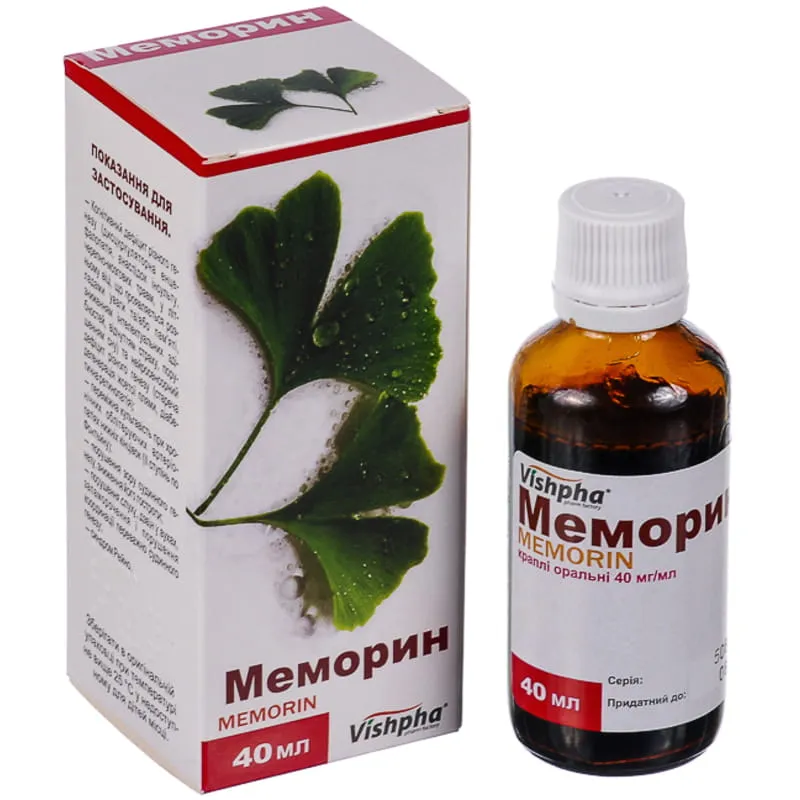
Table of Contents
INSTRUCTIONS for medical use of the medicinal product MЕMORIN (MEMORIN)
Composition:
Active substance: dry extract of Ginkgo biloba leaves;
1 ml of oral drops contains dry extract of Ginkgo biloba leaves (Ginkgonis folia) (1:50) (extraction solvent – ethanol 80%), standardized to 24% ginkgoflavonoids and 6% terpene lactones, 40 mg;
Excipient: ethanol 70%.
Pharmaceutical form. Oral drops.
Main physicochemical properties: clear liquid of dark reddish-brown color with a characteristic odor, bitter in taste.
Pharmacotherapeutic group.
Agents used in dementia. ATC code N06D X02.
Pharmacological Properties
Pharmacodynamics
Memorin is a plant-derived preparation that normalizes cellular metabolism, blood rheological properties, and microcirculation. It improves cerebral blood flow and enhances oxygen and glucose supply to the brain, prevents erythrocyte aggregation, and inhibits platelet-activating factor. It exerts a dose-dependent regulatory effect on the vascular system, stimulates the production of endothelium-derived relaxing factor (nitric oxide – NO), dilates small arteries, increases venous tone, thereby regulating vascular filling. It reduces vascular wall permeability (exhibiting anti-edematous effects both in the brain and peripherally). It demonstrates antithrombotic activity (due to stabilization of platelet and erythrocyte membranes, influence on prostaglandin synthesis, and reduction of the effects of biologically active substances and platelet-activating factor). It prevents the formation of free radicals and lipid peroxidation of cell membranes. It normalizes the release, reuptake, and catabolism of neurotransmitters (noradrenaline, dopamine, acetylcholine) and their ability to bind to receptors. It exerts an anti-hypoxic effect, improves metabolism in organs and tissues, promotes accumulation of macroergic compounds in cells, enhances oxygen and glucose utilization, and normalizes neurotransmitter processes in the central nervous system.
Pharmacokinetics
After oral administration, the drug is rapidly and completely absorbed. Complete elimination of the radiolabeled carbon-marked drug occurs within 72 hours via the kidneys and lungs. The half-life of elimination of the drug is 4.5 hours.
Clinical characteristics.
Indications.
- Symptomatic treatment of cognitive disorders in elderly patients, excluding patients with confirmed dementia, Parkinson's disease, iatrogenic cognitive disorders, or those arising as a complication of depression, vascular disorders, metabolic disorders.
- Adjunctive treatment of vertigo of vestibular origin together with vestibular rehabilitation.
- Symptomatic treatment of tinnitus.
Contraindications.
Hypersensitivity to any component of the medicinal product.
Special precautions.
Caution: The medicinal product contains 70% ethanol (i.e., 0.6 g of ethanol per dose). The product may be harmful to patients with alcoholism. The ethanol content should be taken into account when administering to pregnant women or breastfeeding women, children, and patients in high-risk groups, such as patients with liver disease or epilepsy.
Interaction with other medicinal products and other forms of interaction.
Due to the ethanol content: (0.6 g of ethanol per dose), compatibility of this medicinal product should be considered with:
- Medicinal products causing disulfiram-like reaction to alcohol: (elevated body temperature, flushing, vomiting, tachycardia): disulfiram, cefamandole, cefoperazone, latamoxef (cephalosporin antibiotics), chloramphenicol (phenicol antibiotics), chlorpropamide, glibenclamide, glipizide, tolbutamide (antidiabetic sulfonylurea hypoglycemics), griseofulvin (antifungal agents), derivatives of 5-nitroimidazole (metronidazole, ornidazole, secnidazole, tinidazole), ketoconazole, procarbazine (cytostatics);
- Central nervous system depressants.
Potentiation or inhibition of cytochrome P450 isoenzymes has been observed. Midazolam plasma concentrations were altered after concomitant administration of Ginkgo biloba, suggesting a possible interaction via CYP3A4. Therefore, medicinal products primarily metabolized via CYP3A4 and having a narrow therapeutic index should be used with caution.
Special precautions for use.
Careful monitoring is recommended for patients who are concurrently taking drugs metabolized by cytochrome P450 3A4. There is no evidence of abuse with Ginkgo biloba. Due to the pharmacological profile of the drug, Ginkgo biloba has no potential for abuse.
Use during pregnancy or breastfeeding.
This medicinal product is primarily intended for use in elderly patients, in whom the risk of pregnancy is negligible.
Due to the lack of clinical data, the use of this product is not recommended during pregnancy or breastfeeding.
Ability to influence reaction speed when driving or operating machinery.
Studies on the effect on reaction speed when driving or operating machinery have not been conducted. However, dizziness may impair the ability to drive or operate machinery.
Dosage and Administration.
Administer orally, 20 drops (1 mL contains 20 drops) three times daily during meals. The average duration of treatment course is 3 months.
Children.
Do not use in children.
Overdose.
There is no information regarding overdose of this medicinal product.
Side effects.
Rarely observed reactions:
- Gastrointestinal system: digestive disorders, dyspepsia, diarrhea, abdominal pain, nausea, vomiting;
- Immune system: hypersensitivity reactions, including angioneurotic edema, urticaria, dyspnea;
- Skin: skin inflammation, redness, swelling, rash, itching, eczema;
- Nervous system: headache, dizziness, syncope (including vasovagal).
Shelf life. 3 years.
Storage conditions.
Store in the original packaging at a temperature not exceeding 25 °C, in a place inaccessible to children.
Packaging.
40 mL in a bottle per carton.
Dispensing category.
Over-the-counter.
Manufacturer.
LLC "DKP "Pharmaceutical Factory".
Manufacturer's address and location of business activity.
4 Korolova St., Stanishivka village, Zhytomyr district, Zhytomyr region, 12430, Ukraine.