Medrolgin
Ukraine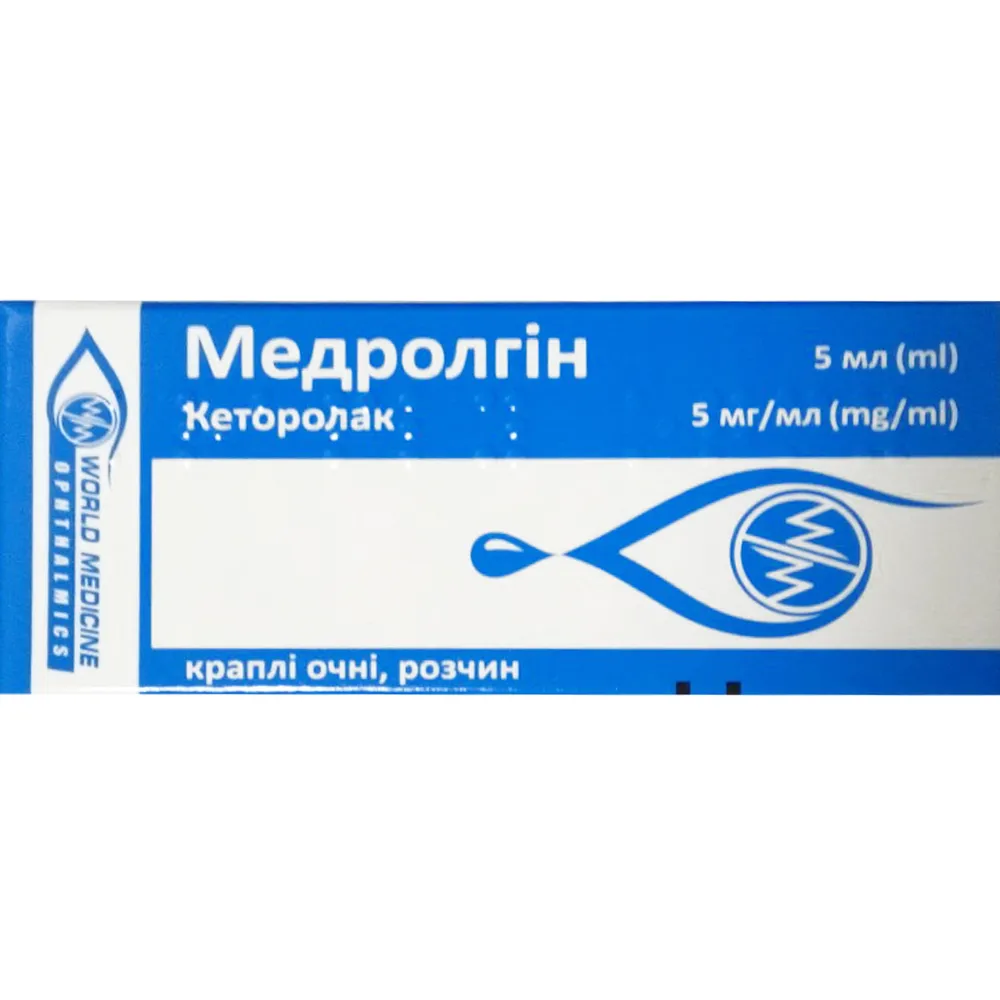
Table of Contents
INSTRUCTIONS for medical use of the medicinal product MЕDROLGIN (MEDROLGIN)
Composition:
Active ingredient: ketorolac;
1 ml of solution contains ketorolac tromethamine 5 mg;
Excipients: oxyquinol 40, disodium edetate, sodium chloride, benzalkonium chloride, sodium hydroxide or hydrochloric acid, purified water.
Pharmaceutical form. Eye drops, solution.
Main physicochemical properties: clear solution, colorless to pale yellow.
Pharmacotherapeutic group.
Non-steroidal anti-inflammatory agents. Ketorolac. ATC code S01BC05.
Pharmacological properties.
Pharmacodynamics.
Ketorolac is a nonsteroidal anti-inflammatory drug (NSAID) that exerts analgesic and anti-inflammatory effects. It acts by inhibiting cyclooxygenase, an enzyme essential for the biosynthesis of prostaglandins. When administered topically to the eye, ketorolac reduces the level of prostaglandins in the aqueous humor of the eye.
When administered systemically, it does not cause pupillary constriction. Ketorolac has no significant effect on intraocular pressure.
Pharmacokinetics.
Ophthalmic solutions of ketorolac (0.1% or 0.5%) or placebo were instilled approximately 12 hours and 1 hour before surgery. Ketorolac concentrations in the aqueous humor during surgery were at the lower limit of detection (40 ng/mL) in 1 patient and below the quantifiable limit in 7 patients who received the 0.1% solution of ketorolac. The mean concentration of ketorolac in the aqueous humor in patients who received the 0.5% solution was 95 ng/mL. The concentration of prostaglandin PGE2 in the aqueous humor was 80 pg/mL, 40 pg/mL, and 28 pg/mL in patients who received placebo, 0.1%, and 0.5% ketorolac solution, respectively.
A 21-day multiple-dose tolerability study in healthy volunteers receiving ketorolac three times daily showed that measurable plasma concentrations of ketorolac were detected in only 1 out of 13 volunteers (0.021 µg/mL). In another group of 13 volunteers, very low plasma concentrations of ketorolac (0.011–0.023 µg/mL) were detected in only 4 subjects 15 minutes after instillation of the solution.
Thus, the observation of higher ketorolac concentrations in the aqueous humor and very low or below-quantifiable-limit concentrations in plasma following ophthalmic administration suggests that ketorolac has minimal systemic absorption when used in ophthalmology.
Clinical characteristics.
Indications.
Prevention and reduction of ocular tissue inflammation following cataract extraction surgery.
Contraindications.
Hypersensitivity to the active substance and/or to excipients of the medicinal product.
Cross-reactivity with acetylsalicylic acid and other NSAIDs is possible; therefore, the use of the medicinal product is contraindicated in patients who have previously shown hypersensitivity to these drugs.
Interaction with other medicinal products and other forms of interaction.
Interaction studies have not been conducted.
Without apparent risk of intolerance, ketorolac in the form of eye drops has been used concomitantly with systemic and ophthalmic agents such as antibiotics, sedatives, beta-blockers, carbonic anhydrase inhibitors, miotics, mydriatics, local anesthetics, and cycloplegics.
Ketorolac may slow or delay wound healing. Topical corticosteroids are also known to impair or delay the healing process. Concomitant use of topical NSAIDs and topical steroids may increase the risk of healing complications (see section "Special warnings and precautions for use").
When using ketorolac eye drops together with other ophthalmic medicinal products, the interval between their administration should be at least 5 minutes.
Special precautions for use.
It has been reported that NSAIDs used for ophthalmic treatment may cause increased bleeding in ocular tissues (including hyphema) during ophthalmic surgery. The medicinal product should be used with caution in patients with a tendency to bleeding or those taking other medications that may prolong bleeding time.
Similar to other NSAIDs, ketorolac may mask the usual signs of infection. Appropriate therapy should be administered if there is a risk of infection.
All NSAIDs (including ketorolac) may delay or impair wound healing. Concomitant use of topical NSAIDs (including ketorolac) and topical corticosteroids may increase the risk of healing complications. Caution should be exercised in patients with a predisposition to corneal epithelial damage when the medicinal product is used concomitantly with topical corticosteroids. Patients should be informed about the possibility of delayed or impaired healing with the use of this medicinal product.
The use of topical NSAIDs (including ketorolac) may lead to the development of keratitis. In some patients predisposed to the condition, prolonged use of topical NSAIDs (including ketorolac) may result in corneal epithelial breakdown, corneal thinning, corneal erosion, corneal ulceration, and corneal perforation. These events may threaten vision loss. Patients showing signs of corneal epithelial breakdown should discontinue the medicinal product immediately and undergo corneal evaluation.
The medicinal product should be used with caution in patients who have undergone complicated ocular surgery, patients with corneal denervation, corneal epithelial defects, diabetes mellitus, ocular surface diseases (e.g., dry eye syndrome), rheumatoid arthritis, or those who have undergone repeated ocular surgeries within a short period, as the risk of corneal adverse reactions, potentially leading to vision loss, is increased.
Post-marketing experience with topical NSAIDs (including ketorolac) suggests that use within 1 day before or more than 14 days after surgery may increase the risk and severity of corneal adverse reactions.
During the post-marketing period, cases of bronchospasm or asthma exacerbation have been observed in patients with hypersensitivity to acetylsalicylic acid/NSAIDs or a history of asthma following the use of ketorolac eye drops. The medicinal product should be used with caution in such patients (see section "Adverse reactions").
The bottle should be closed after each use. The dropper tip should not touch the eye or any other surface to prevent contamination of the eye drops or injury. Serious eye damage with subsequent vision loss may result from the use of contaminated solutions.
The risk of adverse reactions may be minimized by using the lowest effective dose for the shortest duration necessary to control symptoms.
The medicinal product contains benzalkonium chloride, which may cause eye irritation and may discolor soft contact lenses. Contact with soft contact lenses should be avoided. Contact lenses must be removed before instillation of eye drops, and patients should wait 15 minutes after instillation before reinserting contact lenses.
Use during pregnancy or breastfeeding.
Pregnancy.
There is insufficient data on the use of ketorolac eye drops in pregnant women. Animal studies have shown reproductive toxicity. Inhibition of prostaglandin synthesis may adversely affect pregnancy, embryofetal development, and/or postnatal development.
Despite the low systemic exposure following topical ophthalmic administration of ketorolac, the medicinal product is not recommended during pregnancy.
Breastfeeding period.
With systemic administration, ketorolac passes into breast milk. The medicinal product should not be used during breastfeeding.
Fertility.
There is insufficient data on the effect of ketorolac on human fertility.
Ability to influence reaction speed when driving or operating machinery.
Transient blurred vision may occur after instillation of eye drops. Patients should wait until vision clears before driving or operating machinery.
Method of Administration and Dosage
The medicinal product is intended for topical application (into the conjunctival sac) in adults only.
The recommended dose is 1 drop instilled into the affected eye(s) three times daily. Instillations should be initiated 24 hours prior to surgical intervention, continued on the day of surgery, and maintained throughout the postoperative period for 3–4 weeks.
The solution should be administered as 1 drop into the conjunctival sac of the affected eye, gently pulling down the lower eyelid and directing the gaze upward.
When other ophthalmic medicinal products are used concomitantly, an interval of at least 5 minutes should be maintained between their administration.
Elderly Patients
No differences in safety and efficacy have been observed between elderly patients and younger patients.
Children
The safety and efficacy of ketorolac eye drops in children have not been established. The medicinal product must not be used in pediatric practice.
Overdose
There are no data regarding cases of overdose. Overdose is unlikely to occur when the medicinal product is used as recommended.
In case of accidental ingestion of eye drops, drink plenty of fluids.
Adverse Reactions
The most commonly reported adverse reactions associated with ophthalmic ketorolac administration are transient sensations of stinging and burning upon instillation.
Adverse reactions are listed by frequency: very common (≥ 1/10), common (≥ 1/100, < 1/10), uncommon (≥ 1/1,000, < 1/100), rare (≥ 1/10,000, < 1/1,000), very rare (< 1/10,000), and not known (frequency cannot be estimated from available data). Within each frequency grouping, adverse reactions are listed in order of decreasing severity.
Immune system disorders:
Common – hypersensitivity, including local allergic reactions.
Nervous system disorders:
Common – headache.
Eye disorders:
Very common – eye irritation (including burning sensation), eye pain (including stinging);
Common – superficial (punctate) keratitis, eye and/or eyelid edema, eye pruritus, conjunctival hyperemia, eye infections, eye inflammation, iritis, keratic precipitates, retinal hemorrhage, cystoid macular edema, eye injury, increased intraocular pressure, blurred and/or worsened vision;
Uncommon – corneal ulcer, corneal infiltrate, dry eye, epiphora;
Not known – corneal damage (thinning, erosion, degradation, and epithelial perforation)*.
Respiratory, thoracic and mediastinal disorders:
Not known – bronchospasm or asthma exacerbation**.
* There have been a small number of spontaneous reports of corneal adverse events, including corneal thinning, corneal erosion, epithelial damage, and corneal perforation. These events have primarily occurred in patients concurrently using topical corticosteroids and/or in the presence of risk factors (see section "Special precautions").
** During the post-marketing period, cases of bronchospasm or asthma exacerbation have been reported in patients using ophthalmic ketorolac drops, particularly in patients with hypersensitivity to acetylsalicylic acid/NSAIDs or with a history of asthma.
When NSAIDs (including ketorolac) are used in ophthalmology at recommended doses, systemic adverse reactions have not been observed.
Reporting of suspected adverse reactions.
Reporting suspected adverse reactions after medicine authorization is important. It allows ongoing monitoring of the benefit-risk balance of the medicine. Healthcare professionals should report any suspected adverse reactions via the national pharmacovigilance system.
Shelf life.
4 years.
After opening the bottle, the medicinal product can be used for up to 28 days.
Storage conditions.
Store at temperatures not exceeding 25 °C. Keep in the original packaging and out of reach of children.
Packaging.
5 mL in a dropper bottle, 1 dropper bottle per cardboard box.
Prescription status.
Prescription only.
Manufacturer.
UORLД MEDICIN ILAC SAN. VE TIDJ. A.S./
WORLD MEDICINE ILAC SAN. VE TIC. A.S.
Manufacturer's address.
15 Temmuz Mahallesi Cami Yolu Caddesi No:50 Gunesli Bagcilar/Istanbul, Turkey.
Marketing Authorization Holder.
WORLD MEDICINE, LLC, Ukraine.