Medexol
Ukraine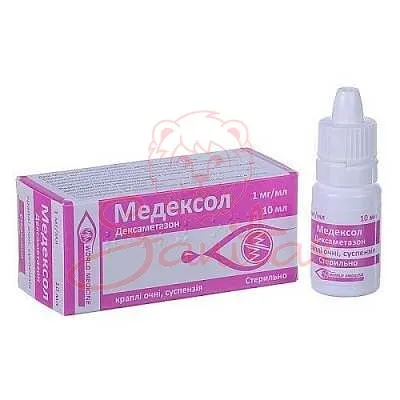
Table of Contents
INSTRUCTIONS FOR MEDICAL USE OF THE MEDICINAL PRODUCT MEDEXOL (MEDEXOL)
Composition:
Active substance: dexamethasone;
1 ml of suspension contains 1 mg of dexamethasone;
Excipients: polysorbate 80; hypromellose; disodium phosphate, dodecahydrate; citric acid, monohydrate; benzalkonium chloride; sodium chloride; disodium edetate; purified water.
Pharmaceutical form. Eye drops, suspension.
Main physicochemical properties: white or almost white suspension; sediment may be present, which rapidly re-suspends upon shaking.
Pharmacotherapeutic group.
Anti-inflammatory agents used in ophthalmology. Corticosteroids. Dexamethasone. ATC code S01BA01.
Pharmacological properties.
Pharmacodynamics.
The efficacy of corticosteroids in the treatment of inflammatory conditions of the eye is well established. Corticosteroids exert their anti-inflammatory action by inhibiting endothelial cell adhesion molecules, cyclooxygenase I or II, and cytokine release. As a result, the formation of inflammatory mediators is reduced and leukocyte adhesion to vascular endothelium is suppressed, thereby preventing their migration into inflamed ocular tissues.
Dexamethasone has potent anti-inflammatory activity with reduced mineralocorticoid effects compared to some other steroids and is one of the most potent corticosteroids available.
The high level of activity results from the addition of a methyl group and fluorine to the prednisolone molecule. This synthetic glucocorticoid suppresses inflammatory responses to mechanical, chemical, or immunological stimuli.
The exact mechanism underlying this property remains unclear.
The precise mechanism of dexamethasone’s anti-inflammatory action is not fully understood. It suppresses numerous inflammatory cytokines and exerts multiple glucocorticoid and mineralocorticoid effects.
Dexamethasone is one of the most potent corticosteroids; it is 5–10 times more potent than prednisolone and 25 times more potent than cortisone and hydrocortisone.
The systemic toxicity of the active substance is well documented. Systemic effects of dexamethasone may be associated with glucocorticoid imbalance.
Pharmacokinetics.
Absorption.
Ophthalmic bioavailability of dexamethasone after topical ocular administration has been studied in patients undergoing cataract surgery. Maximum dexamethasone concentration in the aqueous humor, approximately 30 ng/mL, was reached within 90–120 minutes. Subsequently, the concentration declined with a half-life of 3 hours. Systemic absorption following topical administration is low.
Distribution.
After intravenous administration, the observed volume of distribution was 0.58 L/kg. In vitro, no changes in plasma protein binding were observed at dexamethasone concentrations ranging from 0.04 to 4 µg/mL, with an average plasma protein binding of 77.4%.
Metabolism.
Dexamethasone is primarily metabolized in the liver, mainly by CYP3A4. After topical administration, low concentrations were detected in the aqueous humor up to 12 hours, indicating that dexamethasone is stable against metabolism after penetration into the intraocular fluid.
Excretion.
After intravenous administration, 2.6% of the unchanged parent compound was found in urine. Following oral administration (≤ 4 mg/day) over several weeks, 60% of the dose was recovered as 6β-hydroxydexamethasone and 5–10% as the additional metabolite 6β-hydroxy-20-dihydrodexamethasone. Unchanged dexamethasone was not detected in urine. The systemic plasma half-life is relatively short—3–4 hours—but may be slightly longer in males. This difference was not related to changes in systemic clearance but rather to differences in volume of distribution and body mass. Dexamethasone is approximately 77–84% bound to plasma albumin. Clearance ranges from 0.10 to 0.25 L/h/kg, and volume of distribution ranges from 0.576 to 1.15 L/kg. The bioavailability of dexamethasone after oral administration is approximately 70%.
Linearity/Non-linearity.
The area under the plasma concentration–time curve after oral administration of dexamethasone increased linearly with doses in the range of 0.5 mg to 1.5 mg.
Special patient populations.
The pharmacokinetics of systemic dexamethasone do not differ significantly in patients with impaired renal function compared to healthy subjects.
Preclinical safety data.
Repeated-dose toxicity studies of dexamethasone eye drops in rabbits revealed systemic corticosteroid-related effects; however, even at doses substantially exceeding the human dose, these effects are not considered clinically relevant. The occurrence of such effects is unlikely when dexamethasone eye drops are used at recommended doses.
Dexamethasone showed clastogenic properties in an in vitro chromosomal aberration assay in human lymphocytes and in an in vivo micronucleus test in mice.
Standard carcinogenicity studies with dexamethasone have not been conducted.
Standard fertility studies with dexamethasone have not been conducted.
It has been established that dexamethasone is teratogenic in animals following oral administration: dexamethasone caused fetal developmental abnormalities, including cleft palate, intrauterine growth retardation, retrognathia, umbilical hernia, thymic hypoplasia, skeletal deformities (including impaired development of long bones), and effects on brain growth and development.
Clinical characteristics.
Indications.
Treatment of steroid-sensitive non-infectious inflammatory and allergic conditions of the conjunctiva, cornea, and anterior segment of the eye, including inflammatory reactions in the postoperative period.
Contraindications.
- Hypersensitivity to the active substance and/or to other components of the medicinal product.
- Acute untreated bacterial infections.
- Cattle and varicella pox, and other viral infections of the cornea and conjunctiva (except keratitis caused by Herpes zoster).
- Fungal diseases of ocular structures.
- Untreated parasitic infections of the eye.
- Mycobacterial infections of the eye.
- Acute epithelial keratitis caused by Herpes zoster (dendritic keratitis).
- Acute untreated purulent bacterial infections of the eye.
- Infections or injuries limited to the superficial corneal epithelium.
- Use after removal of a foreign body from the cornea without complications.
Interaction with other medicinal products and other forms of interaction.
Studies on interaction with other medicinal products have not been conducted.
Concomitant use of locally applied ophthalmic steroids and topical nonsteroidal anti-inflammatory drugs (NSAIDs) may increase the risk of corneal wound healing complications.
In patients receiving ritonavir or other potent CYP3A4 inhibitors, plasma concentration of dexamethasone may be increased (see section "Special precautions for use"). CYP3A4 inhibitors (including ritonavir and cobicistat) may reduce dexamethasone clearance, leading to enhanced effects and adrenal suppression/Cushing's syndrome. Such interactions should be avoided unless the benefit outweighs the increased risk of developing systemic adverse effects associated with corticosteroid use. In such cases, patients should be monitored for the development of systemic corticosteroid effects.
Topical ophthalmic administration of dexamethasone may additionally increase intraocular pressure when used concomitantly with mydriatic eye drops (e.g., atropine or other anticholinergic agents), which may also cause elevation of intraocular pressure.
When administering multiple topical ophthalmic medicinal products, the interval between administrations should be at least 5 minutes. Ophthalmic ointments should be used last.
Special precautions for use.
The medicinal product is intended only for ophthalmic use. It is not intended for injection or oral administration.
The medicinal product should not be used without medical examination. It should be prescribed only after biomicroscopic examination using a slit lamp and fluorescein staining test.
This medicinal product is not effective for the treatment of Sjögren's keratoconjunctivitis.
Excessive and/or prolonged use of ophthalmic corticosteroids increases the risk of ocular complications and may lead to systemic adverse effects. If inflammation does not subside during treatment, alternative therapeutic approaches should be considered to reduce these risks.
Prolonged treatment with locally applied ophthalmic corticosteroids may lead to ocular hypertension and/or glaucoma, resulting in optic nerve damage, decreased visual acuity, visual field constriction, and formation of posterior subcapsular cataract. Patients receiving long-term topical ophthalmic corticosteroid therapy should have regular and frequent monitoring of intraocular pressure. This is particularly important in children, as the risk of corticosteroid-induced ocular hypertension is higher in children than in adults. The medicinal product is not indicated for use in children. Patients with a personal or family history of glaucoma have an increased risk of developing corticosteroid-induced elevated intraocular pressure. In patients with glaucoma, eye examinations should be performed weekly.
In acute purulent ocular infections, corticosteroids may mask or exacerbate existing infections. If treatment lasts longer than 10 days, intraocular pressure should be monitored.
Visual disturbances may occur with both systemic and topical corticosteroid use. If a patient experiences symptoms such as blurred vision or other visual disturbances, they should be referred to an ophthalmologist to evaluate possible causes, which may include cataract, glaucoma, or rare conditions such as central serous chorioretinopathy (CSCR), which has been reported following systemic and topical corticosteroid use.
Cushing’s syndrome and/or adrenal suppression due to systemic absorption of ophthalmic dexamethasone formulations may occur after intensive or long-term continuous therapy in susceptible patients, including children and patients receiving CYP3A4 inhibitors (e.g., ritonavir and cobicistat). In such cases, treatment should be tapered gradually.
Corticosteroids may reduce resistance to bacterial, viral, fungal, or parasitic infections and may mask clinical signs of infection, thereby interfering with the detection of antibiotic inefficacy.
Fungal infection should be considered in patients with persistent corneal ulceration who are receiving or have received these products. If a fungal infection develops, corticosteroid therapy should be discontinued.
Ophthalmic corticosteroids may delay corneal wound healing. Topically applied NSAIDs are also known to delay or impair corneal wound healing. Concomitant use of topical NSAIDs and topical corticosteroids may increase the risk of wound healing complications (see section "Interaction with other medicinal products and other forms of interaction").
Topical corticosteroid use is known to potentially cause perforations in patients with diseases leading to corneal or scleral thinning.
Treatment should not be discontinued prematurely due to the risk of inflammatory relapse following abrupt cessation of high-dose corticosteroid therapy.
The medicinal product should be used with particular caution and only in combination with antiviral therapy when treating Herpes simplex-induced stromal keratitis or uveitis; periodic slit-lamp microscopy is required.
Wearing contact lenses during treatment of ocular inflammation is not recommended.
The medicinal product contains benzalkonium chloride, which may cause eye irritation and is known to discolor soft contact lenses. Contact with soft contact lenses should be avoided. However, if the physician considers contact lens use acceptable, patients should be advised to remove contact lenses before instilling the eye drops and to wait 15 minutes after instillation before reinserting contact lenses. Benzalkonium chloride may cause eye irritation, particularly in patients with dry eye symptoms or corneal disorders (the transparent front layer of the eye).
After instillation of eye drops, the following measures are recommended to reduce systemic absorption:
- Keep eyelids closed for 2 minutes;
- Press the tear duct with a finger for 2 minutes.
The medicinal product contains disodium phosphate dodecahydrate (see section "Adverse reactions").
Use during pregnancy or breastfeeding.
Pregnancy.
There are no adequate or well-controlled studies evaluating the effects of topical ophthalmic dexamethasone use in pregnant women. Prolonged or repeated corticosteroid use during pregnancy has been associated with an increased risk of intrauterine growth restriction. Infants born to mothers who received significant corticosteroid doses during pregnancy should be carefully monitored for signs of adrenal insufficiency (see section "Special precautions for use"). Reproductive toxicity has been demonstrated in animal studies with systemic administration. Ophthalmic use of 0.1% dexamethasone solution caused fetal abnormalities in rabbits. The medicinal product is not recommended during pregnancy.
Breastfeeding.
Systemic administration of corticosteroids results in their presence in human breast milk in amounts that may affect the nursing infant. However, systemic exposure following topical dexamethasone use is minimal. It is not known whether dexamethasone passes into breast milk. Data on the mechanism of dexamethasone transfer into breast milk are lacking. It is unlikely that dexamethasone will be present in breast milk or cause clinical effects in infants after maternal use of the medicinal product. However, a risk to the nursing infant cannot be excluded. The possibility of temporarily discontinuing breastfeeding during treatment or discontinuing/withholding therapy should be considered, weighing the potential benefit of the medicinal product for the mother against the benefits of breastfeeding for the infant.
Fertility.
No studies have been conducted to evaluate the effect of dexamethasone on fertility following topical ophthalmic administration. There are limited clinical data on the effect of dexamethasone on reproductive function in men and women.
In rat models under the influence of chorionic gonadotropin, no adverse effects of dexamethasone on reproductive function were observed.
Ability to affect reaction speed when driving or operating machinery.
Topically applied ophthalmic dexamethasone has no or negligible effect on the ability to drive or operate machinery. As with other ophthalmic products, transient blurred vision or other visual disturbances may affect the ability to drive or operate machinery.
If blurred vision occurs after instillation, the patient should wait until vision clears before driving or operating machinery.
Method of Administration and Dosage.
The medicinal product is intended for topical use only (in the conjunctival sac).
Dosage.
Adults (including elderly patients).
In severe or acute inflammation, instill 1–2 drops of the medicinal product into the conjunctival sac(s) of the affected eye(s) every 30–60 minutes (initial therapy).
If a positive effect is observed, reduce the dose to 1–2 drops into the conjunctival sac(s) of the affected eye(s) every 2–4 hours.
Subsequently, the dose may be further reduced to 1 drop 3–4 times daily, if this dosage is sufficient to control inflammation.
If the desired response is not achieved within 3–4 days, additional systemic or subconjunctival therapy may be required.
For chronic inflammation, the dosage is 1–2 drops into the conjunctival sac(s) of the affected eye(s) every 3–6 hours, or more frequently if necessary.
For allergy or mild inflammation, the dosage is 1–2 drops into the conjunctival sac(s) of the affected eye(s) every 3–4 hours until the desired effect is achieved.
Do not discontinue treatment prematurely (see section "Special Warnings and Precautions for Use").
During treatment with this medicinal product, intraocular pressure should be monitored regularly.
Patients with hepatic and/or renal impairment.
Safety and efficacy in these patients have not been established. However, due to the low systemic absorption of dexamethasone following topical ophthalmic administration of this medicinal product, dosage adjustment is not required.
Method of Administration.
- Wash hands before instillation.
- Shake the bottle well.
- For convenience, sit in front of a mirror.
- Remove the cap. Be careful and avoid touching the dropper tip. This may contaminate the bottle contents.
- Hold the bottle upside down between the index and thumb of one hand.
- Tilt the head backward.
- With a finger of the other hand, pull down the lower eyelid.
- Bring the dropper tip close to the eye without touching it, and gently press the base of the bottle with the index finger so that 1–2 drops fall into the space between the eye and the eyelid.
- Close the eye and gently press with a finger on the inner corner of the eye near the nose for 2 minutes. This reduces the amount of medicinal product entering the bloodstream.
- If necessary, repeat the same procedure for the other eye. Immediately after instillation, tightly replace the cap on the bottle.
If more drops are instilled than recommended, rinse the eye with warm water and do not administer further doses until the next scheduled dose.
If a dose is missed, instill a single dose as soon as remembered. However, if it is almost time for the next dose, skip the missed dose and resume the regular dosing schedule. Do not administer a double dose.
To prevent contamination of the dropper tip and bottle contents, do not touch the eyelids, surrounding areas, or any other surfaces with the dropper tip. The bottle must be kept tightly closed during storage.
After instillation of eye drops, nasolacrimal occlusion or gentle eyelid closure is recommended. This reduces systemic absorption of the medicinal product administered into the eye, thereby decreasing the likelihood of systemic adverse reactions.
When using more than one topical ophthalmic product, an interval of at least 5 minutes between administrations is required. Ophthalmic ointments should be applied last.
Children.
The safety and efficacy of this medicinal product in children (under 18 years of age) have not been established.
Overdose.
No cases of overdose have been reported. In cases of acute overdose via ophthalmic administration or accidental ingestion of the bottle contents, considering the properties/characteristics of this medicinal product, additional toxic effects are not expected.
In case of local overdose, flush the excess medicinal product from the eye(s) with warm water. In case of accidental ingestion, symptomatic and supportive treatment is indicated.
Adverse Reactions
The most frequently reported adverse effect observed during clinical studies was eye discomfort.
Adverse effects were classified by frequency: very common (≥ 1/10), common (≥ 1/100 and <1/10), uncommon (≥ 1/1,000 and <1/100), rare (≥ 1/10,000 and <1/1,000), very rare (<1/10,000), frequency not known (cannot be estimated from available data). Within each frequency group, adverse effects are listed in order of decreasing severity. Data on adverse effects were obtained from clinical trials and from post-marketing experience with dexamethasone ophthalmic drops and/or ophthalmic ointment.
Infections and infestations:
Rare – ocular infections (exacerbation of existing infections or development of secondary infections).
Immune system disorders:
Frequency not known – hypersensitivity reactions.
Endocrine system disorders:
Frequency not known – Cushing's syndrome, adrenal suppression (see section "Special precautions for use").
Nervous system disorders:
Uncommon – dysgeusia; frequency not known – dizziness, headache.
Eye disorders:
Common – eye discomfort; uncommon – keratitis, conjunctivitis, dry keratoconjunctivitis, corneal pigmentation, photophobia, blurred vision (see section "Special precautions for use"), eye itching, foreign body sensation in the eye, increased lacrimation, unusual sensation in the eye, scaling at the eyelid margins, eye irritation, eye hyperemia; rare – subcapsular cataract, glaucoma, visual field constriction; frequency not known – ulcerative keratitis, increased intraocular pressure, decreased visual acuity, corneal erosion, ptosis of the eyelid, eye pain, mydriasis.
Injury, poisoning and procedural complications:
Very rare – corneal perforation.
Description of selected adverse reactions.
Prolonged treatment with corticosteroids for local ophthalmic use may lead to ocular hypertension and/or glaucoma, with subsequent optic nerve damage, decreased visual acuity and visual field, as well as development of posterior subcapsular cataract (see section "Special precautions for use").
Since the medicinal product contains a corticosteroid, in patients with conditions causing thinning of the cornea or sclera, the risk of perforation is increased, especially after prolonged use (see section "Special precautions for use").
Corticosteroids may reduce resistance to infections and increase the risk of infection (see section "Special precautions for use").
Very rarely, cases of corneal calcification have been reported in patients with severely damaged corneas using ophthalmic drops containing phosphate.
Reporting of suspected adverse reactions.
Reporting of suspected adverse reactions after medicinal product authorization is extremely important. It allows continuous monitoring of the benefit-risk balance of the medicinal product. Healthcare professionals are requested to report any suspected adverse reactions through the national reporting system.
Shelf life.
3 years.
Storage conditions.
Store at a temperature not exceeding 25 °C, in a place inaccessible to children.
After opening the bottle, the product should be used within 4 weeks.
Packaging.
10 ml suspension in a plastic dropper bottle. One dropper bottle in a cardboard box.
Prescription category.
Prescription only.
Manufacturer.
K.O. Rompharm Company S.R.L./
S.C. Rompharm Company S.R.L.
Manufacturer's address and location of operations.
Otopeni city, Eroilor str. № 1A, 075100, jud. Ilfov, Romania.
Marketing Authorization Holder.
WORLD MEDICINE, LLC, Ukraine.