Mardozia
Ukraine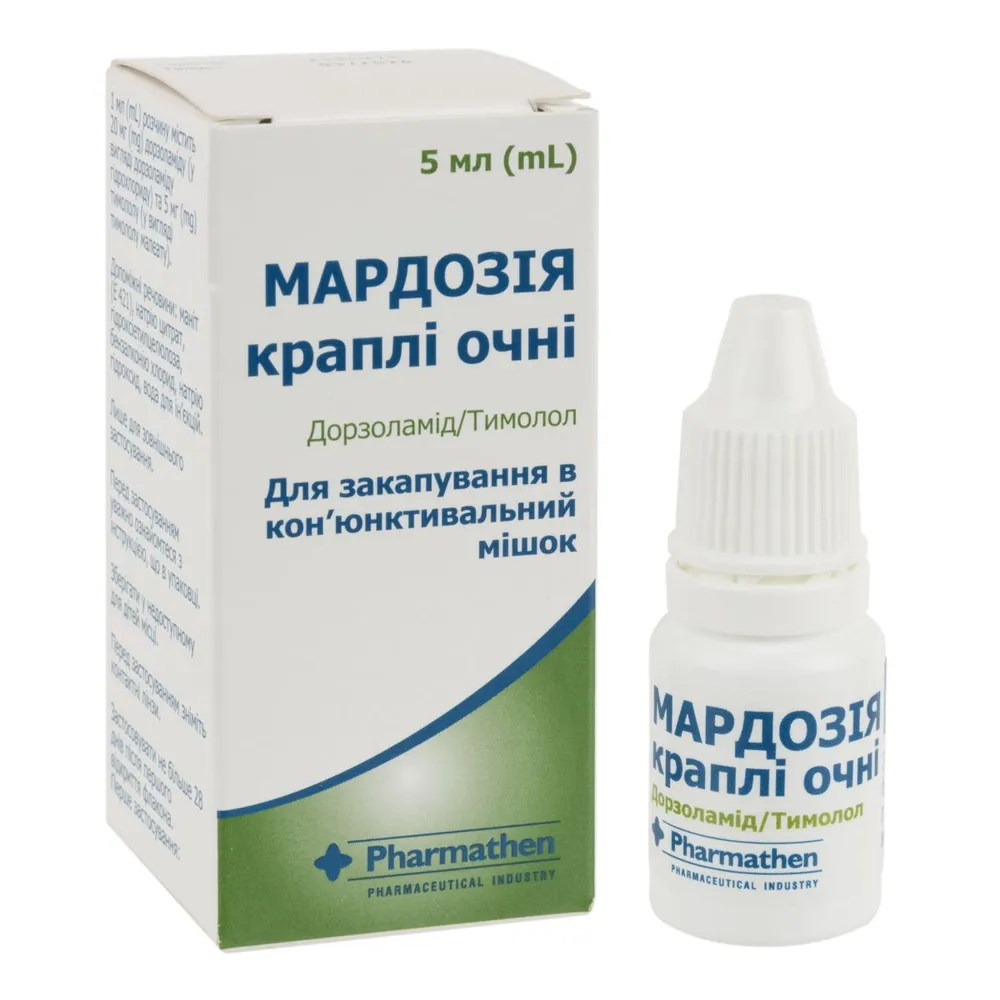
Table of Contents
INSTRUCTION FOR MEDICAL USE OF THE MEDICINAL PRODUCT MARDOZIA (MARDOZIA)
Composition:
Active substances: dorzolamide, timolol;
1 ml of solution contains 20 mg dorzolamide (as dorzolamide hydrochloride) and 5 mg timolol (as timolol maleate);
Excipients: mannitol (E 421), benzalkonium chloride, hydroxyethylcellulose, sodium citrate, sodium hydroxide, water for injections.
Pharmaceutical form. Eye drops.
Main physicochemical properties: clear, slightly viscous, colorless aqueous solution.
Pharmacotherapeutic group. Antiglaucoma preparations and miotics. Beta-adrenoreceptor blockers. Timolol, combinations.
ATC code S01E D51.
Pharmacological properties.
Pharmacodynamics.
The medicinal product contains two active substances: dorzolamide hydrochloride and timolol maleate. Each of these components reduces elevated intraocular pressure by decreasing the secretion of intraocular fluid, but through different mechanisms of action.
Dorzolamide hydrochloride is a potent inhibitor of carbonic anhydrase type II. Inhibition of carbonic anhydrase in the ciliary processes of the eye leads to a reduction in the secretion of intraocular fluid due to slowed formation of bicarbonate ions, which in turn results in reduced transport of sodium and fluid.
Timolol maleate is a non-selective beta-adrenergic receptor blocker. The exact mechanism by which timolol reduces intraocular pressure is not fully understood. Fluorescein and tonographic studies indicate that the effect of timolol is due to decreased aqueous humor secretion. In addition, timolol may enhance aqueous outflow.
The combined action of the two components results in a greater reduction of intraocular pressure compared to the use of either component alone.
Following topical administration, the medicinal product Mardozia reduces intraocular pressure regardless of whether its elevation is associated with glaucoma. Elevated intraocular pressure plays a significant role in the pathogenesis of optic nerve damage and visual field loss in glaucoma.
The medicinal product reduces intraocular pressure without causing the typical side effects associated with miotic agents, such as night blindness, accommodative spasm, and pupillary constriction.
Pharmacokinetics.
Dorzolamide hydrochloride
Following topical administration, dorzolamide enters the systemic circulation. With prolonged use, dorzolamide accumulates in erythrocytes due to binding to carbonic anhydrase type II, maintaining very low concentrations of free active substance in plasma. Dorzolamide is metabolized to a single N-desethylated metabolite, which inhibits carbonic anhydrase type II less potently than the parent compound but also inhibits the less active isoenzyme CA-I. The metabolite also accumulates in erythrocytes, where it binds primarily to carbonic anhydrase type I. Approximately 33% of dorzolamide is protein-bound in plasma. Dorzolamide is excreted in urine unchanged and as metabolite. After discontinuation of administration, dorzolamide is eliminated nonlinearly from erythrocytes, initially resulting in a rapid decline in concentration followed by a phase of slow elimination with a half-life of approximately 4 months.
Timolol maleate
Following topical ocular administration, timolol is systemically absorbed. Systemic exposure to timolol has been determined after topical administration of a 0.5% ophthalmic solution twice daily. The maximum plasma concentration after the morning dose was 0.46 ng/mL, and after the evening dose was 0.35 ng/mL.
Clinical Characteristics.
Indications.
Treatment of elevated intraocular pressure in patients with open-angle glaucoma or pseudoexfoliative glaucoma in whom monotherapy with topical beta-adrenergic blocking agents is insufficiently effective.
Contraindications.
Mardozia is contraindicated in patients:
- with reactive respiratory tract diseases, including bronchial asthma or a history of bronchial asthma, or severe chronic obstructive pulmonary disease (COPD);
- with sinus bradycardia, sick sinus syndrome, sinoatrial block, second- or third-degree atrioventricular block not controlled by a pacemaker, overt heart failure, or cardiogenic shock;
- with severe renal impairment (creatinine clearance CrCl < 30 mL/min) or hyperchloremic acidosis;
- with hypersensitivity to either of the active substances or to any component of the medicinal product;
- during pregnancy or breastfeeding.
The above contraindications are based on information regarding individual active components and are not specific to the combination.
Interaction with other medicinal products and other forms of interaction.
No specific studies on interactions between Mardozia and other medicinal products have been conducted.
In clinical trials, the medicinal product was administered concomitantly with the following systemically acting medicinal products without evidence (without confirmation) of adverse drug interactions: angiotensin-converting enzyme (ACE) inhibitors, calcium channel blockers, diuretics, non-steroidal anti-inflammatory drugs including acetylsalicylic acid, and hormones (e.g., estrogens, insulin, thyroxine).
There is a risk of additive effects leading to arterial hypotension and/or pronounced bradycardia when ophthalmic beta-adrenergic blocking solutions are used concomitantly with oral calcium channel blockers, agents depleting catecholamines, beta-adrenergic blockers, antiarrhythmic drugs (including amiodarone), digitalis glycosides, parasympathomimetics, guanethidine, narcotics, and monoamine oxidase inhibitors (MAOIs).
Potentiation of systemic beta-blockade (e.g., reduced heart rate, depression) has been reported with concomitant use of CYP2D6 inhibitors (e.g., quinidine, fluoxetine, paroxetine) and timolol.
Although the medicinal product itself (as monotherapy) has minimal or no effect on pupil size, mydriasis has occasionally been reported following concomitant use of ophthalmic beta-adrenergic blocking agents and adrenaline (epinephrine).
Beta-adrenergic blockers may enhance the hypoglycemic effect of antidiabetic agents.
Oral beta-adrenergic blockers may provoke rebound arterial hypertension upon withdrawal of clonidine.
Special precautions for use.
Reactions affecting the cardiovascular and respiratory systems
Like other topically applied ophthalmic medicinal products, timolol is absorbed systemically. Since timolol is a beta-adrenergic blocking agent, there is a risk of developing adverse reactions affecting the cardiovascular and respiratory systems, similar to those seen with systemic administration of such agents. The incidence of systemic adverse reactions after topical administration of ophthalmic medicinal products is lower than with systemic administration. For information on reducing systemic absorption, see section "Dosage and administration".
Cardiac disorders
Patients with cardiovascular disorders (e.g., ischemic heart disease, vasospastic angina/Prinzmetal's angina, and heart failure) and hypotension should be carefully evaluated before initiating beta-adrenergic blocking agents, and alternative therapies should be considered. Patients with cardiovascular disorders should be monitored for signs of worsening of these conditions and for adverse reactions. Because of the negative effect on conduction time, beta-adrenergic blocking agents should be used with caution in patients with first-degree heart block.
Vascular disorders
Patients with severe disorders or diseases of the peripheral vascular system (such as severe forms of Raynaud's disease or Raynaud's syndrome) should be treated with caution.
Respiratory disorders
Respiratory reactions, including fatal bronchospasm, have been reported in asthmatic patients following the use of certain ophthalmic beta-adrenergic blocking agents.
MarDOSIA should be used with caution in patients with mild to moderate chronic obstructive pulmonary disease (COPD), and only if the expected benefit outweighs the potential risk.
Hepatic function impairment
The use of this medicinal product has not been studied in patients with hepatic impairment, and therefore it should be used with caution in such patients.
Immunological and hypersensitivity reactions
Like other topically applied ophthalmic medicinal products, this medicinal product may be systemically absorbed.
Dorzolamide, like sulfonamides, contains a sulfonamide group. Therefore, adverse reactions observed with systemic administration of sulfonamide-containing drugs may also occur with topical use, including severe reactions such as Stevens-Johnson syndrome and toxic epidermal necrolysis. If signs of serious reactions or hypersensitivity occur, the use of the medicinal product should be discontinued.
Local ocular adverse reactions similar to those observed with dorzolamide hydrochloride ophthalmic solutions have been reported with this medicinal product. If such reactions occur, discontinuation of this medicinal product should be considered.
Patients with atopy or a history of severe anaphylactic reactions to multiple allergens may be more sensitive to re-exposure to such allergens during anaphylactic reactions when taking beta-adrenergic blocking agents and may not respond to the usual doses of adrenaline.
Concomitant therapy
The effect on intraocular pressure or known systemic effects of beta-adrenergic blocking agents may be potentiated when timolol is used in patients already receiving systemic beta-blockers. The response to treatment in such patients should be carefully monitored. The use of two topical beta-adrenergic blocking agents is not recommended (see section "Interaction with other medicinal products and other forms of interaction").
The concomitant use of dorzolamide and oral carbonic anhydrase inhibitors is not recommended.
Discontinuation of treatment
As with systemic beta-adrenergic blocking agents, discontinuation of ophthalmic timolol products should be gradual if the drug needs to be withdrawn in patients with ischemic heart disease (IHD).
Additional effects of beta-adrenergic blockers
Hypoglycemia/Diabetes
Beta-adrenergic blocking agents should be used with caution in patients prone to spontaneous hypoglycemia or in patients with labile diabetes, as beta-blockers may mask the symptoms of hypoglycemia.
Beta-adrenergic blocking agents may also mask the signs of hyperthyroidism. Abrupt withdrawal of beta-blockers may lead to worsening of symptoms.
Beta-adrenergic blocker therapy may exacerbate symptoms in patients with myasthenia gravis.
Corneal disorders
Ophthalmic beta-adrenergic blocking agents may cause dry eyes. Patients with corneal disorders should be treated with caution.
Ophthalmic beta-adrenergic blocking agents may block the systemic effects of beta-adrenergic agonists, such as adrenaline. The anesthesiologist must be informed that the patient is using timolol.
Additional effects of carbonic anhydrase inhibitors
Treatment with oral carbonic anhydrase inhibitors has been associated with the development of urolithiasis due to disturbances in acid-base balance, especially in patients with a history of kidney stones. Although acid-base disturbances have not been observed with this medicinal product, rare cases of urolithiasis have been reported. Since carbonic anhydrase inhibitors are systemically absorbed after topical administration, patients with a history of kidney stones may have an increased risk of developing urolithiasis when using MarDOSIA.
Other special considerations
Treatment of patients with acute angle-closure glaucoma requires additional therapeutic measures beyond intraocular pressure-lowering agents. The use of this medicinal product has not been studied in patients with acute angle-closure glaucoma.
Corneal edema and irreversible corneal decompensation have been reported with dorzolamide use in patients with pre-existing chronic corneal disorders and/or a history of intraocular surgery. Corneal edema is highly likely to occur in patients with a low number of endothelial cells. Precautions should be taken when prescribing MarDOSIA to such patients.
Choroidal detachment has been reported following filtration procedures when aqueous suppressants (e.g., timolol, acetazolamide) were administered.
As with other antiglaucoma agents, reduced responsiveness to ophthalmic timolol maleate has been reported in some patients after prolonged treatment. However, in clinical studies involving 164 patients followed for at least three years, no significant difference was observed in mean intraocular pressure after initial pressure stabilization.
Use of contact lenses
MarDOSIA contains the preservative benzalkonium chloride, which may cause eye irritation. Contact lenses should be removed before instilling the product and at least 15 minutes should elapse before reinserting them. Benzalkonium chloride is known to discolor soft contact lenses.
Use during pregnancy or breastfeeding.
This medicinal product should not be used during pregnancy.
It is unknown whether dorzolamide is excreted in human milk. Timolol is excreted in breast milk; therefore, breastfeeding should be discontinued during treatment.
Ability to affect reaction speed when driving or operating machinery.
No studies on the effect of the medicinal product on the ability to drive or operate machinery have been conducted. Possible adverse reactions such as blurred vision may negatively affect the ability of some patients to drive or operate machinery.
Administration and Dosage
Instill 1 drop of the medication into the conjunctival sac of the affected eye(s) twice daily.
If another topical ophthalmic agent is being used simultaneously, the interval between administration of Mardozia and the other medication should be at least 10 minutes.
Application of nasolacrimal occlusion or eyelid closure for 2 minutes reduces systemic absorption. This may lead to a reduction in systemic adverse effects and an increase in local activity.
Patients should wash their hands before using the medication and avoid contact between the dropper tip and the surface of the eye or eyelids. To ensure proper dosing, the dropper tip opening must not be enlarged.
Patients should be advised that ophthalmic solutions may become contaminated with common bacteria known to cause eye infections if handled improperly. Use of contaminated solutions may lead to serious eye damage and subsequent vision loss.
To reduce systemic absorption, thereby minimizing systemic adverse effects and increasing local efficacy, it is recommended to apply nasolacrimal occlusion or close the eyelids for 2 minutes after instillation.
Children
Do not use.
Overdose
There are no data on accidental overdose or intentional ingestion of eye drops containing dorzolamide and timolol.
Symptoms
There have been reports of accidental overdose with ophthalmic timolol maleate solution, which may result in systemic effects such as dizziness, headache, dyspnea, bradycardia, bronchospasm, and cardiac arrest—similar to those observed with systemic beta-blocker overdose. The most likely symptoms of dorzolamide overdose include disturbances in electrolyte balance, development of acidosis, and possible effects on the central nervous system.
Limited data are available on accidental overdose or intentional ingestion of dorzolamide hydrochloride. Somnolence has been reported after oral intake. With topical use, nausea, dizziness, headache, weakness, unusual dreams, and dysphagia have been reported.
Treatment
Treatment is symptomatic and supportive. Serum electrolyte levels (particularly potassium) and blood pH should be monitored. Studies have shown that timolol is not completely removed by dialysis.
Adverse reactions.
In clinical studies, adverse reactions observed with the dorzolamide/timolol combination were consistent with those previously reported with dorzolamide hydrochloride and/or timolol maleate.
Like other ophthalmic agents applied locally, timolol is absorbed into the systemic circulation. This may cause systemic effects similar to those observed with systemic beta-adrenergic blockers. The incidence of systemic adverse reactions after topical ophthalmic administration is lower than with systemic administration.
Adverse reactions observed during clinical trials or post-marketing surveillance with dorzolamide/timolol combination or its individual components are listed below by system organ classes.
Immune system disorders
Dorzolamide/timolol ophthalmic solution: symptoms of systemic allergic reactions, including angioedema, urticaria, pruritus, rash, anaphylactic reaction.
Timolol maleate ophthalmic solution: symptoms of allergic reactions, including angioedema, urticaria, localized or generalized rash, anaphylactic reaction, pruritus**.
Metabolism and nutrition disorders
Timolol maleate ophthalmic solution: hypoglycemia**.
Psychiatric disorders
Timolol maleate ophthalmic solution: depression*, insomnia*, nightmares*, memory loss, hallucinations**.
Nervous system disorders
Dorzolamide hydrochloride ophthalmic solution: headache*, dizziness*, paresthesia* (skin sensory disturbances).
Timolol maleate ophthalmic solution: headache*, dizziness*, syncope*, paresthesia*, exacerbation of signs and symptoms of myasthenia gravis, decreased libido*, hemorrhagic stroke*, cerebral ischemia.
Eye disorders
Dorzolamide/timolol ophthalmic solution: burning and stinging, conjunctival injection, blurred vision, corneal erosion, ocular pruritus, lacrimation.
Dorzolamide hydrochloride ophthalmic solution: eyelid inflammation*, eyelid irritation*, iridocyclitis*, eye irritation including redness*, eye pain*, eyelid skin peeling*, transient myopia (resolves upon discontinuation of treatment), corneal edema*, intraocular pressure reduction*, ciliary detachment (after filtration surgery), foreign body sensation in the eye*.
Timolol maleate ophthalmic solution: eye irritation symptoms, including blepharitis*, keratitis*, decreased corneal sensitivity, dry eyes*, visual disturbances including refractive changes (in some cases due to discontinuation of miotics)*, ptosis, diplopia, ciliary detachment after filtration surgery*, pruritus**, lacrimation**, redness**, blurred vision**, corneal erosion**.
Ear and labyrinth disorders
Timolol maleate ophthalmic solution: tinnitus*.
Cardiac disorders
Timolol maleate ophthalmic solution: bradycardia*, chest pain*, tachycardia*, arrhythmia*, congestive heart failure*, cardiac arrest*, heart block*, atrioventricular block**, heart failure**.
Dorzolamide hydrochloride ophthalmic solution: tachycardia*, tachycardia *with frequency "not known".
Vascular disorders
Timolol maleate ophthalmic solution: hypotension*, claudication, Raynaud's phenomenon*, cold sensation in hands and feet*.
Dorzolamide hydrochloride ophthalmic solution: hypertension *with frequency "not known".
Respiratory, thoracic and mediastinal disorders
Dorzolamide/timolol ophthalmic solution: sinusitis, dyspnea, respiratory failure, rhinitis, bronchospasm rarely.
Dorzolamide hydrochloride ophthalmic solution: epistaxis*, dyspnea*.
Timolol maleate ophthalmic solution: dyspnea (difficulty breathing)*, bronchospasm (mainly in patients with pre-existing bronchospastic disease)*, respiratory failure, cough*.
Gastrointestinal disorders
Dorzolamide/timolol ophthalmic solution: dysgeusia (altered taste sensation).
Dorzolamide hydrochloride ophthalmic solution: nausea*, dyspepsia*, throat irritation, dry mouth*.
Timolol maleate ophthalmic solution: diarrhea, dry mouth*, dysgeusia (altered taste sensation)**, abdominal pain**, vomiting**.
Skin and subcutaneous tissue disorders
Dorzolamide/timolol ophthalmic solution: contact dermatitis, Stevens-Johnson syndrome, toxic epidermal necrolysis.
Dorzolamide hydrochloride ophthalmic solution: rash*.
Timolol maleate ophthalmic solution: alopecia*, psoriatic rash or exacerbation of psoriasis*, skin rash**.
Musculoskeletal and connective tissue disorders
Timolol maleate ophthalmic solution: systemic lupus erythematosus, myalgia**.
Renal and urinary disorders
Dorzolamide/timolol ophthalmic solution: urolithiasis.
Reproductive system and breast disorders
Timolol maleate ophthalmic solution: Peyronie's disease*, decreased libido, sexual dysfunction**.
General disorders and administration site conditions
Dorzolamide hydrochloride ophthalmic solution: asthenia/weakness*.
Timolol maleate ophthalmic solution: asthenia/weakness*.
* These adverse reactions were also observed during post-marketing surveillance with dorzolamide/timolol ophthalmic solution.
** Additional adverse reactions observed with ophthalmic beta-adrenergic blockers, which may likely occur with dorzolamide/timolol products.
Shelf life. 3 years.
Do not use after the expiry date stated on the packaging. Use within 28 days after first opening of the bottle.
Storage conditions. Store at temperatures not exceeding 25 °C in the original packaging to protect from light. Keep out of reach of children.
Packaging. 5 mL of ophthalmic solution in dropper bottles closed with caps having a tamper-evident seal. One dropper bottle in a cardboard box.
Prescription category. Prescription only.
Manufacturer. Pharmathen S.A.
Manufacturer's address and place of business.
Dervenakion 6, Pallini Attiki 15351, Greece.