Maltofer®
Ukraine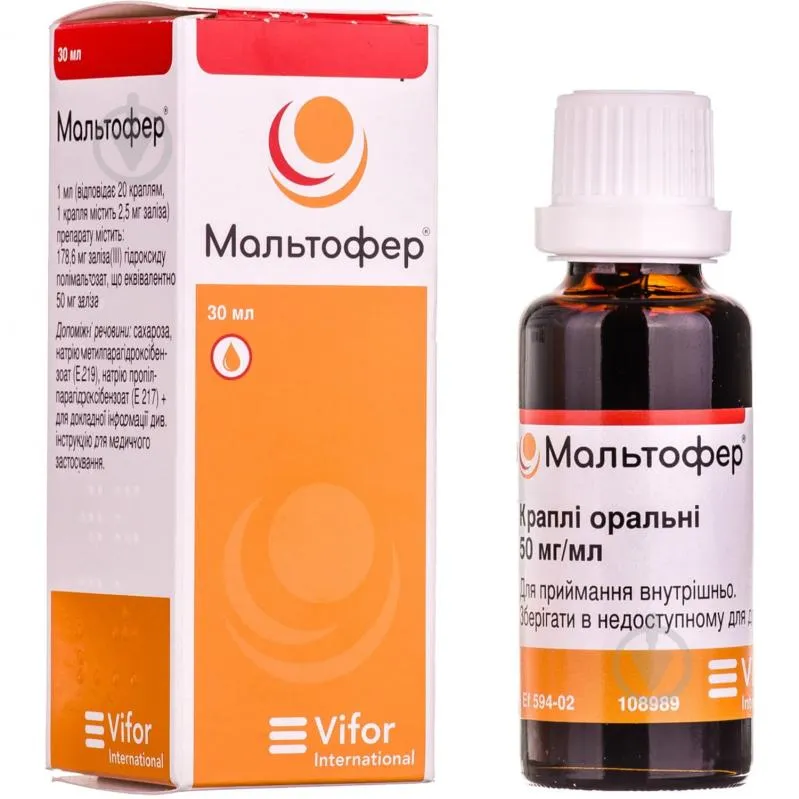
Table of Contents
INSTRUCTIONS FOR MEDICAL USE OF THE MEDICINAL PRODUCT MALTIFER® (MALTOFER®)
Composition:
Active substance:
1 ml (corresponding to 20 drops; 1 drop contains 2.5 mg of iron) of the preparation contains 178.6 mg of iron (III) hydroxide polymaltose complex, equivalent to 50 mg of iron;
Excipients:
sucrose, sodium methylparahydroxybenzoate (E 219), sodium propylparahydroxybenzoate (E 217), cream flavor, sodium hydroxide, purified water.
Pharmaceutical form.
Oral drops.
Main physicochemical characteristics:
dark brown colored solution.
Pharmacotherapeutic group.
Antianaemic agents. Iron (III) preparations for oral use. ATC code B03AB05.
Pharmacological Properties
Pharmacodynamics
The surface of the iron(III) hydroxide core within the polymaltose complex is surrounded by non-covalently bound polymaltose molecules, resulting in an average molecular weight of approximately 50 kDa. The structure of the iron(III) hydroxide core in the iron-polymaltose complex resembles that of ferritin—the physiological protein storage form of iron. The iron polymaltose complex is stable and does not release large amounts of free iron under normal physiological conditions. Due to its size, diffusion of the iron polymaltose complex across the mucous membrane is approximately 40 times lower than that of most water-soluble iron(II) salts, which exist in aqueous solutions as the hexaaqua-iron(II) complex. Iron from the polymaltose complex is absorbed in the intestine via active mechanisms.
Absorbed iron binds to transferrin and is used for hemoglobin synthesis in the bone marrow or stored primarily in the liver in the form of ferritin-bound iron.
Clinical Efficacy
The efficacy of Maltofer® in normalizing hemoglobin levels and restoring iron stores, compared to placebo or other iron preparations in various dosage forms, has been demonstrated in numerous clinical studies involving infants, children, adolescents, and adults. Both solid and liquid dosage forms of the iron polymaltose complex were used in these studies. The primary goal of oral iron replacement therapy is to maintain the body's endogenous iron stores within the normal range (to prevent iron deficiency, e.g., in conditions of increased demand), replenish iron stores, or correct existing iron-deficiency anemia.
Clinical Studies in Adults
A total of 11 controlled clinical trials of monotherapy with iron(III) hydroxide polymaltose complex were conducted, comparing it to placebo and/or oral iron(II) preparations.
More than 900 patients were enrolled in these studies, approximately 500 of whom received monotherapy with iron(III) hydroxide polymaltose complex. At the start of treatment, no significant differences were observed between patient groups in hematological parameters or iron status (hemoglobin [Hb] level, mean corpuscular volume [MCV], serum ferritin). Oral replacement therapy with the iron hydroxide polymaltose complex at doses of 100–200 mg iron/day over several weeks, up to a maximum of six months, resulted in clinically significant increases in iron and hematological parameters at the end of treatment compared to baseline. Improvement in hematological parameters (Hb, MCV, serum ferritin) after a 12-week course of therapy with the iron polymaltose complex was comparable to that achieved with iron(II) sulfate.
The efficacy of the iron polymaltose complex in treating adult patients with iron-deficiency anemia was compared to that of iron(II) sulfate in a meta-analysis of six prospective randomized clinical trials. The total number of patients included in the meta-analysis was 557; 319 received iron hydroxide polymaltose complex and 238 received iron(II) sulfate. The mean baseline hemoglobin level was 10.35 ± 0.92 g/dL (in the iron polymaltose complex group) and 10.20 ± 0.93 g/dL (in the iron(II) sulfate group). After a treatment period averaging 8–13 weeks with equivalent doses, the mean hemoglobin level was 12.13 ± 1.19 g/dL (in the iron polymaltose complex group) and 11.94 ± 1.84 g/dL (in the iron(II) sulfate group), p = 0.93. Hemoglobin levels increased more with longer treatment duration for both agents.
Clinical Studies in Children and Adolescents
The use of Maltofer® in the treatment of children and adolescents (up to 18 years of age) has been investigated in numerous clinical trials involving over 1,000 patients. The efficacy of Maltofer® in improving iron parameters has been confirmed in comparison with placebo or other iron preparations.
Pharmacokinetics
Absorption and Distribution
Studies using radiolabeled iron(III) hydroxide polymaltose complex have shown a good correlation between iron absorption and iron accumulation in hemoglobin. There is a correlation between the degree of iron deficiency and the relative amount of iron absorbed (the greater the iron deficiency, the higher the absorption). It has been established that, unlike iron(II) salts, food does not negatively affect the bioavailability of iron from Maltofer®: a clinical study demonstrated a significant increase in iron bioavailability when administered with food, while three other studies showed only a positive trend without a statistically significant clinical effect.
Elimination
Iron that is not absorbed is excreted in the feces.
Clinical characteristics.
Indications.
Treatment of iron deficiency without anemia and iron-deficiency anemia.
Iron deficiency and its severity must be confirmed by appropriate laboratory tests.
Contraindications.
- Known hypersensitivity or intolerance to the active substance or any component of the medicinal product;
- Excess iron in the body (e.g., hemochromatosis, hemosiderosis);
- Disorders of iron elimination mechanisms (lead anemia, sideroachrestic anemia, thalassemia);
- Anemias not caused by iron deficiency (e.g., hemolytic anemia, megaloblastic anemia due to vitamin B12 deficiency).
Interaction with other medicinal products and other types of interactions.
Studies in rats using tetracycline, aluminium hydroxide, acetylsalicylic acid, sulfasalazine, calcium carbonate, calcium acetate, calcium phosphate combined with vitamin D3, bromazepam, magnesium aspartate, D-penicillamine, methyldopa, paracetamol, and auranofin did not reveal any interaction with iron(III) hydroxide polymaltose complex.
In vitro studies showed no interaction between iron(III) hydroxide polymaltose complex and the following food components: phytic acid, oxalic acid, tannins, sodium alginate, choline and choline salts, vitamin A, vitamin D3, vitamin E, soybean oil, and soy flour. Study results indicate that iron(III) hydroxide polymaltose complex can be administered during or immediately after food intake.
Interaction between iron(III) hydroxide polymaltose complex and tetracycline or aluminium hydroxide was investigated in three clinical studies (crossover studies involving 22 patients in each study). No significant reduction in tetracycline absorption was observed. Tetracycline plasma concentrations did not fall below the level required for bacteriostatic effect. Administration of aluminium hydroxide and tetracycline did not reduce iron absorption from iron(III) hydroxide polymaltose complex. Therefore, iron(III) hydroxide polymaltose complex may be used concomitantly with tetracyclines, other phenolic compounds, and aluminium hydroxide.
Concomitant use of parenteral iron preparations and Maltofer® is not recommended, as such use would inhibit absorption of orally administered iron preparations. Parenteral iron preparations may be used only when treatment with oral iron preparations is unsuitable.
The use of the medicinal product does not affect the results of the fecal occult blood test (hemoglobin-sensitive test); therefore, there is no need to discontinue treatment with the medicinal product.
Special precautions for use
Treatment of anemia should always be carried out under medical supervision. If there is no improvement in hematological parameters (an increase in hemoglobin levels by approximately 20–30 g/L within 3 weeks after initiating treatment), the treatment regimen should be reevaluated.
Caution should be exercised in patients receiving repeated blood transfusions, as red blood cells already contain iron stores, and administration of the drug may lead to iron overload. Infections and tumors may cause the development of anemia. Oral iron preparations may be administered after treating the underlying disease, taking into account the benefit/risk ratio.
Administration of iron polymaltose complex may result in darkening of the stool; however, this is not of clinical significance.
When prescribing the medication to patients with diabetes mellitus, it should be noted that 20 drops (1 mL of solution) contain 0.01 bread units.
One milliliter of Maltifer® oral drops contains 5 mg of sodium. This amount corresponds to 0.25% of the WHO recommended maximum daily sodium intake for adults of 2 g.
Maltifer® oral drops contain sodium methylparahydroxybenzoate (E 219) and sodium propylparahydroxybenzoate (E 217), which may cause allergic reactions (possibly delayed).
The medication must not be administered to patients with rare hereditary fructose intolerance, glucose-galactose malabsorption, or sucrase-isomaltase deficiency, as Maltifer® oral drops contain sucrose.
Sucrose may be harmful to teeth.
Iron preparations should be used with caution in patients with the following conditions: leukemia, chronic liver or kidney diseases, inflammatory gastrointestinal disorders, peptic ulcer of the stomach or duodenum, intestinal diseases (enteritis, ulcerative colitis, Crohn's disease).
Clinical data on the use of Maltifer® in patients with hepatic or renal insufficiency are limited. A careful benefit/risk assessment must be performed in these patients before prescribing Maltifer®.
Use during pregnancy or breastfeeding
Data on use during the first trimester of pregnancy do not indicate adverse effects on pregnancy or on fetal or neonatal health. Epidemiological data are lacking. Animal studies have not revealed direct or indirect harmful effects on pregnancy, embryonic or fetal development. However, the drug should be used with caution during pregnancy.
Human breast milk contains iron bound to lactoferrin. It is unknown how much iron from the iron(III) hydroxide polymaltose complex passes into breast milk. It is unlikely that administration of Maltifer® will have an adverse effect on a breastfed infant.
Use of Maltifer® during pregnancy or breastfeeding is recommended only after consultation with a physician. A benefit/risk assessment should be performed.
Ability to affect reaction speed when driving or operating machinery
No specific studies have been conducted. It is unlikely that Maltifer® affects reaction speed during driving or operating machinery.
Dosage and Administration.
The dose and duration of treatment with the medicinal product depend on the degree of iron deficiency.
The daily dose can be taken once or divided into several doses.
Maltifer ® should be taken during or immediately after meals.
Maltifer ® oral drops can be mixed with fruit and vegetable juices or with infant formula. A slight change in the color of the mixture does not affect the efficacy or taste of the medicinal product.
To obtain an accurate dose of Maltifer® drops, the bottle should be turned upside down and held vertically. Drops will form directly at the tip of the bottle; if not, the bottle should be tilted slightly until a drop forms. Do not shake the bottle.
The treatment duration for iron-deficiency anemia is on average 3–5 months. After this period, the administration of the medicinal product should be continued at the appropriate dosage for the treatment of iron deficiency without anemia in order to replenish iron stores. The treatment duration for latent iron deficiency without anemia is 1–2 months.
Daily iron dose .
|
Category of patients |
Iron-deficiency anemia |
Iron deficiency without anemia |
|
Infants up to 1 year of age |
10-20 drops (25-50 mg) |
6-10 drops (15-25 mg) |
|
Children from 1 to 12 years of age |
20-40 drops (50-100 mg) |
10-20 drops (25-50 mg) |
|
Adolescents from 12 years and adults |
40-120 drops (100-300 mg) |
20-40 drops (50-100 mg) |
Premature infants: 2.5–5 mg of iron per kg of body weight (1–2 drops) daily for 3–5 months.
Children.
The drug may be administered to children from birth (including premature infants).
Overdose.
In case of overdose, intoxication or iron accumulation are unlikely due to the low toxicity of the iron(III) hydroxide polymaltose complex (in mice and rats, the lethal dose for 50% of animals (LD50) is > 2000 mg of iron per kg of body weight); iron absorption saturation is expected. No cases of accidental overdose with fatal outcomes have been reported.
Adverse reactions.
Undesirable effects are classified by frequency of occurrence into the following categories: very common (> 1/10), common (≥ 1/100 to < 1/10), uncommon (≥ 1/1,000 to < 1/100), rare (< 1/1,000).
The safety and tolerability of Maltofer® were evaluated based on a meta-analysis of data from 24 publications and clinical trial reports involving 1,473 patients who received the drug. The most significant adverse drug reactions reported in these trials involved four organ system classes (see below).
Discoloration of stool is a well-known adverse reaction associated with oral iron preparations, but this phenomenon is not clinically significant and is often not reported. Other common adverse events included gastrointestinal disorders (nausea, constipation, diarrhea, and abdominal pain).
Immune system.
Very rare: allergic reactions.
Gastrointestinal tract.
Very common: change in stool color*.
Common: diarrhea, nausea, abdominal pain (including abdominal pain, dyspepsia, epigastric discomfort, bloating), constipation.
Uncommon: vomiting (including vomiting, belching), discoloration of dental enamel, gastritis.
Skin and subcutaneous tissue.
Uncommon: pruritus, rash (including rash, macular rash, bullous rash**, urticaria**, erythema**).
Nervous system.
Uncommon: headache.
Musculoskeletal and connective tissue.
Rare: muscle spasms (including involuntary muscle contractions, tremor), myalgia.
*The incidence rate of stool color change according to the meta-analysis is lower; however, this is a well-known adverse event associated with oral iron preparations. Therefore, stool discoloration has been classified as a very common adverse reaction.
**Information on these events was obtained from spontaneous post-marketing reports; according to assessment, the frequency is < 1/491 (upper limit of 95% confidence interval).
Maltofer® oral drops contain parahydroxybenzoate as a preservative, which may cause allergic reactions (possibly delayed).
Shelf life.
3 years.
Storage conditions.
Store in a light-protected place at a temperature not exceeding 25 °C. Keep out of reach of children!
Packaging.
30 ml in a bottle with dropper; 1 bottle per cardboard box.
Prescription status.
Prescription only.
Manufacturer.
Vifor (International) Inc., Switzerland.
Manufacturer's name and address of place of business.
Rechenstrasse 37, 9014 St. Gallen, Switzerland.