Macmiror
Ukraine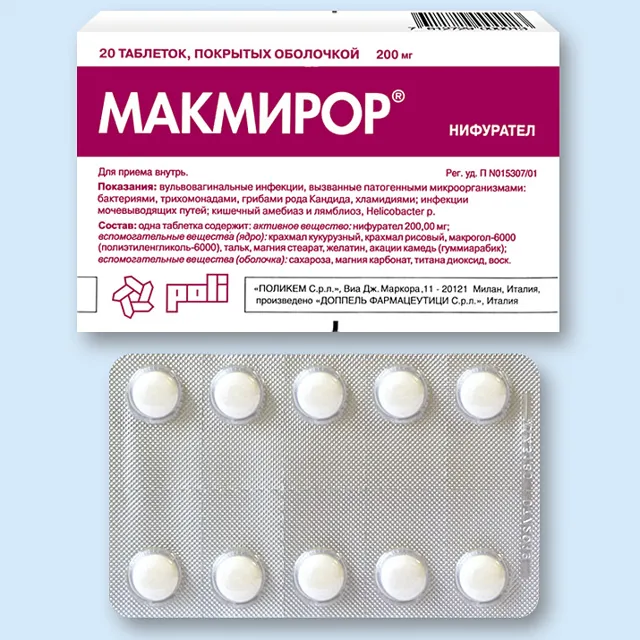
Table of Contents
INSTRUCTIONS FOR MEDICAL USE OF THE MEDICINAL PRODUCT MACMIROR (MACMIROR)
Composition:
Active substance: nifuratel;
1 tablet contains nifuratel 200 mg;
Excipients: corn starch, rice starch, polyethylene glycol 6000, talc, magnesium stearate, gelatin, gum arabic, sucrose, magnesium carbonate, titanium dioxide (E 171), wax E, purified water.
Dosage form. Coated tablets.
Main physico-chemical properties: white, biconvex coated tablets.
Pharmacotherapeutic group. Antimicrobial and antiseptic agents used in gynecology. Antimicrobial and antiseptic agents, excluding combined preparations containing corticosteroids.
ATC code G01A X05.
Pharmacological Properties
Pharmacodynamics
The active ingredient of Macmiror is a nitrofuran derivative – nifuratel.
In vivo/in vitro studies have demonstrated a broad spectrum of activity against microorganisms, including infections of the urogenital system, as well as antiprotozoal and antifungal activity. The mechanism of action has not been fully elucidated; however, it is known that nifuratel, via its metabolites, affects enzymes involved in microbial growth processes. Nifuratel acts on trichomonads in a similar manner.
Nifuratel exhibits antibacterial activity against Gram-negative and Gram-positive aerobic and anaerobic bacteria: Gardnerella vaginalis, Escherichia coli, Shigella, Salmonella spp., Bacillus sp., Proteus spp., Klebsiella pneumoniae. The minimal effective concentration ranges from 2.5–5 mcg/mL. Bacteriostatic and bactericidal effects have been studied in vitro, depending on the concentration of nifuratel.
Nifuratel has shown strong inhibitory activity against Chlamydia trachomatis and less pronounced activity against Mycoplasma pneumoniae and Ureaplasma urealyticum. Antifungal activity of nifuratel in in vivo studies is less pronounced compared to ketoconazole and flutrimazole.
The broad spectrum of antibacterial, antiprotozoal, and antifungal activity confirms the efficacy of nifuratel in all types of urogenital system infections. Nifuratel does not affect Lactobacillus spp., which are a natural component of normal bacterial flora, thereby promoting and accelerating the treatment of vaginal infections and preventing reinfection.
Studies in 2000 patients with vaginitis due to Trichomonas vaginalis demonstrated that treatment efficacy with nifuratel, determined by the absence of trichomonads in microscopic examinations, was 68–89% after the first course, 82–89% after the second course, and 96% after the third course of treatment.
Studies in over 900 patients with vaginitis of various etiologies, including mixed etiology, showed that treatment efficacy with nifuratel ranged from 88–96%. Nifuratel is more effective in treating acute urogenital infections (efficacy 62–93%) than in treating exacerbations of chronic infections (efficacy 50%).
High treatment efficacy has been observed in patients with intestinal amoebiasis and giardiasis, with efficacy rates of 70–90% and 91–94%, respectively. Clinical data also confirm the pronounced antiprotozoal activity of nifuratel.
Nifuratel does not induce cross-resistance of microorganisms to other drugs used in the treatment of infections. Over 30 years, no cases of resistance to nifuratel have been reported.
Pharmacokinetics
Pharmacokinetic studies were conducted in healthy volunteers who received a single 200 mg dose of nifuratel, revealing a biphasic kinetic profile. After administration of a single 200 mg dose, rapid absorption of nifuratel was observed; the plasma concentration 2 hours after administration was 9.48 ± 3.6 mcg/mL. Nifuratel is rapidly metabolized in virtually all body tissues, with a half-life of 2.75 ± 0.8 hours. Approximately 0.5% of nifuratel is excreted unchanged in urine, while the remainder is excreted as metabolites. Nifuratel demonstrates high lipophilicity and extensive distribution volume, amounting to 17.428 L. Nifuratel is not detected in enterohepatic circulation.
Clinical characteristics.
Indications.
Vulvovaginal infections caused by pathogens sensitive to the drug (pathogenic microorganisms, trichomonads, fungi, yeasts, chlamydia, Candida species).
Urinary tract diseases (cystitis, urethritis, pyelonephritis, pyelitis).
Intestinal amoebiasis and giardiasis.
Contraindications.
Known individual hypersensitivity to the active substance or to other components of the drug. The drug should not be used in cases of impaired kidney function, in neuropathies, and in patients with glucose-6-phosphate dehydrogenase (G6PD) deficiency.
Interaction with other medicinal products and other forms of interaction.
Clinically significant interaction of the drug with other medicinal products has not been established.
Concomitant intake of alcohol may lead to disulfiram-like reactions.
Special precautions.
Prolonged use of the drug, especially over a long period of time, may cause hypersensitivity reactions.
Alcohol should be avoided during treatment to prevent the development of fatigue and nausea, which resolve spontaneously after some time.
If signs of an allergic reaction occur, administration of the drug should be discontinued.
Sexual intercourse should be avoided during treatment with this drug.
Simultaneous treatment of the sexual partner is necessary to prevent reinfection.
The drug contains sucrose, which should be taken into account in patients with diabetes mellitus.
Thrombocytopenic purpura, hepatotoxicity, blood disorders, and pulmonary reactions have been reported with other nitrofuran compounds. However, a causal relationship between these clinical reactions and the drug Macmiror, 200 mg coated tablets, has not been established. Nevertheless, the occurrence of such reactions cannot be completely ruled out.
Use during pregnancy or breastfeeding.
The drug should not be used during pregnancy. Breastfeeding should be discontinued during treatment.
Ability to affect reaction rate while driving or operating machinery.
The drug does not affect reaction rate while driving or operating machinery.
Method of administration and dosage.
Vulvovaginal infections.
Adults: 1 tablet of Macmiror 3 times daily after meals for 7 days for treatment of both the woman and her partner, if possible. For local treatment, use Macmiror Complex, soft vaginal capsules or Macmiror Complex, vaginal cream.
Important: patients treated only with oral tablets should increase the dose to 4 tablets per day. Sexual intercourse should be avoided during treatment; otherwise, Macmiror Complex, vaginal cream should be applied before each sexual act.
Children aged 10 years and older: the recommended dose is 10 mg/kg body weight per day, divided into 2 doses. The drug should be taken after meals. The duration of treatment is on average 10 days.
Urinary tract infections.
Adults: the recommended dose depends on the severity of the disease and ranges from 3 to 6 tablets per day (i.e., 200–400 mg 3 times daily), taken after meals. The treatment course lasts on average 1–2 weeks.
Children aged 6 years and older: the recommended dose is 10–20 mg/kg body weight per day, divided into 2 doses. Administer after meals. Treatment duration is 7–14 days.
Upon physician's prescription, if necessary, the treatment course with MACMIROR may be extended or a repeated course prescribed for urinary tract infections.
Intestinal amebiasis.
Adults: 2 tablets 3 times daily after meals for 10 days.
Children aged 6 years and older: the recommended daily dose is 30 mg/kg body weight, divided into 3 doses, for 10 days.
Intestinal giardiasis.
Adults: 2 tablets 2–3 times daily after meals for 7 days.
Children aged 6 years and older: the recommended daily dose is 30 mg/kg body weight, divided into 2 doses, taken after meals for 7 days.
Children. The drug is indicated for children aged 6 years and older.
Overdose. Cases of overdose are unknown.
Side effects.
From the gastrointestinal tract
Short-term and minor gastrointestinal disorders:
Rare (<1/10,000, <1/1,000): nausea, bitter taste in the mouth, diarrhea.
Very rare (<1/10,000): vomiting, dyspepsia.
From the skin and subcutaneous tissue
Possible hypersensitivity reactions, including:
Very rare (<1/10,000): skin rash, urticaria, pruritus.
From the nervous system
Peripheral neuropathies.
Shelf life. 5 years.
Storage conditions.
Store at a temperature not exceeding 25 °C. Keep out of reach of children!
Packaging.
10 tablets per blister, 2 blisters per cardboard box.
Prescription category. Prescription only.
Manufacturer.
Doppel Farmaceutici S.r.l./Doppel Farmaceutici S.r.l.
Manufacturer's address and place of business.
Via Volturno, 48 – Quinto De’Stampi – 20089 Rozzano (MI), Italy / Via Volturno,
48 – Quinto De’Stampi – 20089 Rozzano (MI), Italy.