Magnicum
Ukraine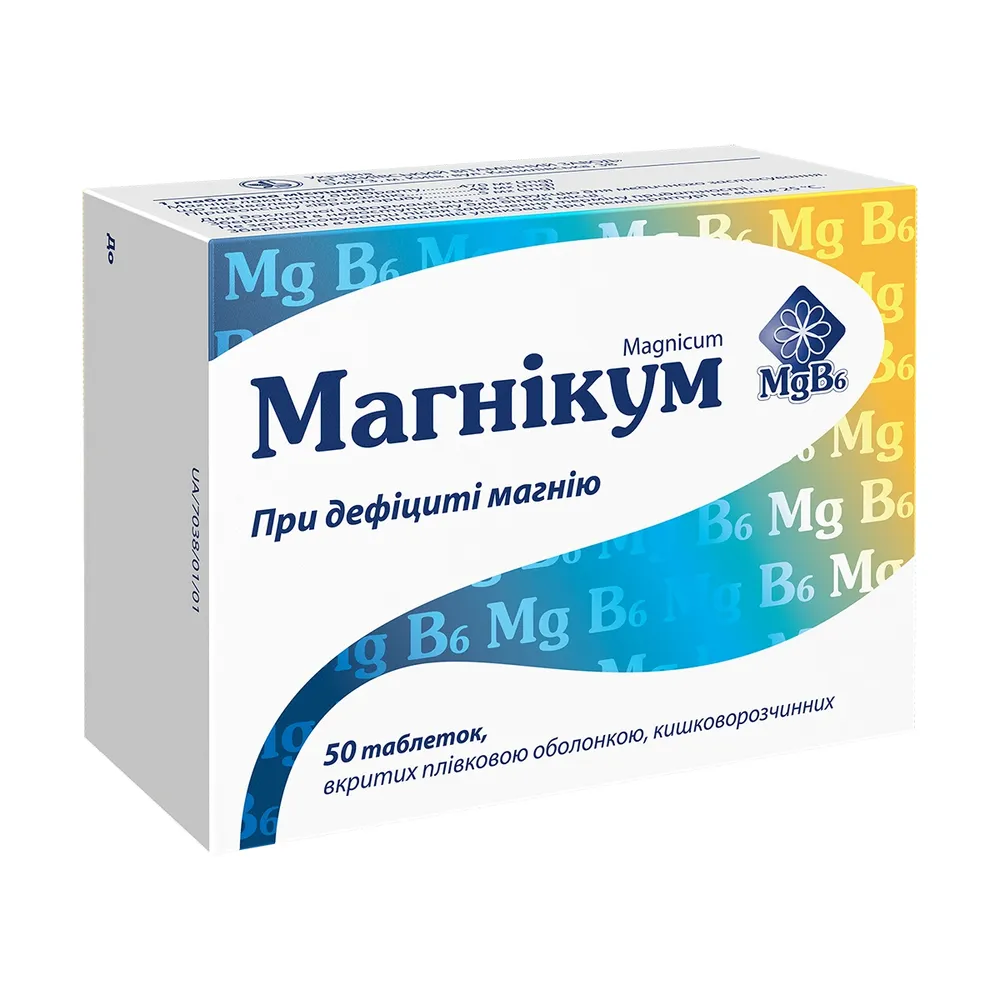
Table of Contents
INSTRUCTIONS FOR MEDICAL USE OF THE MEDICINAL PRODUCT MАGNICUM (MAGNICUM)
Composition:
Active substances: 1 tablet contains magnesium lactate dihydrate 470 mg, equivalent to 48 mg of magnesium, and pyridoxine hydrochloride 5 mg;
Excipients: microcrystalline cellulose, polyvinyl alcohol, colloidal anhydrous silicon dioxide, talc, magnesium stearate;
Coating: film-coating mixture for enteric coating Acryl-EZE White (methacrylic acid copolymer, colloidal anhydrous silicon dioxide, sodium bicarbonate, sodium lauryl sulfate, talc, titanium dioxide (E 171), triethyl citrate).
Pharmaceutical form. Film-coated enteric-coated tablets.
Main physicochemical properties: elongated, biconvex film-coated tablets of white or almost white color.
Pharmacotherapeutic group. Complex of B vitamins with minerals. ATC code A11EC.
Pharmacological properties.
Pharmacodynamics.
The therapeutic effects of the drug result from the synergistic action of its two active components, both of which are extensively involved in biochemical reactions in the human and animal organism.
Magnesium is an essential component of all enzymatic, ATP-dependent reactions; it participates in the metabolism of carbohydrates, proteins, and fats, as well as in redox reactions.
Magnesium activates glycolytic enzymes, enzymes of cellular oxidation, and enzymes involved in nucleic acid synthesis; it also plays an important role in myocardial contraction processes. Magnesium is a stabilizer of platelets and fibrinogen. The pathogenetic role of magnesium deficiency in arterial hypertension, vascular spasm, neoplastic diseases, and urolithiasis is well established. Magnesium plays a leading role in neuromuscular excitability—acting as a calcium antagonist in this process.
Pyridoxine is primarily involved in amino acid metabolism; in the form of pyridoxal phosphate, it is a component of enzymes catalyzing decarboxylation and transamination reactions, as well as metabolism of carbohydrates and fats. It facilitates amino acid transport across membranes, is necessary for phosphorylase activation, and for the synthesis of neurotransmitters such as gamma-aminobutyric acid, glycine, and serotonin. It participates in vitamin B12 and folic acid metabolism, porphyrin synthesis, and unsaturated fatty acid synthesis. It activates metabolic processes in the myocardium, particularly under hypoxic conditions, and may exhibit neurotropic, hemopoietic, cardioprotective, and hepatotropic properties. The precise mechanism of interaction between magnesium and vitamin B6 has not yet been fully elucidated. Symptoms of deficiency, as well as overdose, of both components are similar; however, vitamin B6 deficiency symptoms are more pronounced when magnesium deficiency is concurrent, since magnesium is required for the activation of pyridoxine-dependent enzymatic systems.
Pharmacokinetics.
Concomitant administration of magnesium and pyridoxine increases the rate of magnesium absorption in the intestine and improves its transmembrane transport into cells due to the formation of a chelate complex of vitamin B6–magnesium–amino acid. This leads to increased magnesium concentration in plasma and erythrocytes, as well as reduced urinary excretion of magnesium.
Clinical characteristics.
Indications.
Prevention of complications associated with magnesium and/or vitamin B6 deficiency.
The medicinal product can also be used prophylactically in the following conditions:
chronic physical and mental fatigue, irritability, increased risk of stress, depression, sleep disorders, myalgia, prevention of atherosclerosis and myocardial infarction.
Magnicum may also be used in hypomagnesemia due to prolonged smoking and alcohol abuse, long-term use of laxatives, contraceptives, certain diuretics, or osmotic diuresis in patients with diabetes and persistent hyperglycemia.
In the complex treatment of cardiovascular diseases such as arterial hypertension (AH), congestive heart failure, cardiac arrhythmias, in patients recovering after bone fractures, and in the complex treatment of osteoporosis.
Contraindications.
Hypersensitivity to the components of the medicinal product, severe renal insufficiency (creatinine clearance less than 30 ml/min), hypermagnesemia, hypervitaminosis of vitamin B6, AV-blockade, severe myasthenia, Parkinson's disease (treated with levodopa without concomitant use of peripheral decarboxylase inhibitors of levodopa), severe arterial hypotension, diarrhea.
Interaction with other medicinal products and other types of interactions.
Concomitant use of agents containing phosphates and calcium salts, as well as excess lipids, may significantly reduce magnesium absorption in the gastrointestinal tract. Diuretics, cisplatin, cycloserine, and mineralocorticoids increase urinary excretion of magnesium. Aminoglycoside antibiotics, skeletal muscle relaxants, and colistin, when used concomitantly with the product, may cause muscle paralysis.
Magnesium reduces the absorption of theophylline, tetracyclines, iron preparations, fluorides, and oral anticoagulants – warfarin derivatives. When used concomitantly with oral tetracyclines, the interval between administration of these agents should be at least 3 hours to prevent the negative effect of Magnicum on tetracycline absorption from the gastrointestinal tract.
The use of cycloserine, hydralazine, isoniazid, penicillamine, and oral contraceptives increases the requirement for vitamin B6.
Contraindicated combinations: simultaneous use with levodopa should be avoided, as levodopa's action is inhibited when its administration is not accompanied by inhibitors of peripheral dopa-decarboxylase. The use of pyridoxine in any dosage is not recommended if levodopa is not administered concomitantly with dopa-decarboxylase inhibitors.
Special precautions for use.
In patients with moderate renal impairment, preventive measures should be taken to avoid the development of hypermagnesemia (regular monitoring of serum magnesium levels and avoidance of prolonged use of the drug at high doses). Patients with cardiac or renal insufficiency should consult their physician prior to starting treatment with this medicinal product.
If there is no improvement in condition after 1 month of treatment, the medicinal product should be discontinued.
In cases of concomitant calcium deficiency, magnesium deficiency should be corrected before initiating additional calcium supplementation.
Prolonged excessive use of pyridoxine may lead to the development of sensory neuropathy when administered in high doses (> 200 mg/day) over a prolonged period (i.e., several months or years). This effect is usually reversible and resolves after discontinuation of the drug.
In patients with severe magnesium deficiency, treatment with the medicinal product should be initiated via intravenous administration. This is also indicated in patients with malabsorption.
Use during pregnancy or breastfeeding.
It is unknown whether the use of this medicinal product poses any risk to the fetus, as adequate studies during pregnancy have not been conducted. Therefore, the decision regarding the use of this medicinal product during pregnancy or breastfeeding should be made individually for each patient by a physician, taking into account the benefit-risk ratio for the woman and the potential risk to the fetus (child).
Ability to influence reaction rate when driving or operating machinery.
The medicinal product does not affect the ability to drive or operate potentially hazardous machinery.
Method of Administration and Dosage.
Prophylaxis: adults and children aged 12 years and older – 2 tablets once daily or 1–2 tablets twice daily.
Treatment: only as prescribed by a physician. The duration of treatment is determined by the physician.
The tablet should be swallowed whole and taken with a glass of water.
Children. The medicinal product should be administered to children aged 12 years and older.
Overdose.
Magnesium overdose following oral administration usually does not lead to toxic reactions in patients with normal kidney function. However, in patients with renal insufficiency, magnesium intoxication may develop. Toxic effects depend on serum magnesium levels.
Symptoms: nausea, vomiting, arterial hypotension, central nervous system depression, muscle weakness, respiratory depression, pathological changes on ECG, coma, cardiac arrest, respiratory paralysis, anuria, pain in the extremities, impaired reflex functions.
Treatment: rehydration, forced diuresis. In cases of renal insufficiency, hemodialysis or peritoneal dialysis is required. Symptomatic therapy.
Side effects.
Very rare – gastrointestinal disorders (abdominal pain, constipation, diarrhoea, nausea, vomiting); allergic reactions, including itching, urticaria, skin rash.
Shelf life. 3 years.
Storage conditions.
Store in the original packaging at a temperature not exceeding 25 °C.
Keep out of reach of children.
Packaging. 10 tablets in a blister; 5 blisters per pack.
Prescription status. Over-the-counter.
Manufacturer: JSC "KYIV VITAMIN PLANT".
Manufacturer's address and place of business.
38, Kopilivska Street, Kyiv, 04073, Ukraine.
Web-site: www.vitamin.com.ua