Magnefar® в6
Ukraine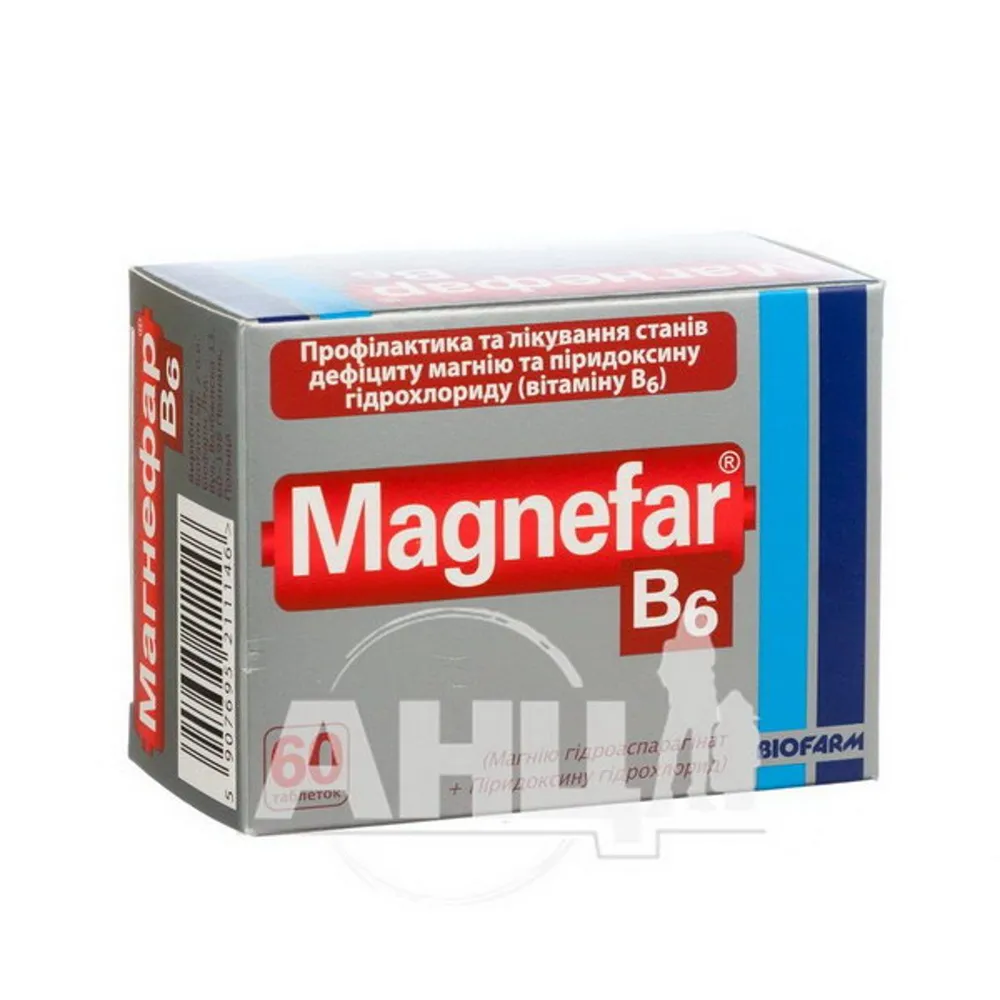
Table of Contents
INSTRUCTIONS FOR MEDICAL USE OF THE MEDICINAL PRODUCT magneFAR® B6
Composition:
Active substances: magnesium hydroaspartate tetrahydrate and pyridoxine hydrochloride;
One tablet contains 500 mg of magnesium hydroaspartate tetrahydrate (corresponding to 34 mg of Mg2+) and 5 mg of pyridoxine hydrochloride;
Excipients: microcrystalline cellulose, magnesium stearate, hypromellose.
Pharmaceutical form. Tablets.
Main physicochemical properties: white, elongated oval biconvex tablets with a score line on one side.
Pharmacotherapeutic group.
Vitamin B complex with minerals. ATC code A11E C.
Pharmacological properties.
Pharmacodynamics.
Magnesium belongs to essential cations required for normal metabolic processes in the body. It participates in ATP-dependent enzymatic reactions and acts as a stabilizer of cell membranes and intracellular organelles.
Magnesium is involved in the regulation of metabolism in the nervous, musculoskeletal, respiratory, cardiovascular, and hematopoietic systems, as well as in hormone metabolism (including sex hormones). It protects the myocardium from hypoxia and ischemia.
It exerts a calming effect, reduces neuromuscular excitability, and ensures normal muscle contraction.
Vitamin B6 (pyridoxine hydrochloride) participates in amino acid metabolism, carbohydrate and lipid metabolism, and in the process of hemoglobin synthesis.
Concomitant administration of magnesium and pyridoxine hydrochloride enhances the effect of each component. Thus, vitamin B6 increases the concentration of magnesium in blood plasma and erythrocytes and reduces its urinary excretion. Magnesium, in turn, activates the biotransformation of pyridoxine hydrochloride in the liver into its active metabolite, pyridoxal-5-phosphate. Combined administration of vitamin B6 and magnesium compensates for deficiencies of these substances and enhances their intestinal absorption and cellular uptake due to the formation of a chelate complex "vitamin B6 – magnesium – amino acids".
Pharmacokinetics.
Magnesium is very well absorbed from the gastrointestinal tract. Intracellular magnesium concentration is nearly 10 times higher (99%) than extracellular concentration. Its concentration in peripheral blood ranges from 0.75 to 1.25 mmol/L (typically 0.8–0.9 mmol/L).
In blood, approximately 55% of magnesium is in ionized form, 32% is bound to plasma proteins, and the remaining 13% consists of complexes with anions.
In the kidneys, about 70% of plasma magnesium undergoes glomerular filtration, and 95–97% of it is reabsorbed in the renal tubules.
Pyridoxine hydrochloride is readily soluble in water, well absorbed after oral administration, and accumulates in the liver. In the body, it is phosphorylated to pyridoxal phosphate, the active form of pyridoxine involved in metabolic processes, or exists as pyridoxamine. Metabolites are excreted in urine.
Clinical characteristics.
Indications.
Prevention and treatment of magnesium and pyridoxine hydrochloride (vitamin B6) deficiency states.
Contraindications.
Hypersensitivity to the components of the drug; phenylketonuria; hypermagnesemia; hypervitaminosis B6; acute renal failure; atrioventricular (AV) block; myasthenia gravis; severe arterial hypotension; Parkinson's disease treated with levodopa without concomitant use of peripheral dopa-decarboxylase inhibitors; malabsorption; diarrhea.
Interaction with other medicinal products and other forms of interaction.
Concomitant use with levodopa should be avoided, as the effect of levodopa is inhibited when it is administered without concomitant use of peripheral dopa-decarboxylase inhibitors. Administration of pyridoxine in any dosage is not recommended if levodopa is not accompanied by dopa-decarboxylase inhibitors.
Magnesium reduces the absorption of theophylline, tetracyclines, fluoroquinolones, iron preparations, fluorides, phosphates, and oral anticoagulants – warfarin derivatives.
Phosphates, high doses of calcium, excess lipids, and phytates reduce magnesium absorption from the gastrointestinal tract. Diuretics (furosemide, ethacrynic acid), cisplatin, cycloserine, and mineralocorticoids increase urinary excretion of magnesium. Aminoglycoside antibiotics, skeletal muscle relaxants, and colistin, when used concomitantly with magnesium-containing drugs, may cause muscle paralysis. Alkalinization of urine reduces renal excretion of quinidine, increasing the risk of quinidine overdose.
Vitamin B6 may reduce serum phenytoin concentrations. The use of cycloserine, hydralazine, isoniazid, penicillamine, and oral contraceptives increases the requirement for vitamin B6.
Long-term use of potassium-sparing diuretics may enhance magnesium reabsorption in renal tubules and lead to hypermagnesemia. Other medicinal products containing magnesium, such as laxatives and antacids, when used concomitantly with magnesium hydroaspartate, may cause magnesium overdose, especially in patients with renal insufficiency.
The drug should be used with caution in combination with cardiac glycosides (digitalis).
Special precautions.
In cases of concomitant calcium deficiency, magnesium deficiency should be corrected before initiating calcium supplementation. Patients with cardiac or renal insufficiency should consult a physician prior to starting treatment with Magnefar® B6. If a patient has moderate renal impairment, the drug should be administered with caution to avoid the risk of developing hypermagnesemia.
When using tetracycline antibiotics concomitantly with Magnefar® B6, the interval between administration of these drugs should be at least 3 hours.
Magnesium deficiency may be:
- Primary – due to an inherited metabolic disorder of magnesium (chronic inherited hypomagnesemia);
- Secondary – due to inadequate intake (imbalanced nutrition, chronic alcohol abuse, exclusive parenteral nutrition); due to impaired gastrointestinal absorption (chronic diarrhea, gastrointestinal fistula, hypoparathyroidism); due to renal losses (tubular disorders, marked polyuria, diuretic abuse, chronic pyelonephritis, primary hyperaldosteronism, cisplatin therapy).
In patients with severe magnesium deficiency, treatment should be initiated with intravenous administration of the drug. This is also indicated in patients with malabsorption.
Use during pregnancy or breastfeeding.
It is unknown whether administration of the medicinal product poses a risk to the fetus, as adequate and well-controlled clinical studies during pregnancy have not been conducted. Therefore, the decision to use the drug during pregnancy or breastfeeding should be made by a physician, taking into account the benefit to the woman versus the potential risk to the fetus (child).
Ability to affect reaction rate when driving or operating machinery.
Does not affect.
Dosage and Administration
MagnefAR® B6 is intended for oral administration. Tablets should be taken after meals with water (at least 200–250 mL).
In magnesium and vitamin B6 deficiency:
- Adults and children aged 12 years and older: usually 1–2 tablets three times daily;
- Children aged 6 years (with body weight over 20 kg) to 12 years: 1 tablet three times daily.
For prophylaxis:
- Adults and children aged 12 years and older: usually 1–2 tablets once daily.
Any increase in dosage should be discussed with a physician.
Children.
This medicinal product is not recommended for children under 6 years of age.
Overdose.
Overdose symptoms are rarely observed in patients with normal renal function. Prolonged use at doses exceeding the recommended ones may cause symptoms listed in the section "Adverse Effects," as well as arterial hypotension, muscle weakness, sensory disturbances, limb pain, diminished tendon reflexes, respiratory difficulty, arrhythmias as a consequence of milk-alkali syndrome, central nervous system depression, pathological ECG changes, coma, cardiac arrest and respiratory paralysis, anuria.
In case of overdose, large amounts of fluid should be taken orally, and intravenous administration of physiological saline solution should be performed in severe cases. Immediately after hydration, furosemide or other diuretics should be administered. If previous measures are ineffective, calcitonin should be used. In patients with normal renal function and low serum phosphate levels, oral phosphates may be prescribed. Patients with renal insufficiency require hemodialysis or peritoneal dialysis.
Adverse reactions.
The medicinal product is usually well tolerated.
Cardiac side effects: Atrioventricular block (AV block).
Gastrointestinal side effects: Abdominal pain, diarrhea, nausea, vomiting, flatulence, which usually resolve after discontinuation of the medicinal product.
Skin reactions: Skin redness, allergic reactions including rash, pruritus, urticaria.
Prolonged regular use of pyridoxine at a daily dose of 50 mg may cause sensory neuropathy; doses exceeding 200 mg/day may lead to folic acid deficiency, respiratory disorders, and dermatoses.
Shelf life: 3 years.
Storage conditions.
Store at a temperature not exceeding 25 °C in the original packaging.
Keep out of reach of children.
Packaging.
10 tablets in a blister, 6 blisters in a cardboard box.
Marketing authorization category: Over-the-counter (without prescription).
Manufacturer:
BIOFARM Ltd.
Manufacturer's address and place of business.
Valbzhiska Street 13, 60-198 Poznan, Poland.