Lordes®
Ukraine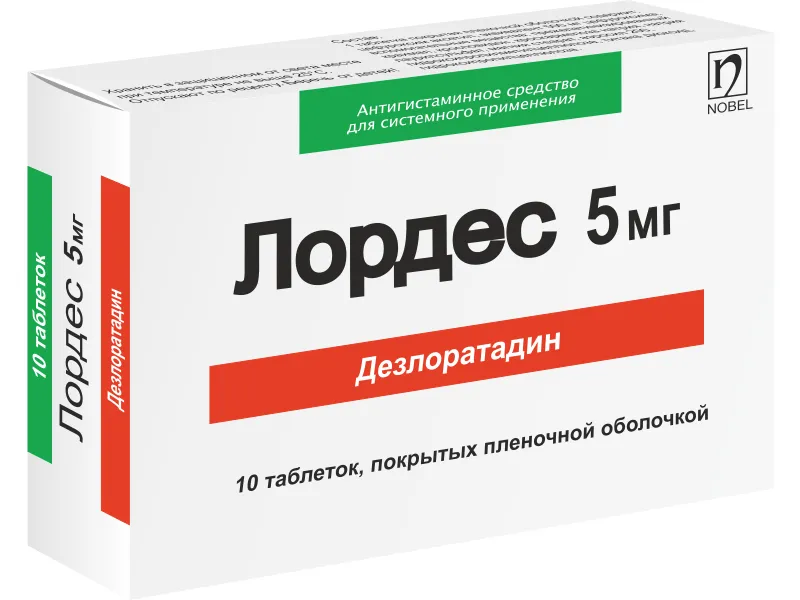
Table of Contents
INSTRUCTION FOR MEDICAL USE OF THE MEDICINAL PRODUCT LORDES®
Composition:
Active ingredient: desloratadine;
1 tablet contains 5 mg of desloratadine;
Excipients: calcium hydrogen phosphate, microcrystalline cellulose, maize starch, talc, Opadry II Blue 85F20578 coating: polyvinyl alcohol, polyethylene glycol, titanium dioxide (E 171), indigo carmine (E 132), yellow iron oxide (E 172), talc.
Pharmaceutical form. Film-coated tablets.
Main physicochemical properties: round, blue, film-coated tablets with the company logo imprinted on one side.
Pharmacotherapeutic group.
Antihistamines for systemic use. ATC code: R06AX27.
Pharmacological Properties
Pharmacodynamics
Desloratadine is a non-sedating, long-acting antihistamine with selective antagonistic activity at peripheral H1-receptors. After oral administration, desloratadine selectively blocks peripheral histamine H1-receptors.
In in vitro studies, desloratadine demonstrated anti-allergic and anti-inflammatory properties in endothelial cells. These effects were manifested by inhibition of pro-inflammatory cytokine release, such as IL-4, IL-6, IL-8, and IL-13, from human mast cells/basophils, as well as inhibition of adhesion molecule expression, including P-selectin. The clinical relevance of these observations remains to be confirmed.
In high-dose clinical studies, where desloratadine was administered daily at doses up to 20 mg for 14 days, no statistically significant cardiovascular effects were observed. In a clinical pharmacology study using 45 mg daily (10 times the maximum recommended clinical daily dose) for 10 days, no QT interval prolongation was observed.
In patients with allergic rhinitis, desloratadine effectively relieved symptoms such as sneezing, rhinorrhea, nasal and ocular itching, tearing, eye redness, and palate itching. Desloratadine provided effective symptom control for 24 hours.
Desloratadine barely penetrates the central nervous system. In controlled clinical trials, at the recommended daily dose of 5 mg, the incidence of somnolence was not different from placebo. In clinical studies, single-dose administration of desloratadine at a daily dose of 7.5 mg did not affect psychomotor performance.
Desloratadine effectively improved the severity of seasonal allergic rhinitis, as measured by the total rhinoconjunctivitis quality-of-life questionnaire score. The greatest improvement was observed in questionnaire items related to practical problems and daily activities limited by symptoms.
Chronic idiopathic urticaria was studied in a clinical model of urticaria conditions. Since histamine release is a causative factor in all forms of urticaria, desloratadine is expected to effectively relieve symptoms in other forms of urticaria, including chronic idiopathic urticaria.
In two placebo-controlled, 6-week studies involving patients with chronic idiopathic urticaria, desloratadine effectively relieved itching and reduced the number and size of hives by the end of the first dosing interval. In each study, the effect lasted throughout the 24-hour dosing interval. Relief of itching by more than 50% was observed in 55% of patients taking desloratadine compared to 19% of patients taking placebo. The drug did not significantly affect sleep or daytime activity.
Pharmacokinetics
Absorption.
Plasma concentrations of desloratadine can be detected within 30 minutes after administration. Desloratadine is well absorbed, with peak concentrations reached approximately 3 hours after intake; the elimination half-life is approximately 27 hours. The extent of desloratadine accumulation corresponded to its half-life (approximately 27 hours) and once-daily dosing. Desloratadine bioavailability was dose-proportional in the range of 5 to 20 mg.
In a pharmacokinetic study where patient demographics were comparable to the general population with seasonal allergic rhinitis, approximately 4% of participants exhibited higher desloratadine concentrations. This proportion may vary depending on ethnicity. Maximum desloratadine concentration was approximately 3 times higher at about 7 hours, and the terminal half-life was approximately 89 hours. The safety profile in these patients did not differ from that in the general population.
Distribution.
Desloratadine is moderately bound to plasma proteins (83–87%). No evidence of clinically significant accumulation was observed after administration of desloratadine doses (5 to 20 mg) once daily for 14 days.
Biotransformation.
The enzyme responsible for desloratadine metabolism has not yet been identified; therefore, some drug interactions cannot be completely excluded. Desloratadine does not inhibit CYP3A4 in vivo. In vitro studies demonstrated that the drug does not inhibit CYP2D6 and is neither a substrate nor an inhibitor of P-glycoprotein.
Elimination.
In a single-dose study of 7.5 mg desloratadine, food intake (a high-fat, high-calorie breakfast) did not affect the pharmacokinetics of desloratadine. Additionally, grapefruit juice was shown not to affect desloratadine pharmacokinetics.
Clinical characteristics.
Indications.
For relief of symptoms associated with:
- allergic rhinitis, such as sneezing, rhinorrhea, itching, swelling and nasal congestion, as well as eye redness and itching, lacrimation, itching of the palate, and cough;
- urticaria, such as itching and rash.
Contraindications.
Hypersensitivity to the active substance or to any excipient or to loratadine.
Interaction with other medicinal products and other forms of interaction.
In clinical studies of desloratadine tablets, no clinically significant interactions were observed when co-administered with erythromycin or ketoconazole.
In clinical pharmacological studies of desloratadine administered concomitantly with alcohol, the drug did not enhance the negative effect of ethanol on psychomotor function. However, during the post-marketing period, cases of alcohol intolerance and alcohol intoxication have been reported while taking the drug. Therefore, caution is necessary when consuming alcohol during treatment with Lordes**®**.
Special precautions for use.
In patients with severe renal impairment, the use of the medicinal product Lordes**®** should be carried out under medical supervision.
Desloratadine should be administered with caution to patients who have a history of seizures. Children may be more susceptible to the development of new seizures during desloratadine treatment. The physician must decide whether to discontinue desloratadine therapy in patients who experience a seizure while taking the drug.
Use during pregnancy or breastfeeding.
Desloratadine did not show teratogenic effects in animal studies. However, the safety of using the drug during pregnancy has not been established. Therefore, the use of the medicinal product Lordes**®** during pregnancy is not recommended.
Breastfeeding.
Desloratadine passes into breast milk; therefore, the use of the medicinal product Lordes**®** in breastfeeding women is not recommended.
Ability to affect reaction speed when driving or operating machinery.
In clinical studies assessing the ability to drive, no impairments were observed in patients taking desloratadine. Nevertheless, patients should be informed that in very rare cases dizziness or somnolence may occur, which could affect their ability to drive a car or operate complex machinery.
Dosage and Administration.
LORDES® is intended for oral administration. The recommended dose for adults and children aged 12 years and older is 1 tablet (5 mg) once daily, regardless of food intake. The tablet should be swallowed whole with water. LORDES® should preferably be taken regularly at the same time each day.
The duration of treatment depends on the severity and course of the disease.
For the treatment of intermittent allergic rhinitis (symptoms present less than 4 days per week or for less than 4 weeks), therapy should be administered based on clinical history: treatment should be discontinued upon symptom resolution and resumed upon symptom recurrence.
For persistent allergic rhinitis (symptoms present more than 4 days per week or for more than 4 weeks), treatment should be continued throughout the entire period of allergen exposure.
Children.
Limited clinical data on the efficacy of desloratadine tablets in adolescents aged 12 to 17 years are available (see section "Adverse Reactions").
The efficacy and safety of desloratadine tablets in children under 12 years of age have not been established.
Overdose.
In case of overdose, standard procedures for removal of unabsorbed active substance should be applied. Symptomatic and supportive treatment is recommended. In clinical studies where desloratadine was administered at doses of 45 mg (9 times the recommended dose), no clinically significant adverse reactions were observed. Desloratadine is not removed by hemodialysis; its elimination via peritoneal dialysis has not been established.
Adverse Reactions
In clinical trials of desloratadine for indications including allergic rhinitis and chronic idiopathic urticaria, adverse events were reported in patients receiving a 5 mg daily dose 3% more frequently than in patients receiving placebo. The most commonly reported adverse events compared to placebo were fatigue (1.2%), dry mouth (0.8%), and headache (0.6%).
Children. In clinical trials involving 578 adolescents aged 12 to 17 years, the most commonly reported adverse event was headache, occurring in 5.9% of patients treated with desloratadine and in 6.9% of patients receiving placebo.
There is a risk of psychomotor hyperactivity (abnormal behavior) associated with the use of desloratadine, which may manifest as irritability and aggression, as well as excitation.
In the post-marketing period, the following events have been observed (frequency unknown): QT interval prolongation, arrhythmias, and bradycardia.
Summary table of adverse reaction frequencies.
The frequency of adverse reactions is classified as follows: very common (≥1/10), common (≥1/100, <1/10), uncommon (≥1/1000, <1/100), rare (≥1/10,000, <1/1000), very rare (<1/10,000), and frequency not known.
| Classes/system organs |
Frequency of occurrence |
Adverse reactions* |
| Psychiatric disorders |
very rare |
hallucinations |
| frequency unknown |
depressed mood |
|
| Nervous system disorders |
common |
headache |
| very rare |
dizziness, somnolence, insomnia, psychomotor hyperactivity, seizures |
|
| Cardiac disorders |
very rare |
tachycardia, rapid heartbeat |
| frequency unknown |
QT interval prolongation, supraventricular tachyarrhythmia |
|
| Gastrointestinal disorders |
common |
dry mouth |
| very rare |
abdominal pain, nausea, vomiting, dyspepsia, diarrhea |
|
| Hepatobiliary disorders |
very rare |
elevated liver enzymes, increased bilirubin, hepatitis |
| frequency unknown |
jaundice |
|
| Musculoskeletal and connective tissue disorders |
very rare |
myalgia |
| Skin and subcutaneous tissue disorders |
frequency unknown |
photosensitivity |
| General disorders |
common |
increased fatigue |
| very rare |
hypersensitivity reactions (such as anaphylaxis, angioedema, dyspnea, pruritus, rash and urticaria) |
|
| frequency unknown |
asthenia |
|
| Metabolism and nutrition disorders |
frequency unknown |
increased appetite |
| Investigations |
frequency unknown |
weight gain |
| Eye disorders |
frequency unknown |
dry eyes |
Shelf life.
3 years.
Storage conditions.
Store at a temperature not exceeding 25 °C in the original packaging.
Keep out of reach of children.
Packaging.
10 tablets per blister; 1, 2 or 3 blisters per cardboard pack.
Classification.
Over-the-counter (without prescription).
Manufacturer.
NOBEL ILAC SANAYI VE TICARET A.S.
Manufacturer's address.
Sankaklar district, Eski Akcakoca Avenue, No. 299, 81100, Duzce, Turkey.