Locoid lipocream
Ukraine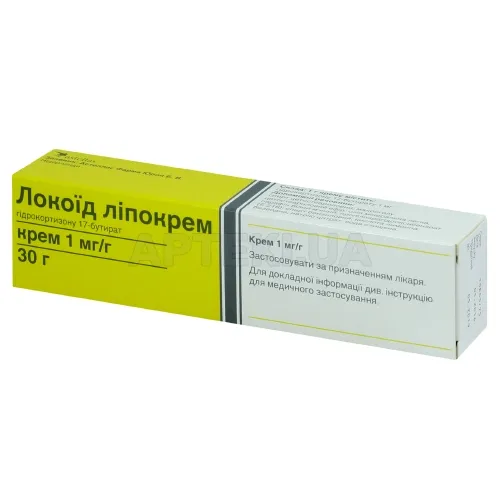
Table of Contents
I N S T R U C T I O N for medical use of the medicinal product LOKOYID LIPOCREAM
Composition:
Active substance: hydrocortisone 17-butyrate;
1 g of cream contains 1 mg of hydrocortisone 17-butyrate;
Excipients: cetostearyl alcohol; macrogol cetostearyl ether; light mineral oil; white soft paraffin; propylparahydroxybenzoate (E 216); benzyl alcohol; citric acid anhydrous; sodium citrate; purified water.
Pharmaceutical form. Cream.
Main physicochemical characteristics: white-colored cream.
Pharmacotherapeutic group. Dermatological corticosteroids.
ATC code D07AB02.
Pharmacological Properties.
Pharmacodynamics.
Hydrocortisone 17-butyrate is an active synthetic non-halogenated corticosteroid for topical use. It exerts a rapid anti-inflammatory, anti-edematous, and antipruritic effect. Its efficacy is comparable to that of halogenated steroids. Use at recommended doses does not cause suppression of the hypothalamic-pituitary-adrenal system. Although prolonged use of high doses, especially under occlusive dressings, may lead to increased plasma cortisol levels, this is not associated with reduced responsiveness of the pituitary-adrenal system, and discontinuation of the drug results in rapid normalization of cortisol production.
The medicinal form of the drug is characterized by a high lipid content, which promotes restoration of the skin's physiological barrier function.
Pharmacokinetics.
Absorption. After application, the active substance accumulates in the epidermis, predominantly in the stratum granulosum.
Metabolism. Hydrocortisone 17-butyrate, absorbed through the skin, is metabolized to hydrocortisone and other metabolites directly in the epidermis, and subsequently in the liver.
Elimination. Metabolites and a small portion of unchanged hydrocortisone 17-butyrate are excreted in urine and feces.
Clinical characteristics.
Indications. Superficial non-infected dermatoses treatable with topical corticosteroids (eczema, allergic and contact dermatitis, neurodermatitis, psoriasis).
Continuation of treatment or maintenance therapy of dermatoses previously treated with more potent corticosteroids.
Contraindications.
- Skin lesions caused by bacterial infections (e.g., pyoderma, syphilitic or tuberculous lesions), viral infections (e.g., varicella, herpes simplex, herpes zoster, common warts, flat warts, condyloma, molluscum contagiosum); fungal and yeast infections; parasitic infections (e.g., scabies);
- ulcerative skin lesions, wounds;
- adverse reactions caused by corticosteroids (e.g., perioral dermatitis, striae);
- ichthyosis, juvenile plantar dermatosis, acne vulgaris, rosacea, skin fragility, skin atrophy;
- hypersensitivity allergic reactions to components of the medicinal product or corticosteroids (the latter are rare).
Interaction with other medicinal products and other forms of interaction. Data on drug interactions with Locoid lipocream are not available.
Special precautions for use.
Do not apply the ointment to the eyelids due to the risk of contact with the conjunctiva and an increased risk of developing open-angle glaucoma or subcapsular cataract.
The skin of the face, genital area, and scalp is most sensitive to corticosteroids. Therefore, only weak-acting corticosteroids should be used for treating lesions in these areas.
It should be noted that when corticosteroids are applied over large areas of skin, especially under occlusive dressings or in skin folds, systemic absorption may increase, potentially leading to suppression of adrenocortical function.
Adrenal cortex suppression may develop rapidly in children. Suppression of growth hormone production may also occur. If long-term treatment is necessary, it is advisable to regularly monitor the child's height and body weight, as well as plasma cortisol levels.
In comparative studies, no significant differences in adrenocortical function were observed in children treated with Locoid ointment or 1% hydrocortisone at doses of 30–60 grams per week over a period of 4 weeks.
Application of the drug to the face, flexural areas, and other regions of thin skin may lead to skin atrophy and increased systemic absorption.
Topically applied corticosteroids may be hazardous in patients with psoriasis for several reasons, including the risk of "rebound syndrome" due to the development of tolerance, generalized pustular psoriasis, or local systemic toxicity due to impaired skin barrier function. Steroids may be used in scalp psoriasis or chronic plaque psoriasis of the hands and feet. Close monitoring of patients is essential.
Use during pregnancy or breastfeeding.
Pregnancy. Corticosteroids cross the placenta. Currently, there is no clear evidence of teratogenic effects in humans similar to those observed in animal studies. However, systemic administration of high doses of corticosteroids has been associated with effects on the fetus or newborn (intrauterine growth retardation, adrenocortical suppression).
Despite limited data on the use of topical corticosteroids in human pregnancy, due to their limited systemic absorption, weak and moderately potent corticosteroids (class 1 and class 2), such as hydrocortisone, may be used for short durations and over limited skin areas. The aforementioned adverse effects cannot be excluded with prolonged use or application over large skin areas. Such use should only be considered when clearly indicated.
Breastfeeding: Locoid Lipocream may be used in breastfeeding women only for short-term treatment and on small skin areas. For long-term treatment or application over large skin areas, breastfeeding should be discontinued.
Ability to affect reaction speed when driving or operating machinery.
There are no data on the effects of Locoid Lipocream on the ability to drive or operate machinery. Effects are not expected.
Dosage and Administration.
Apply a small amount of the medication to the skin 1–3 times daily. Once improvement occurs, usually once daily or 2–3 times weekly application is sufficient.
The total weekly dose should not exceed 30–60 g.
Lokoid Lipocream should be applied as a thin, even layer to affected skin areas. The medication may be gently rubbed into the skin to enhance penetration.
For enhanced therapeutic effect, an occlusive dressing may be applied.
Children. Can be used in children from 3 months of age.
Overdose. Chronic overdose or inappropriate use may lead to adverse effects described in the section "Adverse Reactions."
If symptoms of hypercorticism occur, treatment should be discontinued.
Adverse reactions.
| System organ class |
Rare (>1/10000, <1/1000) |
Very rare (<1/10000, including isolated reports) |
| Immune system disorders |
Hypersensitivity |
|
| Endocrine system disorders |
Adrenal suppression |
|
| Eye disorders |
Increased intraocular pressure, increased risk of cataract development (with local application) |
|
| Skin and subcutaneous tissue disorders |
Contact allergy; pustular acne; skin atrophy, often irreversible, associated with epidermal thinning, telangiectasia, purpura and striae; depigmentation; rosacea-like and perioral dermatitis, with or without skin atrophy; "rebound effect" which may lead to steroid dependence; dermatitis and eczema, including contact dermatitis, delayed wound healing; hypertrichosis. |
Systemic adverse reactions with topical corticosteroids in adults are rare but can be serious, particularly in cases of prolonged use leading to adrenocortical suppression.
The risk of systemic effects increases under the following conditions: use under occlusion (e.g., plastic occlusive dressings or application in skin folds); application over large areas of skin; prolonged duration of treatment; use in pediatric patients (children are particularly sensitive due to their thinner skin and relatively larger body surface area); and presence of components or excipients that enhance penetration through the stratum corneum and/or potentiate the effect of the active substance.
The risk of local adverse reactions increases with the potency of the preparation and the duration of treatment. Use under occlusion (e.g., plastic occlusive dressings or application in skin folds) increases this risk. The skin of the face, scalp, and genital area is especially susceptible to adverse reactions. Inappropriate use, as well as the presence of bacterial, parasitic, fungal, or viral infections, may mask and/or exacerbate the signs and symptoms of these conditions.
Shelf life. 3 years.
Storage conditions.
Store in the original packaging at a temperature not exceeding 25 °C.
Do not freeze.
Keep out of reach of children.
Packaging.
30 g of cream in an aluminum tube; 1 tube per cardboard box.
Prescription status.
Prescription only.
Manufacturer.
Temmler Italia S.r.l., Italy / Temmler Italia S.r.l., Italy.
Manufacturer's address and place of business.
Temmler Italia S.r.l.: Via delle Industrie 2, 20061 Carugate (MI), Italy / Temmler Italia S.r.l.: Via delle Industrie 2, 20061 Carugate (MI), Italy.