Lipin-biolik
Ukraine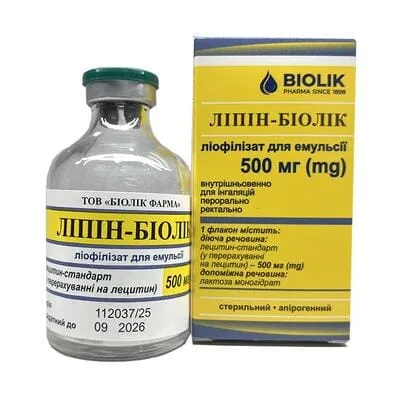
Table of Contents
INSTRUCTIONS FOR MEDICAL USE OF THE MEDICINAL PRODUCT LIPIN-BIOLIK (LIPIN-BIOLIK)
Composition:
Active substance: 1 vial or bottle contains lecithin-standard (calculated as lecithin) – 500 mg;
Excipient: lactose monohydrate.
Pharmaceutical form. Lyophilisate for emulsion.
Main physico-chemical properties: amorphous mass of white or light-yellow color with a characteristic odor.
Pharmacotherapeutic group. Agents affecting the digestive system and metabolism.
ATC code A16A X.
Pharmacological Properties.
Pharmacodynamics.
LIPIN-BIOLIK has anti-hypoxic effects, promotes increased diffusion rate of oxygen from the lungs into the blood and from the blood into tissues, and normalizes tissue respiration processes. It restores functional activity of endothelial cells, synthesis and release of endothelium-derived relaxing factor, improves microcirculation and blood rheological properties. LIPIN-BIOLIK inhibits lipid peroxidation processes in blood and tissues, supports antioxidant system activity of the body, exerts a membrane-protective effect, acts as a non-specific detoxicant, and enhances non-specific immunity.
When administered by inhalation, LIPIN-BIOLIK helps preserve pulmonary surfactant, thereby improving pulmonary and alveolar ventilation and increasing the rate of oxygen transport across biological membranes. LIPIN-BIOLIK does not impair the functional state of organs and body systems, is non-toxic, and lacks cumulative properties.
Pharmacokinetics.
After intravenous administration, LIPIN-BIOLIK, as a liposomal composition, circulates in the blood for up to 2 hours. Maximum accumulation of the drug occurs in the liver and spleen (up to 20%), reached within 5 minutes after administration and maintained for 180–300 minutes. The drug is excreted in urine and feces.
Clinical characteristics.
Indications.
The drug is to be used as part of combination therapy.
Pulmonology. Acute and chronic respiratory failure of any etiology in adults and children, including newborns with respiratory disorders associated with perinatal hypoxia and birth asphyxia.
Cardiology. Acute myocardial infarction and unstable angina.
Gastroenterology. Acute and chronic active hepatitis, chronic non-calculous cholecystitis, liver cirrhosis, ulcerative colitis.
Obstetrics. Late gestosis, intrauterine fetal hypoxia.
Nephrology. Acute and chronic pyelonephritis, glomerulonephritis, diabetic nephropathy, polycystic kidney disease, renal failure.
Contraindications. Individual hypersensitivity to the components of the drug.
Interaction with other medicinal products and other forms of interaction.
LIPIN-BIOLIK may be administered in combination therapy with steroid, cytostatic, choleretic, vitamin preparations, and antibiotics.
Special precautions for use.
The drug contains lactose; therefore, LIPIN-BIOLIK should not be administered to patients with rare hereditary forms of galactose intolerance, lactase deficiency, or glucose-galactose malabsorption syndrome.
Use during pregnancy or breastfeeding.
Can be used during pregnancy or breastfeeding.
Ability to influence reaction rate while driving or operating machinery.
Not studied.
Method of Administration and Dosage.
Administer intravenously, by inhalation, orally, and rectally. The liposomal composition (emulsion) of LIPIN-BIOLIK must be prepared immediately before use.
Preparation of the liposomal composition (emulsion).
Keep the vial (bottle) at room temperature for 30 minutes. Then add 50 mL of 0.9% sodium chloride solution for injection or infusion, pre-warmed to 36 °C, to the lyophilized powder contained in the vial (bottle). Shake the vial (bottle) for 2–3 minutes until a homogeneous white emulsion is formed.
For preparing the LIPIN-BIOLIK emulsion for oral or rectal administration, distilled or boiled water may be used.
Pulmonology.
Preparation of the liposomal composition (emulsion) for inhalation use.
Keep the vial (bottle) at room temperature for 30 minutes. Then add 10 mL of 0.9% sodium chloride solution for injection or infusion, pre-warmed to 36 °C, to the lyophilized powder in the vial (bottle). Shake the vial for 2 minutes until a milky-white liquid is formed, with a drug concentration of 50 mg/mL.
For inhalation use, LIPIN-BIOLIK should be administered at a dose of 10–15 mg/kg body weight per inhalation, 1–2 times daily. Treatment course: 5–10 days. The inhaler may be connected to the breathing circuit of a mechanical ventilation (MV) apparatus. Ultrasonic or aerosol-type inhalers must be used for inhalation. Steam aerosol inhalers are strictly contraindicated. In severe cases, the drug should be administered intravenously at a dose of 10–15 mg/kg body weight, 1–3 times daily. For newborns with respiratory distress syndrome, LIPIN-BIOLIK should be administered via inhalation at doses of 25–100 mg/kg body weight, 3–4 times daily. Optimal inhalation duration is 3–4 minutes. Treatment course: 4–5 days. If necessary, the course may be extended to 10–12 days.
Use of nebulizer inhalers is recommended. Before use, remove the inhaler from the packaging and allow it to warm to room temperature. Assemble the inhaler parts as indicated in the diagram.
| Pour the required amount of emulsion into the nebulizer chamber using a sterile syringe or directly from the vial (bottle), and close with a lid as shown in Fig. 1. Connect the nebulizer chamber to the ventilator or compressor via an oxygen tube (Fig. 2). Attach the T-connector to the nebulizer chamber (Fig. 3). Attach appropriate accessories (nasal cannulas, pediatric and adult face masks, mouthpieces, endotracheal tubes) to the T-connector. It is recommended to use a nebulizer filling volume of 2–5 ml and a "working" gas flow rate of 6–8 L/min. Inhalation should continue until the calculated dose is fully administered. Cardiology. In the treatment of acute myocardial infarction and unstable angina, LIPIN-BIOLIK should be administered at a dose of 35 mg/kg body weight, four times daily. The drug should be administered intravenously slowly. Treatment course: 4–5 days. During thrombolytic therapy, to prevent reperfusion myocardial injury, LIPIN-BIOLIK should be administered at a dose of 30 mg/kg body weight 30 minutes before thrombolytic administration, followed by 15 mg/kg body weight four times daily. Treatment course: 7–9 days. Obstetrics. In the treatment of late gestoses, LIPIN-BIOLIK should be administered at a dose of 5–10 mg/kg body weight once daily. |
The drug should be administered intravenously slowly. The treatment course lasts 3–10 days, depending on the clinical manifestations of gestosis.
Gastroenterology. For the treatment of acute or chronic active hepatitis, chronic non-calculous cholecystitis, and liver cirrhosis, LIPIN-BIOLIK should be administered orally at a dose of 1 g twice daily. The treatment course is 18–21 days. In cases of severe disease, LIPIN-BIOLIK should be dissolved in 0.9% sodium chloride solution for injection or infusion and administered intravenously by slow drip at a dose of 1 g twice daily for 10 days. During treatment, the route of administration may be changed. For the treatment of nonspecific ulcerative colitis, LIPIN-BIOLIK should be administered as microenemas at a dose of 1 g twice daily for 10 days, followed by 0.5 g twice daily for another 10 days.
Nephrology. For the treatment of acute and chronic pyelonephritis, LIPIN-BIOLIK should be administered at a dose of 10–20 mg/kg body weight once daily as part of combined antibacterial therapy. The drug should be administered intravenously by slow drip infusion. The treatment course is 3–4 days. For the treatment of chronic glomerulonephritis, pyelonephritis, and diabetic nephropathy at the stage of chronic renal failure, LIPIN-BIOLIK should be administered at a dose of 10–20 mg/kg body weight once daily in combination with standard basic therapy. The drug should be administered intravenously by slow drip infusion. The treatment course is 14 days.
Children.
Can be used in children from birth.
Overdose.
Possible manifestations of increased sensitivity to the components of the medicinal product.
Treatment is symptomatic.
Adverse reactions.
The drug is well tolerated by patients at therapeutic doses.
Immune system disorders: allergic reactions.
Nervous system disorders: headache, dizziness.
Cardiac disorders: palpitations.
Vascular disorders: decreased blood pressure.
Gastrointestinal disorders: vomiting.
Skin and subcutaneous tissue disorders: urticaria, pruritus.
General disorders and administration site conditions: fever, weakness, lower back pain, limb tremor, shooting pains in the chest and lower back, vein pain along the venous pathway.
In such cases, the drug should be discontinued and symptomatic treatment administered.
Shelf life. 1 year 6 months.
Storage conditions.
Store in a freezer at a temperature from minus 20 °C to minus 10 °C.
Keep out of reach of children.
Incompatibility.
Do not use in the same syringe or inhalation device with other parenteral or inhalation solutions.
Packaging.
500 mg in a vial or bottle No. 1; or a set: three vials of 500 mg each with one NEBULISER inhaler.
Prescription status. Prescription only.
Manufacturer.
LLC "BIOLIK PHARMA".
Manufacturer's location and address of business activity.
Legal entity location:
70 Pomirky, Kharkiv, Kharkiv region, 61070, Ukraine.
Address of business activity:
Pomirky-70, building without number, Kharkiv, Kharkiv region, 61070, Ukraine.