Lidoxan lemon
Ukraine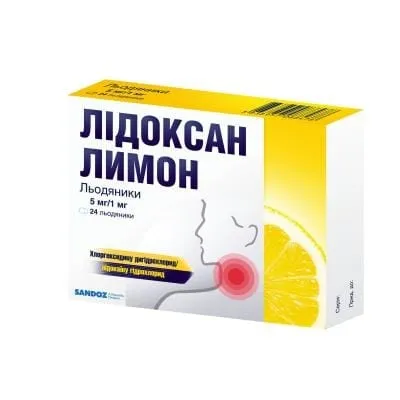
Table of Contents
INSTRUCTIONS FOR MEDICAL USE OF THE MEDICINAL PRODUCT LIDOKSAN LEMON
Composition:
Active substances: chlorhexidine dihydrochloride, lidocaine hydrochloride;
1 lozenge contains 5 mg of chlorhexidine dihydrochloride and 1 mg of lidocaine hydrochloride;
Excipients: aspartame (E 951), potassium acesulfame, lemon flavoring 501050 APO551, magnesium stearate, sorbitol (E 420).
Pharmaceutical form. Lozenges.
Main physicochemical properties: white or almost white, round tablets with small specks, lemon-flavored.
Pharmacotherapeutic group. Medicinal products used in throat disorders. Antiseptics. ATC code R02AA05.
Pharmacological Properties
Pharmacodynamics. Lidocaine hydrochloride is an amide-type local peripheral anesthetic. It exerts a surface analgesic effect without delaying the conduction of nerve impulses at the site of application.
As a local anesthetic, lidocaine has the same mechanism of action as other agents in this class: it blocks the generation and conduction of nerve impulses in sensory, motor, and autonomic nerve fibers. It acts directly on cell membranes, inhibiting the influx of sodium ions into nerve fibers through the membranes. As the anesthetic effect progressively spreads, the threshold of electrical excitation in peripheral nerves increases, nerve impulse conduction slows down, and action potential recovery is weakened, ultimately leading to complete blockade of the nerve impulse. In general, local anesthetics block autonomic nerves, small unmyelinated fibers (pain sensation), and small myelinated fibers (pain, temperature sensation) more rapidly than large myelinated fibers (touch, pressure sensation).
At the molecular level, lidocaine specifically blocks sodium ion channels in their inactive state, thereby preventing the generation of action potentials and blocking nerve impulse conduction when lidocaine is applied locally near a nerve.
The effect on peripheral nerves is particularly important when lidocaine is used as a local anesthetic. The ratio of efficacy to toxicity is favorable. Allergic reactions caused by lidocaine are very rare.
Chlorhexidine is a cationic antiseptic agent exerting antibacterial activity against both Gram-positive and Gram-negative microorganisms (e.g., Micrococcus sp., Staphylococcus sp., Streptococcus sp., Bacillus sp., Clostridium sp., Corynebacterium sp.). It also exhibits antifungal activity against dermatophytes and fungi. At low concentrations, chlorhexidine acts as a bacteriostatic agent, while at higher concentrations, it exerts bactericidal effects.
Chlorhexidine carries a strong positive charge and thus is adsorbed onto negatively charged sites of the bacterial cell wall and extracellular structures. This adsorption is specific and localized to phosphate-containing regions of the bacterial cell wall.
Chlorhexidine binds to the bacterial cytoplasmic membrane. It is adsorbed onto the negatively charged surfaces of teeth, dental plaque, and oral mucosal membranes. Small amounts of active substances may enter the gastrointestinal tract via saliva. Chlorhexidine is not absorbed systemically. Lidocaine may be absorbed through the mucous membranes of the mouth and pharynx; however, most of it is degraded before reaching systemic circulation.
Pharmacokinetics.
Chlorhexidine
Absorption
After topical or oral administration, chlorhexidine is poorly absorbed. When applied topically to damaged skin areas, chlorhexidine is absorbed by the outer skin layer, resulting in prolonged bactericidal effects on the skin. Pharmacokinetic studies have shown that approximately 30% of chlorhexidine remains in the oral cavity after rinsing and is gradually released into saliva. Patients swallow about 4% of chlorhexidine.
Distribution
After oral administration, plasma protein binding of chlorhexidine is negligible.
Metabolism and Excretion
Chlorhexidine does not accumulate. Only a minor fraction is metabolized. 10% of the absorbed active substance is excreted in urine, and 90% is excreted in feces.
Lidocaine
Absorption
The extent of systemic absorption of lidocaine depends on the site and route of administration. It is rapidly absorbed from the gastrointestinal tract, mucous membranes, and through damaged skin, although most of it is metabolized before entering systemic circulation. Absorption from mucous membranes after local application depends on perfusion and total dose. Within 30 minutes after administration, less than 17% of the dose may be excreted unchanged from the gastrointestinal tract, and less than 1.5% from other tissues.
The anesthetic effect of lidocaine after local application begins within two to five minutes and lasts from 30 to 45 minutes. Anesthesia is superficial and does not extend to submucosal structures.
Distribution
Lidocaine is well distributed in tissues (kidneys, lungs, liver, heart, adipose tissue). It crosses the blood-brain barrier and placenta and is excreted in human breast milk.
Metabolism and Excretion
Lidocaine undergoes hepatic first-pass metabolism. It is dealkylated in the liver. The first two metabolites are pharmacologically active. In some patients, these two metabolites may exert toxic effects on the central nervous system. Lidocaine is primarily excreted by the kidneys as metabolites, with 10% excreted unchanged. The biological half-life of lidocaine is 1.5–2 hours in adults and 3 hours in newborns. The biological half-life of lidocaine metabolites ranges from 2 to 10 hours.
The biological half-life is prolonged in conditions such as congestive heart failure, liver disease, and myocardial infarction.
Clinical characteristics.
Indications.
Inflammatory and infectious diseases of the oral cavity and pharynx accompanied by pain on swallowing and irritation.
Contraindications.
- Hypersensitivity to the active substances (chlorhexidine or lidocaine), to any of the excipients of the medicinal product, or to local anesthetics of the amide type.
- Children under 6 years of age.
Interaction with other medicinal products and other forms of interaction.
Lidocaine is an inhibitor of the CYP1A2 enzyme and to a lesser extent of the 2D6 and 3A4 isoenzymes; however, interactions with substrates of these enzymes when the medicinal product is used at recommended doses are clinically insignificant.
Lidocaine should not be used concomitantly with disinfectant solutions containing heavy metals. Iontophoresis of vasoactive substances may significantly affect transdermal delivery of lidocaine.
Clinically insignificant interactions of lidocaine with the following medicinal products have been reported: neuromuscular blockers, other antiarrhythmics, hydantoins (antiepileptic agents), adrenaline, opioids, beta-blockers, cimetidine, and the antiarrhythmic mexiletine. Insignificant interactions have also been observed in patients with cocaine-induced myocardial infarction.
Patients should not take Lidoksan Lemon simultaneously with cholinesterase inhibitors (e.g., neostigmine, distigmine, pyridostigmine) or with other medicinal products used to treat severe myasthenia gravis.
During treatment with Lidoksan Lemon lozenges, patients should not use other local antiseptics for simultaneous disinfection of the throat. This does not apply to other medicinal products containing chlorhexidine/lidocaine due to the presence of the same active ingredient. A single dose of lozenges should replace a single dose of spray. When using both spray and lozenges simultaneously, patients should not exceed the maximum daily dose. Additionally, spray and lozenges should not be used simultaneously in children.
Chlorhexidine is incompatible with anionic surfactants (e.g., sodium lauryl sulfate) and certain other substances (e.g., alginates, tragacanth, insoluble powders such as kaolin, and insoluble calcium, magnesium, or zinc compounds), which are often present in toothpastes. Therefore, the interval between tooth brushing and taking Lidoksan Lemon lozenges should be at least 30 minutes.
Special precautions for use
Bacterial infections accompanied by elevated body temperature should be treated separately. In such cases, Lidoksan Lemon may be used as an additional medicinal product for relief of throat pain after consultation with a physician.
Caution is advised when prescribing the drug to patients with heart failure, impaired liver function, and to those concurrently receiving lidocaine analogs (class I antiarrhythmic agents), due to the possible increased risk of enhanced adverse effects of lidocaine.
Lidoksan Lemon should be used with caution in patients prone to hypersensitivity reactions.
Patients should not use this medicinal product for longer than 3–4 days. It is recommended for use only to reduce pain and throat irritation caused by inflammation. If the patient's condition does not improve within this period, treatment should be discontinued and medical advice sought.
After application, patients should refrain from eating or drinking and from tooth brushing.
This medicinal product contains sorbitol (E 420). If you have been diagnosed with intolerance to certain sugars, consult your doctor before taking this medicinal product.
Lidoksan Lemon also contains aspartame (E 951), a source of phenylalanine. This may be harmful to patients with phenylketonuria.
The medicinal product contains a small amount of ethanol (alcohol), less than 100 mg per lozenge (0.000024 mg).
Use during pregnancy or breastfeeding
Changes in the pharmacokinetics and/or pharmacodynamics of lidocaine during pregnancy may lead to toxic effects. There are no adequate and well-controlled studies on the use of chlorhexidine in pregnant women.
Metabolites of lidocaine are excreted in breast milk; however, no adverse effects have been observed in breastfed infants. It is unknown whether chlorhexidine passes into breast milk. Nevertheless, the use of this medicinal product in pregnant and breastfeeding women is not recommended unless the potential benefit justifies the potential risk to the fetus or infant.
There are no data on the effects of lidocaine and chlorhexidine on human fertility.
Ability to affect reaction speed when driving or operating machinery
No studies on the effect of the drug on reaction speed during driving or operating machinery have been conducted.
The medicinal product has no effect or negligible effect on the ability to drive a vehicle or operate machinery.
Method of Administration and Dosage
Adults and children aged 12 years and older
The recommended dose is 6 to 10 lozenges per day, depending on the severity of symptoms. Each lozenge should be slowly dissolved in the mouth every 2.5–4 hours.
Children aged 6 to 12 years
The recommended dose for children aged 6 years and older is half the adult dose, i.e. 3 to 5 lozenges per day, depending on the severity of symptoms. Lidoksan Lemon lozenges should be slowly dissolved in the mouth every 5–8 hours.
The maximum single dose for adults is 5 mg of chlorhexidine (0.08 mg/kg body weight) and 1 mg of lidocaine (0.02 mg/kg body weight), equivalent to 1 lozenge.
The maximum daily dose of chlorhexidine is 50 mg, and the maximum daily dose of lidocaine is 10 mg, corresponding to 10 lozenges.
Method of administration
Lidoksan Lemon lozenges must be sucked until completely dissolved. The medicinal product is intended for local application in the oral cavity and throat.
It is not advisable to use the product during or immediately after eating.
Treatment duration
Lidoksan Lemon should not be used for more than 3–4 days. If the patient's condition does not improve during this period, or if a bacterial infection develops, accompanied by an increase in body temperature, treatment should be discontinued and medical advice should be sought.
Patients with diabetes mellitus
Lidoksan Lemon does not contain sugar (sucrose) and therefore can be used by patients with diabetes mellitus.
Children. Not recommended for children under 6 years of age.
Overdose
Although the medicinal product contains only a small fraction of the toxic doses of both active substances and is used locally in the oral cavity, it may be accidentally or carelessly swallowed. This is particularly relevant for children.
Chlorhexidine is absorbed from the gastrointestinal tract to a negligible extent. Lidocaine is absorbed more rapidly, but its bioavailability after oral administration is only 35%. Toxic effects of lidocaine occur at plasma concentrations exceeding 6 mg/L. After administration of excessive doses (more than 20 lozenges per day), difficulty in swallowing (reduced control of the swallowing reflex) may occur. In such cases, immediate medical attention is required. Systemic intoxication results from effects on the central nervous system and cardiovascular system. The initial signs of overdose are related to central nervous system involvement.
Symptoms that may occur in systemic intoxication:
- Central nervous system:
headache, hallucinations, dizziness, lethargy, drowsiness, restlessness, tinnitus, paraesthesia, speech and hearing disturbances, perioral numbness, metabolic acidosis, nystagmus, muscle tremors, psychosis, seizures, respiratory arrest, coma, epileptic seizure, altered level of consciousness;
- Cardiovascular system:
circulatory collapse, severe bradycardia, cardiac arrhythmia (sinus node arrest, tachyarrhythmia), cardiac arrest.
In addition, isolated cases of chlorhexidine overdose have been reported, with symptoms including: pharyngeal edema, necrotic lesions of the esophagus, elevated serum aminotransferase levels (more than 30 times above normal), vomiting, gastric and duodenal erosions with active atrophic gastritis, euphoria, visual disturbances, and complete loss of taste (lasting up to 8 hours).
Treatment in case of systemic intoxication
If symptoms of systemic intoxication occur, treatment should be discontinued immediately. Induce vomiting and perform gastric lavage. Administer anionic agents such as alkylbenzene sulfonate, alkyl sulfonate, or sodium alkyl sulfate. In more severe cases, hospitalize the patient to maintain respiration and circulation and to prevent dehydration. Diazepam is used to treat seizures.
Adverse Reactions
Adverse events are listed by system organ classes and frequency of occurrence:
Very common (≥ 1/10);
Common (≥ 1/100 to < 1/10);
Uncommon (≥ 1/1,000 to < 1/100);
Rare (≥ 1/10,000 to < 1/1,000);
Very rare (< 1/10,000);
Not known (cannot be estimated from available data).
Blood and lymphatic system disorders
Not known: Methaemoglobinaemia.
Immune system disorders
Common: Skin hypersensitivity reactions.
Rare: Severe hypersensitivity reactions, including anaphylactic shock.
Very rare: Urticaria.
Not known: Delayed-type hypersensitivity reactions (contact allergy, photosensitivity), or other skin or dental reactions.
Psychiatric disorders
Not known: Restlessness, excitement, euphoria.
Nervous system disorders
Not known: Somnolence, dizziness, disorientation, confusion (including speech confusion), vertigo, tremor, psychosis, nervousness, paraesthesia, numbness, seizures, loss of consciousness, coma.
Eye disorders
Not known: Visual disturbances, including blurred vision or diplopia.
Ear and labyrinth disorders
Not known: Tinnitus (ringing in the ears).
Respiratory, thoracic and mediastinal disorders
Not known: Dyspnoea, respiratory distress syndrome, respiratory depression, respiratory arrest, asthma.
Gastrointestinal disorders
Common: Nausea, vomiting, abdominal pain.
Not known: Dysphagia, oral ulcers.
Skin and subcutaneous tissue disorders
Rare: Contact dermatitis.
Not known: Lichenoid reactions, skin peeling, parotid gland swelling.
Musculoskeletal and connective tissue disorders
Not known: Muscle twitching or tremor.
General disorders and administration site conditions
Not known: Asthenia, transient taste disturbances or burning sensation of the tongue, sensation of heat or cold.
Prolonged and continuous use of chlorhexidine over the entire surface of the oral cavity may lead to temporary brownish discoloration of teeth. However, this discoloration can be removed. There have been no reports of tooth discoloration when the medicinal product is used only in the pharyngeal area.
Reporting suspected adverse reactions after authorization is important. It allows ongoing monitoring of the benefit-risk balance of the medicinal product. Healthcare professionals and patients, as well as their legal representatives, are encouraged to report all suspected adverse reactions and lack of efficacy through the Automated Pharmacovigilance System at the following link: https://aisf.dec.gov.ua/.
Shelf life: 2 years.
Storage conditions. Store at temperatures not exceeding 25 °C. Keep out of reach of children.
Packaging. Blister pack containing 12 lozenges; 2 blisters per cardboard box.
Prescription status. Over-the-counter (without prescription).
Manufacturer.
(Batch release)
Lek Farmacevtska podjetje d.d. / Lek Pharmaceuticals d.d.
Verovskova 57, Ljubljana 1526, Slovenia / Verovskova 57, Ljubljana 1526, Slovenia.
Manufacturer.
(Full-cycle manufacturing)
Laboratoria Qualiphar NV (Qualiphar NV)
Rijksweg 9, Bornem, 2880, Belgium / Rijksweg 9, Bornem, 2880, Belgium.
Date of latest review.