Lidaza-biopharma
Ukraine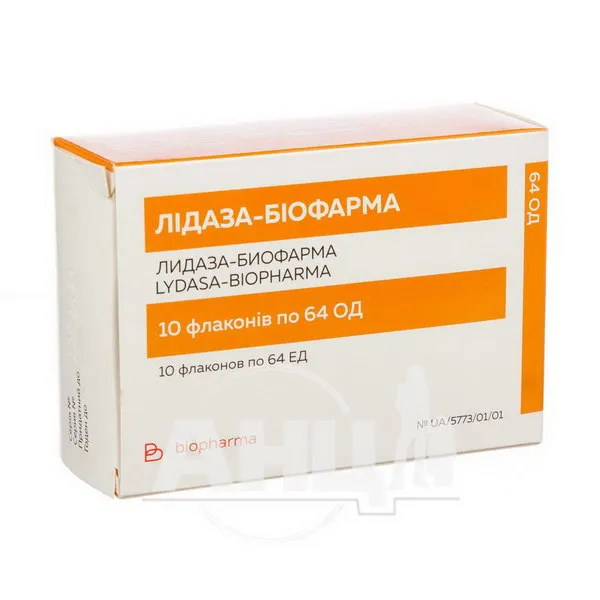
Table of Contents
INSTRUCTIONS FOR MEDICAL USE OF THE MEDICINAL PRODUCT LIDAZA - BIOFARMA (LYDASUM - BIOFARMA)
Composition:
Active substance: 1 vial contains 64 IU of hyaluronidase (obtained from bovine testes);
Excipients: sodium chloride, disodium phosphate dodecahydrate, dextran 70.
Pharmaceutical form. Powder for solution for injection.
Main physicochemical properties: powder consolidated into a tablet or lyophilized porous mass of white to creamy color of varying intensity. The presence of a dry crust on the surface is permissible.
Pharmacotherapeutic group.
Haematological agents. Enzymes. ATC code B06A A03.
Pharmacological properties.
Pharmacodynamics.
Hyaluronidase is an enzyme for which hyaluronic acid is the specific substrate. Hyaluronic acid is a mucopolysaccharide composed of acetylglucosamine and glucuronic acid. Hyaluronic acid has high viscosity; its biological role is that of a "cementing" intercellular substance in connective tissue. The effect of the drug consists in improving joint mobility, softening scars, eliminating and reducing contractures, and resorbing hematomas. The action is most pronounced at the initial stage of pathological processes. Hyaluronidase ("spreading factor") causes degradation of hyaluronic acid into glucosamine and glucuronic acid, thereby increasing tissue permeability and improving the movement of interstitial fluids. The effect of hyaluronidase is reversible—decreased concentration restores the viscosity of hyaluronic acid.
Pharmacokinetics.
Not studied.
Clinical characteristics.
Indications.
- Joint contractures;
- ankylosing spondylitis;
- Dupuytren's contracture (initial stage);
- scar tissue changes of various origins;
- hematomas (in the organization phase);
- scleroderma;
- in ophthalmological practice (keratitis, retinopathies);
- productive inflammatory lung lesions in patients with pulmonary tuberculosis;
- traumatic injuries of nerve plexuses and peripheral nerves;
- rheumatoid arthritis.
Contraindications.
- Hypersensitivity to the active substance;
- malignant neoplasms;
- acute infectious and inflammatory processes;
- pulmonary hemorrhages and hemoptysis;
- use of estrogens;
- acute phase of hematomas;
- tuberculosis with pronounced pulmonary insufficiency.
Interaction with other medicinal products and other forms of interaction.
The drug accelerates the absorption of other medicinal products (local anesthetics, isotonic solutions, muscle relaxants) when administered subcutaneously or intramuscularly.
Special precautions for use.
The drug can be used in combination with physiotherapeutic treatment methods, including phonophoresis.
Use during pregnancy or breastfeeding.
Data on the efficacy and safety of the drug during pregnancy or breastfeeding are lacking. The drug is contraindicated in pregnant women. Breastfeeding should be discontinued during treatment.
Ability to influence reaction rate when driving or operating machinery.
Not studied. The drug should be used with caution in patients whose activities require high attention and quick psychomotor reactions. When the drug is administered subconjunctivally or applied locally to the cornea, temporary blurred vision and other visual disturbances may occur. If these effects occur, patients should wait until vision is restored before driving or operating machinery.
Method of Administration and Dosage
The drug Lidaza-Biofarma is administered subcutaneously, under altered fibrous tissues, intramuscularly, by inhalation, via electrophoresis, or by application onto mucous membranes. In ophthalmological practice, the drug may also be administered subconjunctivally or retrobulbarly.
For injections, the contents of the vial should be dissolved in 1 mL of 0.9% sodium chloride solution or in 1 mL of 0.5% procaine solution.
For contractures, scars of various origins, hematomas, and ankylosing spondylarthritis: administer subcutaneously near the affected area or under altered fibrous tissue at a dose of 64 IU for adults. Injections are given daily or every other day. A treatment course consists of 6–10–15 injections.
For traumatic injuries of peripheral nerve plexuses: administer subcutaneously every other day at a dose of 64 IU for adults in procaine solution. The treatment course (12–15 injections) may be repeated if necessary.
For rheumatoid arthritis: apply the drug via electrophoresis. Dissolve 64 IU of lidase in 30 mL of distilled water, add 4–5 drops of 0.1 N hydrochloric acid solution, and administer via a split electrode (anode) to two joints. The procedure lasts 20–30 minutes; the treatment course consists of 10–15 sessions.
For productive inflammatory processes in patients with pulmonary tuberculosis: administer the drug via injections and inhalations as part of combination therapy to enhance the concentration of antibiotics and other antibacterial agents at the site of lesion. For inhalations, dissolve the contents of one vial in 5 mL of 0.9% sodium chloride solution. Daily inhalations once daily (5 mL of solution containing 64 IU). A treatment course requires 20–25 inhalations. Repeat courses, if necessary, with intervals of 1.5–2 months.
For finer scarring of affected corneal areas in keratitis: instill the drug solution (one vial dissolved in 20 mL of isotonic sodium chloride solution or in 20 mL of 0.5% procaine solution), concurrently with antibiotics and sulfonamides.
For retinopathies: administer subcutaneously in the temporal region, 0.5 mL of solution (one vial dissolved in 20 mL of isotonic sodium chloride solution or in 20 mL of 0.5% procaine solution). The treatment course consists of 10–15 injections.
Children
There is no data available on the efficacy and safety of the drug in children; therefore, the drug should not be used in pediatric practice.
Overdose
Symptoms: chills, nausea, vomiting, dizziness, tachycardia and arterial hypotension, local edema, urticaria, erythema.
Treatment: administration of adrenaline, glucocorticoids, and antihistamine drugs.
In case of overdose and development of allergic reactions, administration of the drug should be discontinued.
Adverse Reactions.
General reactions: weakness, increased body temperature, chills, sweating.
Nervous system disorders: dizziness, headache.
Cardiovascular system disorders: arterial hypotension, tachycardia.
Respiratory system disorders: dyspnea, shortness of breath.
Allergic reactions, including hyperemia, skin rash, pruritus, urticaria, angioneurotic edema.
Local reactions: with intramuscular or subcutaneous administration, skin rash, hyperemia, erythema, pruritus, redness, swelling, pain, and sensation of warmth at the injection site may occur; in ophthalmological practice, with subconjunctival or retrobulbar administration – swelling, hyperemia of the eyelids, periorbital area, facial skin, and scleral hyperemia.
Shelf life. 2 years.
Storage conditions. Store in the original packaging, protected from light, at a temperature between 2 °C and 8 °C. Keep out of reach of children.
Incompatibility. Use only the recommended solvent. Do not mix the prepared solution with other medicinal agents. Use immediately after preparation.
Packaging. 5 vials in a blister. 2 blisters with vials in a cardboard box.
Prescription status. Prescription only.
Manufacturer. LLC "FZ "BIOFARMA", Ukraine.
Manufacturer's address and place of business.
Ukraine, 09100, Kyiv region, city of Bila Tserkva, Kyivska St., 37.