Levomycetin
Ukraine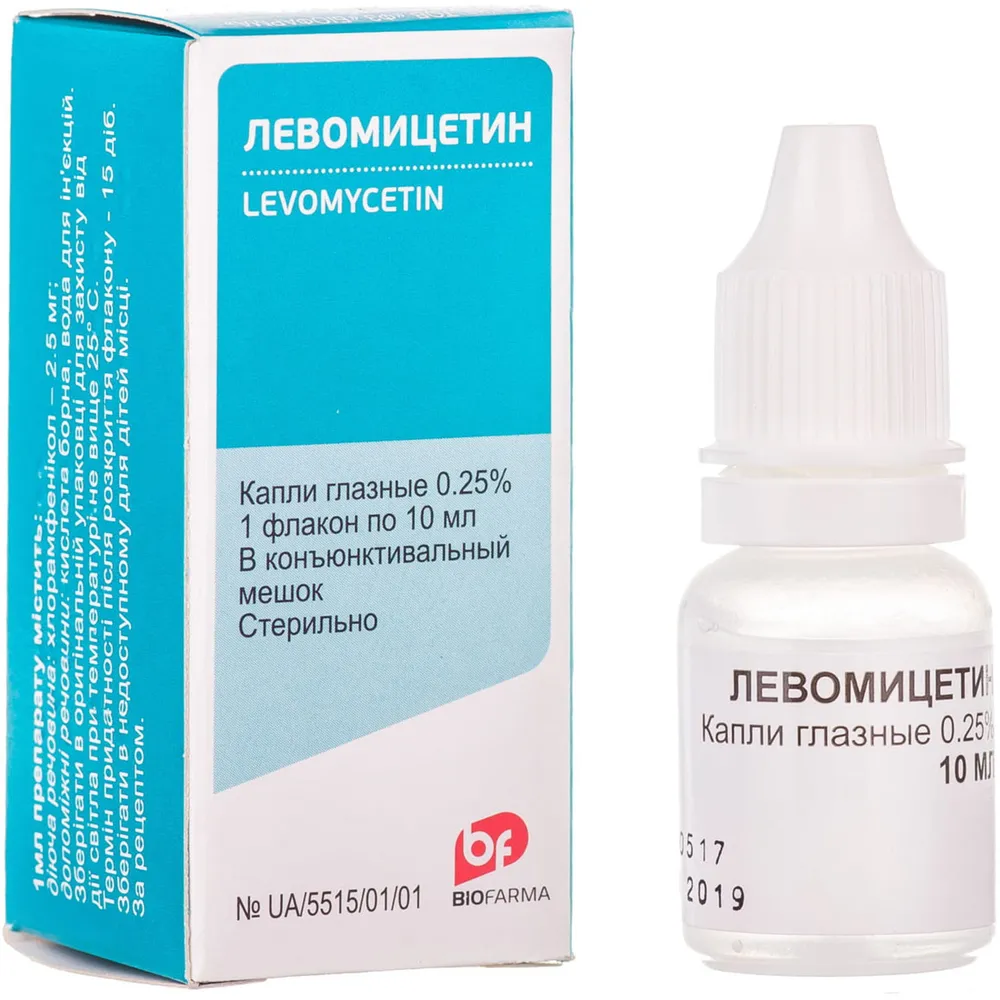
Table of Contents
INSTRUCTION FOR MEDICAL USE OF THE MEDICINAL PRODUCT LEVOMYCETIN (LEVOMYCETIN)
Composition:
Active substance: 1 ml of the preparation contains 2.5 mg of chloramphenicol;
Excipients: boric acid, water for injections.
Pharmaceutical form. 0.25 % eye drops.
Main physicochemical properties: clear, colorless liquid.
Pharmacotherapeutic group. Agents used in ophthalmology. Antibiotics. Chloramphenicol. ATC code S01AA01.
Pharmacological Properties.
Pharmacodynamics.
Chloramphenicol is a broad-spectrum antibiotic: effective against many Gram-positive and Gram-negative bacteria, rickettsiae, spirochetes, causative agents of trachoma, psittacosis, and venereal lymphogranuloma; active against bacterial strains resistant to penicillin, streptomycin, and sulfonamides. Weakly active against acid-resistant bacteria, Pseudomonas aeruginosa, protozoa, and Clostridia. Microbial resistance to chloramphenicol develops relatively slowly.
At usual doses, it exerts a bacteriostatic effect. The mechanism of antimicrobial action of chloramphenicol is associated with inhibition of microbial protein synthesis.
Pharmacokinetics.
The drug penetrates well into tissues and body fluids; therapeutic concentrations of chloramphenicol are achieved in the vitreous body, cornea, iris, and aqueous humor of the eye following topical administration as eye drops; the drug does not penetrate into the lens.
Clinical characteristics.
Indications. Conjunctivitis, keratitis, blepharitis caused by microorganisms sensitive to the drug.
Contraindications. Individual hypersensitivity to any component of the medicinal product. Skin disorders (psoriasis, eczema, fungal infections).
Myelosuppression during previous use of chloramphenicol.
Blood dyscrasias in personal or family history, including aplastic anemia.
Interaction with other medicinal products and other forms of interaction. Interaction with other drugs has not been established when topical application of eye drops is used. If other local ophthalmic medicinal products are used concomitantly, an interval of at least 15 minutes between applications should be observed. Ophthalmic ointments should be applied last.
Concomitant use of chloramphenicol with other medicinal products that suppress bone marrow function should be avoided.
When used simultaneously, chloramphenicol will inhibit chymotrypsin.
Special precautions for use.
Uncontrolled use of chloramphenicol is not permitted, especially in pediatric practice.
Chloramphenicol is absorbed into the systemic circulation following topical application, and toxicity due to chronic exposure has been reported.
Cases of bone marrow hypoplasia, including aplastic anemia and death, have been reported following topical use of chloramphenicol. Although such events are rare, the risk should be considered when evaluating the expected benefits of using this medicinal product. Systemic absorption can be reduced by pressing the lacrimal sac at the medial canthus for one minute during and after instillation of the drops. This blocks the passage of the drops through the nasolacrimal duct into the extensive absorptive area of the nasal and pharyngeal mucosa. This is particularly important in children.
If chloramphenicol eye drops are used for prolonged periods or intermittently, it is advisable to perform routine blood tests before treatment and at appropriate intervals during therapy to detect any hematopoietic abnormalities.
In severe infections, topical use of chloramphenicol should be supplemented with appropriate systemic therapy; therefore, the patient should consult a physician.
Prolonged use of chloramphenicol eye drops should be avoided, as it increases the likelihood of sensitization and emergence of resistant organisms. If a new infection develops during treatment, antibiotic use should be discontinued and appropriate measures taken. Chloramphenicol should be used only for infections for which it is indicated. Topical use of chloramphenicol may occasionally lead to overgrowth of insensitive organisms, including fungi. If a new infection appears during treatment, the patient should be referred to a physician.
Chloramphenicol eye drops do not provide adequate protection against Pseudomonas aeruginosa and Serratia marcescens.
Do not use the medicinal product for more than 5 days without consulting a physician.
The patient should consult a physician if there is no improvement within 2 days or if symptoms worsen, particularly if:
- visual disturbances develop;
- severe eye pain occurs;
- photophobia appears;
- eye inflammation associated with a skin rash on the head or face occurs;
- the eye appears cloudy;
- the pupil appears unusual;
- a foreign body in the eye is suspected.
Medical advice should also be sought in the following cases:
- recent history of conjunctivitis;
- history of glaucoma;
- history of dry eye syndrome;
- eye surgery or laser treatment within the last 6 months;
- history of eye trauma;
- current treatment with other eye drops or ointments;
- use of contact lenses.
Soft contact lenses should not be worn during treatment with chloramphenicol eye drops due to adsorption of the preservative into the lens, which may lead to lens damage. Wearing any type of contact lenses is not recommended during ocular infections. Soft contact lenses should not be worn for 24 hours after completion of treatment.
Use during pregnancy or breastfeeding. The medicinal product is contraindicated during pregnancy. Breastfeeding should be discontinued for the duration of treatment with this product. Chloramphenicol may be systemically absorbed after use of eye drops, may cross the placenta, and may appear in breast milk.
Ability to affect reaction speed when driving or operating machinery. For 1 hour after administration (until vision clears), patients should refrain from driving or operating machinery.
Dosage and Administration
Instill 1 drop of the preparation into the conjunctival sac 3 times daily in both eyes using the dropper. The duration of treatment usually ranges from 5 to 15 days (depending on the nature and severity of the disease, as well as the therapeutic effect achieved).
Patients should be advised to wash their hands before instillation and to avoid contact between the dropper tip and the eye or surrounding areas, as this may lead to eye injury.
Patients should also be instructed that ophthalmic solutions, if handled improperly, may become contaminated with common bacteria known to cause ocular infections. Serious eye damage and subsequent vision loss may result from the use of contaminated solutions.
Children. In infants under 4 weeks of age, the drug should be administered only if clearly indicated.
Overdose. Excessive doses of chloramphenicol may cause temporary reduction in visual acuity. In such cases, rinse eyes thoroughly with running water.
Accidental ingestion of the drops is unlikely to cause systemic toxicity due to the low antibiotic content in the medicinal product. If irritation, pain, swelling, tearing, or photophobia occur after unintended contact with the eyes, the affected eye should be irrigated for at least 15 minutes. If symptoms persist after irrigation, ophthalmological evaluation should be considered.
Adverse reactions.
Immune system, skin and subcutaneous tissue disorders: allergic reactions, including rash, angioneurotic edema, anaphylaxis, urticaria, pruritus, skin hyperemia, vesicular and maculopapular dermatitis.
Nervous system disorders: headache, dizziness.
General disorders and administration site reactions: local reactions, including eyelid swelling, pruritus and dermatitis, stinging, burning, eye irritation and lacrimation, fever.
Blood and lymphatic system disorders: bone marrow suppression and aplastic anemia (rarely) have been reported, as well as death following topical application of chloramphenicol. Pallor, weakness, increased heart rate, shortness of breath, headache, pain, fever, infection, and bruising may be signs of a serious blood disorder. Although the risk is low, this should be taken into account when assessing the benefits expected from the use of the medicinal product.
Shelf life. 2 years.
After opening the bottle – 15 days.
Do not use after the expiry date stated on the packaging.
Storage conditions. Store in the original packaging to protect from light at a temperature not exceeding 25 °C. Keep out of reach of children.
Packaging. 10 ml of 0.25% solution in plastic bottles. 1 bottle in a cardboard box.
Prescription category. Prescription only.
Manufacturer. FZ "STADA", Ukraine.
Manufacturer's address and place of business.
37, Kyivska Street, Bila Tserkva, Kyiv region, 09100, Ukraine.