Levocom retard asino
Ukraine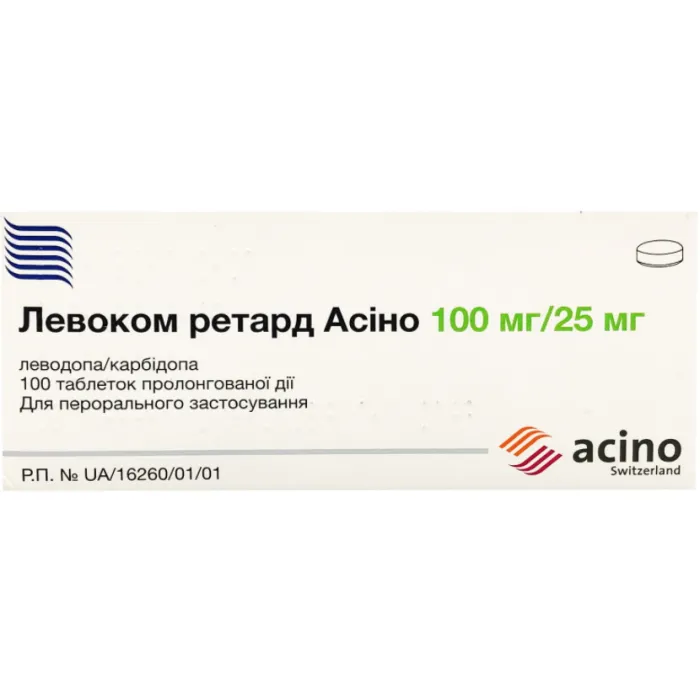
Table of Contents
INSTRUCTIONS FOR MEDICAL USE OF THE MEDICINAL PRODUCT LEVOCOM RETARD ACINO (LEVOCOM RETARD ACINO)
Composition:
Active substances: levodopa, carbidopa (in the form of carbidopa monohydrate);
One prolonged-release tablet of Levocom Retard Acino 100/25 contains: levodopa 100 mg, carbidopa monohydrate equivalent to carbidopa – 25 mg;
One prolonged-release tablet of Levocom Retard Acino 200/50 contains: levodopa 200 mg, carbidopa monohydrate equivalent to carbidopa – 50 mg;
Excipients: hypromellose, colloidal anhydrous silicon dioxide, fumaric acid, sodium stearyl fumarate, quinoline yellow (E 104), macrogol 6000, iron oxide yellow (E 172), iron oxide red (E 172), titanium dioxide (E 171).
Pharmaceutical form. Prolonged-release tablets.
Main physicochemical properties:
Levocom Retard Acino 100/25: round, biconvex tablet of orange-brown color with rounded edges.
Levocom Retard Acino 200/50: round tablet of orange-brown color.
Pharmacotherapeutic group. Antiparkinson agents. DOPA and its derivatives.
ATC code N04B A02.
Pharmacological Properties
Pharmacodynamics
Levocom Retard Asino is a combination of carbidopa, a decarboxylase inhibitor, and levodopa, a metabolic precursor of dopamine.
Levodopa alleviates the symptoms of Parkinson's disease by being decarboxylated to dopamine in the brain, where it is present in reduced amounts in these patients (replacement therapy). Since at least 95% of orally administered levodopa is decarboxylated in peripheral tissues, only a small fraction reaches the brain.
Dopamine formed in peripheral tissues, and adrenergic substances derived from it, cause numerous adverse effects on the gastrointestinal and cardiovascular systems when levodopa is used as monotherapy.
Concomitant administration of the decarboxylase inhibitor carbidopa substantially prevents the peripheral decarboxylation of levodopa. As a result, the dose of levodopa required to achieve a similar clinical effect can be reduced to 20% of that needed for monotherapy. Thus, adverse effects on the gastrointestinal and cardiovascular systems can be avoided.
Pharmacokinetics
Levodopa/carbidopa prolonged-release 100 mg/25 mg
It is known that the pharmacokinetics of the prolonged-release combination of levodopa/carbidopa 100 mg/25 mg has been studied in patients with Parkinson's disease. Administration of the prolonged-release levodopa/carbidopa combination 100 mg/25 mg twice daily, at total daily doses of 50–150 mg carbidopa and 200–600 mg levodopa over 3 months (open, uncontrolled studies) did not result in accumulation of levodopa in plasma.
Levodopa/carbidopa prolonged-release 200 mg/50 mg
It is known that the pharmacokinetics of the prolonged-release combination of levodopa/carbidopa 200 mg/50 mg has been studied in healthy volunteers of younger (23–45 years) and older (55–76 years) age.
Comparison of pharmacokinetic parameters showed that bioavailability and plasma concentrations were on average higher in elderly patients after administration of the prolonged-release levodopa/carbidopa combination 200 mg/50 mg.
The mean time to reach maximum concentration was approximately 2 hours for the 200 mg/50 mg prolonged-release tablets, and 0.75 hours for the 100 mg/25 mg prolonged-release tablets.
On average, the peak plasma concentration of the prolonged-release levodopa/carbidopa 200 mg/50 mg combination was 60% lower (depending on the dose) than that of the 100 mg/25 mg prolonged-release combination, and the in vivo absorption period of the 200 mg/50 mg prolonged-release levodopa/carbidopa was 4 to 6 hours.
Plasma levodopa levels fluctuated less with the administration of the prolonged-release 200 mg/50 mg formulation compared to the 100 mg/25 mg formulation.
Since the bioavailability of levodopa in the 200 mg/50 mg prolonged-release tablets is only 70% compared to the 100 mg/25 mg levodopa/carbidopa tablets, the daily dose of levodopa in prolonged-release formulations is usually higher than in immediate-release dosage forms.
There was no evidence of excessively rapid or uncontrolled release of the active substance. It is unknown whether high-protein food affects absorption, and to what extent.
Dopamine formation is inhibited in the presence of carbidopa. The formation of 3-O-methyldopa becomes the main pathway of degradation. During further metabolism of dopamine, secondary metabolites such as 3,4-dihydroxyphenylacetic acid (DOPAC) and homovanillic acid (HVA) are formed. The urinary excretion of levodopa, dopamine, DOPAC, and HVA over 24 hours accounted for 0.53%, 4.24%, 32%, and 25.9% of the administered dose, respectively. Levodopa is 6% bound to plasma proteins.
On average, 50% of an oral 50 mg dose of carbidopa is excreted in urine and 34% in feces, indicating incomplete absorption. The recovery rate of unchanged carbidopa after oral administration averaged 10.2% of the administered dose. Three major metabolites were found in urine.
Clinical characteristics.
Indications.
As an adjunctive therapy in Parkinson's disease in patients who have developed motor fluctuations during treatment with standard immediate-release levodopa/dopadecarboxylase inhibitors.
Levocom Retard Asino medicinal product should be used in combination with other medicinal products for the treatment of Parkinson's disease as an alternative to immediate-release levodopa/dopadecarboxylase inhibitor preparations (standard).
There is insufficient clinical experience regarding the use of Levocom Retard Asino medicinal product in patients who have not previously received levodopa or other antiparkinsonian agents, neither during transition from treatment with Levocom Retard Asino 100/25 mg tablets to treatment with Levocom Retard Asino 200/50 mg tablets, nor during long-term treatment.
Note
Levocom Retard Asino medicinal product is not intended for the treatment of extrapyramidal and other movement disorders caused by medicinal products.
Contraindications.
Hypersensitivity to the active substance or to any of the excipients of the product. Suspicious undiagnosed skin lesions (dermatoses) or history of melanoma, since levodopa may activate malignant melanoma. Closed-angle glaucoma. Concomitant use of Levocom Retard Asino medicinal product and non-selective monoamine oxidase inhibitors (MAO). Treatment with MAO inhibitors should be discontinued at least two weeks before starting the product. The product may be used with selective MAO-B inhibitors (e.g., selegiline) at recommended doses.
Interaction with other medicinal products and other forms of interaction.
Levocom Retard Asino medicinal product should be used with caution concomitantly with the following medicinal products:
Antihypertensive agents
Symptomatic orthostatic hypotension has been observed in patients receiving levodopa/dopadecarboxylase inhibitor preparations together with antihypertensive agents (particularly those containing reserpine). Therefore, dosage adjustment of the antihypertensive agent may be required at the beginning of therapy with Levocom Retard Asino.
Antidepressants
Rare isolated cases of adverse reactions, including arterial hypertension and dyskinesia, have been reported with concomitant use of tricyclic antidepressants and carbidopa/levodopa combination (see section "Contraindications" regarding concomitant use of MAO inhibitors).
Concomitant oral administration of selegiline and carbidopa/levodopa may be associated with the development of severe orthostatic arterial hypotension; however, this is not solely attributable to carbidopa/levodopa administration.
Anticholinergic agents
Anticholinergic agents may impair absorption of the medicinal product in patients, thus reducing the efficacy of Levocom Retard Asino.
Concomitant use with other medicinal products during treatment of Parkinson's disease
Anticholinergic agents, dopamine agonists, and amantadine may be taken together with Levocom Retard Asino medicinal product. Dose adjustment of Levocom Retard Asino tablets may be required when these medicinal products are prescribed concomitantly. Interactions with other antiparkinsonian medicinal products have not been studied. For interaction with anticholinergic agents, see above.
Other medicinal products
Antipsychotic medicinal products, such as phenothiazines, butyrophenones, risperidone, and isoniazid, may reduce the therapeutic effect of levodopa. Reduced efficacy of levodopa has been reported during treatment of Parkinson's disease when administered concomitantly with phenytoin, papaverine, and opioids. Patients should be carefully monitored for lack of therapeutic effect. Concomitant use of Levocom Retard Asino and sympathomimetics may potentiate their effects; therefore, dosage reduction may be necessary.
Concomitant use of Levocom Retard Asino and medicinal products that deplete dopamine stores (e.g., reserpine and tetrabenazine), or other medicinal products that deplete monoamine stores, is not recommended.
Since levodopa competes with certain amino acids, levodopa absorption may be impaired in some patients on a high-protein diet. Since carbidopa prevents the pyridoxine-induced elimination of levodopa effect, Levocom Retard Asino may be prescribed to patients taking pyridoxine (vitamin B6).
The effect of concomitant administration of antacids and prolonged-release levodopa/carbidopa combination on levodopa bioavailability has not been studied.
Concomitant intake of medicinal products containing ferrous sulfate or ferrous gluconate may lead to reduced bioavailability of Levocom Retard Asino.
Laboratory tests
Changes in various laboratory diagnostic parameters may occur:
- measurement of catecholamines, creatinine, uric acid, glucose, alkaline phosphatase, AST, ALT, LDH, bilirubin, and blood urea nitrogen;
- decreased hemoglobin and hematocrit, increased serum glucose and leukocyte levels, presence of bacteria and blood in urine;
- false-positive reaction for ketone bodies when using test strips (this reaction is not altered by boiling urine samples);
- false-negative result may occur when using the glucose oxidase method for detection of glucosuria;
- false-positive Coombs test (hemolytic anemia has been diagnosed very rarely in such cases).
Note
Prior to anesthesia with halothane, cyclopropane, and other substances that increase cardiac sensitivity to sympathomimetic amines, administration of the product should be discontinued at least 8 hours before, unless opioids are administered concomitantly.
If treatment has been temporarily discontinued, it may be resumed by prescribing the usual dosage as soon as the patient is able to take the product.
Special precautions for use.
Levocom Retard Asino should not be administered to patients with severe cardiovascular or respiratory disorders, bronchial asthma, or kidney, liver, or endocrine organ diseases (e.g., hyperthyroidism, pheochromocytoma), as well as in cases of peptic ulcer or history of seizures, tachycardia, severe hematopoietic system disorders, or in the presence of contraindications to sympathomimetics, endogenous or exogenous psychoses.
Note
Like levodopa, Levocom Retard Asino should be used with caution in patients who have experienced myocardial infarction or who have supraventricular, nodal, or ventricular arrhythmias. During initial dose titration in such patients, cardiac monitoring with particularly careful observation is required.
Excretion of the active components of Levocom Retard Asino tablets in urine, saliva, and sweat may cause stains on clothing that are impossible to remove after drying; therefore, fresh stains should be washed off immediately.
Warning
After many years of treatment with levodopa-containing medications, sudden discontinuation or very rapid dose reduction of Levocom Retard Asino may lead to withdrawal syndrome (malignant neuroleptic syndrome with muscle rigidity, elevated body temperature, mental changes, and increased serum creatine phosphokinase levels) or akinetic crisis. Both conditions are life-threatening. Therefore, treatment interruptions with levodopa, when indicated for therapeutic reasons, should only be carried out in a clinical setting, especially if the patient is receiving neuroleptics.
Dopamine dysregulation syndrome (DDS) has been observed in some patients treated with carbidopa/levodopa. This is an addiction disorder leading to excessive drug consumption. Patients and caregivers should be informed about the potential risk of developing DDS before initiating treatment (see also section "Adverse reactions").
Impulse control disorders
Patients should be monitored for the development of impulse control disorders. Patients and caregivers should be aware that in some patients treated with dopamine agonists and/or other dopaminergic drugs for Parkinson's disease, symptoms of impulsive behavioral disorders (such as pathological gambling, increased libido, hypersexuality, compulsive shopping/spending, compulsive overeating) have been observed. If such symptoms occur, the treatment regimen should be reassessed.
Treatment monitoring
During dose adjustment, periodic blood tests and assessments of liver and kidney function should be performed (at least once a year).
If there is a history of myocardial infarction, cardiac arrhythmias, or coronary circulation disorders, regular monitoring of circulation and ECG should be performed, especially at the beginning of treatment. Patients with a history of seizures or gastric and duodenal ulcers require special medical supervision.
In cases of chronic open-angle glaucoma, Levocom Retard Asino may be used provided intraocular pressure is adequately controlled and careful monitoring for possible changes during treatment is maintained.
All patients should be closely observed for the development of psychiatric changes and signs of depression, with or without suicidal thoughts. The drug should be used with caution in patients with a history of or current psychosis.
Malignant melanoma
Epidemiological data indicate that patients with Parkinson's disease have a 2–6 times higher risk of developing melanoma compared to the general population. It is not yet clear whether this increased risk is due to Parkinson's disease itself or to other factors, such as medications used in the treatment of Parkinson's disease.
Given the above factors, patients and caregivers should be informed about the necessity of frequent and regular melanoma screening. Periodic skin examinations should be performed by qualified specialists (dermatologists).
The medicinal product contains less than 1 mmol of sodium (23 mg) per tablet, i.e., it is practically sodium-free.
Use during pregnancy or breastfeeding
Pregnancy
There is insufficient data on the use of the levodopa/carbidopa combination during pregnancy. In preclinical studies, the drug caused pathological changes in internal organs and the skeleton in rabbits.
Levocom Retard Asino tablets should not be used during pregnancy. However, in each individual case, it should be determined whether discontinuation of Levocom Retard Asino in a pregnant woman may be justified, as the severity of untreated disease may pose a serious risk to the patient.
Period of breastfeeding
It is unknown whether carbidopa is excreted in breast milk. It is known that in studies involving women with Parkinson's disease, levodopa was excreted in breast milk.
Levodopa/carbidopa suppress prolactin release and thus lactation. Women should avoid breastfeeding during treatment with the levodopa/carbidopa combination.
Ability to influence reaction speed when driving or operating machinery.
Since Levocom Retard Asino may cause fatigue even when used as directed, and very rarely excessive daytime sleepiness and sudden sleep attacks (possibly even without warning signs), patients should be advised to be particularly cautious when driving or operating machinery. Patients who experience excessive daytime sleepiness or sleep attacks should not drive or operate machinery that could place themselves or others at risk of serious injury. In such cases, dose reduction or discontinuation of therapy should also be considered.
Dosage and Administration
Levocom Retard Asino contains carbidopa and levodopa in a 1:4 ratio.
The daily dose should be individually adjusted for each patient through careful stepwise titration. An increase in the daily dose of levodopa by up to 30% may be required. During the titration phase, patients must be closely monitored for worsening nausea and for the development of pathological involuntary movements, including dyskinesia, chorea, and dystonia. In cases of more severe gastrointestinal complaints, particularly at the beginning of treatment, antiemetic agents such as domperidone (preparations not containing metoclopramide) may occasionally be used.
The dosage level and dosing intervals must be individually determined by the physician after thorough evaluation.
Initial Dose
Patients previously treated with other standard combination preparations containing levodopa and decarboxylase inhibitors
The daily dose of Levocom Retard Asino should contain approximately 10% more levodopa. Depending on the response to treatment, an increase in the daily levodopa dose of up to 30% may be required.
The interval between doses should be from 4 to 12 hours.
Titration
After initiation of treatment, the dose may be increased or decreased, and the dosing interval may be extended or shortened, depending on the response to therapy. For most patients, administration of 2 to 8 tablets of Levocom Retard Asino extended-release per day, divided into individual doses and taken at intervals of 4 to 12 hours throughout the day, may be appropriate.
If different doses are required, it is recommended to use the lower dose in the evening.
Dosage adjustments should be made at intervals of at least 3 days.
Maintenance Dose
Levocom Retard Asino tablets are usually taken over a prolonged period (replacement therapy). Duration of treatment is not limited if it is well tolerated.
Combination with other medicinal products for the treatment of Parkinson’s disease
Experience with concomitant use of anticholinergic agents, dopamine agonists, and amantadine is limited. If such combination therapy is used, dose reduction of either the concomitant agents or of Levocom Retard Asino may be necessary.
Discontinuation of Levocom Retard Asino therapy
Patients should be carefully monitored when the dose is suddenly reduced or treatment with Levocom Retard Asino is discontinued, particularly if they are taking antipsychotic medicinal products.
Levocom Retard Asino extended-release tablets must not be chewed or crushed and should be taken whole.
Route and Duration of Administration
The duration of treatment is determined by the physician. Clinical experience with long-term therapy is limited. It is preferable to take the tablets 30 minutes before or 90 minutes after meals, with a small amount of liquid and biscuits. High-protein meals should be avoided before administration.
Children
The safety and efficacy of Levocom Retard Asino have not been established in patients under 18 years of age. Use in patients under 18 years of age is not recommended.
Overdose
Symptoms of overdose
Symptoms of overdose correspond to those described in the section "Adverse Reactions".
Treatment measures in overdose
Therapeutic measures in acute overdose with Levocom Retard Asino are primarily the same as for levodopa overdose. However, in cases of overdose with Levocom Retard Asino, administration of pyridoxine is ineffective.
In case of overdose, gastric lavage should be performed immediately, along with clinical monitoring and general supportive measures, with special attention to cardiovascular function. Cardiac arrhythmias may be prevented by the use of beta-adrenergic blockers. There is no specific antidote. Experience with dialysis is lacking.
Adverse Reactions
It is known that the use of extended-release levodopa/carbidopa combination in patients with moderate or severe motor disorders did not lead to adverse reactions related to the pharmaceutical form of the drug.
The most common adverse reaction was dyskinesia (abnormal, involuntary movements).
Dyskinesia was observed somewhat more frequently in patients receiving extended-release levodopa/carbidopa compared to those receiving immediate-release formulations, as the reduced "off" period with extended-release levodopa/carbidopa results in a longer "on" period (with more frequent occurrence of dyskinesias).
Other common adverse reactions (>1%) included: nausea, hallucinations, confusion, dizziness, chorea, dry mouth, night terrors, dystonia, somnolence (including very rarely excessive daytime sleepiness and sudden sleep attacks), insomnia, depression, asthenia, vomiting, loss of appetite.
The following adverse reactions were also observed in clinical studies and during the post-marketing period.
Adverse reactions reported during use of the medicinal product are listed below by system organ class and frequency: very common (≥1/10), common (≥1/100, <1/10), uncommon (≥1/1000, <1/100), rare (≥1/10,000, <1/1000), very rare (<1/10,000), frequency not known (cannot be estimated from available data).
Metabolism and nutrition disorders:
Uncommon – weight loss.
Psychiatric disorders:
Uncommon – agitation, anxiety, disorientation;
Rare – psychiatric disorders, including paranoid ideation and psychotic episodes, depression with possible suicidal ideation;
Frequency not known – dopamine dysregulation syndrome (DDS).
DDS is a dependency disorder observed in some patients treated with carbidopa/levodopa. Patients with signs of DDS may exhibit compulsive dopamine use, taking doses higher than required for adequate control of motor symptoms in Parkinson’s disease. In some cases, this may lead to severe dyskinesia (see section "Special precautions for use").
Impulse control disorders
Patients receiving dopamine agonists and/or other dopaminergic treatments containing levodopa, including prolonged-release levodopa/carbidopa, may develop pathological gambling, increased libido, hypersexuality, compulsive spending or shopping, binge eating, and compulsive eating (see section "Special precautions for use").
Nervous system disorders:
Common – "on-off" phenomenon (fluctuations between mobility and immobility), headache, paraesthesia (e.g., tingling and numbness of limbs);
Uncommon – decreased intellectual performance, extrapyramidal and other movement disorders, loss of consciousness;
Rare – neuroleptic malignant syndrome.
Eye disorders:
Rare – blurred vision.
Cardiac disorders:
Uncommon – palpitations.
Vascular disorders:
Common – orthostatic hypotension (orthostatic effects upon change in position);
Rare – flushing.
Respiratory, thoracic and mediastinal disorders:
Common – dyspnoea.
Gastrointestinal disorders:
Common – constipation, diarrhoea, dyspepsia;
Uncommon – abdominal pain;
Rare – dark saliva.
Skin and subcutaneous tissue disorders:
Uncommon – urticaria;
Rare – angioneurotic oedema, pruritus, alopecia, exanthema, dark discolouration of sweat.
Musculoskeletal and connective tissue disorders:
Common – muscle cramps.
Renal and urinary disorders:
Rare – dark discolouration of urine.
General disorders:
Common – chest pain;
Uncommon – gait disturbance;
Rare – lethargy.
Injury, poisoning and procedural complications:
Uncommon – tendency to fall.
Infections and infestations:
Very common – urinary tract infections.
Other adverse reactions reported during use of levodopa/carbidopa:
Benign and malignant neoplasms (including cysts and polyps):
Malignant melanoma (see section "Contraindications").
Blood and lymphatic system disorders:
Agranulocytosis, leucopenia, haemolytic and non-haemolytic anaemia, thrombocytopenia.
Metabolism and nutrition disorders:
Weight gain.
Psychiatric disorders:
Bruxism, dementia, euphoria.
Nervous system disorders:
Activation of Horner’s syndrome, ataxia, bitter taste in mouth, convulsions, syncope, worsening of hand tremor, numbness of limbs, restlessness.
Eye disorders:
Blepharospasm, oculogyric crisis, mydriasis, diplopia.
Cardiac disorders:
Cardiac arrhythmias.
Vascular disorders:
Hyperaemia, arterial hypotension, phlebitis.
Respiratory, thoracic and mediastinal disorders:
Respiratory disorders, hoarseness.
Gastrointestinal disorders:
Burning of the tongue, development of duodenal ulcers, dysphagia, flatulence, gastrointestinal haemorrhage, hiccups, increased salivation.
Skin and subcutaneous tissue disorders:
Henoch-Schönlein purpura, increased sweating.
Musculoskeletal and connective tissue disorders:
Muscle twitching, trismus.
Renal and urinary disorders:
Urinary incontinence, urinary retention.
Reproductive system and breast disorders:
Priapism.
General disorders:
Oedema, increased fatigue, weakness.
Investigations:
See section "Interaction with other medicinal products and other forms of interaction".
Shelf life.
4 years.
Storage conditions.
No special storage conditions required. Keep in the original packaging.
Keep out of the reach of children.
Packaging.
10 tablets in a blister; 3 or 10 blisters in a cardboard box.
Prescription status.
Prescription only.
Manufacturer.
Acino Pharma AG.
Manufacturer's address and place of business.
Birsweg 2, 4253 Liesberg, Switzerland.