Levamisole-zdorovya
Ukraine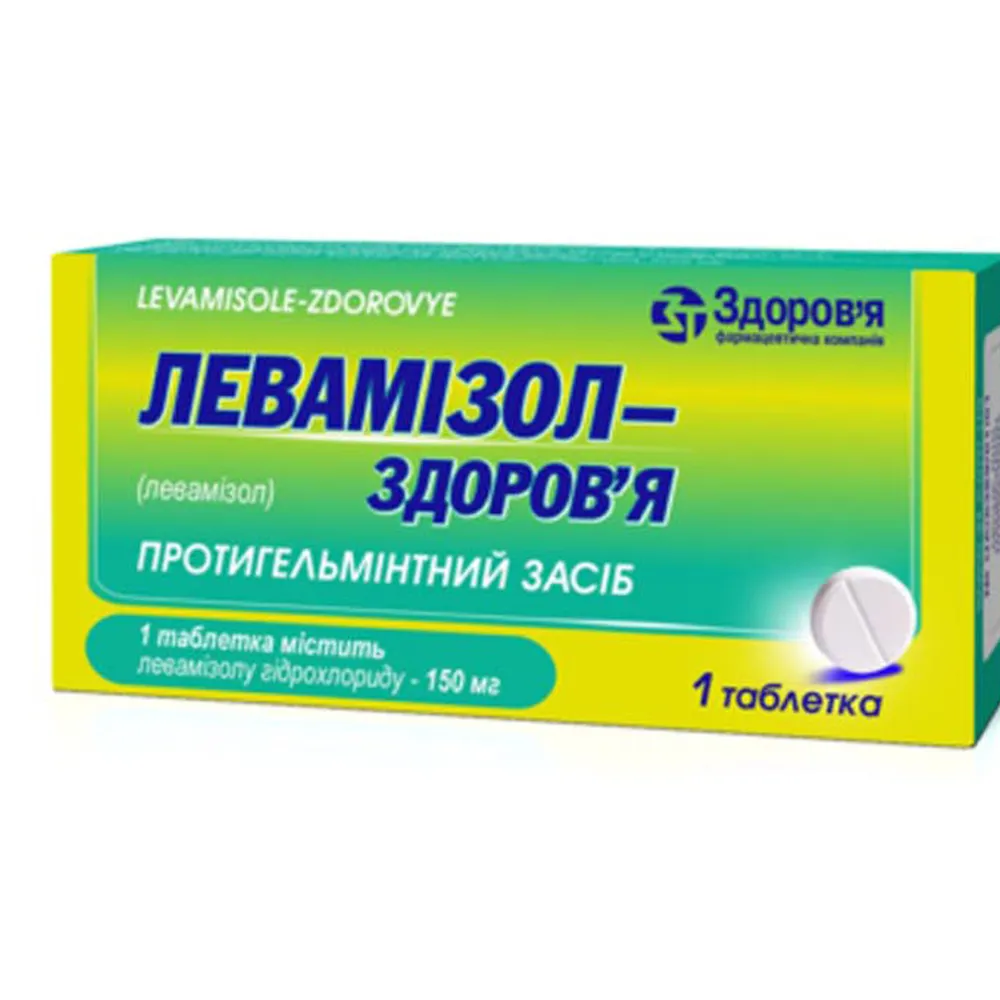
Table of Contents
INSTRUCTION FOR MEDICAL USE OF THE MEDICINAL PRODUCT LEVAMISOLE-ZDOROVYA
Composition:
Active ingredient: 1 tablet contains levamisole hydrochloride 150 mg;
Excipients: maize starch, lactose monohydrate, povidone, stearic acid.
Pharmaceutical form. Tablets.
Main physicochemical properties: white or almost white tablets, flat cylindrical in shape, with beveled edges and a score line.
Pharmacotherapeutic group. Anthelmintic agents. Agents used in nematodosis. Imidazothiazole derivatives. ATC code P02CE01.
Pharmacological Properties
Pharmacodynamics. Levamisole has a rapid anthelmintic effect. In ganglion-like structures of nematodes, levamisole causes depolarizing neuromuscular paralysis. Thus, paralyzed nematodes are eliminated from the body by normal intestinal peristalsis within 24 hours after administration of the drug.
Pharmacokinetics. The drug is rapidly absorbed from the gastrointestinal tract. Maximum plasma concentration of levamisole is reached on average within 1.5–2 hours after administration. Levamisole is metabolized in the liver; its main metabolites are p-hydroxy-levamisole and its glucuronide derivative. The elimination half-life is 3–6 hours. Less than 5% of the administered dose is excreted unchanged in urine, and less than 0.2% in feces.
Clinical characteristics.
Indications. Ascariasis, necatoriasis, ancylostomiasis.
Contraindications. Hypersensitivity to levamisole or to any of the excipients.
Interaction with other medicinal products and other forms of interaction. Disulfiram-like symptoms may occur when the drug is taken concomitantly with alcoholic beverages.
Levamisole should be used with caution in combination with agents affecting hematopoiesis.
Concomitant use of the drug with coumarin-like anticoagulants may increase prothrombin time; therefore, the dose of the oral anticoagulant should be adjusted accordingly.
The drug increases blood phenytoin levels; hence, phenytoin plasma levels should be monitored when used concomitantly.
Levamisole must not be used simultaneously with lipophilic agents such as carbon tetrachloride, tetrachloroethylene, Chenopodium oil, chloroform, or ether, as the toxicity of levamisole may be enhanced.
Special precautions for use.
Alcoholic beverages are not permitted during and for 24 hours after taking the medication.
If a patient has known intolerance to certain sugars, medical advice should be sought before taking this medicinal product.
Use during pregnancy or breastfeeding. This medication may be prescribed during pregnancy only if the expected benefit outweighs the potential risk of using the drug. During breastfeeding, in order to protect the infant, a decision must be made whether it is necessary for the mother to take the medication.
Ability to affect reaction speed when driving or operating machinery. Levamisole has not been shown to depress the nervous system. However, mild and transient dizziness may occur during treatment; therefore, caution should be exercised when driving vehicles, working in hazardous environments, or operating machinery.
Dosage and Administration.
For the treatment of helminthiasis, administer a single dose of 150 mg (1 tablet) to adults.
The drug should be taken after a meal with a small amount of water, in the evening.
There is no need for laxatives or a special diet.
If necessary, treatment may be repeated after a 7–14-day interval.
Children. The drug in this dosage strength must not be used in children.
Overdose. Signs of intoxication following ingestion of a large dose of levamisole (over 600 mg) may include: nausea, vomiting, lethargy, spasms, diarrhea, headache, dizziness, and confusion.
Treatment: in case of accidental overdose—when ingestion occurred recently—perform gastric lavage. Monitoring of vital signs and symptomatic therapy are required.
In the presence of signs of anticholinesterase activity, atropine may be administered as an antidote.
Adverse Reactions.
Cardiovascular system: palpitations1;
Blood and lymphatic system disorders: agranulocytosis2, leukopenia2;
Psychiatric disorders: insomnia1;
Central nervous system: seizures1, dizziness1, encephalopathy3, headache1;
Gastrointestinal disorders: abdominal pain1, diarrhea1, nausea1, vomiting1;
Immune system disorders: hypersensitivity reactions possible, including skin rash, itching, and angioneurotic edema.
1 In isolated cases, headache, insomnia, dizziness, palpitations, seizures, and dyspeptic symptoms such as nausea, vomiting, abdominal pain, and diarrhea may occur. These effects are mild, transient, and resolve spontaneously.
2 Leukopenia and agranulocytosis may occur with high doses or prolonged therapy.
3 There have been reports of central nervous system reactions (encephalopathy) developing 2–5 weeks after drug administration. In most cases, these were reversible, and early treatment with corticosteroids improved the condition.
Shelf life. 3 years.
Storage conditions. Store in the original packaging at a temperature not exceeding 25 °C. Keep out of reach of children.
Packaging. 150 mg tablets, 1 tablet in a blister pack per box.
Availability. Over-the-counter.
Manufacturer: LIMITED LIABILITY COMPANY "CORPORATION "ZDOROVIYA".
Manufacturer's address.
22, Shevchenka Street, Kharkiv, Kharkiv Oblast, 61013, Ukraine.