Lergesan
Ukraine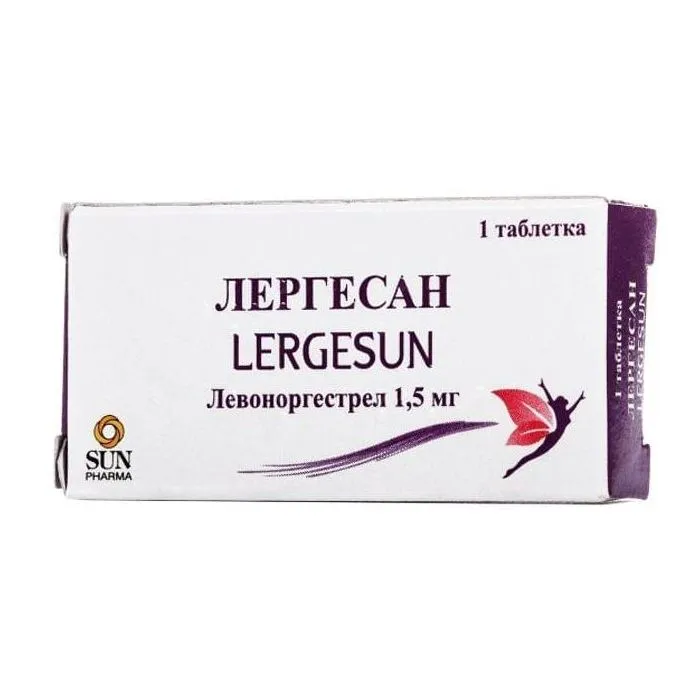
Table of Contents
INSTRUCTIONS for medical use of the medicinal product LERGESUN (LERGESUN)
Composition:
Active substance: levonorgestrel;
1 tablet contains 0.75 mg or 1.5 mg of levonorgestrel;
Excipients: lactose monohydrate; corn starch; hypromellose; talc; colloidal anhydrous silicon dioxide; magnesium stearate.
Pharmaceutical form. Tablets.
Main physicochemical properties:
0.75 mg tablets: round, flat, uncoated tablets, white or almost white, with bevelled edges, embossed with "403" on one side and smooth on the other;
1.5 mg tablets: round, flat, uncoated tablets, white or almost white, with bevelled edges, embossed with "718" on one side and smooth on the other;
Pharmacotherapeutic group. Hormonal contraceptives for systemic use. Emergency contraceptives. Levonorgestrel. ATC code G03A D01.
Pharmacological properties.
Pharmacodynamics.
The exact mechanism of action of levonorgestrel is unknown.
It is presumed that, at the recommended doses, levonorgestrel prevents ovulation and fertilization when sexual intercourse occurs during the preovulatory phase, when the likelihood of fertilization is highest. The drug is not effective if the process of implantation has already begun.
Efficacy. According to results of clinical studies, 750 mcg of levonorgestrel (administered as two doses of 750 mcg each, taken 12 hours apart) prevents pregnancy in 85% of cases. The efficacy of the drug likely decreases with increasing time elapsed after sexual intercourse (95% when administered within 24 hours, 85% when administered 24–48 hours later, and 58% when administered 48–72 hours later).
According to results of clinical studies, two tablets of levonorgestrel 750 mcg taken simultaneously within 72 hours after unprotected sexual intercourse prevent pregnancy in 85% of cases. No differences were observed in the frequency of pregnancy among women who took the drug on the 3rd or 4th day after unprotected sexual intercourse (p > 0.2).
There are limited data requiring further confirmation regarding the impact of excess body weight/high body mass index (BMI) on contraceptive efficacy. In three studies conducted by the World Health Organization (WHO), no trend toward reduced efficacy with increasing body weight/BMI was observed (see Table 1), whereas in two other studies, a reduction in efficacy with increasing body weight/BMI was reported (see Table 2). Both meta-analyses excluded cases where the drug was taken more than 72 hours after unprotected sexual intercourse (off-label use) and women who had unprotected sexual intercourse after taking the drug.
Table 1
| BMI (kg/m2) |
Women with low body weight |
Women with normal body weight |
Women with overweight |
Women with obesity |
| Total number |
600 |
3952 |
1051 |
256 |
| Number of pregnancies |
11 |
3952 |
6 |
3 |
| Pregnancy rate |
1.83 % |
0.99 % |
0.57 % |
1.17 % |
| Confidence interval |
0.92–3.26 |
0.70–1.35 |
0.21–1.24 |
0.24–3.39 |
Table 2
| BMI (kg/m2) |
Women with low body weight |
Women with normal body weight |
Women with overweight |
Women with obesity |
| Total number |
64 |
933 |
339 |
212 |
| Number of pregnancies |
1 |
9 |
8 |
11 |
| Pregnancy rate |
1.56 % |
0.96 % |
2.36 % |
5.19 % |
| Confidence interval |
0.04–8.40 |
0.44–1.82 |
1.02–4.60 |
2.62–9.09 |
The recommended doses of levonorgestrel do not significantly affect blood coagulation factors, lipid and carbohydrate metabolism.
At the recommended dosage regimen, levonorgestrel does not exert a significant effect on blood coagulation factors, lipid and carbohydrate metabolism.
Pharmacokinetics.
After oral administration, levonorgestrel is rapidly and almost completely absorbed.
According to pharmacokinetic studies in 16 healthy women, after administration of 1.5 mg of levonorgestrel, the maximum plasma concentration of the drug reaches 18.5 ng/mL and is achieved within 2 hours.
After reaching the peak, levonorgestrel concentration declines, with a mean elimination half-life of approximately 26 hours.
Levonorgestrel is excreted in the form of metabolites and is not excreted unchanged. Levonorgestrel metabolites are excreted in urine and feces in approximately equal amounts. The biotransformation of levonorgestrel follows the metabolism pathway typical for steroids. Levonorgestrel is hydroxylated in the liver, and metabolites are excreted as conjugated glucuronides. Pharmacologically active metabolites of levonorgestrel are not known.
Levonorgestrel binds to serum albumin and sex hormone-binding globulin (SHBG). Approximately 1.5% of the dose remains free, while 65% is specifically bound to SHBG. The absolute bioavailability of levonorgestrel is nearly 100%.
Approximately 0.1% of the dose is excreted into breast milk and thus transferred to the infant.
Clinical characteristics.
Indications.
Emergency contraception within 72 hours after unprotected sexual intercourse or when the contraceptive method used was unreliable.
Contraindications.
Hypersensitivity to any component of the drug, severe hepatic impairment; pregnancy.
Interaction with other medicinal products and other forms of interaction.
The metabolism of levonorgestrel is enhanced when co-administered with drugs that are hepatic enzyme inducers, primarily inducers of the CYP3A4 enzyme system. A decrease in plasma levels of levonorgestrel (AUC) by approximately 50% has been observed when co-administered with efavirenz.
Medicinal products that may reduce levonorgestrel plasma levels include barbiturates (including primidone), phenytoin, carbamazepine, herbal preparations containing St. John’s wort (Hypericum perforatum), rifampicin, ritonavir, rifabutin, and griseofulvin.
In some cases, significant changes (increases or decreases) in plasma levels of levonorgestrel have been observed when co-administered with HIV protease inhibitors or non-nucleoside reverse transcriptase inhibitors.
Women who have been taking drugs that are inducers of hepatic microsomal enzymes during the preceding 4 weeks should consider using non-hormonal emergency contraceptives (e.g., copper intrauterine device (IUD)) if emergency contraception is needed. A double dose of levonorgestrel (e.g., 3 mg levonorgestrel within 72 hours after unprotected sexual intercourse) is recommended for women who are unable or unwilling to use a copper IUD, although this specific combination (double dose of levonorgestrel during use of hepatic microsomal enzyme inducers) has not been studied.
Medicinal products containing levonorgestrel may increase cyclosporine toxicity due to a possible inhibition of its metabolism.
Special precautions for use.
Emergency contraception is a method intended for occasional use only. It should not replace regular contraception.
Emergency contraception does not prevent pregnancy in all cases.
If there is uncertainty regarding the timing of unprotected sexual intercourse, or if more than 72 hours have passed since the unprotected intercourse within the same menstrual cycle, there is a possibility that conception has already occurred. Therefore, using Lergesan after another sexual act may be ineffective in preventing pregnancy. If menstruation is delayed by more than 5 days, if unusual bleeding occurs on the expected day of menstruation, or if there are other reasons to suspect pregnancy, pregnancy must be ruled out.
If pregnancy occurs after taking Lergesan, ectopic pregnancy should be considered. The absolute risk of ectopic pregnancy is low, as levonorgestrel prevents ovulation and fertilization.
Ectopic pregnancy may develop even in the presence of uterine bleeding. Ectopic pregnancy should be considered, particularly in women presenting with abdominal/pelvic pain or collapse, and in those with a history of ectopic pregnancy, pelvic surgery, or pelvic inflammatory disease. Therefore, the drug should be used with increased caution in patients at risk of ectopic pregnancy (e.g., salpingitis or previous ectopic pregnancy in medical history).
Lergesan is not recommended for patients with severe liver function impairment.
The effectiveness of Lergesan may be negatively affected by severe malabsorption syndromes, such as Crohn's disease. Women with such conditions should consult a physician when emergency contraception is needed.
After taking Lergesan, the regularity and nature of menstruation are usually not disrupted. However, menstruation may start several days earlier or later than expected. Women should be advised to consult a physician to select and initiate one of the regular contraceptive methods. If withdrawal bleeding does not occur in the following pill-free interval after using Lergesan and after starting regular hormonal contraception, pregnancy must be excluded.
Repeated use of the drug within the same menstrual cycle is not recommended due to the risk of menstrual cycle disturbances.
There are limited data, requiring further confirmation, suggesting that the contraceptive efficacy of levonorgestrel may decrease with increasing body weight or BMI. All women, regardless of body weight or BMI, should take emergency contraceptive methods as soon as possible after unprotected sexual intercourse.
Lergesan is ineffective as a regular contraceptive method and should only be used as an emergency measure. Women seeking repeated emergency contraception should be advised to consider long-term contraceptive methods.
Emergency contraception does not replace the need for protective measures against sexually transmitted infections.
This medicinal product contains lactose and therefore should not be used in patients with rare hereditary problems of galactose intolerance, lactase deficiency, or glucose-galactose malabsorption syndrome.
Use during pregnancy or breastfeeding.
Pregnancy
Lergesan tablets are contraindicated during pregnancy. The drug does not cause termination of pregnancy.
According to epidemiological data, if pregnancy occurs despite the use of emergency contraception, the drug has no adverse effects on the fetus. However, there are no clinical data on the potential consequences of using doses exceeding 1.5 mg of levonorgestrel.
Breastfeeding period
Levonorgestrel passes into breast milk. The potential impact of levonorgestrel on the infant can be minimized by taking the drug immediately after breastfeeding or by avoiding breastfeeding for 8 hours after taking the drug.
Fertility
Levonorgestrel may cause menstrual cycle disturbances, which in some cases may lead to earlier or later ovulation. These changes may affect the timing of the fertile period; however, there are no data on fertility after long-term follow-up.
Ability to affect reaction speed when driving or operating machinery.
The effect of the drug on the ability to drive or operate machinery has not been studied.
Method of Administration and Dosage.
Doses
Tablets 0.75 mg:
Two tablets of 0.75 mg should be taken. Both tablets must be taken together as soon as possible, preferably within 12 hours and no later than 72 hours after unprotected sexual intercourse (see section "Pharmacological properties").
If vomiting occurs within 3 hours after taking the tablets, another two tablets should be taken immediately.
Tablets 1.5 mg: One tablet should be taken as soon as possible after unprotected sexual intercourse, preferably within the first 12 hours and no later than 72 hours.
If vomiting occurs within 3 hours after taking the tablet, another tablet should be taken.
Women who have taken enzyme-inducing drugs during the previous 4 weeks and require emergency contraception are advised to use non-hormonal methods of emergency contraception, i.e., copper IUD, or to take a double dose of levonorgestrel (i.e., 2 tablets of 1.5 mg or 4 tablets of 0.75 mg taken simultaneously) for women who cannot or do not wish to use a copper IUD (see section "Interaction with other medicinal products and other forms of interaction").
Lergesan can be used at any phase of the menstrual cycle provided there is no delay in menstrual bleeding.
After using emergency contraception, it is recommended to use a local barrier method (e.g., condoms, diaphragms, spermicides, cervical caps) until the onset of the next menstruation. Use of Lergesan is not a contraindication for continuing regular hormonal contraception.
Children.
The Lergesan drug is not intended for use in prepubertal children for the indication of emergency contraception.
Overdose.
No serious adverse effects have been reported after acute overdose with large doses of oral contraceptives. In case of overdose, nausea and breakthrough bleeding may occur. There are no specific antidotes; treatment is symptomatic.
Adverse reactions.
The most common adverse effect was nausea.
Table 3
| System organ class |
Frequency of adverse reactions |
|
| Very common (>10 %) |
Common (from >1 % to < 10%) |
|
| Nervous system disorders |
headache |
dizziness |
| Gastrointestinal disorders |
nausea, abdominal pain in lower abdomen |
diarrhea, vomiting |
| Reproductive system and breast disorders |
bleeding not related to menstruation |
menstrual delay of more than 7 days, irregular bleeding (spotting), breast tenderness |
| General disorders |
increased fatigue |
|
The nature of bleeding may vary slightly; however, in most women, the next menstruation begins within 5–7 days of the expected date.
If menstruation is delayed by more than 5 days, pregnancy should be considered.
According to post-marketing surveillance data, the following additional adverse reactions have been reported:
Skin and subcutaneous tissue disorders: very rare (< 1/10,000): pruritus, urticaria, rash.
Reproductive system and breast disorders: very rare (< 1/10,000): pelvic pain, dysmenorrhea (menstrual disorder).
Gastrointestinal disorders: very rare (< 1/10,000): abdominal pain.
General disorders: very rare (< 1/10,000): facial swelling.
Shelf life.
3 years.
Storage conditions.
Store at temperatures not exceeding 25°C, in a light-protected place.
Keep out of reach of children.
Packaging.
0.75 mg tablets: 2 tablets in a blister, 1 blister in a cardboard package.
1.5 mg tablets: 1 tablet in a blister, 1 blister in a cardboard package.
Prescription status.
Prescription only.
Manufacturer.
San Pharmaceuticals Industries Ltd.
Manufacturer's address and place of business.
Baroda Highway, Khalol, Gujarat, 389350, India.