Leflutab
Ukraine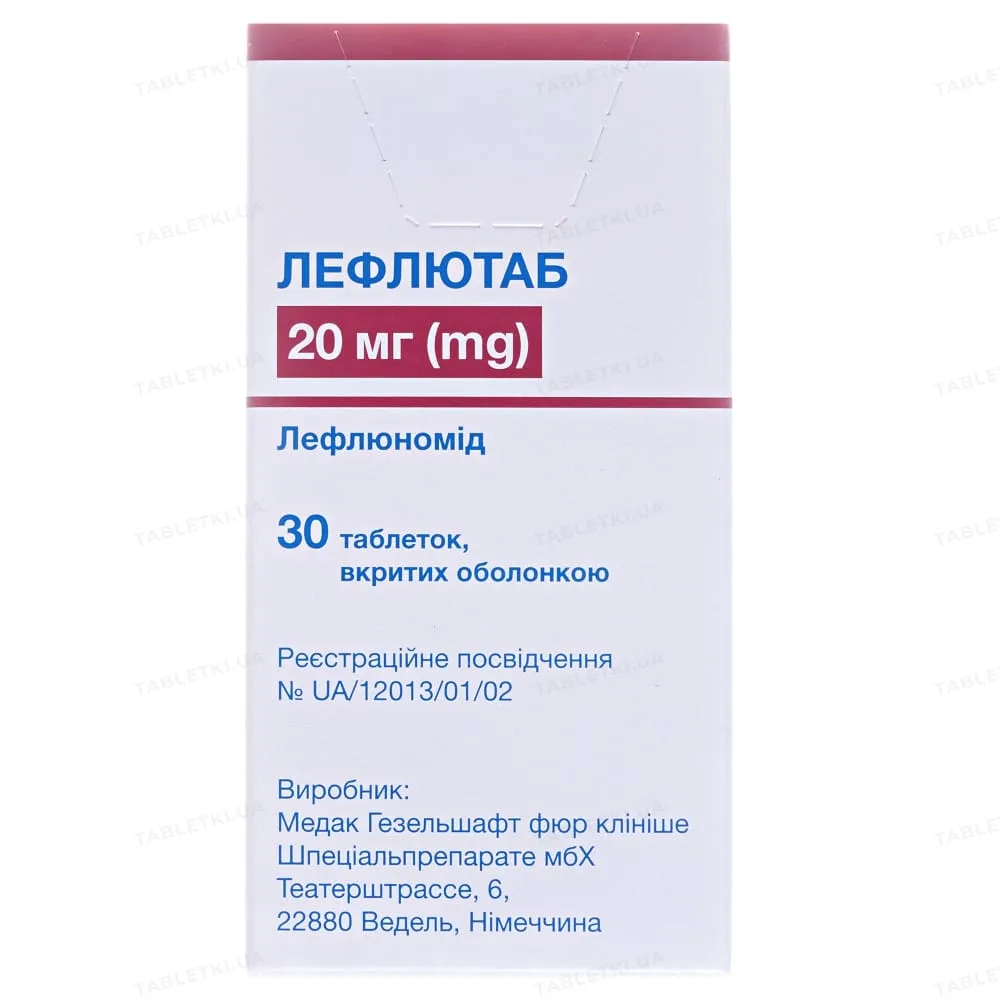
Table of Contents
INSTRUCTIONS FOR MEDICAL USE OF THE MEDICINAL PRODUCT LEFLUTAB (LEFLUTAB)
Composition:
Active substance: leflunomide;
One film-coated tablet contains 10 mg or 20 mg of leflunomide;
Excipients: lactose monohydrate, low-substituted hydroxypropylcellulose, tartaric acid, sodium lauryl sulfate, magnesium stearate, polyvinyl alcohol, titanium dioxide (E 171), talc, lecithin, xanthan gum.
Pharmaceutical form. Film-coated tablets.
Main physicochemical properties:
Leflunomide 10 mg: white or almost white, round, biconvex, film-coated tablets.
Leflunomide 20 mg: white or almost white, round, biconvex, film-coated tablets with a breakline on one side.
Pharmacotherapeutic group. Selective immunosuppressive agents.
ATC code L04AA13.
Pharmacological properties.
Pharmacodynamics.
Leflunomide is a disease-modifying antirheumatic drug used in the treatment of rheumatoid arthritis, with anti-proliferative properties. Leflunomide has demonstrated efficacy in models of arthritis and other autoimmune diseases, as well as in transplantation, primarily when administered during the sensitization phase. It exhibits immunomodulatory/immunosuppressive effects, acts as an anti-proliferative agent, and shows anti-inflammatory properties. Leflunomide demonstrates a better protective effect in models of autoimmune diseases when administered early in the course of the disease. In vivo, it is rapidly and almost completely metabolized to A771726, which shows activity in vitro and is considered responsible for the therapeutic effect.
A771726, the active metabolite of leflunomide, inhibits the human enzyme dihydroorotate dehydrogenase and demonstrates anti-proliferative activity.
Pharmacokinetics.
Leflunomide is rapidly converted to the active metabolite A771726 during presystemic metabolism (ring opening) in the intestinal wall and liver. In studies administering radiolabeled 14C-leflunomide to three healthy volunteers, unchanged leflunomide was not detected in plasma, urine, or feces. In other studies, unchanged leflunomide was occasionally detected in plasma at low concentrations (ng/mL). The only labeled metabolite detected in plasma was A771726. This metabolite is almost entirely responsible for the activity of Leflunomide in vivo.
Data on excretion obtained from studies using radiolabeled 14C-leflunomide indicate that at least 82–95% of the drug is absorbed. The time to reach peak plasma concentration of A771726 is highly variable; peak plasma levels may be achieved between 1 and 24 hours after a single dose. Leflunomide can be taken with food, as the extent of absorption is comparable when administered fasting or after food intake. Due to the long elimination half-life of A771726 (approximately 2 weeks), a loading dose of 100 mg for 3 days was used in clinical trials to rapidly achieve steady-state concentrations of A771726. It has been established that without a loading dose, the time required to reach steady-state plasma concentrations may be approximately 2 months. In multiple-dose studies in patients with rheumatoid arthritis, the pharmacokinetic parameters of A771726 were linear across the dose range of 5 to 25 mg. In these studies, clinical response was closely related to the plasma concentration of A771726 and the daily dose of leflunomide. At a dose of 20 mg/day, the mean plasma concentration of A771726 at steady state is 35 µg/mL. At steady state, plasma concentrations are approximately 33–35 times higher than after a single dose.
In human plasma, A771726 is extensively bound to protein (primarily albumin). The unbound fraction of A771726 is approximately 0.62%. Binding of A771726 is linear over the entire therapeutic concentration range. Slightly reduced and more variable binding of A771726 in plasma has been observed in patients with rheumatoid arthritis or chronic renal insufficiency. Extensive protein binding of A771726 may lead to displacement of other drugs that are highly protein-bound. In vitro studies of plasma protein binding interactions using warfarin at clinically relevant concentrations did not reveal such an interaction. Similar studies demonstrated that ibuprofen and diclofenac do not displace A771726, although the free fraction of A771726 increases 2–3 times in the presence of tolbutamide. A771726 displaces ibuprofen, diclofenac, and tolbutamide, but the levels of free fractions of these drugs increase only by 10–50%. There is no evidence of clinical significance for these effects. Due to the extensive protein binding of A771726, its apparent volume of distribution is low (approximately 11 L). There is no preferential uptake into erythrocytes.
Leflunomide is metabolized to the primary metabolite (A771726) and a large number of secondary metabolites, including TFMA (4-trifluoromethylaniline). The metabolic biotransformation of leflunomide to A771726 and further metabolism of A771726 are not controlled by a single enzyme and occur in microsomal and cytosolic cellular fractions. Interaction studies using cimetidine (a non-specific cytochrome P450 inhibitor) and rifampicin (a non-specific cytochrome P450 inducer) demonstrate that cytochrome P450 enzymes play only a minor role in the in vivo metabolism of leflunomide.
Elimination of A771726 is slow and characterized by an apparent clearance of approximately 31 mL/h. The elimination half-life in patients is approximately 2 weeks. After administration of radiolabeled leflunomide, radioactivity was excreted equally in feces, likely via biliary excretion, and in urine. A771726 was detected in urine and feces up to 36 days after a single dose. The main metabolites in urine were glucuronides, derivatives of leflunomide (mainly in samples from 0–24 hours), and oxanilic acid, a derivative of A771726. The main component present in feces was A771726. Oral administration of activated charcoal or cholestyramine suspension to patients significantly accelerates and increases the elimination of A771726 and reduces its plasma concentration. This effect is believed to be due to the mechanism of enterohepatic dialysis and/or interruption of reutilization in the small intestine and liver.
Clinical characteristics.
Indications.
− Disease-modifying antirheumatic therapy (DMARD) for the active phase of rheumatoid arthritis in adults.
− Active form of psoriatic arthritis.
Recent or concomitant treatment with hepatotoxic or hematotoxic DMARDs (e.g., methotrexate) increases the risk of serious adverse reactions. Therefore, the decision to initiate treatment with leflunomide should be carefully considered, taking into account the benefit-risk ratio.
In addition, switching from leflunomide to another DMARD without completing the washout procedure (see section "Special precautions") also increases the risk of serious adverse reactions, even long after such a switch.
Contraindications.
- Hypersensitivity to the active substance (especially in patients with a history of Stevens-Johnson syndrome, toxic epidermal necrolysis, or erythema multiforme), to the main active metabolite teriflunomide, or to any of the excipients of the drug.
- Hypersensitivity to peanuts or soy.
- Impaired liver function.
- Severe immunodeficiency states (including AIDS).
- Severe bone marrow dysfunction, severe anemia, leukopenia, neutropenia, or thrombocytopenia due to other causes (excluding rheumatoid or psoriatic arthritis).
- Severe infections.
- Moderate or severe renal insufficiency, as there is insufficient experience with leflunomide use in this patient group.
- Severe hypoproteinemia, including in nephrotic syndrome.
- The drug is contraindicated in pregnant women and women of childbearing potential who are not using reliable contraception during treatment with leflunomide and after treatment until plasma levels of the active metabolite fall below 0.02 mg/L.
- Pregnancy must be excluded before starting leflunomide therapy.
- Breastfeeding period.
Interaction with other medicinal products and other types of interactions.
The interaction data provided below apply only to adult patients.
Enhanced adverse effects may occur with recent or concomitant use of hepatotoxic or hematotoxic drugs, or when drugs are administered after leflunomide treatment without considering the time required for complete elimination of the drug from the body. Therefore, close monitoring of liver enzymes and hematological parameters is recommended during the initial phase after switching.
Metotrexate.
In a small study (n = 30) combining leflunomide (10–20 mg daily) with methotrexate (10–25 mg weekly), liver enzyme levels increased 2–3 times in 5 out of 30 patients. Elevated enzyme levels returned to normal in 2 patients who continued both drugs and in 3 after discontinuation of leflunomide. In another 5 patients, increases exceeding 3 times were observed. In all cases, levels normalized: 2 patients continued both drugs, while 3 discontinued leflunomide.
In patients with rheumatoid arthritis, no pharmacokinetic interaction was observed between leflunomide (10–20 mg daily) and methotrexate (10–25 mg weekly).
Vaccination.
Data on the efficacy and safety of vaccination during leflunomide treatment are lacking. Nevertheless, vaccination with live attenuated vaccines is not recommended. When planning vaccination with a live attenuated vaccine after discontinuation of leflunomide therapy, it is important to consider that the half-life of leflunomide is quite prolonged.
Warfarin and other coumarin anticoagulants.
Cases of increased prothrombin time have been reported with concomitant use of leflunomide and warfarin. A pharmacokinetic interaction with warfarin was observed with A771726 in a clinical study. Therefore, careful monitoring and control of the international normalized ratio (INR) are recommended when leflunomide is used concomitantly with warfarin or other coumarin anticoagulants.
NSAIDs/Corticosteroids.
If a patient is already receiving nonsteroidal anti-inflammatory drugs (NSAIDs) and/or corticosteroids, their use may be continued after starting leflunomide.
Effect of other medicinal products on leflunomide
Cholestyramine or activated charcoal powder.
Cholestyramine or activated charcoal powder is not recommended for patients receiving leflunomide, as it leads to rapid and significant reduction in plasma concentrations of A771726 (the active metabolite of leflunomide). The mechanism is believed to involve interruption of enterohepatic recirculation and/or gastrointestinal dialysis of A771726.
Inhibitors and inducers of cytochrome P450.
Some in vitro studies using human liver microsomes indicate that cytochrome P450 (CYP) 1A2, 2C19, and 3A4 are involved in the metabolism of leflunomide.
An in vivo interaction study with cimetidine (a non-specific cytochrome P450 inhibitor) did not reveal any significant interaction.
After co-administration of a single dose of leflunomide to patients receiving multiple doses of rifampicin (a non-specific cytochrome P450 inducer), peak levels of A771726 increased by approximately 40%, while AUC values did not change significantly. The mechanism of this effect is unclear.
Effect of leflunomide on other medicinal products
Oral contraceptives.
In a study where leflunomide was administered to healthy female volunteers together with triphasic oral contraceptives containing 30 μg ethinylestradiol, no reduction in contraceptive efficacy was observed, and the pharmacokinetics of A771726 remained within the expected range. A pharmacokinetic interaction with oral contraceptives was observed with A771726.
Pharmacokinetic and pharmacodynamic studies of interactions with A771726 (the main active metabolite of leflunomide) have been conducted. Since similar drug interactions cannot be ruled out when leflunomide is used at recommended doses, the following study results and recommendations should be considered when using leflunomide.
Effect on repaglinide (CYP2C8 substrate).
An increase in mean Cmax and AUC of repaglinide (by 1.7 and 2.4 times, respectively) was observed after repeated doses of A771726. Thus, A771726 may be considered an in vivo inhibitor of CYP2C8. Monitoring is recommended for patients taking drugs metabolized by CYP2C8, particularly repaglinide, paclitaxel, pioglitazone, or rosiglitazone, as their effects may be enhanced.
Effect on caffeine (CYP1A2 substrate).
Repeated doses of A771726 reduced mean Cmax and AUC of caffeine (a CYP1A2 substrate) by 18% and 55%, respectively. Thus, A771726 may act as a weak inducer of CYP1A2 in vivo. Therefore, medicinal products metabolized by CYP1A2 (such as duloxetine, alosetron, theophylline, and tizanidine) should be used with caution, as their efficacy may be reduced.
Effect on organic anion transporting polypeptide 3 (OATP3) substrates.
Cefaclor showed increased mean Cmax and AUC (by 1.43–1.54 times, respectively) after repeated doses of A771726. Thus, A771726 may be considered an in vivo inhibitor of OATP3. Therefore, caution is recommended when co-administering with OATP3 substrates such as cefaclor, benzylpenicillin, ciprofloxacin, indomethacin, ketoprofen, furosemide, cimetidine, methotrexate, or zidovudin.
Effect on substrates of breast cancer resistance protein BCRP and/or organic anion transporting polypeptides OATP1B1/B3.
An increase in mean Cmax and AUC of rosuvastatin (by 2.65 and 2.51 times, respectively) was observed after repeated doses of A771726. However, no apparent effect of increased plasma rosuvastatin concentration on HMG-CoA reductase activity was observed. When used concomitantly, the daily dose of rosuvastatin should not exceed 10 mg. When using other substrates of breast cancer resistance protein (BCRP) (e.g., methotrexate, topotecan, sulfasalazine, daunorubicin, doxorubicin) and OATP substrates, particularly HMG-CoA reductase inhibitors (such as simvastatin, atorvastatin, pravastatin, methotrexate, nateglinide, repaglinide, rifampicin), caution is also required. Regular monitoring of patients is recommended to promptly detect symptoms of excessive effects of these drugs, and dose reduction should be considered if necessary.
Effect on oral contraceptives (0.03 mg ethinylestradiol and 0.15 mg levonorgestrel).
An increase in mean Cmax and AUC0–24 of ethinylestradiol (by 1.58 and 1.54 times, respectively) and levonorgestrel (by 1.33 and 1.41 times, respectively) was observed after repeated doses of A771726. Although this interaction is not considered to adversely affect the efficacy of oral contraceptives, the type of oral contraceptive should be taken into account.
Effect on warfarin.
Repeated doses of A771726 showed no effect on the pharmacokinetics of S-warfarin, indicating that A771726 is neither an inhibitor nor inducer of CYP2C9. However, a 25% decrease in peak INR was observed with concomitant administration of A771726 and warfarin compared to warfarin alone. Therefore, careful monitoring and control of INR are recommended when leflunomide is used concomitantly with warfarin.
Special precautions for use.
Recent or concomitant treatment with hepatotoxic or hematotoxic DMARDs (e.g., methotrexate) may increase the risk of serious adverse reactions; therefore, the benefit-risk ratio should be carefully considered before initiating leflunomide therapy.
Additionally, switching patients from leflunomide to another DMARD without a washout procedure following leflunomide treatment may also increase the risk of serious adverse reactions, even long after the switch.
The active metabolite of leflunomide, A771726, has a long elimination half-life, typically ranging from 1 to 4 weeks. Serious adverse effects (e.g., hepatotoxicity, hematotoxicity, or allergic reactions described below) may occur even after discontinuation of leflunomide. Therefore, if such toxicity occurs or any other condition requiring rapid elimination of A771726 from the body arises, a washout procedure should be performed. The washout procedure may be repeated if clinically necessary.
Washout procedures and other recommended actions in the case of desired or unplanned pregnancy are described in the section "Pregnancy".
Hepatic reactions.
Rare cases of severe liver injury, including fatal outcomes, have been reported during leflunomide treatment. Most cases occurred within the first 6 months of treatment. Concomitant use of other hepatotoxic drugs was frequently observed. Monitoring and strict adherence to recommendations are considered advisable.
Alanine aminotransferase (ALT) (or serum glutamic-pyruvic transaminase (SGPT)) levels should be checked before initiating leflunomide, during the first 6 months of treatment, and every 8 weeks thereafter with the same frequency as complete blood count monitoring (once every 2 weeks).
If ALT (SGPT) levels increase to 2–3 times the upper limit of normal, dose reduction to 10 mg should be considered, and weekly monitoring should be initiated. If ALT (SGPT) levels remain elevated more than 2 times the upper limit of normal or if ALT levels exceed 3 times the upper limit of normal, leflunomide should be discontinued and a washout procedure initiated.
Monitoring of liver enzymes should continue after discontinuation of leflunomide until liver enzyme levels return to normal.
Due to the potential for additional hepatotoxic effects, alcohol consumption should be avoided during leflunomide therapy.
Since the active metabolite of leflunomide, A771726, is highly protein-bound and eliminated via hepatic metabolism and biliary secretion, increased plasma levels of A771726 are expected in patients with hypoproteinemia. Leflunomide is contraindicated in patients with severe hypoproteinemia or impaired liver function.
Hematological reactions.
Along with monitoring ALT (SGPT), a complete blood count, including white blood cell differential and platelet count, should be performed before initiating leflunomide therapy and every 2 weeks during the first 6 months of treatment, then every 8 weeks thereafter.
Patients with pre-existing anemia, leukopenia, and/or thrombocytopenia, as well as those with impaired bone marrow function or at risk of bone marrow suppression, have an increased frequency of hematological disorders. If such effects occur, a washout procedure should be considered to reduce plasma levels of A771726.
In cases of severe hematological reactions, including pancytopenia, Leflunomide and any other concomitant myelosuppressive therapy must be discontinued and a leflunomide elimination procedure initiated.
Combination with other therapies.
The use of leflunomide in combination with antimalarial drugs used to treat rheumatism (e.g., chloroquine, hydroxychloroquine), orally or intramuscularly administered gold compounds, D-penicillamine, azathioprine, and other immunosuppressive agents, including TNF-alpha inhibitors, has not been studied in randomized trials (except for use with methotrexate). The risk associated with combination therapy, particularly with long-term treatment, is unknown. Since such therapy may lead to additive or even synergistic toxicity (e.g., hepatotoxicity or hematotoxicity), combination with another DMARD (e.g., methotrexate) is not recommended.
Concomitant use of leflunomide with teriflunomide is not recommended, as leflunomide is a derivative of teriflunomide.
Switching to other therapies.
Since leflunomide remains in the body for a prolonged period, switching to another DMARD (e.g., methotrexate) without a washout procedure (see below) may increase the likelihood of additional risks (i.e., kinetic interactions, toxic effects) even long after the switch.
Similarly, recent treatment with hepatotoxic or hematotoxic drugs (e.g., methotrexate) may lead to enhanced adverse effects. Therefore, the decision to initiate leflunomide therapy should be carefully weighed considering benefit-risk aspects, and close monitoring is recommended in the initial period after switching.
Skin reactions.
Leflunomide use should be discontinued in cases of ulcerative stomatitis.
In isolated cases, Stevens-Johnson syndrome, toxic epidermal necrolysis, and drug reaction with eosinophilia and systemic symptoms (DRESS) have been reported in patients treated with leflunomide. Immediately after the onset of skin and/or mucosal reactions suggestive of severe reactions, Leflunomide and any other treatment that may cause such skin reactions should be discontinued, and a leflunomide washout procedure should be initiated immediately. A complete washout is required in such cases. Re-administration of leflunomide is contraindicated in cases of these skin reactions.
Pustular psoriasis or exacerbation of psoriasis has been reported in patients treated with leflunomide. The decision to discontinue treatment should be made considering the patient's condition and medical history. Skin ulcers may occur in patients during leflunomide treatment. If a leflunomide-related skin ulcer is suspected or persists despite appropriate therapy, discontinuation of leflunomide and complete washout should be considered. The decision to resume leflunomide treatment after skin ulcers should be based on clinical assessment of adequate wound healing.
In patients undergoing surgery, impaired wound healing may occur during leflunomide treatment. Based on evaluation of individual cases in the postoperative period, discontinuation of leflunomide treatment and initiation of a washout procedure, as described below, should be considered. If treatment is discontinued, the decision to resume leflunomide should be based on clinical assessment of adequate wound healing.
Infectious diseases.
It is known that drugs with immunosuppressive properties similar to leflunomide may make patients more susceptible to infections, including those caused by opportunistic pathogens. Infections may have a more severe course and therefore require early and aggressive treatment. In case of severe uncontrolled infection, leflunomide treatment must be discontinued and a washout procedure initiated as described above.
Cases of progressive multifocal leukoencephalopathy have been reported in patients receiving leflunomide among other immunosuppressants.
Before initiating treatment, all patients should be evaluated for risk of active or inactive (latent) tuberculosis according to local requirements. This may include medical history review, assessment of prior exposure to tuberculosis, appropriate screening including chest X-rays, tuberculin skin tests, and interferon-gamma release assays. Patients should be informed about the risk of false-negative tuberculin skin test results, especially in immunocompromised or severely ill patients. Patients with a history of tuberculosis should be closely monitored due to the possibility of reactivation.
Respiratory reactions.
Interstitial lung disease has been observed during leflunomide therapy, as well as rare cases of pulmonary hypertension. The risk of developing disease increases in patients with a history of interstitial lung disease. Acute onset of interstitial lung disease with potentially fatal outcome may occur during treatment. Pulmonary symptoms such as cough and dyspnea may warrant discontinuation of therapy and further appropriate evaluation.
Peripheral neuropathy.
Cases of peripheral neuropathy have been reported in patients taking leflunomide. Most patients improved after drug discontinuation. However, a wide range of outcomes was observed: from complete resolution in some patients to persistent symptoms in others. Age over 60 years, concomitant treatment with neurotoxic agents, and diabetes may increase the risk of peripheral neuropathy. If peripheral neuropathy develops during leflunomide treatment, discontinuation of the drug and initiation of an elimination procedure should be considered.
Blood pressure.
Blood pressure should be checked before initiating leflunomide treatment and periodically during therapy.
Colitis.
Colitis, including microscopic colitis, has been reported in patients receiving leflunomide. Appropriate diagnostic procedures should be performed in patients receiving leflunomide who develop chronic diarrhea of unknown origin.
Reproduction (recommendations for men).
Male patients should be aware of the potential for fetal toxicity from their side; therefore, reliable contraception should be ensured during leflunomide treatment.
There are no specific data on the risk of fetal toxicity from men. However, animal studies specifically evaluating this risk have not been conducted. To minimize any potential risk, men wishing to father children should consider discontinuing leflunomide and taking cholestyramine 8 g three times daily for 11 days or 50 g of powdered activated charcoal four times daily for 11 days.
In any case, plasma concentration of A771726 should first be determined. Subsequently, plasma concentration of A771726 should be re-measured at least 14 days later. If both plasma concentration values are below 0.02 mg/L, and after an additional waiting period of at least 3 months, the risk of fetal toxicity is considered very low.
Elimination procedure.
Cholestyramine 8 g three times daily or 50 g of powdered activated charcoal four times daily should be administered. The duration of complete elimination is usually 11 days. Duration may vary depending on clinical or laboratory indicators.
Effect on measurement of ionized calcium levels.
Measurements of ionized calcium levels may show falsely low values during leflunomide and/or teriflunomide (active metabolite of leflunomide) therapy, depending on the type of ionized calcium analyzer used (e.g., blood gas analyzer). Thus, the validity of observed low ionized calcium levels should be questioned in patients receiving leflunomide or teriflunomide. In case of doubtful measurement results, total serum calcium concentration with albumin should be determined.
Excipients.
Lactose.
Leflunomide contains lactose. Patients with rare hereditary problems of galactose intolerance, lactase deficiency, or glucose-galactose malabsorption should not take this medicinal product.
Soy lecithin.
Leflunomide contains soy lecithin. Patients with hypersensitivity to peanuts or soy should not take Leflunomide.
Sodium.
This medicinal product contains less than 1 mmol sodium (23 mg) per tablet, i.e., essentially "sodium-free".
Use during pregnancy or breastfeeding.
Pregnancy.
It is likely that the active metabolite of leflunomide, A771726, causes serious congenital malformations when used during pregnancy.
Leflunomide is contraindicated during pregnancy.
Women of childbearing potential must use effective contraception for 2 years after treatment (see below "waiting period") or for 11 days after treatment (see below "accelerated elimination procedure").
Pregnancy must be excluded before initiating leflunomide treatment.
Patients should be informed that in case of missed menstruation or other signs indicating pregnancy, they must immediately inform their physician to confirm pregnancy. If the test is positive, the physician and patient should consider the potential risk to the fetus. Rapid reduction of the active metabolite level in blood by immediate initiation of the elimination procedure described below upon missed menstruation may reduce the risk to the fetus caused by leflunomide use.
In a small prospective study of women (n = 64) who inadvertently became pregnant while taking leflunomide for no more than 3 weeks after conception, followed by discontinuation of the drug, no significant differences (p = 0.13) were observed in the overall frequency of structural fetal defects (5.4%) compared to any of the comparison groups (4.2% in disease-matched group [n = 108] and 4.2% in healthy pregnant women [n = 78]). For women taking leflunomide who wish to become pregnant, one of the elimination procedures specified below is recommended to ensure that the fetus is not exposed to toxic concentrations of A771726 (target concentration below 0.02 mg/L).
Waiting period.
Plasma levels of A771726 may exceed 0.02 mg/L for a prolonged period. It may take up to 2 years after discontinuation of leflunomide treatment to reduce concentrations below 0.02 mg/L.
After the 2-year waiting period, plasma concentration of A771726 should be measured for the first time. Subsequently, plasma concentration of A771726 should be re-measured after an interval of at least 14 days. If both plasma concentration values are below 0.02 mg/L, teratogenic risk is not expected.
Elimination procedure.
After discontinuation of leflunomide treatment:
- administer cholestyramine 8 g three times daily for 11 days;
- alternatively, administer powdered activated charcoal 50 g four times daily for 11 days.
However, after any elimination procedure, two separate plasma concentration measurements with an interval of at least 14 days are required, followed by a waiting period of 1.5 months after the first plasma concentration result below 0.02 mg/L before conception.
Women of childbearing potential should be advised that if pregnancy is planned, a waiting period of 2 years after discontinuation of treatment is mandatory. If a waiting period of approximately 2 years with reliable contraception is considered unacceptable, an elimination procedure should be recommended.
Both cholestyramine and powdered activated charcoal may affect the absorption of estrogens and progestogens; therefore, the reliability of oral contraceptives used during the elimination procedure with cholestyramine or powdered activated charcoal cannot be guaranteed. Use of alternative contraceptive methods is recommended.
Breastfeeding period.
Animal studies indicate that leflunomide or its metabolites pass into breast milk. Therefore, leflunomide is contraindicated in women who are breastfeeding.
Fertility.
Fertility studies in animals did not show effects on male or female fertility, but adverse effects on male reproductive organs were observed in repeat-dose toxicity studies.
Ability to affect reaction speed when driving or operating machinery.
If adverse effects such as dizziness occur, the patient's ability to concentrate and react appropriately may be impaired. In such cases, patients should refrain from driving or operating machinery.
Method of Administration and Dosage
Treatment with leflunomide should be initiated and monitored by a specialist experienced in the management of rheumatoid arthritis and psoriatic arthritis.
It is necessary to monitor ALT (or SGPT) levels and perform a complete blood count with leukocyte differential and platelet count at the following intervals:
- before initiation of leflunomide treatment;
- every 2 weeks during the first 6 months of treatment;
- every 8 weeks thereafter.
Doses
For rheumatoid arthritis, leflunomide therapy is initiated with a loading dose of 100 mg once daily for 3 days. However, omitting the loading dose reduces the risk of adverse reactions.
The recommended maintenance dose for rheumatoid arthritis is 10–20 mg once daily, depending on the severity of the disease.
For psoriatic arthritis: leflunomide therapy is initiated with a loading dose of 100 mg once daily for 3 days.
The recommended maintenance dose is 20 mg once daily.
Therapeutic effect usually occurs within 4–6 weeks after initiation of treatment and may continue to improve over the next 4–6 months.
Dose adjustment in patients with mild renal impairment is not recommended.
No dose adjustment is necessary for patients aged 65 years and older.
Method of Administration
Leflutab tablets should be swallowed whole, without chewing, and taken with sufficient water. Food intake does not affect the extent of leflunomide absorption.
Children
The drug is not administered to patients under 18 years of age, as the efficacy and safety of its use in juvenile rheumatoid arthritis have not been established.
Overdose
Symptoms
Cases of chronic overdose have been reported in patients who received Leflutab at daily doses up to five times higher than recommended, as well as cases of acute overdose in adults and children. In most reported cases of overdose, no adverse reactions were observed. Adverse effects consistent with the safety profile of leflunomide include abdominal pain, nausea, diarrhea, elevated liver enzymes, anemia, leukopenia, pruritus, and skin rashes.
Treatment of Overdose
In cases of overdose, cholestyramine or activated charcoal is recommended to accelerate drug elimination from the body.
Oral cholestyramine, administered at a dose of 8 g three times daily for 24 hours, reduces plasma levels of A771726 by approximately 40% at 24 hours and by 49–65% at 48 hours.
Oral administration of activated charcoal (as a powder suspension), either orally or via nasogastric tube, resulted in a 37% reduction in plasma concentration of the active metabolite A771726 at 24 hours and a 48% reduction at 48 hours. The procedure may be repeated if clinically necessary. Studies on hemodialysis and chronic ambulatory peritoneal dialysis (CAPD) indicate that the active metabolite of leflunomide, A771726, is not dialyzable.
Adverse reactions.
The most commonly reported adverse reactions during leflunomide treatment include mild increase in blood pressure, leukopenia, paresthesia, headache, dizziness, diarrhea, nausea, vomiting, oral mucosal lesions (e.g., aphthous stomatitis, oral ulcers), abdominal pain, increased hair loss, eczema, skin rashes (including maculopapular rashes), pruritus, dry skin, tendinitis, elevated creatine kinase (CK) levels, anorexia, weight loss (usually mild), asthenia, mild allergic reactions, and increased liver enzymes (transaminases [especially ALT], less frequently gamma-glutamyl transferase and alkaline phosphatase, bilirubin).
The frequency of adverse reactions is classified as follows:
Very common (≥1/10), common (≥1/100 to <1/10), uncommon (≥1/1,000 to <1/100), rare (≥1/10,000 to <1/1,000), very rare (<1/10,000), frequency not known (cannot be estimated from available data).
Infections and infestations:
Rare: severe infections, including sepsis, which may be fatal.
As with other immunosuppressive medicinal products, leflunomide may increase susceptibility to infections, including those caused by opportunistic pathogens. Therefore, the overall incidence of infections (such as rhinitis, bronchitis, and pneumonia) may increase.
Benign, malignant and unspecified neoplasms (including cysts and polyps)
The risk of developing malignancies, particularly lymphoproliferative disorders, may increase with the use of certain immunosuppressive medicinal products.
Blood and lymphatic system disorders:
Common: leukopenia (white blood cell count > 2 x 10⁹/L);
Uncommon: anemia, mild thrombocytopenia (platelets < 100 x 109/L);
Rare: pancytopenia (likely due to antiproliferative mechanism), eosinophilia;
Very rare: agranulocytosis.
Concomitant, recent, or sequential use of potentially myelotoxic agents may be associated with an increased risk of hematological adverse effects.
Immune system disorders:
Moderate allergic reactions, severe anaphylactic/anaphylactoid reactions, vasculitis, including cutaneous necrotizing vasculitis.
Metabolism and nutrition disorders:
Common: elevated CK levels;
Uncommon: hypokalemia, hyperlipidemia, hypophosphatemia;
Rare: elevated LDH levels;
Frequency not known: decreased serum uric acid levels.
Psychiatric disorders:
Uncommon: anxiety.
Nervous system disorders:
Common: paresthesia, headache, dizziness, peripheral neuropathy.
Cardiac disorders:
Common: mild increase in blood pressure;
Rare: marked increase in blood pressure.
Respiratory, thoracic and mediastinal disorders:
Rare: interstitial lung disease (including interstitial pneumonitis), potentially fatal;
Frequency not known: pulmonary hypertension.
Gastrointestinal disorders:
Common: colitis (including microscopic colitis, lymphocytic colitis, and collagenous colitis), diarrhea, nausea, vomiting, oral mucosal lesions (e.g., aphthous stomatitis, oral ulcers), abdominal pain;
Uncommon: taste disturbances;
Very rare: pancreatitis.
Hepatobiliary disorders:
Common: increased liver function tests (transaminases, especially ALT, less frequently gamma-glutamyl transferase and alkaline phosphatase, bilirubin);
Rare: hepatitis, jaundice/cholestasis;
Very rare: severe liver injury, such as liver failure and acute liver necrosis, which may be fatal.
Skin and subcutaneous tissue disorders:
Common: hair loss, eczema, skin rashes (including maculopapular rashes), pruritus, dry skin;
Uncommon: urticaria;
Very rare: toxic epidermal necrolysis, Stevens–Johnson syndrome, erythema multiforme;
Frequency not known: systemic lupus erythematosus, pustular psoriasis or exacerbation of psoriasis, drug reaction with eosinophilia and systemic symptoms (DRESS syndrome), skin ulceration.
Musculoskeletal and connective tissue disorders:
Common: tendinitis;
Uncommon: tendon rupture.
Renal and urinary disorders:
Frequency not known: renal failure.
Reproductive system and breast disorders:
Frequency not known: borderline (reversible) reduction in sperm concentration, spermogram parameters, and linear progressive motility.
General disorders and administration site conditions:
Common: anorexia, weight loss (usually mild), asthenia.
The active metabolite of leflunomide, A771726, has a long elimination half-life—typically from 1 to 4 weeks. In the event of severe adverse effects from leflunomide or when rapid elimination of A771726 is required for other reasons, an elimination procedure as described in the section "Special precautions for use" should be performed. The procedure may be repeated based on clinical indications. Full elimination procedure is mandatory if severe immunological/allergic reactions such as Stevens–Johnson syndrome or Lyell’s syndrome are suspected.
Reporting of suspected adverse reactions
Reporting suspected adverse reactions after medicine authorization is important. It allows continued monitoring of the benefit-risk balance of the medicinal product. Healthcare professionals are required to report adverse reactions in accordance with current legislation governing medicinal products circulation in Ukraine.
Shelf life. 3 years.
Storage conditions.
Store in a tightly closed container to protect from moisture, in a place inaccessible to children.
Packaging.
Leflutable 10 mg: 30 tablets in a wide-mouth container with a screw cap and desiccant, 1 container in a cardboard box.
Leflutable 20 mg: 15 or 30 tablets in a wide-mouth container with a screw cap and desiccant, 1 container in a cardboard box.
Prescription category. Prescription only.
Manufacturer.
Medac Gesellschaft für klinische Spezialpräparate mbH, Germany.
Haupt Pharma Münster GmbH, Germany.
Manufacturer's address and location of operations.
Theaterstrasse 6, 22880 Wedel, Germany.
Schlebrüggenkamp 15, 48159 Münster, Germany.