Lays house dust mites
Ukraine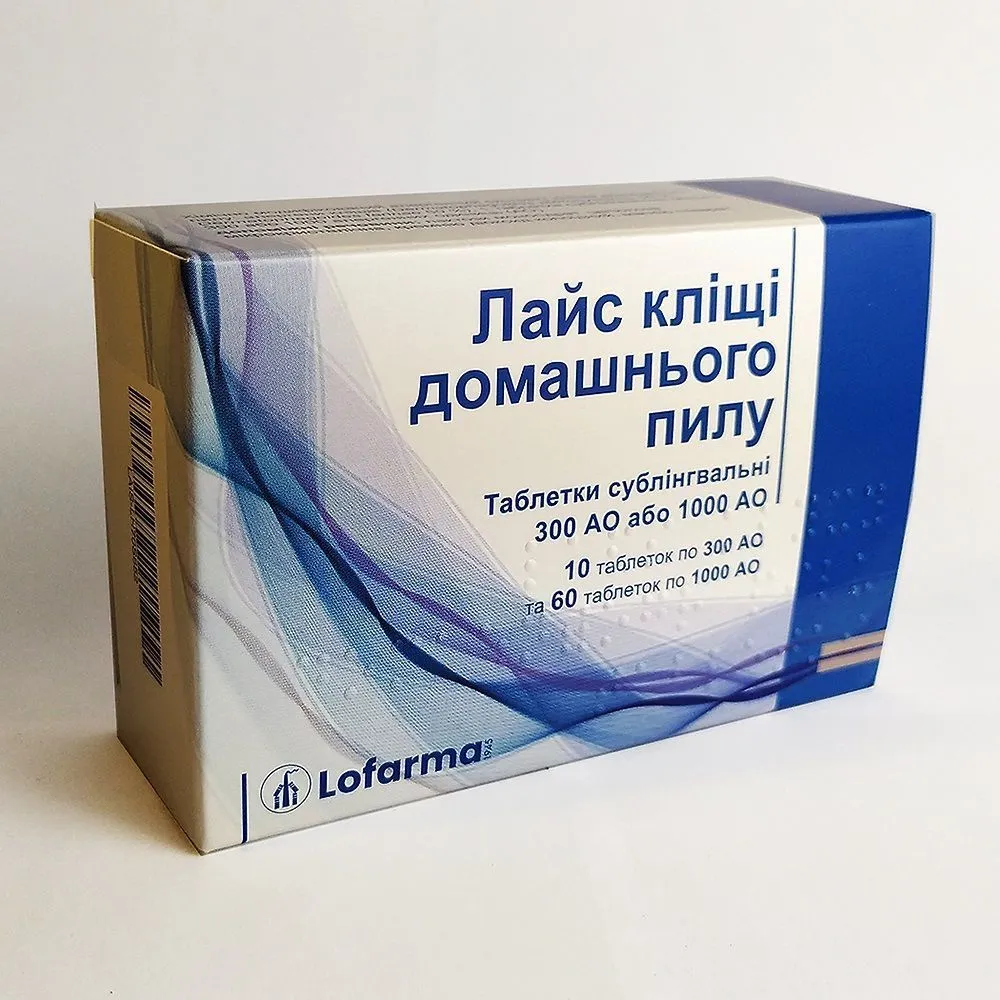
Table of Contents
INSTRUCTIONS FOR MEDICAL USE OF THE MEDICINAL PRODUCT Lais House Dust Mites
Composition:
Active substances: chemically modified allergen extract of house dust mites:
allergens of mites (Dermatophagoides pteronyssinus 50%, Dermatophagoides farinae 50%);
1 sublingual tablet contains 300 or 1000 allergen units (AU);
Excipients: lactose monohydrate, microcrystalline cellulose, colloidal silicon dioxide, magnesium stearate.
AU – allergen unit, a dosing unit for specific immunotherapeutic agents.
Pharmaceutical form. Sublingual tablets.
Main physicochemical characteristics: white, round tablets with a score line on one side and engraved number: 300 AU – with number "3", 1000 AU – with number "4".
Pharmacotherapeutic group.
Allergens. Allergen extracts. ATC code V01A A.
Pharmacological properties.
Lys acari domestici is an agent for specific immunotherapy based on the use of chemically modified allergen extracts. Chemical modification involves carbamylation reaction under alkaline conditions. This procedure ensures:
- modification of epitopes where binding of IgE to allergenic components of the extract occurs, as evidenced by a significant reduction in the capacity to induce allergy (allergenicity), determined by the EAST (enzyme allergosorbent test)-inhibition method, thus improving the safety profile;
- preservation of immunogenic properties of the resulting product (i.e., the ability to induce a beneficial immune response). In addition, this procedure does not significantly alter the molecular size of the allergenic components of the resulting extract, which remains suitable for sublingual administration.
Pharmacodynamics.
Specific sublingual immunotherapy is a treatment method involving repeated sublingual administration of specific allergens to modify the immunological response to allergens in patients suffering from diseases in which pathological allergic reaction is the dominant component. The complete and precise mechanism of action underlying the clinical effect of specific immunotherapy is not fully known or described. It is presumed to be related to a significant effect on IgE-mediated inflammatory reactions associated with natural allergen exposure. It has also been demonstrated that specific sublingual immunotherapy significantly reduces IgE-mediated inflammation, as evidenced by decreased allergen-induced inflammatory infiltrate (neutrophils and eosinophils) and adhesion molecules (ICAM-1) in the nasal cavity or conjunctiva. Functional blockade of various stages of IgE-mediated reactions prevents further triggering, amplification mechanisms, and self-maintenance of allergic inflammation.
The above information suggests that specific sublingual immunotherapy is capable of significantly reducing allergic inflammation and plays an important role in protecting organs from damage.
It has been demonstrated that specific sublingual immunotherapy using the medicinal product Lys acari domestici induces a significant reduction in allergen-specific cellular proliferation in the human body while simultaneously enhancing allergen-specific innate immunity. In particular, Lys acari domestici promotes a shift from Th2-type immune response (typical of allergic inflammation) to Th1-type immune response and activates regulatory T cells, culminating in increased secretion of IL-10 cytokines. Collectively, these effects indicate that the mechanism of action of Lys acari domestici is associated with induction of immunological tolerance to allergens responsible for allergic sensitization.
Pharmacokinetics.
The pharmacokinetic properties of the medicinal product Lys acari domestici have not been studied due to the nature of the active substance (an extract, natural or allergoid, consisting of a mixture of various components). On the other hand, some of these components are recognized as major allergens. They can be purified and used in pharmacokinetic studies, which could provide useful information. For this purpose, volunteers in experimental settings received allergens or their chemical modifications (allergoids), labeled with radionuclides, sublingually. In these studies, it was demonstrated that both natural and modified allergen extracts exhibit a prolonged half-life—over 20 hours—from the oral mucosa and buccal lymphatic tissues. Absorption into blood plasma begins 30 minutes after administration and reaches plateau levels within 2 hours. Only in the case of the allergoid can intact molecules be detected in blood serum; whereas, with the natural allergen, only small molecular fragments are detected in serum, confirming differences in pharmacokinetic profiles.
Clinical characteristics.
Indications.
Treatment of house dust mite-induced rhinitis, conjunctivitis, and allergic bronchial asthma in patients with clinically significant symptoms.
Diagnosis is established based on a positive skin test reaction and/or specific IgE test results for house dust mites.
Contraindications.
- Hypersensitivity to any component of the medicinal product.
- Presence of malignant neoplasm.
- Severe autoimmune disease, immune disorder, immunodeficiency, or immunosuppression.
- Chronic inflammatory disease.
- Acute inflammation in the oral cavity with severe symptoms.
- Target organ pathology (e.g., cardiac or respiratory insufficiency, emphysema, bronchiectasis).
- Severe bronchial asthma.
- Bronchial obstruction, particularly with FEV1 < 70% of predicted value after appropriate pharmacological treatment.
- Partially or uncontrolled bronchial asthma (according to the current GINA guidelines (Global Initiative for Asthma)).
- Conditions where epinephrine use is contraindicated.
Special safety precautions.
Unused medicinal product or waste material must be disposed of in accordance with national regulatory requirements.
Interaction with other medicinal products and other types of interactions.
No studies on interactions with other medicinal products have been conducted. Interactions with other medicinal products are unknown.
Concomitant therapy with symptomatic anti-allergic medications (e.g., corticosteroids, antihistamines, mast cell degranulation inhibitors) may improve patient tolerance to allergen-specific immunotherapy. This should be considered when temporarily discontinuing such medications. Although specific studies have not been performed, interaction with food cannot be excluded.
Currently, there is no information regarding possible interactions between the medicinal product Lais house dust mites and immunosuppressive agents; therefore, as a precautionary measure, specific immunotherapy is not recommended.
There are no data available on the potential risks of concomitant immunotherapy against other allergens during treatment with the medicinal product Lais house dust mites.
Special precautions for use
Any local (e.g. oral pruritus or lip itching) and/or systemic (e.g. generalized pruritus, urticaria, skin rashes, nausea, cough, rhinorrhea or nasal congestion, general malaise, and excitation/anxiety) adverse events occurring during specific immunotherapy should be reported immediately to the physician. The physician must adjust the therapeutic regimen and prescribe appropriate treatment depending on the severity of the allergic reaction (e.g. antihistamines, corticosteroids, mast cell stabilizers, β2-agonists).
In case of severe systemic reactions such as angioneurotic edema, difficulty in breathing or swallowing, development or exacerbation of asthma, voice changes, or arterial hypotension, immediate medical consultation is required. The physician must decide on the duration of therapy interruption (if necessary). In serious anaphylactic reactions, adrenaline (epinephrine) should be administered. The effect of adrenaline may be potentiated in patients receiving tricyclic antidepressants and/or monoamine oxidase inhibitors (MAOIs), with a possible fatal outcome. This should be taken into account before initiating specific immunotherapy. In patients taking β-blockers, there may be no response to epinephrine used in the treatment of serious systemic reactions. Concomitant use of β-blockers requires consultation with the physician regarding the advisability of switching to an alternative medication.
Prior to initiating specific immunotherapy, allergic symptoms should be adequately stabilized with appropriate pharmacological treatment.
For patients suffering from bronchial asthma, the medicinal product Lais house dust mite should be used as an adjunct to pharmacological therapy, not as a replacement for prior treatment. It is recommended not to abruptly discontinue asthma control medications after starting Lais house dust mite. Dose reduction of asthma control medications should be performed gradually under medical supervision and in accordance with bronchial asthma treatment protocols.
If influenza-like illness with fever or respiratory tract infections occur, treatment should be temporarily suspended until the infection resolves. It is recommended to consult the physician regarding dose adjustment.
There is no clinical experience with administration of antiviral or antibacterial vaccination during therapy with the medicinal product Lais house dust mite. If vaccination is required, immunization should be performed one week after discontinuation of Lais house dust mite. Immunotherapy may be resumed two weeks after vaccination.
Alcohol consumption and physical exertion should be avoided for several hours after taking the medicinal product.
Oral inflammation
If the patient has severe oral inflammation (e.g. oral lichen planus, oral ulcers, or candidal stomatitis), oral wounds, or has undergone oral surgery, including tooth extraction/loss, initiation of therapy with Lais house dust mite should be postponed. If therapy has already been initiated, it should be temporarily interrupted until healing of the oral lesion is complete.
The product contains lactose; therefore, its use is not recommended in patients with rare hereditary forms of galactose intolerance, lactase deficiency, or glucose-galactose malabsorption syndrome.
Use during pregnancy or breastfeeding
Pregnancy
Data on the use of specific immunotherapy products in pregnant women are limited, as studies on reproductive toxicity and fetal development have not been conducted.
Due to the limited safety data available, initiating specific immunotherapy during pregnancy is contraindicated because of the potential risk to the pregnant woman and/or fetus associated with the possibility of systemic reactions and the need for concomitant medications to manage them. If pregnancy occurs during the induction phase, discontinuation of further immunotherapy should be considered.
Breastfeeding
There are no data on the use of the medicinal product Lais house dust mite during breastfeeding. No effect on the breastfed infant is expected.
Fertility
There are no clinical data on the effect of Lais house dust mite on fertility.
Ability to affect reaction speed when driving or operating machinery
As with other medicinal products used for specific immunotherapy, fatigue may occur. Lais house dust mite may have a slight influence on the ability to drive or operate machinery due to reduced attention in the patient.
Method of administration and dosing.
For use in adults, adolescents, and children aged 5 years and older.
Diagnosis is established based on a positive skin test reaction and/or results of a specific IgE test to house dust mites.
The dosing regimen for specific immunotherapy should always be selected individually. The physician selects the dose and frequency of administration according to the course of the disease. The dosing regimen described below is provided as an example only.
Dosing
Treatment must be administered under the supervision of a physician experienced in the management of allergic diseases.
The medication may be taken independently unless otherwise advised by the physician. To ensure proper patient training in the correct administration of the medicinal product and to facilitate information exchange between physician and patient regarding potential adverse reactions and necessary measures in response to such reactions, or in case of safety concerns, the physician may require the first dose to be administered under medical supervision.
Treatment may be initiated at any time and should be continued throughout the year.
Allergen-specific immunotherapy guidelines recommend annual treatment for 3–5 years.
INITIATION OF THERAPY
Treatment is initiated with 300 AU tablets according to the dosing schedule outlined below.
Dosing schedule
| Day 1 |
1 tablet of 300 AU |
| Day 2 |
2 tablets of 300 AU |
| Day 3 |
3 tablets of 300 AU |
| Day 4 |
4 tablets of 300 AU |
MAINTENANCE THERAPY
After the initial treatment phase, continue taking 1 tablet of 1000 AU once daily, 1–5 times per week (for example, from Monday to Friday).
The dosing regimen may be adjusted by the physician depending on the patient's clinical and therapeutic response.
The tablet should be placed in the mouth and held under the tongue for several minutes until completely dissolved, after which it may be swallowed.
The tablets should not be taken during meals.
If treatment is interrupted for more than 2 weeks, the patient should consult a physician for recommendations on appropriate dose adjustment. Therapy should be restarted at the last tolerated dose.
Children.
The use of Lais house dust mite allergen extract in children under 5 years of age is not recommended due to lack of data on safety and efficacy in this patient population.
Overdose.
In clinical trials, adults with house dust mite allergy received the medicinal product at doses up to 3000 AU.
No adverse effects related to overdose were observed. However, administration of doses exceeding the recommended dose may cause local or systemic allergic reactions. If severe systemic reactions occur—such as angioedema, swallowing difficulties, breathing difficulties, acute bronchial asthma attack, voice changes, arterial hypotension, or a sensation of a lump in the throat—administration of the medicinal product must be discontinued immediately and medical advice should be sought.
Treatment is symptomatic.
Adverse reactions.
The information on adverse reactions presented in the table below is based on data from controlled clinical trials involving adult patients with house dust mite-induced rhinoconjunctivitis. The information on the frequency of adverse reactions is based on data from 132 patients who received active treatment.
Adverse reactions were classified by frequency according to the recommended MedDRA (Medical Dictionary for Regulatory Activities) system: very common (≥ 1/10), common (≥ 1/100 to < 1/10), uncommon (≥ 1/1,000 to < 1/100), rare (≥ 1/10,000 to < 1/1,000), very rare (< 1/10,000), frequency not known (cannot be estimated from the available data).
Table
| Body systems |
Common |
Uncommon |
| Gastrointestinal disorders |
Oral paresthesia Oral hypoaesthesia Uncomfortable sensation in the mouth Uncomfortable sensation of the tongue Itching in the mouth Itching of the tongue Tongue swelling |
|
| General disorders |
Malaise |
|
| Infections and infestations |
Herpes virus infection |
|
| Investigations |
Increased blood glucose Increased body weight |
|
| Nervous system disorders |
Dysgeusia |
|
| Respiratory system disorders |
Rhinorrhea Sneezing |
Hoarseness Productive cough |
| Skin and subcutaneous tissue disorders |
Itching |
The frequency of adverse reactions during the post-marketing period cannot be determined as the information is derived from spontaneous reports. Therefore, the frequency of these adverse events is classified as unknown.
Infections and infestations: Conjunctivitis, rhinitis, oral herpes.
Immune system disorders: Oral allergy syndrome, anaphylactic reaction.
Metabolism and nutrition disorders: Acidosis.
Psychiatric disorders: Enuresis.
Nervous system disorders: Headache, attention disturbance, tremor, dizziness, paraesthesia.
Eye disorders: Increased lacrimation, eye swelling, eyelid oedema, allergic conjunctivitis.
Vascular disorders: Cold extremities, peripheral vascular disorder, flushing.
Respiratory system disorders: Asthmatic crisis, bronchial asthma, bronchial oedema, bronchospasm, respiratory distress syndrome, cough, nasal congestion, rhinorrhoea, sneezing, nasal discomfort, dyspnoea, throat irritation, foreign body sensation in the throat, pharyngeal oedema, laryngeal oedema.
Gastrointestinal disorders: Diarrhoea, nausea, dysphagia, abdominal pain, lip oedema, dry mouth, tongue oedema.
Skin and subcutaneous tissue disorders: Angioedema, urticaria, facial oedema, erythema, dermatitis, atopic dermatitis, bullae, pruritus, generalized pruritus, eczema, skin reactions.
General disorders: Abnormal sensations, mucosal oedema, malaise, foreign body sensation, fatigue.
Investigations: Increased heart rate, increased systolic blood pressure, positive test result for antibodies against thyroid tissue.
Description of selected adverse reactions
If a significant adverse reaction occurs during therapy, the patient should immediately inform their physician. Depending on the severity of the clinical presentation, consideration should be given to interrupting therapy, adjusting the dose, and, if necessary, administering an antiallergic agent.
In case of sudden worsening of asthma symptoms or severe systemic reactions, angioedema, difficulty swallowing, breathing difficulties, voice changes, arterial hypotension, or a sensation of a lump in the throat, immediate medical attention should be sought.
Children and adolescents
The use of the medicinal product Lais house dust mite in children under 5 years of age is not recommended due to lack of data in this patient group.
Reporting of suspected adverse reactions
After marketing authorization of the medicinal product, it is very important to report suspected adverse reactions. This allows continuous monitoring of the benefit-risk ratio associated with the use of the medicinal product. Healthcare professionals are required to report any adverse reactions through the national reporting system.
Shelf life. 3 years.
Storage conditions.
Store at temperatures not exceeding 25 °C.
Keep out of the reach of children.
Packaging.
Sublingual tablets № 40: 10 tablets of 300 AU (1 blister pack) and 30 tablets of 1000 AU (3 blister packs) in a cardboard box;
sublingual tablets № 70: 10 tablets of 300 AU (1 blister pack) and 60 tablets of 1000 AU (6 blister packs) in a cardboard box.
Prescription category.
Prescription only.
Manufacturer.
LOFARMA S.P.A
Manufacturer's address and place of business.
BOULAVARD CASSALA, 40 - 20143 MILAN (MI), Italy.