Lantigen b
Ukraine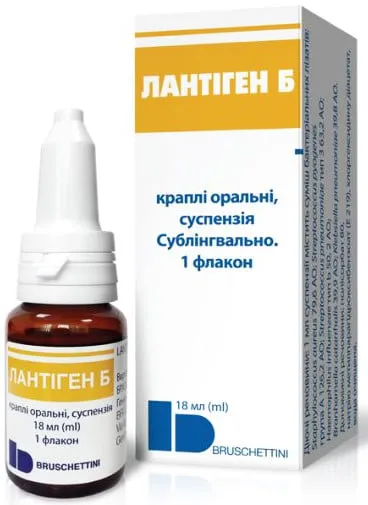
Table of Contents
INSTRUCTIONS FOR MEDICAL USE OF THE MEDICINAL PRODUCT LANTIGEN B (LANTIGENB)
Composition:
Active substances: 1 ml of suspension contains a mixture of bacterial lysates:
Staphylococcus aureus 79.6 AU;
Streptococcus pyogenes group A 126.2 AU;
Streptococcus pneumoniae type 3 63.2 AU;
Haemophilus influenzae type B 50.2 AU;
Branhamella catarrhalis 39.9 AU;
Klebsiella pneumoniae 39.8 AU;
Excipients: polysorbate 80, methylparaben sodium (E 219), chlorhexidine diacetate, purified water.
Pharmaceutical form. Oral drops, suspension.
Main physicochemical characteristics: grey-brown suspension with opalescence.
Pharmacotherapeutic group. Antimicrobial agents for systemic use. Vaccines. Bacterial vaccines. Other bacterial vaccines. ATC code J07AX.
Pharmacological properties.
Pharmacodynamics.
Lantigen B contains a suspension of bacterial antigens obtained through controlled autolysis of certain species of microorganisms that are the most common causative agents of respiratory tract infections (S. pneumoniae, S. pyogenes, B. catarrhalis, S. aureus, H. influenzae, K. pneumoniae).
When administered sublingually, the drug promotes stimulation of local immune responses by absorption of bacterial antigens through the mucous membrane of the oral cavity and pharynx. This leads to the production of secretory immunoglobulins of class A (sIgA) by submucosal plasma cells, which play an important role in protecting the mucous membrane of the respiratory tract.
In vitro studies have demonstrated that the drug exerts its pharmacological effects via immunostimulatory activity, resulting in:
- restoration of functional parameters of polymorphonuclear neutrophils to normal levels;
- increased production of interleukin-1 in cultured mononuclear cells;
- action as a polyclonal lymphocyte activator with higher stimulating activity than the mitogen concanavalin A;
- active stimulation of IgM production in cultured lymphocytes.
Moreover, in vivo studies have shown that Lantigen B:
- increases the production of salivary and circulating IgA, IgM, and IgG;
- reduces the frequency and severity of respiratory infections;
- decreases the need for antibiotic use.
Study LAN-BR-11-001 involving 120 patients aged 18 to 65 years who had experienced 2 to 6 upper respiratory tract infections during the previous year, often associated with respiratory allergic disorders, in which 62 patients were actively treated with Lantigen B and 58 received placebo, showed that the number of infections during the study period was significantly lower (–42%) in patients treated with Lantigen B compared to those receiving placebo.
Similar results were observed in the subgroup of patients with allergies.
Pharmacokinetics.
Due to the nature of the product, pharmacokinetic studies are not feasible.
Clinical characteristics.
Indications.
Adults
Prevention of recurrent infections of the upper respiratory tract.
Children
Prevention of recurrent bacterial infections of the upper respiratory tract in children aged 1 year and older.
Contraindications.
Hypersensitivity to the active substance or to any of the excipients of the medicinal product.
Autoimmune diseases.
Acute intestinal infections.
Interaction with other medicinal products and other forms of interaction.
Studies on interactions with other medicinal products or vaccines have not been conducted.
Immune response may be suppressed in patients with congenital or acquired immunodeficiency, during immunosuppressive therapy, or during treatment with corticosteroids.
Special precautions for use.
Traceability.
To facilitate the traceability of biological medicinal products, the name and batch number of the administered medicinal product should be clearly recorded.
Treatment must be discontinued if body temperature rises, especially if this occurs at the beginning of treatment.
Patients should be informed about the possibility of a rare adverse effect such as an increase in body temperature above 39 °C. This temperature rise is isolated, without apparent cause, and unrelated to the onset of acute respiratory disease accompanied by laryngological, nasal, or otological symptoms. In such cases, treatment must be discontinued permanently without resumption.
Concomitant use with other medicinal products having non-specific immunomodulatory activity, for example those containing bacterial extracts, should be avoided.
In some patients predisposed to bronchial asthma, asthma attacks have been observed after administration of products containing bacterial antigens. In such cases, Lantigen B should not be used.
If hypersensitivity reactions occur, the drug must be discontinued immediately and permanently.
There are no clinical data demonstrating that the use of Lantigen B can prevent pneumonia; therefore, its use for pneumonia prevention is not recommended.
Sodium methylparahydroxybenzoate (E 219), an ingredient of the medicinal product, may cause allergic reactions (possibly delayed) and, in exceptional cases, bronchospasm.
Lantigen B is not recommended during pregnancy. The medicinal product should be used only if absolutely necessary and under strict medical supervision (see section "Use during pregnancy or breastfeeding").
Use in patients with impaired liver/kidney function or other organs.
There are no data on the use of Lantigen B in patients with impaired liver or kidney function.
Use during pregnancy or breastfeeding.
Pregnancy. There are no data on the use of Lantigen B in pregnant women; therefore, its use during pregnancy is not recommended.
Breastfeeding. Studies on the use of Lantigen B during breastfeeding have not been conducted; therefore, its use is not recommended during this period.
Ability to affect reaction speed when driving or operating machinery.
No data available.
Method of Administration and Dosage
Adults and children aged 10 years and older
One dose (15 drops) of Lantigen B should be administered sublingually twice daily (in the morning and evening). The required number of drops is obtained by inverting the bottle and pressing the cap-dropper.
Children aged 1 to 10 years
One dose (15 drops) of Lantigen B should be administered sublingually once daily in the morning, preferably on an empty stomach, or half a dose (7–8 drops) should be administered sublingually twice daily (in the morning and evening). The required number of drops is obtained by inverting the bottle and pressing the cap-dropper.
Important: each dose should be held in the mouth for approximately 2 minutes without swallowing, allowing the suspension to dissolve in saliva, thus facilitating absorption of the medication.
The bottle must be shaken before use. Floating aggregates may be present (even after shaking), but do not affect the safety of the preparation.
Treatment course: two bottles (36 ml) for adults and one bottle (18 ml) for children, according to the specified dosage. Treatment should then be interrupted for 2–3 weeks. After this interval, a repeat course should be conducted using one bottle (18 ml) for adults and half a bottle for children, according to the specified dosage.
To achieve and maintain adequate immune protection throughout the winter season, treatment should begin in September and be repeated in January.
Children. Do not use in children under 1 year of age.
Overdose.
The risks of overdose are unknown.
Side effects.
After the first use of the drug, temporary worsening of symptoms such as constipation and rhinorrhea may occur.
Side effects with rare frequency (> 1/10,000 and < 1/1,000):
- increase in body temperature above 39 °C, occurring individually and without apparent cause;
- in some cases, asthma attacks may occur in patients predisposed to bronchial asthma;
- constipation;
- rhinorrhea.
Such reactions are generally mild.
Reporting of suspected adverse reactions.
Reporting of suspected adverse reactions occurring after drug authorization is important, as it allows continuous monitoring of the drug's risk/benefit ratio.
Shelf life.
3 years.
After first opening of the bottle, the shelf life is no more than 28 days.
Storage conditions.
Store in the original packaging at a temperature not exceeding 25 °C, in a place protected from light. Keep out of reach of children.
Packaging.
18 ml in bottles with dropper cap, 1 bottle per cardboard box.
Prescription status. Prescription only.
Manufacturer.
BRUSCHETTINI S.R.L.
Manufacturer's address and location of business activity.
Bia Isonzo 6, Genoa (GE), 16147, Italy.