Lactuvit®
Ukraine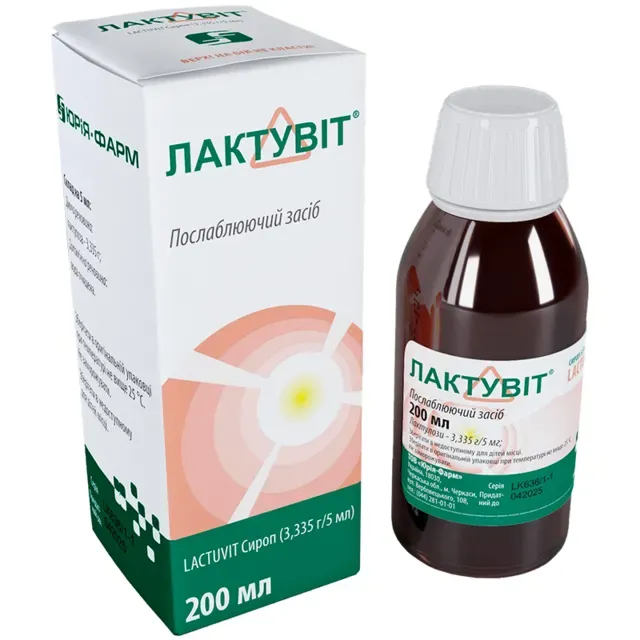
Table of Contents
INSTRUCTION FOR MEDICAL USE OF THE MEDICINAL PRODUCT LACTUVIT® (LACTUVIT)
Composition:
Active substance: lactulose;
5 ml of syrup contains lactulose 3.335 g;
Excipient: purified water.
Pharmaceutical form. Syrup.
Main physico-chemical properties: clear or slightly opalescent, viscous liquid, colorless or pale brownish-yellow.
Pharmacotherapeutic group. Osmotic laxatives. ATC code A06AD11.
Pharmacological properties.
Pharmacodynamics.
Laxative agent. In the large intestine, lactulose is broken down by intestinal bacteria into low-molecular-weight organic acids. These acids lower the pH within the lumen of the large intestine and, due to the osmotic effect, increase the volume of intestinal contents. This stimulates colonic peristalsis and normalizes stool consistency, relieves constipation, and promotes restoration of the physiological rhythm of intestinal function. In portosystemic encephalopathy or hepatic (pre)coma, the action of the drug is due to suppression of proteolytic bacterial growth as a result of increased numbers of acidophilic bacteria (e.g., lactobacilli), transformation of ammonia into its ionized form due to acidification of intestinal contents, intestinal cleansing due to low pH, as well as the osmotic effect, and altered bacterial nitrogen metabolism through stimulation of ammonia utilization by bacteria for synthesis of bacterial proteins. In this context, however, it should be noted that the neuropsychiatric manifestations of portosystemic encephalopathy cannot be explained solely by hyperammonemia. Nevertheless, the described mechanism of ammonia reduction by lactulose may be analogous for other nitrogen compounds.
As a prebiotic, lactulose enhances the growth of beneficial bacteria such as bifidobacteria and lactobacilli, while suppressing the growth of potentially pathogenic bacteria such as clostridia and Escherichia coli. This may contribute to normalization of intestinal flora balance.
Pharmacokinetics.
Lactulose is almost not absorbed after oral administration and reaches the intestine unchanged. When Lactuvit® is administered at doses of 40–75 mL, lactulose is completely metabolized by bacterial flora. When higher doses are used, part of the lactulose may be excreted unchanged.
Clinical characteristics.
Indications.
- Constipation: regulation of the physiological bowel rhythm.
- Conditions requiring facilitation of defecation (hemorrhoids, postoperative conditions following surgery on the colon and anorectal area).
- Hepatic encephalopathy: treatment and prevention of hepatic coma and precoma.
Contraindications.
Galactosemia, gastrointestinal obstruction, gastrointestinal perforation or risk of gastrointestinal perforation, hypersensitivity to the active substance or to other components of the medicinal product.
Interaction with other medicinal products and other forms of interaction.
Interaction studies have not been performed. Lactulose may increase potassium loss induced by other medicinal products (e.g. thiazide diuretics, corticosteroids, and amphotericin B). Potassium deficiency may enhance the effect of cardiac glycosides.
Special precautions for use.
Consult a physician if:
- abdominal pain of undetermined origin is present before starting treatment;
- therapeutic effect is insufficient within a few days of treatment.
Lactuvit® should be used with caution in patients with lactose intolerance.
Considering the amount of sugar contained in the medication, the dose usually used for the treatment of constipation does not cause problems in patients with diabetes mellitus. However, the dose used for the treatment of hepatic (pre)coma is usually much higher, so the sugar content of the medication should be taken into account when treating diabetic patients.
Prolonged use of the medication without proper dose adjustment or incorrect use may lead to diarrhea and electrolyte imbalance.
This medication contains lactose, galactose, and a small amount of fructose. Therefore, patients with rare hereditary galactose intolerance, fructose intolerance, lactase deficiency, or glucose-galactose malabsorption should not take this medication. Lactulose should be used in patients with gastroesophageal syndrome (Röhmer's syndrome) only after consultation with a physician. To prevent bloating, it is recommended to gradually increase the dose. If bloating occurs, the dose should be reduced or treatment discontinued.
Use during pregnancy or breastfeeding.
Pregnancy
No adverse effects on the fetus are expected, as the systemic effect of lactulose on the pregnant woman is negligible.
Lactuvit®, syrup, may be used during pregnancy.
Breastfeeding period
No adverse effects on the newborn/infant are expected during breastfeeding, as the systemic effect of lactulose on the breastfeeding woman is negligible.
Lactuvit®, syrup, may be used during breastfeeding.
Fertility
No adverse effects are expected, as the systemic effect of lactulose is negligible.
Ability to influence reaction rate while driving or operating machinery.
Lactuvit® has no effect or has a negligible effect on the ability to drive or operate machinery.
Method of administration and dosage.
Lactuvit® can be taken either diluted or undiluted. The dose should be individually adjusted according to the clinical response.
The single dose of lactulose should be swallowed immediately and not retained in the mouth for any length of time.
The dosing regimen should be tailored according to the patient's individual needs.
If the patient is prescribed the medication once daily, the dose should always be taken at the same time of day, for example, during breakfast. During treatment with laxatives, it is recommended to consume an adequate amount of fluid (1.5–2 liters, equivalent to 6–8 glasses) per day.
Dosage for constipation or conditions requiring facilitation of defecation
Lactulose may be taken as a single daily dose or divided into two doses.
After a few days, the initial dose may be adjusted to a maintenance dose based on the treatment response. A therapeutic effect may require several days of treatment (2–3 days) to become apparent.
| Age |
Initial dose, per day |
Maintenance dose, per day |
| Adults and children aged 14 years and older |
15–45 ml |
15–30 ml |
| Children 7–14 years |
15 ml |
10–15 ml |
| Children 1–6 years |
5–10 ml |
5–10 ml |
| Children under 1 year |
up to 5 ml |
up to 5 ml |
Dosage in hepatic coma and precoma (adults only)
Initial dose – 30–45 mL three to four times daily.
This dose may be adjusted until a maintenance dose is reached that produces soft bowel movements 2 to 3 times per day.
The safety and efficacy of the drug in children (0–18 years) with portosystemic encephalopathy have not been established. Data are lacking.
Geriatric patients and patients with renal or hepatic impairment
Since the systemic effects of lactulose are minimal, no special dosage recommendations are required for these patient groups.
Children.
Laxatives may be used in children only in exceptional cases and under medical supervision.
It should be noted that the defecation reflex may be impaired during treatment.
Overdose.
If doses are too high, abdominal pain and diarrhea may occur. Recommended treatment includes discontinuation or dose reduction of the drug, and correction of electrolyte imbalances caused by excessive fluid loss due to diarrhea or vomiting.
Adverse reactions.
Safety profile
During the first days of treatment, flatulence may occur, which usually resolves after a few days. When the drug is used at doses exceeding the recommended ones, abdominal pain and diarrhea may occur. In such cases, the dose should be reduced. With prolonged use of high therapeutic doses (usually only in patients with portosystemic encephalopathy), electrolyte imbalance due to diarrhea is possible.
Gastrointestinal disorders: very common – diarrhea; common – flatulence, abdominal pain, nausea, and vomiting.
Laboratory test abnormalities: uncommon – electrolyte imbalance due to diarrhea.
Immune system disorders: not known – hypersensitivity reactions.
Skin and subcutaneous tissue disorders: not known – rash, pruritus, urticaria.
Children
The safety profile in children is expected to be the same as in adults.
Shelf life. 2 years.
Storage conditions.
Store in the original packaging at a temperature not exceeding 25 °C.
An opened bottle should be stored for no more than 30 days at a temperature not exceeding 25 °C.
Do not freeze. Keep out of reach of children.
Packaging.
100 ml or 200 ml in polymer bottles; 1 bottle per cardboard box (a measuring device may additionally be included in the package).
Prescription status. Over-the-counter.
Manufacturer.
LLC "Yuria-Pharm".
Manufacturer's address and location of business activity.
108, Kozbirska Street, Cherkasy, Cherkasy region, 18030, Ukraine. Tel.: (044) 281-01-01.