Lafieromax
Ukraine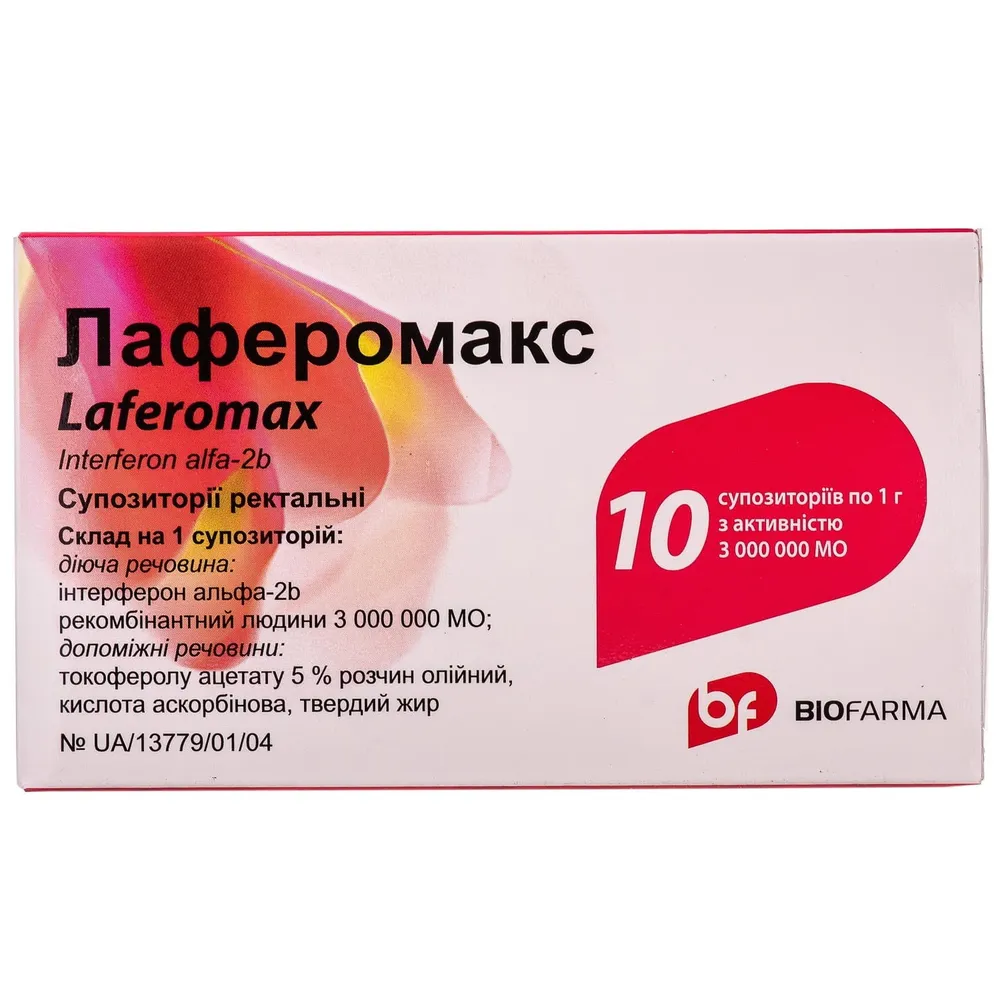
Table of Contents
I N S T R U C T I O N for medical use of the medicinal product LAFEROMAX
Composition:
Active substance: interferon alfa-2b
1 suppository contains: human recombinant interferon alfa-2b – 1,000,000 IU or 3,000,000 IU;
Excipients: refined sunflower oil, tocopheryl acetate, sodium ascorbate, ascorbic acid, hard fat.
Pharmaceutical form. Suppositories.
Main physicochemical properties: yellowish-white, homogeneous, bullet-shaped suppositories.
Pharmacotherapeutic group. Immunostimulants. Interferons. Interferon alfa-2b.
ATC code L03AB05.
Pharmacological Properties.
Pharmacodynamics.
Recombinant alpha-2b interferon has pronounced antiviral, antiproliferative, and immunomodulatory effects. The active ingredient of the medicinal product Laferonmax – recombinant alpha-2b interferon – exerts immunomodulatory effects on T- and B-lymphocytes, normalizes immunoglobulin E levels, and possesses antiviral activity. Neutralizing antibodies against the antiviral activity of recombinant alpha-2b interferon do not develop, even after its administration for up to 2 years, and the functioning of the endogenous system is normalized.
Pharmacokinetics.
The pharmacokinetic properties of the medicinal product have not been studied.
Clinical characteristics.
Indications.
For adults:
- in papillomavirus infections (common warts, genital warts);
- in urogenital mixed sexually transmitted infections;
- in precancerous cervical diseases.
Contraindications.
Hypersensitivity to the components of the drug; presence of thyroid dysfunction in the patient; presence of severe visceral disorders in patients with Kaposi's sarcoma; severe cardiovascular diseases; psoriasis; pronounced impairment of liver and/or kidney function; epilepsy and other CNS diseases (including functional disorders); chronic hepatitis on the background of progressive or decompensated liver cirrhosis; chronic hepatitis in patients receiving or recently treated with immunosuppressants (except for a short course of corticosteroid therapy); autoimmune hepatitis or other autoimmune diseases in history. Myeloid hematopoiesis suppression.
Interaction with other medicinal products and other types of interactions. The drug should be used with caution when administered simultaneously with opioid drugs, analgesics, hypnotics and sedatives (potentially causing myelosuppressive effect).
When used concomitantly with drugs metabolized via oxidation pathways (including xanthine derivatives – aminophylline and theophylline), possible influence of Laferobex on oxidative metabolic processes should be considered. Serum theophylline concentration should be monitored and, if necessary, dosage regimen adjusted.
When the drug is used in combination with chemotherapeutic agents (cytarabine, doxorubicin, teniposide, cyclophosphamide), the risk of developing toxic effects (severity and duration) that may be life-threatening increases.
When used concomitantly with zidovudine, the risk of developing neutropenia increases.
Special precautions for use
Treatment with Laferonmax should be carried out under medical supervision.
Alcohol consumption must be avoided during treatment with this medication.
Before prescribing the drug for prolonged use, thyroid function should be evaluated. Treatment should be initiated only if the level of thyroid-stimulating hormone (TSH) is within the normal range. If any abnormalities in TSH levels are detected, appropriate treatment should be administered, and Laferonmax therapy should be started only when TSH levels can be maintained within the normal range. Monitoring of TSH levels is also advisable during treatment.
After discontinuation of therapy, thyroid function impaired due to administration of the drug does not recover.
All patients should undergo a complete peripheral blood analysis before starting treatment and regularly during therapy, including qualitative and quantitative assessment of blood parameters, as well as biochemical blood tests, including electrolytes, calcium, liver enzymes, and creatinine.
In patients with myeloma, periodic monitoring of kidney function is required.
In all patients receiving the drug, careful monitoring of serum albumin levels and prothrombin time is recommended.
The drug should be administered with caution in patients with a history of diabetes mellitus with episodes of ketoacidosis, chronic obstructive pulmonary diseases, coagulation disorders (including thrombophlebitis of the pulmonary artery), and severe myelosuppression.
During treatment, adequate hydration must be maintained; if fever occurs, other potential causes should be ruled out.
It is recommended to use the drug in combination with antihistamine and antipyretic therapy.
In the event of an immediate-type hypersensitivity reaction (urticaria, angioedema, bronchospasm, anaphylaxis), the drug must be discontinued immediately and appropriate measures taken.
The development of severe or moderate adverse effects requires dose adjustment or, in some cases, discontinuation of treatment.
The drug should be discontinued in the following cases: prolonged blood clotting time (in patients with chronic hepatitis), development of pulmonary syndrome and radiological detection of infiltrates or impaired lung function, onset or worsening of visual disturbances, thyroid dysfunction (TSH levels outside the normal range), decreased serum albumin levels, and reduced prothrombin time values.
Use of the drug after the expiry date is not permitted. The drug is not subject to re-testing for quality or extension of shelf life.
This medicinal product contains less than 1 mmol (23 mg)/dose of sodium, i.e., it is practically sodium-free.
Use during pregnancy or breastfeeding. Data on the use of the drug during pregnancy and breastfeeding are lacking.
Ability to influence reaction rate when driving or operating machinery. Some adverse effects on the central nervous system associated with the use of the drug may affect patients' ability to drive vehicles or operate potentially hazardous machinery.
Administration and Dosage.
For adults:
- in papillomavirus infections (common warts, genital warts): administer the drug rectally, 1,000,000 IU twice daily with a 12-hour interval. Treatment course: 10 days. Treatment should be conducted with monitoring of the patient's condition through cytological and bacteriological examinations, as well as observation of clinical symptoms;
- in urogenital mixed infections transmitted sexually, and in bacterial, viral, and mixed infections: prescribe the drug rectally at a dose of 1,000,000–3,000,000 IU twice daily with a 12-hour interval. Treatment course: 10 days. Treatment should be conducted with monitoring of the patient's condition through cytological and bacteriological examinations, as well as observation of clinical symptoms. Both sexual partners should be treated simultaneously;
- in precancerous conditions of the cervix: administer the drug rectally, 1,000,000 IU twice daily with a 12-hour interval. Treatment course: 10 days. Further treatment is determined based on clinical and laboratory findings.
Children. Not used in pediatric practice.
Overdose. Cases of overdose with Laferomax have not been reported to date. However, as with any drug overdose, symptomatic therapy is recommended, along with monitoring of vital organ functions and careful observation of the patient's condition.
Adverse Reactions
All adverse reactions associated with the use of Laferomax are mild or of moderate severity. They usually resolve after completion of treatment.
The rectal route of administration of the drug is not accompanied by pronounced adverse reactions, which are commonly observed with parenteral administration of interferon preparations. In individual cases, influenza-like symptoms may occur during the first days of treatment; these typically diminish and disappear over time. To prevent such symptoms, paracetamol-containing preparations may be used at doses appropriate for the patient's age.
General disorders: Influenza-like symptoms such as chills, fever, fatigue, malaise, headache, muscle and joint pain, and sweating may occur during administration of Laferomax. Rarely, vomiting, dizziness, and hot flushes may develop. Hypersensitivity reactions to the drug are possible.
Blood and lymphatic system disorders: With prolonged use, leukopenia, thrombocytopenia, anemia, and nasal bleeding are possible.
Gastrointestinal and hepatic disorders: Increased levels of ALT and AST, increased alkaline phosphatase (ALP) levels, loss of appetite, and impaired liver function.
Endocrine disorders: Thyroid gland dysfunction.
Nervous system disorders: With prolonged use, dizziness, sleep disturbances, confusion, anxiety and depressive states, increased excitability, somnolence, ataxia, and paresthesia are possible.
Cardiovascular disorders: Possible arterial hypertension or hypotension; rarely, tachycardia.
Skin and subcutaneous tissue disorders: Allergic reactions including rash (including herpetic rash), pruritus, hyperemia, urticaria, and anaphylactic shock.
Respiratory system disorders: Cough.
Other: Local reactions at the site of administration, visual disturbances, impaired kidney function, and electrolyte imbalance.
Reporting of adverse reactions following drug registration is important. It enables continuous monitoring of the benefit-risk balance of the medicinal product. Healthcare professionals are requested to report any suspected adverse reactions through the national reporting system.
Shelf life. 2 years.
Storage conditions. Store in the original packaging, protected from light, at a temperature between 2 and 8 °C.
Keep out of reach of children.
Packaging.
3 or 5 suppositories in a blister pack. One blister pack containing 3 or 5 suppositories, or two blister packs each containing 5 suppositories, in a cardboard box.
Prescription status. Prescription only.
Manufacturer: LLC "FZ "BIOFARMA", Ukraine.
Manufacturer's address and place of business:
37, Kyivska Street, Bila Tserkva, Kyiv region, 09100, Ukraine.