Aminocaproic acid
Ukraine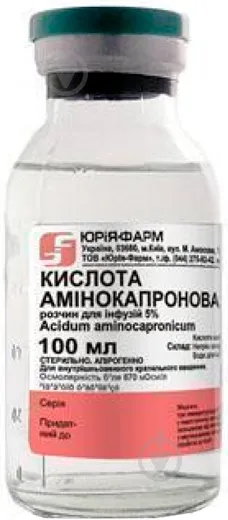
Table of Contents
INSTRUCTIONS FOR MEDICAL USE OF THE MEDICINAL PRODUCT AMINOCAPROIC ACID (AMINOCAPROIC ACID)
Composition:
Active substance: aminocaproic acid;
100 ml of solution contain 5 g of aminocaproic acid;
Excipients: sodium chloride, water for injections.
Pharmaceutical form. Infusion solution.
Main physicochemical properties: clear, colorless liquid.
Pharmacotherapeutic group. Antihemorrhagic agents. Fibrinolysis inhibitors.
ATC code B02A A01.
Pharmacological Properties
Pharmacodynamics
Aminocaproic acid solution exerts hemostatic and antifibrinolytic effects in bleeding caused by increased fibrinolysis. Its action is associated with blockade of plasminogen activators and partial inhibition of plasmin activity. The drug also inhibits biogenic polypeptides — kinins. It promotes stabilization of fibrin and its deposition within the vascular bed, and induces aggregation of platelets and erythrocytes.
Aminocaproic acid exerts antiallergic and antiviral effects, and enhances the liver's detoxifying function. It inhibits proteolytic activity associated with the influenza virus. Aminocaproic acid exerts an inhibitory effect on the early stages of virus interaction with susceptible cells, and also suppresses the proteolytic processing of hemagglutinin. As a result, a functionally active viral protein responsible for the infectious activity of the influenza virus is not formed, and the yield of progeny infectious virus is reduced. Aminocaproic acid not only demonstrates antiviral activity but also improves certain cellular and humoral parameters of specific and non-specific defense mechanisms in respiratory viral infections.
Pharmacokinetics
After intravenous administration, the effect becomes apparent within 15–20 minutes. The drug is rapidly excreted by the kidneys: 40–60% of the administered dose is eliminated in urine within 4 hours. In case of impaired renal excretory function, the concentration of aminocaproic acid in blood increases significantly.
Clinical characteristics.
Indications.
Bleeding after surgical procedures and various pathological conditions associated with increased fibrinolytic activity of blood and tissues.
Prevention of the development of secondary hypofibrinogenemia during massive transfusions of preserved blood.
Treatment and prevention of influenza and acute respiratory viral infections (ARVI) in children and adults.
Contraindications.
Hypersensitivity to components of the drug; predisposition to thrombosis and thromboembolic disorders, thromboembolism; coagulopathies due to disseminated intravascular coagulation (DIC); kidney diseases with impaired renal function, renal failure, hematuria; pregnancy, childbirth, breastfeeding; severe form of ischemic heart disease; cerebral circulation disorders.
Interaction with other medicinal products and other types of interactions.
The effect of the drug is reduced by anticoagulants and direct and indirect-acting antiplatelet agents. Concomitant use with estrogen-containing contraceptives and coagulation factors IX increases the risk of thromboembolism. Use with caution in patients taking retinoids (including tretinoin).
Special precautions for use
When administered intravenously, coagulogram monitoring is required, especially in patients with ischemic heart disease, after myocardial infarction, or with pathological processes in the liver. The drug is contraindicated in cases of hematuria due to the risk of developing acute renal failure (see section "Contraindications"). It is recommended to avoid fatty foods during treatment with this drug. Use with caution in patients with heart diseases. If it is necessary to use the drug in patients with cardiac conditions, monitoring of plasma creatine phosphokinase levels is recommended.
Do not use any remaining drug after administration.
This medicinal product contains 15.4 mmol (or 354.06 mg) of sodium per 100 ml. Caution is advised when administering to patients on a sodium-restricted diet.
Use during pregnancy or breastfeeding.
The drug is contraindicated during pregnancy. Its use in women for prevention of excessive blood loss during childbirth is not recommended due to the possible risk of thromboembolic complications.
If it is necessary to use the drug, breastfeeding should be discontinued.
Ability to affect reaction speed when driving or operating machinery.
During treatment, patients should refrain from driving vehicles and engaging in potentially hazardous activities due to possible adverse reactions affecting the central nervous system.
Method of Administration and Dosage
The "Aminocaproic acid" solution is administered orally or intravenously.
For oral administration in adults, administer 5 g (100 mL) of the drug. Then, every hour, administer 1 g (20 mL) for 8 hours until complete cessation of bleeding.
If a rapid effect is required (acute hypofibrinogenemia), administer up to 100 mL of solution (5 g) intravenously by drip infusion at a rate of 50–60 drops per minute over 15–30 minutes. During the first hour, administer 4–5 g; in cases of prolonged bleeding — until complete cessation of bleeding — administer 1 g hourly, but not for more than 8 hours.
In case of recurrent bleeding, repeat administration of the 5% solution.
Children.
For moderate increase in fibrinolytic activity, administer aminocaproic acid to children at a dose of 0.05 g/kg body weight once daily. The dose depending on age is as follows:
- children under 1 year: single dose — up to 2.5 mL; daily dose — 15 mL;
- aged 2 to 6 years: single dose — 2.5–5 mL; daily dose — 15–30 mL;
- aged 7 to 10 years: single dose — 5–7 mL; daily dose — 30–45 mL;
- aged 11 to 18 years: single dose — 7–14 mL; daily dose — 45–90 mL.
For acute bleeding, the doses are:
- children under 1 year: single dose — 5 mL; daily dose — 30 mL;
- aged 2 to 4 years: single dose — 5–7.5 mL; daily dose — 30–45 mL;
- aged 5 to 8 years: single dose — 7.5–10 mL; daily dose — 45–60 mL;
- aged 9 to 10 years: single dose — 15 mL; daily dose — 90 mL;
- aged 11 to 14 years: single dose — 20 mL; daily dose — 120 mL;
- aged 15 to 18 years: single dose — 28 mL; daily dose — 160 mL.
Duration of treatment — from 3 to 14 days.
For prevention and treatment of influenza and acute respiratory viral infections, the drug is administered orally and locally (0.5–1 mL into each nostril 3–4 times daily).
Oral administration in children:
- children under 2 years — 1–2 g (20–40 mL of 5% solution per day) — 1–2 teaspoons 4 times daily (0.02–0.04 g/kg — single dose); may be added to food or drinks;
- children aged 2 to 6 years — 2–4 g (40–80 mL of 5% solution per day) — 1–2 tablespoons 4 times daily;
- children aged 7 years and older and adults — 4–5 g (80–100 mL of 5% solution per day), divided into 4 doses per day.
For more accurate dosing of the solution, it is advisable to use a 10 or 20 mL syringe without a needle.
Local application of aminocaproic acid is also justified. It is recommended to insert cotton swabs moistened with 5% aminocaproic acid solution into the nasal passages every 3–4 hours for 5–10 minutes, or to instill 3–5 drops of the solution into each nostril at the same intervals.
Aminocaproic acid, if necessary, may be used in combination with other antiviral agents, interferon, and its inducers.
Intranasal instillations of aminocaproic acid (3–4 times daily) are advisable during the epidemic period for prevention of influenza and should be supplemented with enteral administration (as used for treatment) in infection foci upon contact with infected individuals.
The duration of oral administration of aminocaproic acid for influenza and acute respiratory viral infections is 3–7 days.
The duration of treatment depends on the severity of the disease and is determined individually by the physician. The physician may also adjust the dosage and prescribe a repeated course of treatment.
Children.
There are no data regarding restrictions on the use of the drug in children.
Overdose.
Symptoms. Sudden decrease in blood fibrinolytic activity. Pronounced side effects: dizziness, nausea, diarrhea, skin rash, orthostatic hypotension, seizures, headache, nasal congestion, acute renal failure, rhabdomyolysis, myoglobinuria. Increased side reactions, thrombus formation, embolism. Hemorrhages may occur with prolonged use (more than 6 days) of high doses (in adults — more than 24 g per day).
Treatment. In case of overdose, discontinue administration of the drug and provide appropriate symptomatic therapy.
Side effects.
Cardiovascular system: orthostatic hypotension, subendocardial hemorrhage, bradycardia, arrhythmia.
Gastrointestinal system: nausea, diarrhea, vomiting.
Blood coagulation system: impaired blood coagulation; with prolonged use (more than 6 days) of high doses (for adults — over 24 g per day) — hemorrhages.
Central nervous system: headache, dizziness, tinnitus, seizures.
Immune system: hypersensitivity reactions, including allergic reactions, rash.
Respiratory system, thoracic organs and mediastinum: nasal congestion, catarrhal symptoms of the upper respiratory tract.
General disorders: reactions at the injection site.
Other: myoglobinuria, rhabdomyolysis, acute renal failure. If the infusion rate is exceeded, bradycardia, extrasystoles, chills, and fever may occur.
Shelf life. 3 years.
Storage conditions. Store in the original packaging at a temperature not exceeding 25 °C, in an upright position, protected from light and inaccessible to children.
Incompatibility. For intravenous infusion, do not mix in the same container with other infusion solutions.
Packaging. 100 ml in bottles.
Prescription status. Prescription only.
Manufacturer: Private Joint Stock Company "Infuziya".
Manufacturer's location and address of business activity:
84A Nemirovskе Highway, village Vinnitski Khotory, Vinnitsa district, Vinnitsa region, 23219, Ukraine.