Quercetin
Ukraine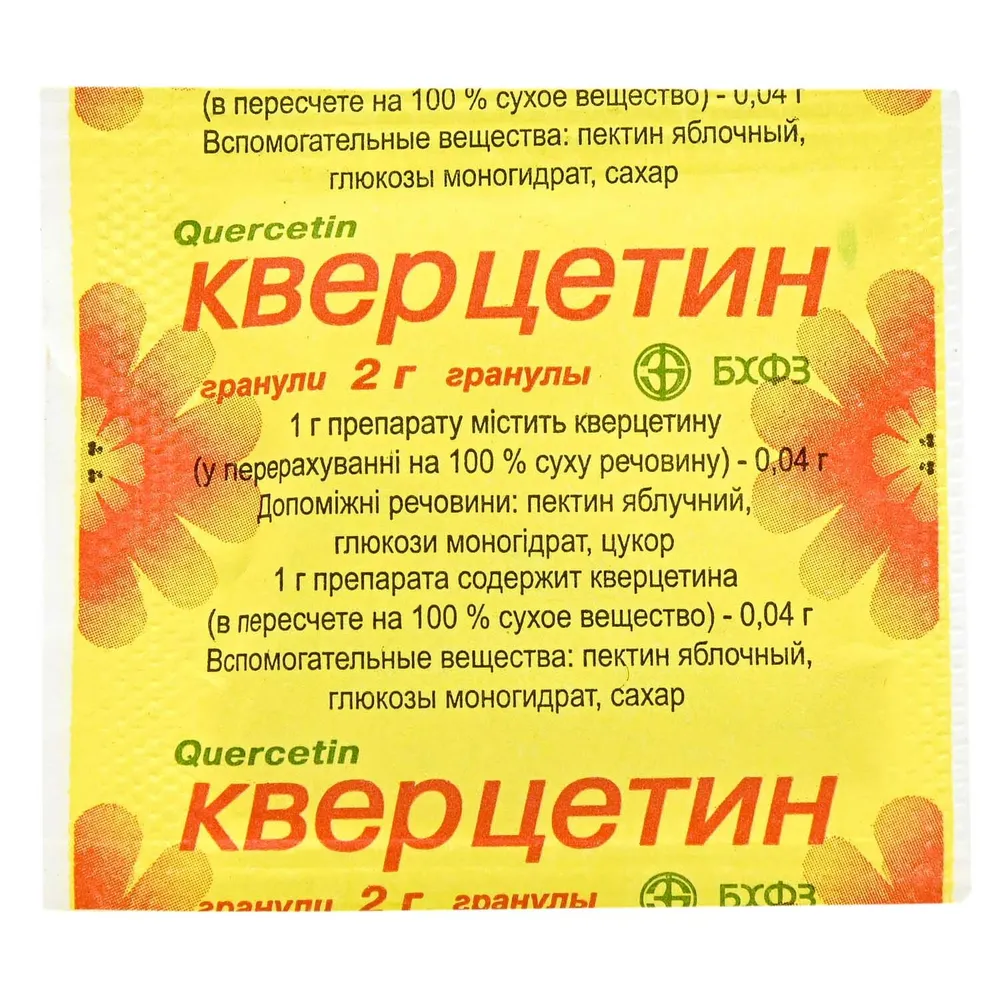
Table of Contents
INSTRUCTIONS FOR MEDICAL USE OF THE MEDICINAL PRODUCT Quercetin (Quercetin)
Composition:
Active substance: quercetin;
1 g of the preparation contains quercetin (calculated as 100 % dry substance) – 0.04 g;
Excipients: apple pectin, glucose monohydrate, sugar.
Pharmaceutical form. Granules.
Main physicochemical characteristics: granules of yellow color with a greenish tint, or yellow with a brownish tint, or yellow-brown with a greenish tint.
Pharmacotherapeutic group. Angioprotectors. Other capillary stabilizing agents.
ATC code C05C X.
Pharmacological properties.
Pharmacodynamics.
The flavonoid quercetin is an aglycone of many plant flavonoid glycosides, including rutin, and belongs to vitamin preparations of the P group.
Having capillary-stabilizing properties associated with antioxidant and membrane-stabilizing effects, the medicinal product reduces capillary permeability. Quercetin has anti-inflammatory activity due to blockade of the lipoxygenase pathway of arachidonic acid metabolism, reduction of leukotriene, serotonin, and other inflammatory mediators synthesis.
Quercetin exerts anti-ulcer activity (in case of nonsteroidal anti-inflammatory drugs use) and also has radioprotective activity (after X-ray and gamma irradiation).
Cardioprotective properties of quercetin are related to enhanced energy supply to cardiomyocytes due to antioxidant effects and improved blood circulation.
The reparative properties of quercetin consist in accelerated wound healing. The drug may influence bone tissue remodeling processes and demonstrates sustained immunomodulatory activity. Diuretic, spasmolytic, and anti-atherosclerotic properties have also been experimentally established. Quercetin is capable of normalizing arterial pressure, stimulating insulin release, inhibiting thromboxane synthesis, and slowing platelet aggregation.
Quercetin also binds to estrogen receptors. Due to its estrogen-like properties (influencing prolidase hydroxylase, inhibiting tumor necrosis factor and interleukin synthesis), the drug has pro-osteoclastic effects.
Pharmacokinetics.
Not studied.
Clinical characteristics.
Indications.
In complex therapy:
- for prevention of erosive-ulcerative lesions of the upper gastrointestinal tract caused by nonsteroidal anti-inflammatory drugs;
- local radiation injuries following X-ray and gamma-ray therapy and their prophylaxis;
- periodontosis, erosive-ulcerative diseases of the oral mucosa;
- purulent-inflammatory diseases of soft tissues;
- climacteric, vertebrogenic pain syndrome, neuroreflex manifestations of spinal osteochondrosis;
- chronic glomerulonephritis;
- neurocirculatory dystonia, ischemic heart disease, exertional angina pectoris
II–III functional class.
Contraindications.
Hypersensitivity to quercetin and other components of the drug, as well as to drugs with P-vitamin activity.
Interaction with other medicinal products and other types of interactions.
When using quercetin:
- with preparations of ascorbic acid, summation of effects is observed;
- with nonsteroidal anti-inflammatory drugs, anti-inflammatory action of the latter is enhanced with reduced ulcerogenic effect;
- with digoxin, maximum serum concentration and total area under the concentration-time curve of digoxin are increased;
- with cyclosporine, bioavailability and blood concentration of cyclosporine are increased;
- with paclitaxel – influence on the metabolism of the latter;
- with verapamil, bioavailability of the latter is increased;
- with tamoxifen, bioavailability is increased, metabolism and elimination of the latter are reduced.
Special precautions for use
Since the formulation contains sugar and glucose, the drug should not be administered to patients with hereditary fructose intolerance, glucose-galactose malabsorption, or saccharose-isomaltase deficiency.
Quercetin should be used with caution in patients using removable dentures.
The drug should be used with caution in patients with diabetes mellitus.
Use during pregnancy or breastfeeding
The drug is not recommended during pregnancy or breastfeeding. If use of the drug is necessary, breastfeeding should be discontinued during treatment.
Effect on the ability to drive or operate machinery
No effect.
Method of Administration and Dosage
Quercetin granules are intended for both topical and oral use in adults and children aged 12 years and older.
For topical use: Dissolve 2 g of quercetin granules in 10 mL of water at a temperature of 45–50 °C and let stand until a uniform viscous mass (gel) is formed.
For oral use: Dissolve 1 g (1/2 teaspoon) of quercetin granules in 100 mL of warm water.
In the treatment of periodontosis and erosive-ulcerative diseases of the oral mucosa: Apply the gel once daily by first spreading it onto a sterile gauze pad.
In complex therapy of purulent-inflammatory soft tissue diseases: administer quercetin both topically and orally at the indicated doses: topically – apply gel prepared from 2 g of quercetin granules twice daily; orally – 1 g (1/2 teaspoon) of granules twice daily.
For prevention and treatment of local lesions in radiation sickness: administer the drug topically and orally: topically – apply the gel to affected skin areas 2–3 times daily; orally – 1 g of quercetin granules 3–4 times daily, 30 minutes before meals.
For patients living in areas contaminated with radionuclides: administer quercetin orally, 1 g (1/2 teaspoon) of granules twice daily, 30 minutes before meals.
In comprehensive treatment of neuroreflex manifestations of spinal osteochondrosis, chronic glomerulonephritis, ischemic heart disease, and for prevention of ulcerogenic effects of nonsteroidal anti-inflammatory drugs (NSAIDs), administer the drug orally at a dose of 1 g three times daily. When used concomitantly with NSAIDs, administer quercetin orally to adults at a dose of 2 g three times daily.
In neurocirculatory dystonia: administer the drug orally, 2 g of quercetin granules twice daily for one month.
In comprehensive treatment of climacteric and vertebrogenic pain syndrome: include oral administration of quercetin granules, 1 g three times daily. The treatment duration is 6 months.
Children.
There is no clinical experience with the use of quercetin in children under 12 years of age; therefore, the drug is not recommended for this age group.
Overdose.
No cases of quercetin overdose have been reported. Overdose may result in increased severity of adverse reactions.
Treatment is symptomatic.
Side effects.
Possible side effects: headache, tingling sensation in limbs, nausea, hypersensitivity reactions including rash and itching.
Shelf life. 4 years.
Storage conditions. In the original packaging at a temperature not exceeding 25 °C.
Keep out of reach of children.
Packaging.
1 g or 2 g in sachets; 1 g or 2 g in sachets, 20 sachets per pack.
Category of supply. Over-the-counter.
Manufacturer.
Public Joint-Stock Company “Scientific-Production Center “Borshchagovsky Chemical and Pharmaceutical Plant”.
Manufacturer's location and address of business activity.
17, Miru Street, Kyiv, 03134, Ukraine.