Cuprenil
Ukraine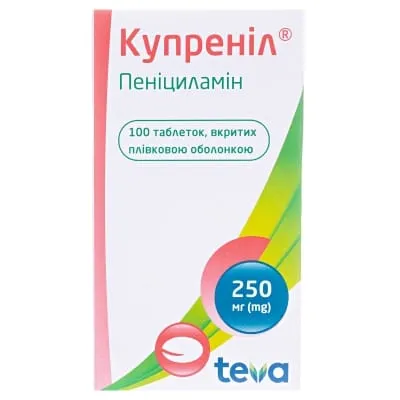
Table of Contents
INSTRUCTIONS for medical use of the medicinal product Kuprenil® (Cuprenil®)
Composition:
Active substance: penicillamine;
1 tablet contains 250 mg of penicillamine;
Excipients: lactose monohydrate, potato starch, povidone, talc, magnesium stearate, hypromellose, polyethylene glycol, titanium dioxide (E 171), azorubine (E 122).
Pharmaceutical form. Film-coated tablets.
Main physicochemical properties: violet-pink, round, biconvex film-coated tablets with a smooth surface, free from spots and damage.
Pharmacotherapeutic group. Specific antirheumatic agents. ATC code M01C C01.
Pharmacological properties.
Pharmacodynamics. Penicillamine is a synthetic preparation, a degradation product of penicillin; it differs from cysteine by the presence of two methyl groups. It forms stable, water-soluble complex compounds with heavy metal ions, which are excreted from the body in urine. It has high chelating activity towards ions of copper, mercury, lead, iron, and calcium. The ability of the medicinal product to form chelate compounds with copper makes it the drug of choice for the treatment of hepatolenticular degeneration (Wilson’s disease). The disease is caused by impaired copper metabolism, resulting in copper accumulation in various organs: brain, kidneys, liver, and eyeball. The medicinal product Cuprenil® reduces the absorption of copper from food and promotes its elimination from body tissues. In addition, the drug is an effective agent in severe lead poisoning and poisoning with other heavy metals, particularly iron and mercury.
The mechanism of action of penicillamine in rheumatoid arthritis is not fully understood. Penicillamine reduces the concentration of rheumatoid factor (IgM) and immunoglobulin complexes in blood serum and synovial fluid, with a slight reduction in the total concentration of immunoglobulins in blood serum.
In vitro, penicillamine inhibits the activity of T-lymphocytes without affecting B-lymphocytes.
Penicillamine exerts an antiurolithic effect. In patients with cystinuria, penicillamine forms complexes with cystine, resulting in the formation of penicillamine-cysteine disulfide, which is more soluble than cystine and is readily excreted by the kidneys. As a result, the concentration of cystine in urine is significantly reduced, which is highly important for the prevention of cystine stones. With proper treatment, cystine stones gradually dissolve.
Pharmacokinetics. Penicillamine is readily absorbed from the gastrointestinal tract and reaches maximum blood concentration within 2 hours. The medicinal product Cuprenil® is metabolized in two phases: the half-life of the first phase is 1 hour, and of the second phase is 5 hours. The drug penetrates into almost all body tissues. Approximately 80% of Cuprenil® is excreted in feces and urine within 48 hours.
Clinical Characteristics
Indications
- Severe active rheumatoid arthritis
- Wilson’s disease (hepatolenticular degeneration)
- Cystinuria
- Lead poisoning
Contraindications
- Hypersensitivity to any component of the medicinal product
- Systemic lupus erythematosus
- Pregnancy (except in cases of Wilson’s disease in pregnant women) and lactation
- History of aplastic anemia or agranulocytosis associated with penicillamine
- Rheumatoid arthritis with concurrent or history of renal dysfunction — due to the potential nephrotoxic effect of penicillamine
- Chronic lead poisoning in the presence of radiologically confirmed lead in the gastrointestinal tract. Treatment may be initiated only after removal of lead from the gastrointestinal tract. Animal studies indicate that penicillamine may be ineffective and hazardous if excessive lead continues to enter the body during its administration
- Concomitant use of gold compounds, antimalarial agents, cytostatics, oxyphenylbutazone, phenylbutazone — as these, like penicillamine, may cause adverse effects on the hematopoietic system and kidneys
- Moderate or severe renal impairment
- Severe thrombocytopenia associated with penicillamine
Interaction with other medicinal products and other forms of interaction
The medicinal product Cuprenil® increases the body’s requirement for vitamin B6.
Penicillamine is an antagonist of pyridoxine and increases its urinary excretion, which may lead to the development of anemia or peripheral neuritis.
The drug forms complex compounds with heavy metals; therefore, when co-administered with iron-containing products, a 2-hour interval should be maintained between the administration of these agents and penicillamine.
Cuprenil® must not be used concomitantly with medicinal products that suppress bone marrow function, such as gold compounds, antimalarial agents, cytostatics, oxyphenylbutazone, and phenylbutazone.
Antacids reduce the absorption of the drug.
Oral absorption of digoxin may be reduced when administered concomitantly with penicillamine.
Concomitant use of penicillamine and nonsteroidal anti-inflammatory drugs (NSAIDs) or other nephrotoxic agents increases the risk of renal dysfunction.
Penicillamine may potentiate blood dyscrasias induced by clozapine.
Oral absorption of penicillamine may be reduced when administered concomitantly with zinc; likewise, zinc absorption may be reduced by penicillamine intake.
Cases of phlebitis reactivation have been reported with concomitant use of penicillamine and diazepam.
Unexpected hypoglycemia has been reported in patients with type 1 diabetes 6–8 weeks after initiating penicillamine treatment for rheumatoid arthritis. These patients required insulin dose reduction. This effect may have an immunological basis.
Probenecid may reduce the therapeutic effects of penicillamine in cystinuria. Combined use of penicillamine and probenecid in patients with hyperuricemia is considered inadvisable.
Special precautions for use.
When using Cuprenil®, constant medical supervision is required. During treatment, a general urine analysis, blood morphology with blood smear, and platelet count must be performed every 2 weeks during the first 6 months of treatment, and then monthly. Patients should be informed about possible symptoms of granulocytopenia and thrombocytopenia such as fever, sore throat, chills, petechial hemorrhages, and bleeding. If these symptoms occur, the above-mentioned tests should be repeated.
Typically, during the 2nd or 3rd week of treatment, some patients may develop fever as a reaction to the drug. Fever may be accompanied by a rash. Type III allergic reactions in the form of a rash usually resolve within a few days after discontinuation of the drug and rarely reappear when treatment is resumed at lower doses.
If itching or rash occurs, antihistamine agents may be used.
Much less frequently (after 6 months or later from the start of treatment), a late-type allergic reaction in the form of a rash may occur, requiring discontinuation of the drug.
The appearance of drug-induced rash with fever, joint pain, lymphadenopathy, and other allergic symptoms usually requires discontinuation of the drug.
Patients with penicillin allergy may be sensitized to penicillamine (cross-sensitization). The possibility of adverse effects caused by penicillamine contamination with trace amounts of penicillin during manufacturing is excluded, as penicillamine is now produced synthetically, not by degradation of penicillin.
Due to the effect of penicillamine on collagen and elastin, the daily dose of the drug should be reduced to 250 mg before any planned surgical procedure. High-dose treatment may be resumed only after complete healing of postoperative wounds.
In some patients taking penicillamine, disorders such as aplastic anemia, agranulocytosis, thrombocytopenia, Goodpasture's syndrome, and myasthenia may occur.
During treatment, symptoms such as proteinuria and hematuria may appear, which could indicate the onset of glomerulonephritis potentially leading to nephrotic syndrome. Such patients should be closely monitored. In some patients, proteinuria symptoms may resolve without discontinuing the drug, whereas in others, penicillamine treatment should be stopped. In case of proteinuria and hematuria, the physician must confirm that glomerular damage is related to treatment.
If changes in urine occur during penicillamine treatment in patients with Wilson's disease or cystinuria, the risk of continued treatment versus therapeutic benefit should be carefully evaluated. For cystinuria treatment with penicillamine, annual radiographic examination of the kidneys and urinary tract is recommended to detect nephrolithiasis early. Cystine stones may form rapidly, sometimes within 6 months.
Despite limited reports of intrahepatic cholestasis and toxic hepatitis, liver function tests are recommended every 6 months throughout the entire duration of treatment.
Although acute bronchitis is rare, patients should be warned to immediately inform their physician about symptoms such as dyspnea on exertion, unexplained cough, or wheezing. Pulmonary function testing should be considered.
Cases of myasthenic syndrome have been reported, sometimes leading to myasthenia gravis. Ptosis, diplopia, and weakness of the extraocular muscles are often early signs of myasthenia. Symptoms of myasthenia usually resolve after discontinuation of penicillamine.
If pemphigus develops, penicillamine treatment should be discontinued. Pemphigus treatment includes high-dose corticosteroids, either as monotherapy or sometimes combined with immunosuppressive agents. Treatment usually lasts several weeks or months, and in some cases − more than 1 year.
Patients who discontinued gold therapy due to severe adverse reactions belong to a high-risk group for adverse reactions during penicillamine treatment.
If penicillamine treatment has been interrupted for any reason, it should be resumed at low doses and gradually increased to reach an effective therapeutic dose.
Particular caution and close monitoring are required in elderly patients. Increased toxicity has been observed in this patient group, independent of renal function.
Reversible loss of taste may occur. Mineral supplements are not recommended to counteract this effect.
Worsening of neurological symptoms in Wilson's disease (dystonia, rigidity, tremor, dysarthria) has been reported after penicillamine administration. This may result from redistribution of copper from the liver to the brain.
Gynecomastia, in both women and men, may occur as a rare complication of penicillamine treatment. Danazol has been successfully used to treat this condition if it does not resolve after discontinuation of therapy.
Concomitant use of NSAIDs and other nephrotoxic drugs increases the risk of kidney damage.
If a patient is prescribed oral iron, digoxin, or antacids, a 2-hour interval should be maintained after penicillamine intake.
Antihistamines, corticosteroids, or temporary dose reduction may help control the risk of allergic reactions.
If gold therapy is discontinued due to lack of efficacy, treatment with Cuprenil® may be initiated after 6 months.
Caution is advised when using Cuprenil® concomitantly with anti-inflammatory agents or other drugs that may impair bone marrow function.
In patients with rheumatoid arthritis, penicillamine therapy should be discontinued if macrohematuria or persistent unexplained microhematuria develops.
Some patients may develop a positive test for antinuclear antibodies (ANA). In some of these patients, systemic lupus erythematosus may be diagnosed. Lupus-like syndrome, similar to drug-induced lupus, may be associated with other medications. Lupus-like syndrome is not necessarily associated with hypocomplementemia and may occur without nephropathy. A positive ANA test is not an absolute indication to discontinue treatment. However, the possibility of developing lupus-like syndrome in the future should be considered.
Some patients may develop oral ulcers, sometimes resembling aphthous stomatitis. Cheilitis, glossitis, and gingivostomatitis have also been reported. These oral ulcers are often dose-related and may require dose reduction but do not necessarily require discontinuation of the drug.
Use with caution in patients with mild renal impairment.
After any dosage adjustment, a complete blood count (including platelet count) and urinalysis should be performed.
Treatment should be discontinued if leukopenia or thrombocytopenia occurs, or if progressive or severe proteinuria or hematuria develops.
Since penicillamine increases the body's requirement for vitamin B6, pyridoxine 25 mg daily may be prescribed for prolonged periods, especially in patients on restrictive diets.
This medicinal product contains lactose monohydrate. This medicine should not be administered to patients with rare hereditary intolerance to galactose, Lapp lactase deficiency, or glucose-galactose malabsorption. Cuprenil® contains azorubine (E 122), which may cause allergic reactions.
Use during pregnancy or breastfeeding.
Pregnancy.
Controlled studies in pregnant women have not been conducted. Penicillamine causes skeletal abnormalities and cleft palate in rats when administered at doses six times higher than the maximum recommended human dose.
Use during pregnancy depending on indication
Rheumatoid arthritis in active phase. This medicinal product is not recommended for pregnant women with rheumatoid arthritis, as congenital defects have been reported in children whose mothers received penicillamine treatment for rheumatoid arthritis during pregnancy.
Cystinuria. This medicinal product is not recommended for pregnant women with cystinuria, as congenital defects have been reported in children whose mothers received penicillamine treatment for cystinuria during pregnancy.
Wilson's disease. Although congenital defects in newborns whose mothers received penicillamine during pregnancy have not been observed, it is recommended to reduce the daily dose to 1000 mg. In case of planned cesarean section, the daily dose should be reduced to 250 mg during the last six weeks of pregnancy and continued until complete healing of the postoperative wound after surgery.
Breastfeeding.
There are no data on the excretion of the drug in breast milk. The drug is not recommended during breastfeeding.
Ability to influence reaction rate when driving or operating machinery.
The medicinal product is considered safe and does not affect the ability to drive or operate machinery.
Dosage and Administration
The dosage regimen depends on the indication. The medicinal product Cuprenil® should be taken at least 30 minutes before meals.
Rheumatoid arthritis and juvenile rheumatoid arthritis
Adults – 125–250 mg daily during the first month of treatment. The dose may then be increased by 125–250 mg every 4–12 weeks until remission is achieved. After remission is achieved, the lowest effective dose should be maintained. If no therapeutic effect is observed within 12 months of treatment, the use of the medicinal product should be discontinued.
The maintenance dose is usually 500–750 mg daily. The daily dose should not exceed 1.5 g. After remission has been sustained for 6 months, the dose should be gradually reduced by 125–250 mg every 12 weeks.
Elderly patients – initial dose should not exceed 125 mg daily during the first month of treatment. The dose may then be increased by 125 mg every 4–12 weeks until remission is achieved. The daily dose should not exceed 1 g.
Children – the usual maintenance dose is 15–20 mg/kg body weight daily. The initial dose is 2.5–5 mg/kg body weight daily, which may be gradually increased every 4 weeks over 3–6 months until the minimum effective dose is reached.
Wilson’s disease
Adults – 1.5–2 g daily in several divided doses. After remission is achieved, the dose may be reduced to 0.75 g or 1.0 g daily. Patients with a negative copper balance should receive the lowest effective dose.
The dose of 2 g daily should not be used for longer than 1 year.
Elderly patients – 20 mg/kg body weight daily in several divided doses. The dose should be adjusted to achieve remission and maintain a negative copper balance.
Children – usually 20 mg/kg body weight daily in 2–3 divided doses, taken 1 hour before meals. For children aged 12 years and older, the usual dose is 0.75–1 g daily. The minimum dose is 500 mg daily.
Cystinuria
It is advisable to determine the minimum effective dose after quantitative measurement of amino acid concentration in urine by chromatography.
Solubilization of cystine stones
Adults – 1–3 g daily in several divided doses. Cystine concentration in urine should be maintained below 200 mg/L.
Prevention of cystine stones
Adults – 0.5–1 g daily until cystine concentration in urine falls below 300 mg/L.
Elderly patients – the minimum dose should be administered until cystine concentration in urine falls below 200 mg/L.
Children – 20–30 mg/kg/day in 2–3 divided doses, taken 1 hour before meals. The dose should be adjusted until cystine concentration in urine falls below 200 mg/L.
Note. During treatment, it is recommended to consume a large amount of fluid, at least 3 L daily. The patient should drink 0.5 L of water before bedtime and another 0.5 L at night, when urine is more concentrated and acidic than during the day. Generally, the more fluid the patient drinks, the lower the required dose of penicillamine.
A low-methionine diet is also recommended to minimize cystine formation. However, due to its low protein content, such a diet is not recommended for growing children or pregnant women.
Lead poisoning
Adults – 1–1.5 g daily in several divided doses until urinary lead excretion decreases to 0.5 mg/day.
Elderly patients – 20 mg/kg body weight in several divided doses until urinary lead excretion decreases to 0.5 mg/day.
Children – this medicinal product should be used when blood lead concentration is less than 45 mg/dL. The total daily dose should be 15–20 mg/kg in 2–3 divided doses.
Children. The product in this dosage form is indicated for children aged 12 years and older, as described in the section "Dosage and Administration."
Overdose.
Acute penicillamine poisoning has not been reported. However, at therapeutic doses, the drug may cause various adverse reactions.
Symptoms. Acute allergic reactions may occur, especially at the beginning of treatment.
Cross-sensitization with penicillin is possible.
Treatment. Symptomatic treatment.
Allergic reactions: discontinue the drug, administer corticosteroids, then reintroduce penicillamine starting with the lowest dose and gradually increasing to effective therapeutic doses.
Iron and vitamin B6 deficiency: correct iron and vitamin B6 deficiency.
Taste disturbances: administer 5–10 mg of copper daily as 5–10 drops of a 4% solution of CuSO4**·**5H2O in fruit juice, divided into two doses.
Copper should not be administered to patients with Wilson’s disease.
Adverse Reactions
The frequency of adverse reactions is defined as follows: very common (≥ 1/10); common (≥ 1/100 to < 1/10); uncommon (≥ 1/1000 to < 1/100); rare (≥ 1/10000 to < 1/1000); very rare (< 1/10000); frequency not known (cannot be estimated from the available data).
Respiratory, thoracic and mediastinal disorders. Rare: chronic bronchitis.
Hepatobiliary disorders. Rare: cholestatic jaundice.
Aural and vestibular disorders. Rare: tinnitus.
Immune system disorders. Common: hypersensitivity reactions.
Musculoskeletal and connective tissue disorders. Common: arthralgia. Rare: myasthenia gravis, lupus-like syndrome.
Blood and lymphatic system disorders. Common: thrombocytopenia, lymphadenopathy. Uncommon: agranulocytosis, aplastic anemia, hemolytic anemia, leukopenia.
Renal and urinary disorders. Common: glomerulonephritis, urinary tract infection. Rare: Goodpasture's syndrome.
Skin and subcutaneous tissue disorders. Common: rash, urticaria, erythema, pruritus. Rare: exfoliative dermatitis, toxic epidermal necrolysis (Lyell's syndrome), bullous pemphigoid, angioedema.
Eye disorders. Rare: optic neuritis.
Gastrointestinal disorders. Common: stomatitis. Rare: pancreatitis, recurrence of peptic ulcer.
General disorders. Common: fever.
Additionally, the following adverse reactions may occur during treatment with penicillamine.
Gastrointestinal disorders: oral ulcers, anorexia, nausea, vomiting, diarrhea, aphthous stomatitis, glossitis, complete loss or distortion of taste sensation, acute colitis, ileal ulcers, stenosis, elastosis.
Skin and subcutaneous tissue disorders: pseudoxanthoma elasticum, skin fragility, penicillamine-induced lupus erythematosus, disorders of collagen and elastin metabolism (pemphigoid, dermatomyositis, adverse effects on hair, increased skin fragility, hemorrhagic lesions, skin wrinkles and laxity), oral lichen planus, alopecia, Stevens-Johnson syndrome, bullous epidermolysis, lupus-like reactions (erythematous rash, development of antinuclear antibodies to DNA).
Musculoskeletal and connective tissue disorders: rheumatoid arthritis, septic arthritis, back and spine pain, polymyositis (rarely with cardiac involvement), dermatomyositis.
Blood and lymphatic system disorders: agranulocytosis and aplastic anemia with fatal outcome, myelotoxicity and myelosuppression, thrombocytopenic purpura, eosinophilia.
Nervous system disorders: worsening of neurological symptoms in Wilson's disease (dystonia, rigidity, dysarthria), reversible polyneuropathy (associated with pyridoxine deficiency), polyneuritis, sensory and motor neuropathies, myasthenia (including ptosis, diplopia, generalized weakness, respiratory muscle weakness).
Hepatobiliary disorders: intrahepatic cholestasis, hepatotoxicity.
Renal and urinary disorders: nephritis, hematuria, proteinuria, glomerulonephritis, nephrotic syndrome.
Respiratory, thoracic and mediastinal disorders: allergic alveolitis, interstitial pneumonitis, diffuse fibrosing alveolitis, pulmonary hemorrhage, rhinitis, sinusitis.
Cardiac disorders: heart block, Adams-Stokes syndrome, myocarditis with fatal outcome.
Reproductive system disorders: breast enlargement with galactorrhea (in women).
Eye disorders: blepharitis.
Shelf life. 3 years.
Storage conditions. Store at temperatures not exceeding 25 °C, in a place inaccessible to children.
Packaging. 100 tablets in a bottle; 1 bottle per carton.
Prescription status. Prescription only.
Manufacturer. TEVA Operations Poland Sp. z o.o.
Manufacturer's address and location of operations.
80 Mogilska Street, 31-546 Kraków, Poland.