Xanthinol nicotinate
Ukraine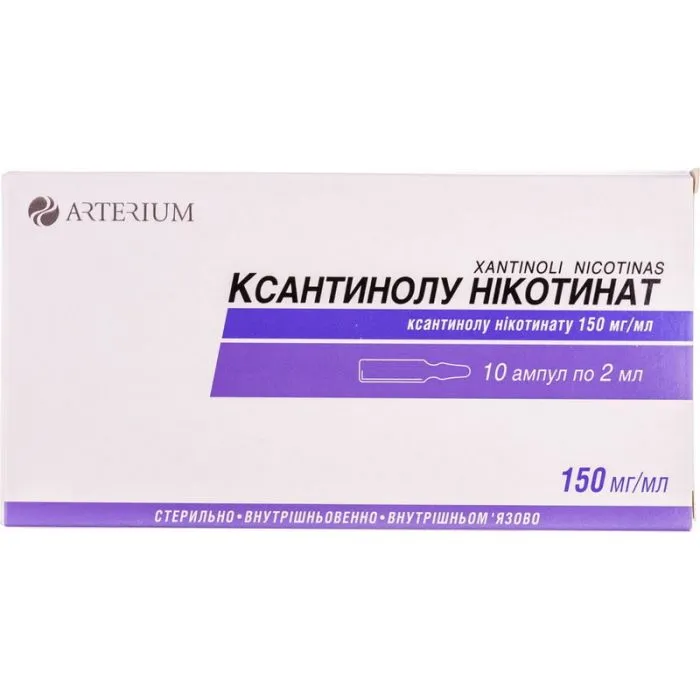
Table of Contents
INSTRUCTIONS FOR MEDICAL USE OF THE MEDICINAL PRODUCT XANTINOLICOTINIC ACID (XANTINOLINICOTINAS)
Composition:
Active substance: 1 ml of solution contains 150 mg of xantinolicotinic acid;
Excipient: water for injections.
Pharmaceutical form. Injection solution.
Main physicochemical properties: colorless clear liquid.
Pharmacotherapeutic group. Peripheral vasodilators. Purine derivatives.
ATC code C04AD02.
Pharmacological Properties.
Pharmacodynamics.
Xanthinol nicotinate has properties of theophylline and nicotinic acid: its mechanism of action is realized through inhibition of phosphodiesterase activity, competition with adenosine for receptors, accumulation of cyclic adenosine monophosphate, stimulation of synthesis of nicotinamide coenzymes and prostacyclin in the vascular wall. The drug dilates peripheral blood vessels, improves collateral and cerebral circulation, reduces manifestations of cerebral hypoxia, decreases platelet aggregation, improves microcirculation in the retinal tissue, enhances myocardial contractility, improves metabolic processes in brain tissue in the postoperative period, reduces levels of cholesterol, atherogenic lipoproteins, uric acid, and fibrinogen, increases lipoprotein lipase activity, and enhances fibrinolysis.
*Pharmacokin游戏副本.
The drug is rapidly metabolized in the body initially into theophylline and nicotinic acid, and subsequently into their metabolites. It is excreted primarily in the urine as metabolites. After intramuscular administration, the effect is observed within 5–10 minutes.
Clinical Characteristics
Indications. Obliterative atherosclerosis of the lower limb vessels (intermittent claudication), Raynaud's disease, diabetic angiopathy, retinopathy, angioneuropathy, acute thrombophlebitis, acute thrombosis, embolism of blood vessels, migraine, atherosclerotic cerebral circulation disorders, postoperative period following removal of brain tumors, Ménière’s disease; poorly healing trophic ulcers of the lower limbs; retinal vascular diseases, degeneration, retinal detachment.
Contraindications.
- Hypersensitivity to the components of the drug, as well as to theophylline and nicotinic acid;
- Acute and chronic heart failure of grade II–III;
- Acute myocardial infarction;
- Acute renal failure;
- Acute heart failure or severe congestive heart failure;
- Acute hemorrhage;
- Peptic ulcer of the stomach and duodenum in the stage of exacerbation;
- Glaucoma;
- Mitral stenosis.
Interaction with other medicinal products and other forms of interactions.
To avoid a sharp drop in arterial pressure, the drug must not be prescribed in combination with antihypertensive agents (beta-adrenoblockers, alpha-adrenoblockers, sympatholytics, ganglion blockers, ergot alkaloids). When used concomitantly with cardiac glycosides, the risk of bradycardia and arrhythmias increases. The drug is also incompatible with MAO inhibitors. It enhances the anticoagulant effect of heparin, streptokinase, and fibrinolysin.
Use with special caution in combination with nicotinic acid patches, as flushing, sensation of warmth, and head pulsation may occur.
Special precautions for use
When it is necessary to use cardiac glycosides concomitantly, treatment should be carried out under electrocardiogram monitoring to prevent the development of bradycardia and arrhythmias.
After administration of the drug, a sensation of warmth may occur, which may be associated with paresthesia and flushing. These reactions may last for several minutes or longer, and their intensity may decrease within a few days after starting treatment with xanthinol nicotinate.
Use with caution in patients with arterial hypertension or labile blood pressure when used concomitantly with antihypertensive agents or cardiac glycosides, due to the possible risk of significant reduction in arterial pressure and/or development of arrhythmias. Postural hypotension may occur due to the vasodilatory effect of the drug.
Due to the possible increase in transaminase and alkaline phosphatase levels during prolonged use of xanthinol nicotinate, caution is required when prescribing the drug to patients with hepatic or renal insufficiency.
Use with caution in patients with severe atherosclerosis of coronary and cerebral vessels, tachysystolic cardiac rhythm disorders, and in elderly patients.
Xanthinol nicotinate should be administered with particular caution to patients who have recently suffered from liver disease. This includes patients with Gilbert's syndrome, who are sensitive to the hepatic effects of nicotinic acid and prone to more pronounced increases in unconjugated bilirubin levels.
Baseline tests are required to determine the presence of elevated lipid levels in blood serum. Regular monitoring is necessary to assess serum lipid levels. If there is insufficient clinical response, the drug should be discontinued.
Xanthinol nicotinate should be prescribed with extreme caution to patients with a history of peptic ulcer disease, and, if possible, the use of maximum doses should be avoided. Nicotinate promotes histamine release from mast cells and enhances gastric hydrochloric acid secretion. Caution is advised in patients with bronchial asthma and those prone to allergies.
With prolonged use of high doses of the drug, changes in glucose tolerance and alterations in blood biochemical parameters may occur, which may necessitate discontinuation of the drug. In patients with diabetes mellitus, blood glucose levels should be monitored more frequently. Patients with implanted pacemakers should receive lower doses of the drug.
The drug should not be used concomitantly with alcohol or coffee.
Use during pregnancy or breastfeeding. The drug should not be used during pregnancy or breastfeeding.
Ability to influence reaction rate when driving or operating machinery. Caution should be exercised when driving or operating machinery due to the possible occurrence of dizziness.
Administration and Dosage
Administer intravenously or intramuscularly to adults in acute cerebral and peripheral circulatory disorders.
For acute disturbances of peripheral and cerebral circulation, administer intravenously (very slowly!). Adults should receive 2 ml of a 15% solution 1–2 times daily intravenously, followed by transition to intramuscular injections—2 ml 1–3 times daily. Concurrently, administer orally 2 tablets of Xanthinol Nicotinate 3 times daily.
In severe cases, administer intravenously by infusion: dilute 10 ml of a 15% solution (1.5 g) in 200 ml to 500 ml of 5% glucose solution or 0.9% sodium chloride solution. Infuse over 1–4 hours, up to 4 times daily. The treatment course is determined individually, approximately up to 21 days, although longer treatment may be possible. For tissue blood supply disorders, administer intramuscularly 2 ml of a 15% solution (0.3 g) 1–3 times daily, gradually increasing the dose to 4–6 ml of a 15% solution 2–3 times daily. Treatment duration depends on the disease course (up to 2–3 weeks).
In ophthalmological practice, administer to adults by iontophoresis to the eyeball—up to 300 mg once daily. The duration of the first procedure is 15 minutes; subsequent sessions may be gradually prolonged to 20–30 minutes. The treatment course lasts 15–20 days.
Children. Experience of use in children is lacking.
Overdose.
Symptoms: tachycardia, sensation of warmth, skin tingling and redness of the head and neck, feeling of pressure in the head, weakness, syncope, nausea, vomiting, diarrhea, gastralgia. Rapid administration may cause dizziness, dyspnea, chest pain, and pronounced arterial hypotension.
Treatment is symptomatic.
Adverse reactions.
Immune system side effects: hypersensitivity reactions including rash, urticaria, pruritus, chills, fever, flushing, sensation of heat, skin hyperemia, tingling; in isolated cases – angioneurotic edema;
Nervous system side effects (central and peripheral): increased fatigue, headache, dizziness;
Gastrointestinal tract side effects: rarely – nausea, vomiting, diarrhea, anorexia, abdominal distension, abdominal discomfort, heartburn, recurrent ulcer, gastralgia, increased activity of liver transaminases and alkaline phosphatase;
Cardiovascular system side effects: flushing, arterial hypotension, tachycardia; in isolated cases possible provocation of angina attacks, cardiac arrhythmias, development of steal syndrome;
Musculoskeletal system side effects: muscle cramps, weakness, arthritis due to development of gout;
Skin and mucous membranes side effects: dry skin, epidermal peeling, pigmentation, hyperkeratosis;
Eye disorders: blurred vision, eye swelling, exophthalmos, amblyopia, cystoid and macular edema;
Respiratory system side effects: in isolated cases – sensation of air shortage, dyspnea;
Endocrine system side effects: with prolonged use of high doses – decreased glucose tolerance;
Biochemical abnormalities: increased alkaline phosphatase, LDH and BSE (blood formed elements), increased uric acid levels promoting development of gout, hyperglycemia;
Other side effects: general weakness, hyperuricemia;
General disorders and injection site reactions: hyperemia and pruritus at injection site.
The appearance of these symptoms upon repeated administration of the drug is a contraindication for continuing treatment.
Shelf life. 3 years.
Storage conditions.
Store in original packaging at a temperature not exceeding 25 °C.
Keep out of reach of children.
Incompatibility.
The drug is incompatible with strophanthin and MAO inhibitors. Do not mix in the same syringe with other medicinal products.
Packaging.
2 ml in an ampoule, 10 ampoules in a contour cell pack, 1 contour cell pack per carton;
2 ml in an ampoule, 10 ampoules in a box.
Prescription category. Prescription only.
Manufacturer. JSC "Galichfarm".
Manufacturer's name and address of place of business.
6/8 Opryshkivska Street, Lviv, 79024, Ukraine.