Kremgen
Ukraine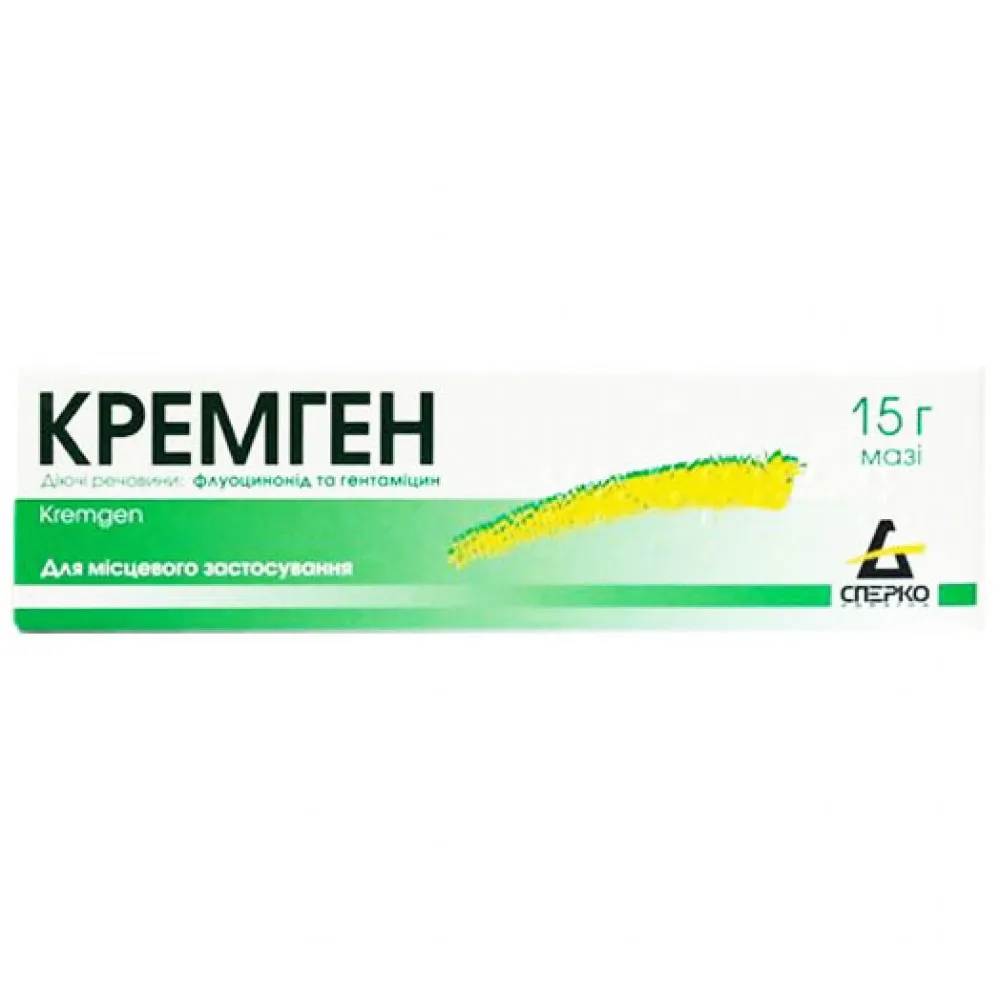
Table of Contents
INSTRUCTIONS FOR MEDICAL USE OF THE MEDICINAL PRODUCT KREMGEN (KREMGEN)
Composition:
Active substances: fluocinonide, gentamicin;
1 g of ointment contains fluocinonide 0.5 mg, gentamicin sulfate 1 mg calculated as gentamicin;
Excipients: propylene glycol; polyethylene glycol 4000; stearyl alcohol; glycerol; citric acid monohydrate; dimethicone.
Pharmaceutical form. Ointment.
Main physicochemical properties: white ointment with a pearly or pearly-yellowish hue.
Pharmacotherapeutic group. Dermatologicals. Corticosteroids in combination with antibiotics.
ATC code D07CC05.
Pharmacological properties.
Pharmacodynamics.
A combined topical medication containing the glucocorticosteroid fluocinonide and the aminoglycoside antibiotic gentamicin. The drug's action is due to the synergistic effects of its components.
Fluocinonide is a synthetic, highly potent third-generation glucocorticosteroid. It exerts pronounced and prolonged anti-inflammatory, antiallergic, anti-edematous, and antipruritic effects. It stabilizes lysosomal membranes, inhibits lysosomal phospholipase A2, thereby reducing the formation of inflammatory mediators—eicosanoids and cytokines (IL-1 and IL-2, γ-interferon, TNF-α)—and blocks the cascade of arachidonic acid conversion into prostaglandins, thus preventing cellular disintegration during the inflammatory process. Stimulation of steroid receptors leads to the production of a specific class of proteins—lipocortins—that exert a pronounced anti-edematous effect.
The second-generation aminoglycoside antibiotic gentamicin exerts a pronounced bactericidal effect. Its antimicrobial mechanism involves binding to the 30S subunit of microbial ribosomes, resulting in irreversible inhibition of protein synthesis. Gentamicin binds to bacterial cytoplasmic membranes, disrupts their permeability, and causes bacterial cells to lose potassium ions, amino acids, and nucleotides. Gentamicin is bactericidal against Streptococcus spp., Staphylococcus spp. (including MRSA), Pseudomonas spp., Escherichia coli, Proteus spp., Klebsiella spp., Shigella spp., Salmonella spp., Enterobacter spp., Acinetobacter spp., and other bacteria.
Pharmacokinetics.
When applied topically, the drug's components readily penetrate all layers of the skin, including areas affected by inflammatory, erosive, and burn-related processes, exerting therapeutic effects. Upon contact with the skin, fluocinonide undergoes deethylation, releasing fluocinolone, which also exerts a pronounced glucocorticoid effect. Due to this deethylation effect, fluocinonide practically does not enter the systemic circulation following topical application. The gentamicin molecule is highly hydrophilic and therefore does not penetrate biological membranes such as the skin or intestinal wall, and does not reach systemic circulation when applied topically.
Clinical characteristics.
Indications.
Inflammatory and allergic skin diseases, including those complicated by secondary bacterial infection: eczema of various forms and localizations, dermatitis (atopic, contact, allergic, seborrheic, radiation, intertriginous, exfoliative, solar), psoriasis, senile pruritus, lichen planus, discoid lupus erythematosus, trophic ulcers (except leg ulcers associated with varicose vein enlargement), first-degree skin burns and frostbite, insect and arthropod bites.
Contraindications.
Infectious skin diseases (viral, bacterial, fungal), including cutaneous manifestations of syphilis, tuberculosis of the skin, pyoderma, varicella, herpes, actinomycosis, blastomycosis, sporotrichosis; rosacea and common acne; diaper dermatitis, perioral dermatitis; anogenital pruritus; skin neoplasms, skin tumors; nevus, atheroma, hemangioma, xanthoma; wounds in application areas; numerous psoriatic plaques; leg trophic ulcers associated with varicose vein enlargement; ulcerative skin lesions; erosive-ulcerative gastrointestinal tract lesions; hypersensitivity to the active substances or to other components of the medicinal product. Kremgen is contraindicated in ophthalmological practice. The product should not be used after prophylactic vaccinations.
Interaction with other medicinal products and other types of interactions.
The product may enhance the effect of immunosuppressive agents and suppress the effect of immunostimulants, antihypertensives, diuretics, antiarrhythmics, and potassium preparations.
The product may be used in combination with other locally or systemically acting antimicrobial agents. Concomitant use with systemic corticosteroids increases the product's efficacy but also increases the risk of systemic and local adverse effects.
Concomitant use with nonsteroidal anti-inflammatory agents increases the risk of systemic and local adverse effects.
When used simultaneously with diuretics (except potassium-sparing diuretics), the risk of hypokalemia increases.
Minimal absorption following topical application does not lead to interactions with other drugs.
During treatment with this product, smallpox vaccination and other types of immunization should not be performed (especially during prolonged use over large skin areas) due to the possible lack of an adequate immunological response, such as production of specific antibodies.
With prolonged use, absorption of gentamicin cannot be excluded, potentially enhancing the ototoxicity of other aminoglycoside antibiotics, polymyxin B, colistin, cephaloridine, ethacrynic acid, and furosemide.
Special precautions for use
Treatment should be carried out under medical supervision. The drug should preferably be used in short courses (no longer than 10 days) and applied to small skin areas only. Prolonged use over large skin areas increases the frequency of adverse effects associated with iatrogenic hypercorticism: edema, arterial hypertension, hyperglycemia, and reduced glucose tolerance. Before each repeated application, any residue from the previous application should be washed off with warm soapy water or an antiseptic solution. Loose-fitting clothing is recommended during treatment. The drug should not be used under occlusive dressings or on mucous membranes of the oral cavity, nose, or eyes. Use with caution on body areas with thin skin (face, groin, and axillary regions), as increased absorption and local adverse effects (e.g., telangiectasias, perioral dermatitis) may occur even after short-term use. Do not apply to the skin of the mammary glands. Avoid applying the drug to the eyelids or periorbital skin in patients with cataract, closed-angle or open-angle glaucoma, due to the potential for worsening of disease symptoms. Contact with the eyes should be avoided. If local irritation, fungal skin infection, or hypersensitivity reactions occur during treatment, the drug should be discontinued. In case of infection resistant to gentamicin developing at the site of ointment application, appropriate antibacterial or antifungal therapy should be initiated.
With topical use of the drug, the following may occur: reduced production of adrenocorticotropic hormone by the pituitary due to suppression of the hypothalamic-pituitary-adrenal system, decreased blood cortisol levels, and development of iatrogenic Cushing's syndrome, which resolves after discontinuation of the drug.
If prolonged use is necessary, periodic monitoring of adrenal cortex function should be performed by measuring blood and urinary cortisol levels following adrenocorticotropic hormone stimulation.
The drug should be used under close supervision in patients with psoriasis, as local application of glucocorticosteroids to psoriatic lesions may lead to recurrence spread due to tolerance development, generalized pustular psoriasis, and systemic toxicity caused by skin dysfunction.
The drug should be used with caution in patients with subcutaneous tissue atrophy, particularly in elderly patients.
Vaccination against smallpox and other types of immunization are not recommended during treatment.
Gentamicin, an ingredient of the drug, may cause cross-allergic reactions with other aminoglycoside antibiotics. Systemic absorption of gentamicin following topical application may be increased when treating large body surface areas, especially during prolonged use or in the presence of skin damage. In such cases, adverse effects related to systemic absorption of gentamicin may occur. Appropriate preventive measures are recommended in these situations, particularly when treating infants and children.
Prolonged topical use of antibiotics may sometimes lead to overgrowth of resistant microflora, including fungi. In such cases, therapy should be discontinued and appropriate treatment initiated.
With prolonged use (more than 14 days) over large skin areas, especially in patients with chronic renal insufficiency, the potential for systemic (resorptive) effects of gentamicin should be considered: ototoxicity (dizziness, nausea, tinnitus), nephrotoxicity (increased blood urea and creatinine levels, reduced diuresis), and elevated serum bilirubin and transaminase levels.
This medicinal product contains propylene glycol, which may cause skin irritation.
This medicinal product contains stearyl alcohol, which may cause local skin reactions (e.g., contact dermatitis).
Use during pregnancy or breastfeeding
The drug is contraindicated during pregnancy. Breastfeeding should be discontinued during treatment with this drug.
Ability to affect reaction speed while driving or operating machinery
The drug does not affect psychomotor reaction speed.
Dosage and Administration.
Apply a thin layer of the medication to the affected skin areas 2–3 times daily. The duration of treatment is determined individually by a physician and depends on the nature of the disease course.
Children.
This medicinal product may be prescribed to children aged 2 years and older. The product should be used cautiously and under physician supervision, applied only once daily to a small skin area. Do not apply the ointment to a child's facial skin. The use of this product in children is only justified when the expected benefit outweighs the potential risk of adverse reactions. When using this product in children, one must consider the possibility of developing signs of hypothalamic-pituitary-adrenal (HPA) axis suppression, which occurs more frequently in children than in adult patients due to greater drug absorption in children, related to a higher skin surface area to body weight ratio. In children receiving topical corticosteroids, adrenal suppression, Cushing's syndrome, growth retardation, inadequate weight gain, and increased intracranial pressure have been reported. Signs of adrenal cortex suppression include low plasma cortisol levels and lack of response to ACTH stimulation tests. Increased intracranial pressure may manifest as bulging fontanelle, headache, and bilateral optic disc swelling.
Overdose.
With prolonged or excessive use of topical glucocorticosteroids, including fluocinonide, especially in children, there is a risk of systemic effects (secondary adrenal insufficiency and symptoms of hypercorticism). Symptoms of hypercorticism are usually reversible. Prolonged topical use of gentamicin may lead to overgrowth of resistant fungal or bacterial microflora. In such cases, discontinuation of the medicinal product and symptomatic treatment are recommended. With prolonged application over large skin areas, overdose symptoms may occur, manifested by an intensification of adverse effects.
Adverse Reactions.
Skin and subcutaneous tissue disorders: burning sensation, irritation, erythema, pruritus, dry skin, folliculitis, hypertrichosis, striae, acneiform eruptions, perioral dermatitis, allergic contact dermatitis, urticaria, maculopapular rash, maceration at the site of application, skin integrity impairment, hyperkeratosis, furunculosis, fungal skin infections. With prolonged use, skin atrophy, local hirsutism, telangiectasia, purpura, pigmentary disturbances, hypertrichosis, alopecia (especially in women), and development of secondary skin infections are possible.
Gastrointestinal disorders: when applied to large areas of skin, especially with prolonged use, gastritis and steroid-induced peptic ulcer may occur.
Endocrine system disorders: hyperglycemia. When applied to large skin areas, systemic effects are possible: adrenal insufficiency, Cushing's syndrome, steroid-induced diabetes mellitus.
Immune system disorders: decreased resistance of the body. With prolonged use, secondary immunodeficiency may develop (exacerbation of chronic infections, generalization of infectious processes, development of opportunistic infections), reparative processes may be delayed, and local or generalized allergic reactions may occur.
Cardiovascular system disorders: arterial hypertension, development of edema is possible.
Shelf life.
3 years.
Do not use the medicinal product after the expiry date stated on the packaging.
Storage conditions.
Store at a temperature not exceeding 25 °C. Keep out of reach and sight of children.
Packaging.
15 g or 30 g in a tube; 1 tube per carton.
Prescription status.
Prescription only.
Manufacturer.
Ukrainian-Spanish joint venture "Sperco Ukraine".
Manufacturer's address and place of business.
21027, Ukraine, Vinnytsia, 600-richchia St., 25.
Tel.: + 38(0432)52-30-36. E-mail: [email protected]
www.sperco.ua