Creazim 10000
Ukraine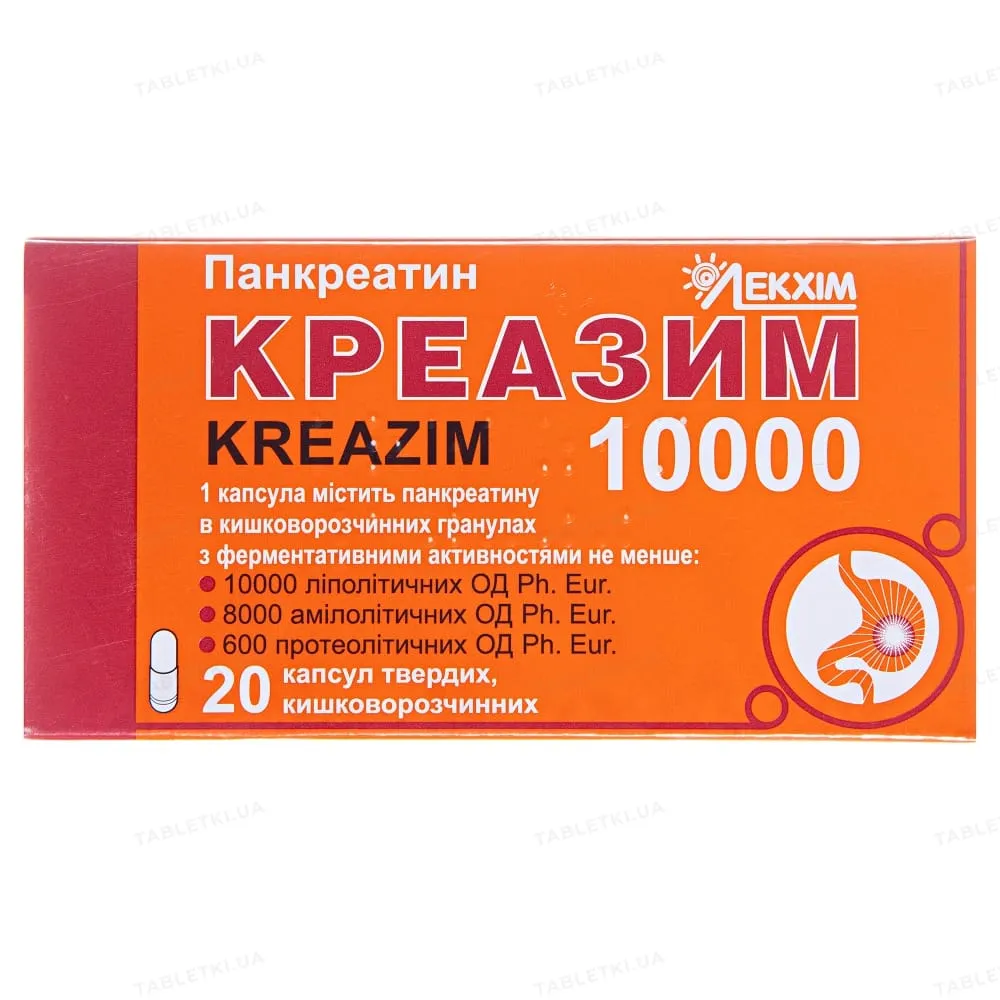
Table of Contents
INSTRUCTIONS FOR MEDICAL USE OF THE MEDICINAL PRODUCT KREAZYM 10000, KREAZYM 20000
Composition:
Active substance:
Kreazym 10000:
1 capsule contains pancreatin in enteric-coated granules with enzymatic activities of not less than: 10,000 lipolytic units Ph. Eur., 8,000 amylolytic units Ph. Eur., 600 proteolytic units Ph. Eur.;
Kreazym 20000:
1 capsule contains pancreatin in enteric-coated granules with enzymatic activities of not less than: 20,000 lipolytic units Ph. Eur., 16,000 amylolytic units Ph. Eur., 1,200 proteolytic units Ph. Eur.;
Excipients: polyethylene glycol 4000 (macrogol 4000), methacrylic acid copolymer dispersion, simethicone, talc, triethyl citrate;
Capsule shell composition (Kreazym 10000): titanium dioxide (E 171), quinoline yellow (E 104), yellow sunset FCF (E 110), gelatin;
Capsule shell composition (Kreazym 20000): titanium dioxide (E 171), yellow sunset FCF (E 110), carmoisine (E 122), diamond black BN (E 151), iron oxide (E 172), gelatin.
Pharmaceutical form. Hard enteric-coated capsules.
Main physicochemical properties: hard gelatin capsules of cylindrical shape, yellow in color, containing beige-brown granules (Kreazym 10000), or hard gelatin capsules of cylindrical shape with an opaque red body and an opaque black cap, containing beige-brown granules (Kreazym 20000).
Pharmacotherapeutic group. Digestive enzymes and other agents improving digestion. Pancreatic enzyme preparations. ATC code A09AA02.
Pharmacological properties.
Pharmacodynamics.
Creazym is an enzyme preparation of animal origin. The drug improves digestion processes. The therapeutic effect of the preparation is based on the activity of pancreatic enzymes – lipase, amylase, and protease – contained in pancreatin, which ensure the digestion of fats, carbohydrates, and proteins, thus promoting more complete absorption of nutrients in the small intestine.
The special dosage form of the drug prevents a decrease in enzyme activity due to inactivation by gastric juice.
Pharmacokinetics.
The granules contained in the capsule, which have an acid-resistant coating, move uniformly with the stomach contents and reach the duodenum. Release and activation of enzymes begins in the small intestine (at pH 5.5), where the granule coating dissolves.
Clinical characteristics.
Indications.
Replacement therapy for exocrine pancreatic insufficiency in the following conditions:
- chronic pancreatitis,
- pancreatectomy,
- pancreatic cancer,
- obstruction of the pancreatic or common bile duct (e.g., by tumor),
- Shwachman-Diamond syndrome,
- other diseases associated with exocrine pancreatic insufficiency.
Contraindications.
Hypersensitivity to animal-derived pancreatin or to any other component of the medicinal product; acute inflammation of the pancreas in early stages; acute exacerbation of chronic pancreatitis.
Interaction with other medicinal products and other forms of interaction.
Concomitant use of pancreatin with iron preparations may reduce iron absorption.
Folic acid. Folic acid absorption may be reduced in patients taking pancreatic enzyme preparations; therefore, monitoring of folic acid levels is recommended when used concomitantly.
Acarbose, miglitol. Pancreatic enzyme preparations may potentially reduce the effect of these antidiabetic agents. Therefore, during concomitant treatment with pancreatin, monitoring of the antidiabetic agents' effect on the patient's blood glucose levels is recommended.
Special precautions for use.
Pancreatin preparations contain active proteins that may cause damage to the mucous membranes (e.g., development of oral ulcers) if released in the oral cavity (e.g., due to chewing). Therefore, the medicinal product should be taken without chewing.
There is a theoretical risk of transmission of viral infections from pigs, including infections caused by new or unidentified viruses. The possibility of pig viruses infecting humans cannot be completely ruled out. However, to date, no cases of infectious disease transmission have been reported following the use of porcine pancreatin preparations.
Caution should be exercised when administering to patients with renal insufficiency or hyperuricemia.
Use during pregnancy or breastfeeding.
Due to the lack of clinical data on the effects of pancreatic enzymes on pregnancy, the drug should be prescribed with caution during pregnancy. Animal studies have shown no evidence of absorption of pancreatic enzymes. Therefore, the possibility of toxic effects on reproductive function and fetal development is excluded.
Use during pregnancy and breastfeeding is possible if, in the physician’s opinion, the expected beneficial effect for the mother outweighs the potential risk to the fetus or infant.
Ability to affect reaction rate while driving or operating machinery.
There are no data indicating a negative effect of Creazyme on the ability to drive vehicles or operate hazardous machinery.
Method of Administration and Dosage
The dosage of the drug is based on individual patient needs and depends on the degree of digestive impairment and dietary composition.
If the single dose exceeds one capsule, it is recommended to take half or one-third of the total number of capsules at the beginning of a meal, and the remainder during the meal. If the single dose is one capsule, it should be taken during the meal.
Capsules with granules should be swallowed whole, without chewing, and taken with an adequate amount of liquid (approximately 100 mL). If the capsule cannot be swallowed whole (e.g., in elderly patients), it may be opened and the granules mixed with soft food that does not require chewing or with a liquid having a pH less than 5.0 (e.g., applesauce, yogurt). This mixture should be taken immediately and not stored.
During treatment with Creazym 10000 and 20000, it is very important to consume sufficient fluids, especially during periods of increased fluid loss. Fluid deficiency may worsen constipation.
Dosing in other types of exocrine pancreatic insufficiency.
Dosage should be individually adjusted depending on the degree of digestive impairment and dietary fat content.
The usual initial dose is 10000 to 20000 IU of lipase per major meal. However, some patients may require higher doses to control steatorrhea and maintain adequate nutritional status. Therefore, the dose per major meal (breakfast, lunch, or dinner) may range from 20000 to 70000 IU of lipase, and for supplemental snacks between main meals—from 5000 to 20000 IU of lipase.
If the required dose per meal is a multiple of 20000 IU of lipase, it is more convenient to use Creazym 20000, which contains 20000 IU of lipase per capsule.
Duration of treatment may vary from several days (in cases of dietary indiscretion) to several months or even years (in cases requiring long-term replacement therapy).
Children.
The medicinal product is not intended for use in children.
Overdose.
With administration of extremely high doses of other pancreatin-containing products, hyperuricemia and hyperuricosuria have been observed.
Adverse Reactions.
Gastrointestinal system: abdominal pain, flatulence, constipation, changes in stool characteristics, diarrhea, vomiting, and nausea.
To exclude damage to the large intestine, all unusual symptoms or changes in the abdominal cavity should be monitored, especially when the patient is taking the drug at a dose exceeding 10,000 lipase units/kg/day.
Immune system: hypersensitivity reactions, including bronchospasm.
Skin and subcutaneous tissue: skin allergic reactions may occur, including rash, itching, urticaria, and skin hyperemia.
General disorders: weakness.
Shelf life. 2 years.
Storage conditions.
Store in the original packaging at a temperature not exceeding 25 °C.
Keep out of reach of children.
Packaging.
10 capsules per blister. 2 blisters per cardboard box.
Prescription category. Over-the-counter.
Manufacturer.
JSC "Tekhnolog".
Manufacturer's address and location of its business activity.
8 Staroprorizna Street, Uman, Cherkasy region, 20300, Ukraine.
INSTRUCTION
on medical use of the medicinal product
CREAZYM 10000,
CREAZYM 20000
Composition:
Active substance:
Creazym 10000:
1 capsule contains pancreatin in enteric-coated granules with enzymatic activities of not less than: 10,000 lipolytic units Ph. Eur., 8,000 amylolytic units Ph. Eur., 600 proteolytic units Ph. Eur.;
Creazym 20000:
1 capsule contains pancreatin in enteric-coated granules with enzymatic activities of not less than: 20,000 lipolytic units Ph. Eur., 16,000 amylolytic units Ph. Eur., 1,200 proteolytic units Ph. Eur.;
Excipients: polyethylene glycol 4000 (macrogol 4000), methacrylate copolymer dispersion, simethicone, talc, triethyl citrate;
Capsule composition (Creazym 10000): titanium dioxide (E 171), quinoline yellow (E 104), sunset yellow FCF (E 110), gelatin;
Capsule composition (Creazym 20000): titanium dioxide (E 171), sunset yellow FCF (E 110), carmoisine (E 122), brilliant black BN (E 151), iron oxide (E 172), gelatin.
Pharmaceutical form. Hard enteric-coated capsules.
Main physicochemical properties: hard cylindrical yellow gelatin capsules containing beige-brown granules (Creazym 10000); or hard cylindrical gelatin capsules with an opaque red body and an opaque black cap, containing beige-brown granules (Creazym 20000).
Pharmacotherapeutic group. Digestive enzymes. Pancreatic enzyme preparations. ATC code: A09AA02.
Pharmacological properties.
Pharmacodynamics.
Creazym is an enzyme preparation of animal origin. The drug improves digestion processes. The therapeutic effect is based on the activity of pancreatic enzymes—lipase, amylase, and protease—contained in pancreatin, which promote the digestion of fats, carbohydrates, and proteins, thereby enhancing the absorption of nutrients in the small intestine.
The special pharmaceutical form of the drug prevents loss of enzyme activity due to inactivation by gastric juice.
Pharmacokinetics.
The granules contained in the capsule have an acid-resistant coating and mix uniformly with gastric contents before passing into the duodenum. Enzyme release and activation begin in the small intestine (at pH 5.5), where the granule coating dissolves.
Clinical characteristics.
Indications.
Replacement therapy for exocrine pancreatic insufficiency in the following conditions:
- chronic pancreatitis,
- pancreatectomy,
- pancreatic cancer,
- obstruction of the pancreatic or common bile duct (e.g., by tumor),
- Shwachman-Diamond syndrome,
- other diseases associated with exocrine pancreatic insufficiency.
Contraindications.
Hypersensitivity to animal-derived pancreatin or to any other component of the medicinal product; acute inflammation of the pancreas in early stages; acute exacerbation of chronic pancreatitis.
Interaction with other medicinal products and other forms of interaction.
Concomitant use of pancreatin with iron-containing preparations may reduce iron absorption.
Folic acid. Folic acid absorption may be reduced in patients taking pancreatic enzyme preparations; therefore, monitoring of folic acid levels is recommended during concomitant use.
Acarbose, miglitol. Pancreatic enzyme preparations may potentially reduce the efficacy of these antidiabetic agents. Therefore, monitoring of blood glucose levels is recommended during concomitant treatment with pancreatin.
Special precautions for use.
Pancreatin preparations contain active proteins that may cause mucosal damage (e.g., oral ulcers) if released in the oral cavity (e.g., by chewing). Therefore, the medicinal product must be taken without chewing.
There is a theoretical risk of transmission of porcine viral infections, including those caused by new or unidentified viruses. The possibility of porcine viruses infecting humans cannot be completely ruled out. However, to date, no cases of infectious disease transmission have been reported following the use of porcine pancreatin preparations.
Use with caution in patients with renal insufficiency or hyperuricemia.
Use during pregnancy or breastfeeding.
Due to the lack of clinical data on the effects of pancreatic enzymes during pregnancy, the drug should be used with caution during pregnancy.
Animal studies have shown no evidence of absorption of pancreatic enzymes. Therefore, the potential for toxic effects on reproductive function or fetal development is considered negligible.
Use during pregnancy and breastfeeding is possible if, in the physician’s opinion, the expected benefit to the mother outweighs the potential risk to the fetus or infant.
Ability to affect reaction rate while driving or operating machinery.
No data are available on negative effects of Creazym on the ability to drive or operate machinery.
Administration and dosage.
Dosage is based on individual patient needs and depends on the degree of digestive impairment and dietary composition.
If the single dose exceeds one capsule, it is recommended to take half or one-third of the total number of capsules before starting a meal, and the remainder during the meal. If the single dose is one capsule, it should be taken during the meal.
Capsules with granules must be swallowed whole, without chewing, and taken with sufficient liquid (approximately 100 mL). If a capsule cannot be swallowed whole (e.g., in elderly patients), it may be opened and the granules mixed with soft food that does not require chewing or with a liquid of pH 5.0 (e.g., mashed apple, yogurt). This mixture should be taken immediately and not stored.
During treatment with Creazym 10000 and 20000, it is very important to consume sufficient fluids, especially during periods of increased fluid loss. Fluid deficiency may worsen constipation.
Dosing in other forms of exocrine pancreatic insufficiency.
Dosage should be individualized according to the degree of digestive impairment and fat content of the diet.
The usual starting dose is 10,000 to 20,000 units of lipase per meal. However, some patients may require higher doses to control steatorrhea and maintain adequate nutritional status. Therefore, the dose during main meals (breakfast, lunch, or dinner) may range from 20,000 to 70,000 units of lipase, and for light snacks between main meals—from 5,000 to 20,000 units of lipase.
If the required dose per intake is a multiple of 20,000 units of lipase, it is more convenient to use Creazym 20000, which contains 20,000 units of lipase per capsule.
Duration of treatment may vary from several days (in cases of dietary-related digestive disturbances) to several months or even years (in cases requiring long-term replacement therapy).
Children.
The medicinal product is not intended for use in children.
Overdose.
Hyperuricemia and hyperuricosuria have been observed with extremely high doses of other pancreatin preparations.
Adverse reactions.
Gastrointestinal system: abdominal pain, flatulence, constipation, changes in stool characteristics, diarrhea, vomiting, and nausea.
To exclude damage to the large intestine, all unusual symptoms or changes in the abdominal cavity should be monitored, especially when the patient is taking the drug at a dose exceeding 10,000 lipase units/kg/day.
Immune system: hypersensitivity reactions, including bronchospasm.
Skin and subcutaneous tissue: skin allergic reactions may occur, including rash, itching, urticaria, and skin hyperemia.
General disorders: weakness.
Shelf life. 2 years.
Storage conditions.
Store in the original packaging at a temperature not exceeding 25 °C.
Keep out of reach of children.
Packaging.
10 capsules per blister. 2 blisters per cardboard box.
Prescription category. Over-the-counter.
Manufacturer.
JSC "Tekhnolog".
Manufacturer's address and location of its business activity.
8 Staroprorizna Street, Uman, Cherkasy region, 20300, Ukraine.